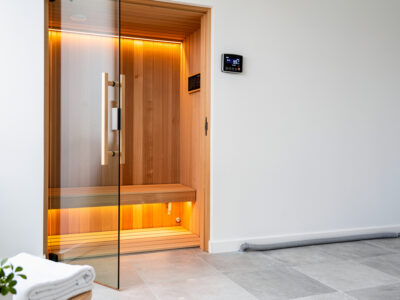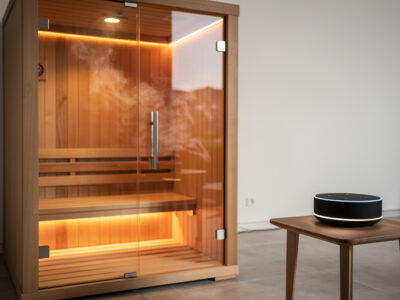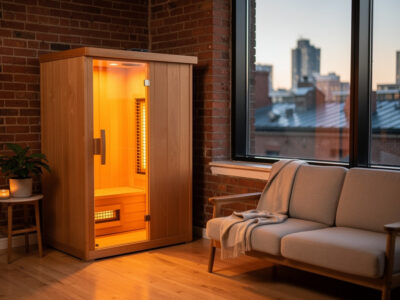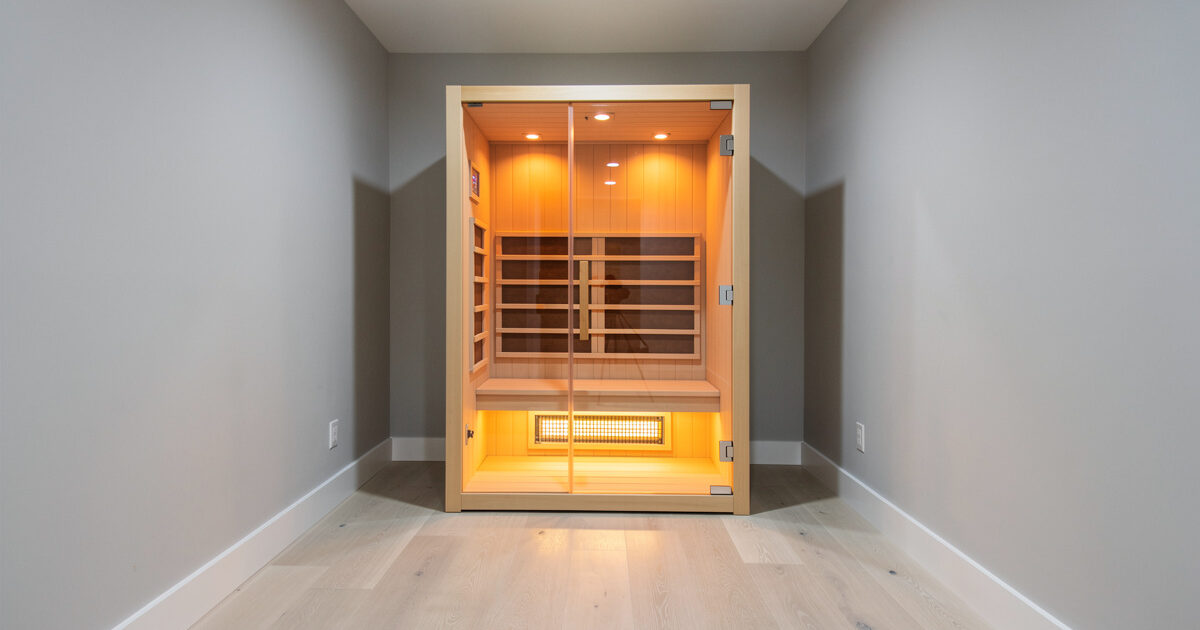
A home infrared sauna is a freestanding 1-4 person cabin that plugs into a standard 110V outlet and slots into a spare room, basement, garage, or large bathroom. Quality home models cost $1,800-$8,500, install in 60-90 minutes with two people, and reach session temperature in 10-15 minutes — no permits, no foundation work, no electrician.
This guide covers the entire indoor sauna decision: how home cabins differ from outdoor and commercial units, where to put one, what size to buy, the actual installed cost, and which brands lead the home market in 2026. For outdoor placement, see the parallel outdoor infrared sauna setup guide.
What Is a Home Infrared Sauna
A home infrared sauna is engineered specifically for residential indoor use: 110V power draw, low-voltage carbon panel heaters that don’t require commercial electrical, ambient operating temperature compatibility with normal HVAC environments, and modular panels that fit through a standard 32-inch interior door. Most models weigh under 250 lbs and ship in 4-7 boxes a UPS driver can carry to the front door.
The home category is distinct from two adjacent categories. Commercial spa cabins (the kind in wellness centers) typically run on 240V, weigh 600+ lbs, and cost $9,000-$25,000. Outdoor home cabins ship larger, cost more, and need foundation/electrical prep — covered separately in our outdoor sauna hub. The indoor home cabin is the format most buyers actually want: simple, plug-and-play, finished install in under 2 hours.
Inside the cabin, the experience is the same as any infrared format: 120-150°F operating temperature, 30-45 minute sessions, and the same evidence-based infrared sauna benefits documented in cardiovascular and recovery research. The wavelength science is identical — the difference is purely in cabin shell engineering and the electrical hookup.
Indoor vs Outdoor: The Decision Matrix
Indoor home saunas win on three big factors: lower upfront cost ($1,800-$8,500 vs $4,500-$12,000 outdoor), zero installation infrastructure, and year-round comfort access without walking outside. Outdoor wins on humidity transfer, square-footage preservation, and cold-plunge integration. About 65% of buyers without a designated outdoor space choose indoor for the simpler install path.
| Factor | Indoor Home Sauna | Outdoor Home Sauna |
|---|---|---|
| Typical price range | $1,800–$8,500 | $4,500–$12,000 |
| Installation time | 60–90 minutes | 2–4 weeks (foundation + electrical) |
| Foundation needed | Existing flooring (level) | Concrete pad, gravel, or composite deck |
| Electrical requirement | Standard 110V outlet | Dedicated 20A or 30A circuit |
| Permit required | No | Yes (electrical, sometimes structure) |
| Climate impact on session | None — controlled HVAC | Faster cooldown, stronger sweat |
| Square footage in home | 30–60 sq ft used | Zero (outside) |
| Humidity transfer to home | Minimal — 5-10% RH rise | Zero |
| Cold plunge integration | Difficult — water management | Easy — outdoor plumbing |
| Walk distance in winter | None | 10-30 feet to the cabin |
| Resale value impact | Personal property | Often improves home value |
Pick indoor if you have a spare room, basement, or large bathroom you’ll convert to wellness use, your install budget is under $4,000, or you’ll skip winter sessions if the cabin is outside. Pick outdoor if you have backyard space, a $7,000+ all-in budget, and want cold-plunge integration. The detailed outdoor build is covered in our 2026 best outdoor saunas roundup.
Sizing Your Home Sauna for Indoor Space
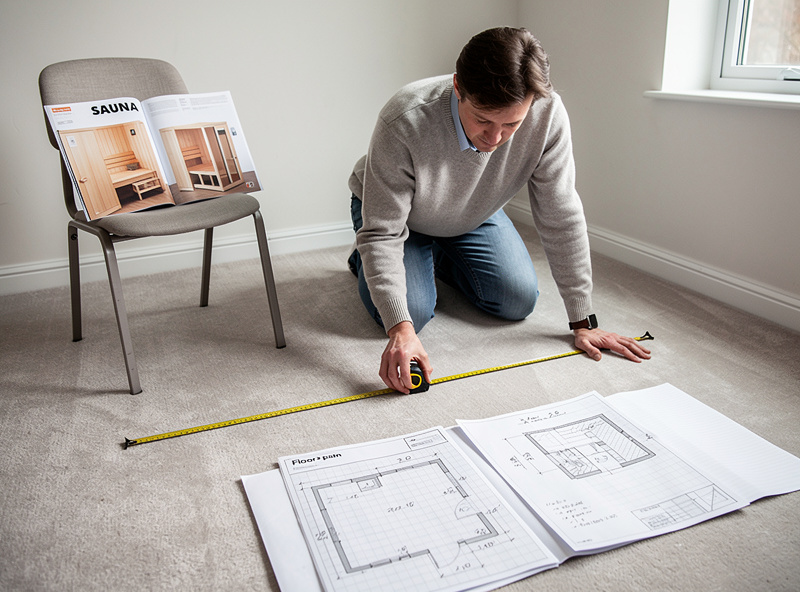
Home cabins are sold as 1, 2, 3, and 4-person models. The 2-person size is the most common indoor choice — it fits in 90% of spare bedrooms, plug-and-plays on a standard outlet, and seats one full-stretch user with room for a partner. Plan for 4-6 inches of clearance on all sides for ventilation and at least 36 inches of door-swing clearance in front.
| Size | Cabin footprint | Floor space needed | Cabin weight | Power | Typical price |
|---|---|---|---|---|---|
| 1-person | 3′ × 3′ (9 sq ft) | 5′ × 5′ room area | 180 lbs | 110V 15A | $1,800–$3,500 |
| 2-person | 4′ × 4′ (16 sq ft) | 6′ × 6′ room area | 295 lbs | 110V 15A | $2,500–$5,500 |
| 3-person | 5′ × 4.5′ (22.5 sq ft) | 7′ × 6.5′ room area | 410 lbs | 110V 20A | $3,800–$7,000 |
| 4-person | 6′ × 5′ (30 sq ft) | 8′ × 7′ room area | 525 lbs | 240V 20A | $5,500–$8,500 |
The 4-person model is the only size that requires a 240V circuit — and it’s the only size that meaningfully changes your install path. If you’re buying 4-person, factor in $400-$900 for an electrician to add the dedicated 240V circuit. Below 4-person, every cabin runs on a standard household outlet.
For a deep-dive on each capacity tier, the dedicated infrared sauna sizes hub compares 1, 2, 3, and 4-person cabins on bench width, dual-zone heater control, EMF, and resale considerations. Couples cross-shopping the eight strongest 2-person cabinets should see the best 2-person infrared saunas for couples roundup.
Where to Put a Home Infrared Sauna
The five practical indoor locations rank in this order by installer feedback: spare bedroom, finished basement, master bathroom, attached garage, large walk-in closet. Each has specific electrical, ventilation, and floor-loading considerations covered in our dedicated room-by-room placement guide. For apartments and homes under 700 sq ft, the apartment-friendly formats guide covers blankets, pop-ups, and 1-person cabins specifically.
Spare bedroom (the most common choice)
Best when you have a 10×10 room or larger that doubles as a guest room or office. Floor loading is a non-issue for any 1-3 person cabin — standard residential floors handle 40-50 lbs/sq ft live load, well above the 35 lbs/sq ft a 2-person cabin generates. Standard outlet works. Carpet is fine; the cabin sits flat on its own base.
Finished basement
The best location overall in terms of session experience because the cool ambient temperature speeds cooldown after a session. Concrete floors should be covered with the manufacturer-supplied vinyl mat or a 1/2-inch rubber gym mat ($60-$140) for thermal insulation and comfort entering/exiting the cabin. Watch for moisture: damp basements add 8-12% humidity into the cabin which slows warmup.
Master bathroom
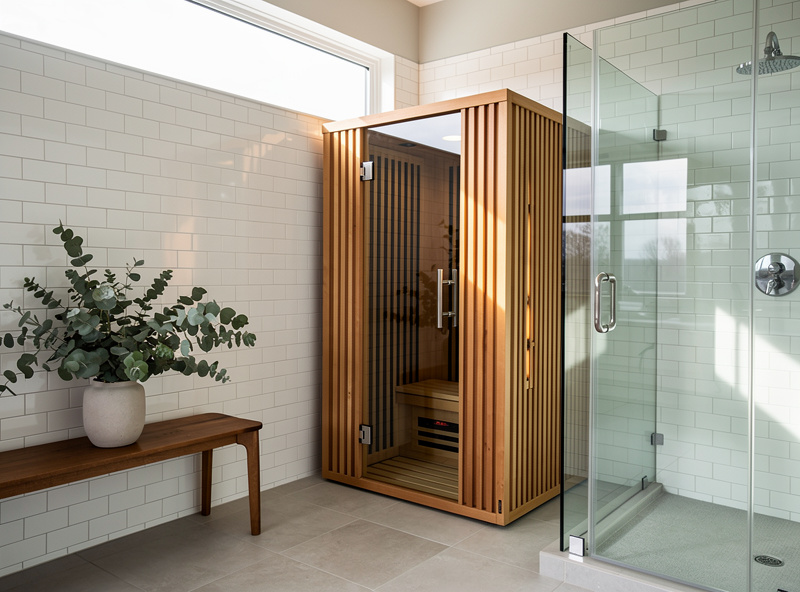
Works well if your bathroom is 80+ sq ft with a 32-inch door clearance for cabin panels. Bathrooms already have moisture-tolerant flooring and good ventilation. The downside: the bathroom is occupied during sessions, and ambient humidity from showers can rise to 65-75% which lengthens cabin warmup by 4-6 minutes. Best paired with a bath fan that runs 30 minutes post-session.
Attached garage (insulated and climate-controlled)
Acceptable only if the garage is insulated to R-13 walls/R-30 ceiling and climate-controlled to within 50-80°F year-round. Uninsulated garages cause 30+ minute warmup times in winter and shorten heater lifespan. If the garage is finished and conditioned, this is a solid choice — separate from living space, easy to ventilate, and floor loading is never a concern.
Large walk-in closet
Workable for the smallest 1-person cabins (3’×3′ footprint) in closets at least 5’×5′. Tight quarters mean ventilation is critical — keep the closet door cracked or install a 4-inch through-wall vent. Not recommended for daily-use scenarios because dwelling-time air stagnation accumulates faster in small enclosures.
Power Requirements at Home
Most home infrared saunas (1, 2, and 3-person sizes) run on a standard 110V 15-amp outlet drawing 1,500-1,950 watts. The cabin must be on a dedicated circuit — that means no other appliances on the same breaker, including bathroom GFCI receptacles or shared bedroom outlets. About 40% of homes already have an unused dedicated circuit in the right room; the other 60% need an electrician to add one ($150-$400).
For 4-person cabins specifically, the 240V 20-amp circuit requires an electrician install — there is no DIY workaround. Budget $400-$900 fully installed. The same electrician work overlaps with what’s covered in our complete home installation guide.
How to verify dedicated circuit availability
- Find the breaker panel and identify the breaker labeled for the room where the sauna will go.
- Turn that breaker off and walk through the room — every outlet that goes dead is on the same circuit.
- If the sauna outlet shares with anything that draws meaningful power (microwave, refrigerator, dishwasher, AC unit), it is NOT dedicated. Have an electrician add a separate circuit.
- If the sauna outlet shares only with low-draw items (lamps, phone charger, decorative outlets), some manufacturers allow this — check your specific cabin spec sheet.
Real Installed Cost and ROI
The home sauna sticker price is much closer to true installed cost than outdoor. A $3,500 cabin typically lands at $3,650-$3,900 fully installed (plus optional dedicated circuit if needed). Compare to outdoor where a $5,500 cabin lands at $7,000-$10,500 once foundation, electrical, and permits are added.
Typical 2-person home sauna project budget:
- Cabin and shipping: $3,500
- Optional rubber floor mat (basement install): $80
- Optional dedicated circuit (if needed): $200
- Optional Bluetooth audio upgrade: $295
- Optional chromotherapy lighting upgrade: $250
- Total without optional: $3,500
- Total with optional: $4,325
For ROI math, run the cost against gym infrared sauna access (typically $25-$45/session at wellness centers) or commercial sauna memberships ($60-$120/month). At 4 sessions per week and $35/session, a home sauna pays for itself in 5-7 months. Running cost is roughly $0.25-$0.40 per session on US average electricity rates of $0.16/kWh — a fraction of a single drop-in commercial visit. Our cost, power, and ROI breakdown walks through the full math by cabin size, electricity rate, and usage frequency.
Top Brands in the Home Infrared Sauna Market
Six brands dominate the home infrared sauna market in 2026: Sunlighten, Clearlight, Sun Home, Health Mate, HigherDose, and Dynamic Saunas. They differ on EMF performance, heater technology, cabin material, and warranty. The detailed comparison lives in our best infrared sauna brands roundup; for home-format-specific ranking and the top 7 indoor cabins by tier, see our 2026 best home infrared saunas roundup. Before you commit to a specific brand, though, the infrared sauna buying guide lays out the spec decisions — heater type, EMF class, warranty terms — that matter more than the brand name itself.
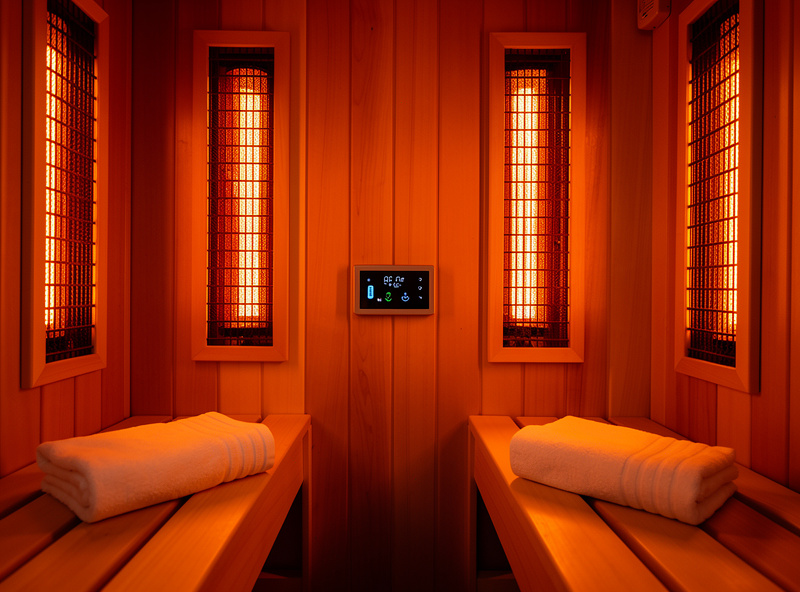
Quick pick guidance for home-format use:
- Premium ($5,000-$8,500): Sunlighten Signature 2 or Clearlight Sanctuary 2 — both offer ultra-low EMF (under 0.5 mG), lifetime heater warranty, and best-in-class cabin tolerances. Detailed in our Sunlighten review and Clearlight review.
- Mid-range ($3,500-$5,500): Sun Home Luminar 2 or Health Mate Restore 2 — strong EMF performance at 2/3 the premium price. The Sun Home review covers their indoor Luminar lineup specifically.
- Budget ($1,800-$3,500): Dynamic Saunas Andora or Maxxus Lapland — meets all minimum specs at the lowest price. Detail in our Dynamic Saunas review.
- Wellness lifestyle ($2,500-$6,500): HigherDose Outdoor Cabin or Sauna Blanket V4 — design-forward with chromotherapy and lifestyle integrations. See the HigherDose review for the cabin vs blanket comparison.
If you’re choosing between an indoor cabin and a portable format (sauna blanket, pop-up tent, sauna box, or DIY near-IR lamp), see our portable infrared sauna hub for the four-format comparison and the sauna blanket vs cabin decision guide for the head-to-head with 5-year cost math.
Heater Type Choices for Home Cabins
Home infrared cabins use the same three heater technologies as outdoor and commercial units: carbon panel, ceramic rod, and full-spectrum. Carbon panels dominate the home market because they produce a more even 4-14 micron far-infrared wavelength across the panel surface and tolerate the on/off cycling of daily home use better than ceramic.
The choice changes the session more than the cabin shell does. Our full-spectrum benefits guide, far-infrared benefits guide, and type comparison cover the wavelength science. For home use specifically, three heater spec lines matter:
- Surface temperature: 150–170°F at the panel face. Lower panel temperatures give a more comfortable session at the same cabin air temperature.
- EMF reading at 6 inches: Under 0.5 milligauss for premium brands, under 3 mG for mid-range. Above 3 mG suggests cheaper heater windings.
- Panel coverage: Front, side, calf, and back panels. Premium 2-person cabins ship with 6-8 panels; budget cabins often skip calf and floor panels, slowing leg heat by 30-40%.
The right heater pick depends on session goals. If you’re using the cabin primarily for relaxation and sweat, far-infrared carbon is the simpler and cheaper choice. If you’re optimizing for skin and circulation outcomes, full-spectrum (carbon + halogen near-IR) adds the wavelength range that drives those specific protocols.
Installation Process at Home
Most home infrared saunas ship in 4-7 cardboard panels and assemble in 60 to 90 minutes with two people, no specialized tools beyond a Phillips screwdriver. The work is genuinely DIY for any homeowner comfortable with flat-pack furniture — closer to assembling a wardrobe than building a structure.
Standard sequence:
- Confirm the room is climate-controlled, the floor is level (within 1/4 inch), and the dedicated outlet is verified (steps from “Power Requirements” above).
- Unbox panels in delivery order, separate hardware bags, and check the manifest against the parts list.
- Place the floor panel in final position — moving the cabin after assembly is difficult.
- Install back panel first, then side panels (left and right), then front panel with door.
- Install ceiling panel and any roof trim.
- Install heaters, benches, and connect the wiring harness via the manufacturer’s wire diagram.
- Plug into the dedicated outlet and run a 60-minute burn-in session to off-gas any factory residue before normal use.
The deeper installation walkthrough including troubleshooting common assembly issues lives in the dedicated home setup guide. Before delivery day, the infrared sauna installation requirements guide walks through the structural, clearance, and electrical pre-checks — weight load limits, ventilation sizing, and permit thresholds for each cabin size. For 4-person 240V cabins, hire the electrician before delivery — it adds 1-2 days to the project but prevents the cabin sitting unusable while you wait for the circuit install.
Ventilation and Humidity Control
Home cabin sessions add 5-10% relative humidity to the surrounding room over 30 minutes — meaningful but well within normal HVAC tolerance. The post-session ventilation routine prevents this from becoming a long-term moisture problem in basement or windowless rooms.
Three ventilation approaches handle 95% of indoor installs:
- Open the cabin door for 15 minutes after each session. Free, dries out the cabin interior, and disperses humidity into a much larger room volume.
- Run a small dehumidifier in basement installs. $150-$300 unit set to maintain under 55% RH year-round prevents any moisture accumulation.
- Use the bathroom fan in master-bath installs. 30-minute post-session run cycle handles the typical humidity rise without any equipment changes.
Avoid placing the cabin in unfinished basements with chronic moisture issues, crawl spaces, or rooms without any HVAC connection — the cabin can dry out fine, but the surrounding space will accumulate moisture over months that affects cedar lifespan.
Home Cabin Maintenance
Indoor home saunas are dramatically lower-maintenance than outdoor units because they’re shielded from UV, rain, and freeze-thaw cycling. The full annual maintenance routine takes about 90 minutes per year and $20-$40 in supplies.
- After every 5-10 sessions: Wipe interior cedar surfaces with a damp microfiber cloth. No chemical cleaners.
- Monthly: Vacuum heater grilles to prevent dust accumulation that reduces heater output by 8-12% over 6 months.
- Quarterly: Tighten any visible hardware and check the door seal for proper closure.
- Annually: Run a 60-minute dehumidify cycle (cabin on, door open) to drive out trace moisture from the wood, lubricate the door hinge with food-safe oil, and inspect heater connections.
- Every 5-7 years: Replace the door gasket if compression has dropped below 30% under thumb pressure ($30-$80 from the manufacturer).
Pair every session with the safety guidance in our infrared sauna safety guide, especially around hydration during longer sessions and contraindications for certain medications.
Five Common Mistakes Home Sauna Buyers Make
After reviewing dozens of indoor installs, the same five errors show up over and over. None are fatal to the cabin if caught early, but each costs an extra $100-$500 to undo if you discover them after assembly.
- Buying a 4-person cabin without verifying 240V availability. The cabin arrives, the buyer realizes they need an electrician, and the cabin sits unused for 1-2 weeks waiting for the circuit install. Always check 240V availability BEFORE ordering 4-person.
- Placing the cabin against a wall. Most manuals require 4-6 inches of clearance behind the cabin for ventilation and heater wiring access. Pushed-against-the-wall installs trap heat against drywall, which can cause discoloration over 18 months. Room choice drives most of this — the where to install an infrared sauna guide covers clearance and airflow requirements by room type in more depth.
- Using a power strip or extension cord. Sauna heaters draw continuous near-rated current. A power strip or extension cord shortens the cord rating by half, can cause melting at the plug interface, and voids the manufacturer warranty. Always plug directly into the wall outlet.
- Skipping the floor mat in basement installs. Concrete floors transmit cold and feel uncomfortable on bare feet entering or exiting the cabin. A $60-$140 rubber gym mat or vinyl sauna mat solves this and adds thermal insulation to the cabin floor.
- Running the first session at full temperature without a burn-in cycle. Factory sealants and finishes off-gas during the first 30-60 minutes of use. Always run an empty 60-minute session at full temperature with the door cracked before normal use to clear residual factory smell.
Frequently Asked Questions
Can a home infrared sauna run on a regular outlet?
Yes for 1-3 person cabins. Home infrared saunas in those sizes draw 1,500-1,950 watts on a standard 110V 15-amp outlet. The outlet must be on a dedicated circuit — meaning no other appliances on the same breaker. 4-person cabins are the exception and require a 240V 20-amp circuit installed by an electrician.
How much room do I need for a home infrared sauna?
For a 2-person cabin, plan for at least 6 feet by 6 feet of floor space. The cabin itself is roughly 4×4 ft, plus 4-6 inches of clearance on all sides for ventilation, plus 36 inches of door-swing clearance in front. 1-person cabins fit in a 5×5 ft area; 4-person cabins need 8×7 ft.
Where is the best place to put an indoor sauna?
The five top indoor locations are spare bedroom, finished basement, master bathroom, insulated attached garage, and large walk-in closet — in roughly that order by installer feedback. Spare bedrooms are the most common because they offer climate control, dedicated outlet access, and adequate floor space without renovation.
How much does a home infrared sauna cost installed?
Home cabins typically install for the sticker price plus $80-$200 for optional accessories and floor mats. A $3,500 2-person cabin lands at $3,500-$3,900 fully installed, dramatically simpler than outdoor saunas where the cabin is roughly 60% of the all-in cost. Budget $200-$400 extra if you need a dedicated circuit added.
Do home saunas add humidity to my house?
Yes, but minimally. A 30-minute session adds 5-10% relative humidity to the surrounding room — well within normal HVAC tolerance. Open the cabin door for 15 minutes after each session, run the bathroom fan if installed in a master bath, or use a small dehumidifier in basement installs to manage long-term humidity accumulation.
How long does a home infrared sauna take to assemble?
60-90 minutes with two people for most 1-3 person cabins. The work uses a standard Phillips screwdriver only — no specialized tools. Modular panels snap together, then heaters and benches install with simple wiring connections. The first 60-minute burn-in session before normal use brings total project time to about 2.5-3 hours.
Should I buy a home sauna or install one outdoors?
Choose home indoor if your install budget is under $4,000, you have a spare room, basement, or large bathroom, or you skip winter sessions if the cabin is outside. Choose outdoor if you have $7,000+ all-in budget, want cold-plunge integration, and have backyard space for a foundation. About 65% of buyers without designated outdoor space pick indoor.
Related Guides
The full Home Saunas cluster:
- Best Home Infrared Saunas 2026 — top 7 indoor cabins ranked by tier
- Indoor Sauna for Apartments and Small Homes — sub-30 sq ft formats
- Where to Put Your Infrared Sauna (Room-by-Room) — placement decision matrix
- Infrared Sauna at Home: Costs, Power, and ROI — full cost breakdown and payback math
Broader infrared sauna context:
- The Ultimate Guide to Infrared Saunas — master pillar covering benefits, types, and decisions
- Outdoor Infrared Sauna Guide — the parallel cluster for backyard installs
- How to Choose the Best Infrared Sauna — the broader buying framework
- Best Infrared Sauna Brands 2026 — top 10 manufacturer comparison
- How to Set Up an Infrared Sauna at Home — full installation walkthrough