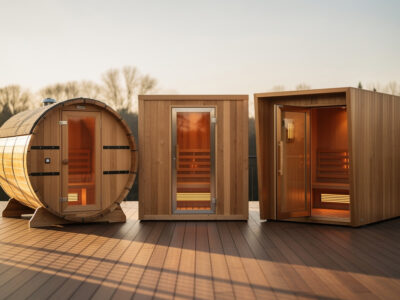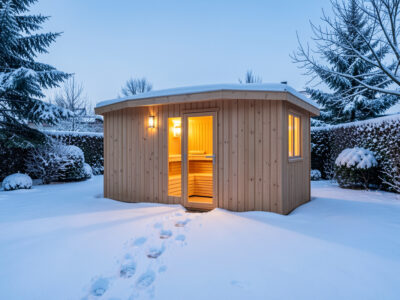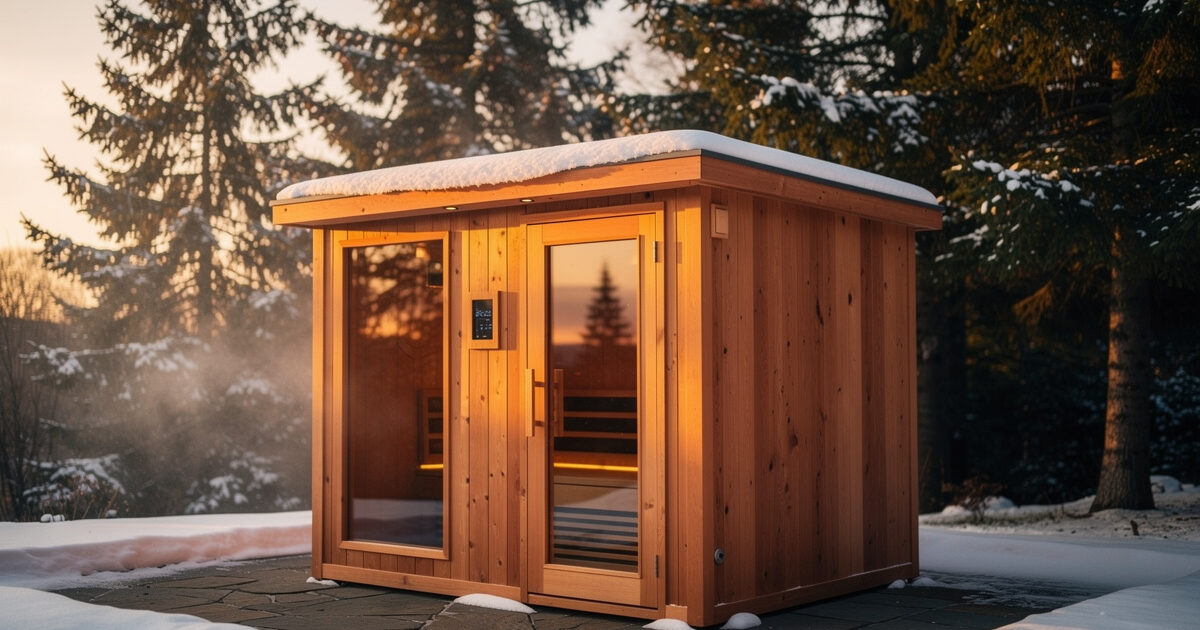
An outdoor infrared sauna is a freestanding cedar or hemlock cabin built for year-round backyard use, with weather-sealed siding, sloped roofing, and 110-volt or 240-volt power. Quality models cost $4,500–$12,000 and require a level pad, a dedicated circuit, and roughly 36 square feet of clearance.
The outdoor format solves the two biggest headaches of indoor cabins: humidity transfer into living spaces and the loss of a closet or spare room. A properly built outdoor unit also opens up the cold-plunge cycle that is now central to most circulatory and recovery protocols. This guide covers materials, sizing, foundations, electrical, weatherproofing, brand selection, and the cost math, with links to deeper spoke guides on each topic.
As an Amazon Associate I earn from qualifying purchases.
What Makes an Outdoor Infrared Sauna Different
Outdoor infrared saunas use the same low-EMF carbon or ceramic heaters as indoor units, but the cabin shell is engineered for thermal cycling, UV exposure, and rain runoff. Expect 1.25-inch thicker cedar walls, sealed roof corners, and exterior-grade door gaskets rated for -22°F to 113°F operating range.
The heater technology is identical to what you read about in our near vs far vs full spectrum comparison — the difference is purely in how the cabin survives weather. Outdoor cabins typically use 1.6-inch Western Red Cedar tongue-and-groove instead of the 1-inch panels common indoors, plus a 12-degree sloped roof, marine-grade aluminum roof flashing, and sealed wire passthroughs rated IP54 or higher.
The internal experience is the same: 120–150°F operating temperature, 30–45 minute sessions, and the same evidence-based infrared sauna benefits documented in cardiovascular and recovery research.
Outdoor vs Indoor Infrared Saunas: Which Should You Buy
Outdoor saunas win on humidity control, square footage preservation, and access to cold plunges, while indoor saunas win on convenience, year-round comfort access, and lower running cost in cold climates. Roughly 60% of buyers with usable backyard space and a budget over $5,000 should choose outdoor.
The decision usually comes down to three factors: do you have 6×6 feet of flat ground with code-compliant clearance from your house, can you run a dedicated 20-amp or 30-amp circuit to that location, and will you actually walk out to it in January? If any of those is a no, the better path is indoor — covered in detail in our home infrared sauna setup and buying guide with the full indoor-vs-outdoor decision matrix, plus the 2026 best home cabins ranking and the general indoor setup walkthrough.
| Factor | Outdoor Sauna | Indoor Sauna |
|---|---|---|
| Typical price range | $4,500–$12,000 | $1,800–$8,000 |
| Installation difficulty | High — pad + electrical + permits | Low — assemble, plug in, run session |
| Foundation needed | Concrete pad, gravel, or composite deck | Existing flooring (level) |
| Electrical requirement | Dedicated 20A or 30A circuit (often 240V) | Standard 110V outlet (most spoke models) |
| Climate impact on session | Faster cooldown, stronger sweat response | None |
| Cold plunge integration | Easy — cold tub or hose runoff outside | Difficult — water management indoors |
| Square footage in home | Zero (outside) | 30–60 sq ft |
| Resale and ROI | Often improves home value | Personal property, no resale boost |
| Permit likely required | Yes (electrical, sometimes structure) | No |
Best Outdoor Infrared Sauna Materials and Construction
Western Red Cedar is the dominant choice for outdoor cabins because its natural oils resist rot, warping, and fungal staining without chemical treatment. Look for 1.5-inch tongue-and-groove cedar walls, 11-gauge stainless screws, and a roof slope of at least 10 degrees to shed rain and snow.
The runner-up material is Canadian Hemlock, which is hypoallergenic and slightly cheaper but requires a sealed exterior treatment every 2–3 years. Avoid pine, spruce, or composite siding for outdoor use — they warp under thermal cycling within 18 months.
Construction features that actually matter
- Tongue-and-groove joints: Floating joinery handles wood expansion across a 100°F seasonal swing without splitting.
- Marine-grade door hardware: Standard zinc hinges corrode within two winters in coastal or salt-air environments.
- IP54+ wire passthroughs: Rubber grommets sealed to the cabin wall keep moisture from reaching the heater wiring harness.
- Sloped roof with overhang: A 4-inch overhang on all four sides keeps rainwater off the cabin walls and out of the door gasket.
- Reinforced floor frame: Pressure-treated 2×4 framing under the cabin floor prevents ground contact rot.
Brands like Sun Home, Clearlight, and Almost Heaven publish the cedar grade and joinery type in their spec sheets — anyone who hides this is using lower-grade lumber. Our Sun Home Saunas review walks through the Equinox outdoor cabin spec sheet in detail, and the 2026 best outdoor infrared saunas roundup compares construction quality across the seven cabins worth considering this year.
Choosing the Right Size for Your Yard
Outdoor saunas are sold as 1, 2, 3, and 4-person models, but the actual deck footprint runs 16 to 60 square feet. Plan for 24 inches of clearance on at least three sides for airflow and maintenance access, plus 36 inches in front of the door for the swing radius.
| Size | Cabin footprint | Pad size needed | Typical cabin weight | Ideal for |
|---|---|---|---|---|
| 1-person | 3′ × 3′ (9 sq ft) | 5′ × 5′ pad | 225 lbs | Apartments, balconies, solo wellness |
| 2-person | 4′ × 4′ (16 sq ft) | 6′ × 6′ pad | 375 lbs | Couples, small yards |
| 3-person | 5′ × 4.5′ (22.5 sq ft) | 7′ × 6.5′ pad | 475 lbs | Families, recovery use |
| 4-person | 6′ × 5′ (30 sq ft) | 8′ × 7′ pad | 625 lbs | Larger families, social use |
The 2-person cabin is the most common outdoor size — it fits in roughly 90% of suburban backyards, runs on a standard 20-amp 110V circuit, and seats one full-stretch user with room for a partner. Anything larger than 4-person typically needs 240V wiring and a poured concrete pad. For yard layout, privacy screening, and pad placement specifics, our backyard sauna setup guide walks through the suburban-yard install scenario step by step.
Foundation, Power, and Permits
The three pre-installation requirements are a level foundation rated for 80 pounds per square foot, a dedicated electrical circuit sized to the cabin draw, and a local permit if the unit exceeds your municipality’s accessory structure threshold. Most US jurisdictions require a permit for any structure over 120 square feet — outdoor saunas almost never trigger this.
Foundation options ranked from cheapest to best:
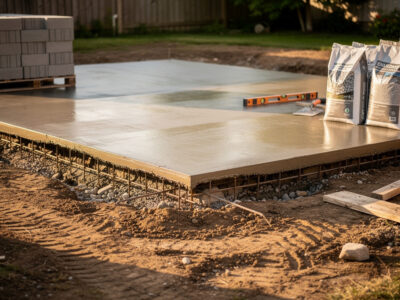
- Compacted gravel pad ($150–$400): Acceptable for 1-2 person cabins in dry climates. Excavate 6 inches, lay landscape fabric, fill with 3/4-inch crushed stone, compact in 2-inch lifts.
- Composite deck ($600–$2,000): Works if you already have a deck rated for 60 lbs/sq ft. Verify with a structural engineer for cabins over 400 lbs.
- Concrete pavers on sand ($300–$700): Mid-range option that levels well and drains. Use 24-inch pavers with 1 inch of compacted sand underneath.
- Poured concrete pad ($800–$2,500): The professional choice for 3-4 person cabins. Spec a 4-inch slab with #4 rebar at 16-inch centers.
For electrical, smaller cabins (1-2 person) typically draw 1,500–2,400 watts and run on a dedicated 20-amp 110V circuit. Larger 3-4 person cabins draw 3,400–4,800 watts and require a 240V 30-amp circuit installed by a licensed electrician. Budget $400–$1,200 for the electrical run from your panel to the cabin location.
Permit-wise, only the electrical work usually requires a permit pull (typically $75–$200). The cabin itself sits on the foundation as movable property in most municipalities, similar to a hot tub. A few HOAs and historic districts have additional restrictions — call your county building department before ordering, since some districts treat any structure with continuous power as an accessory building regardless of square footage. Our outdoor sauna foundation, power, and permits guide walks through the full code research process, NEC wire-gauge specs, and HOA approval workflow.
Weatherproofing and Year-Round Use
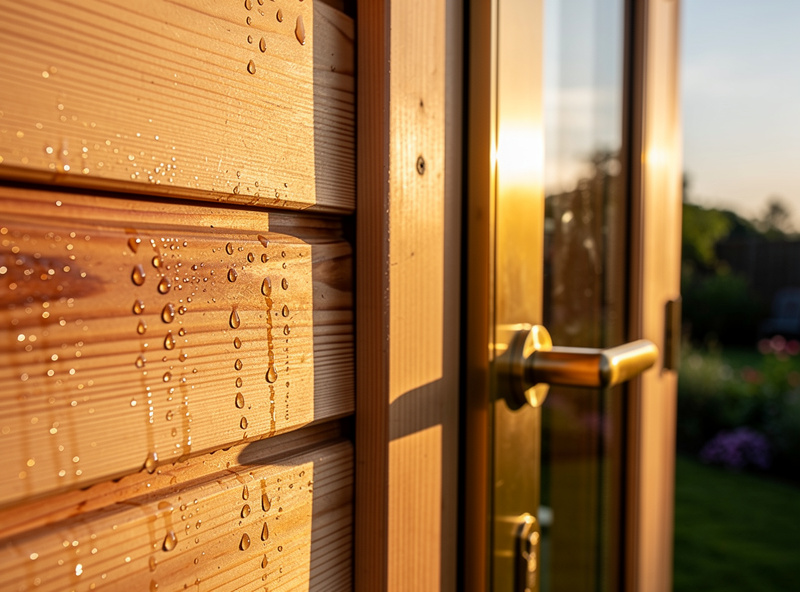
Outdoor infrared saunas need three layers of weatherproofing to last 15+ years: an exterior cedar sealant applied every 2-3 years, a door gasket inspection twice yearly, and a winter cover or cabin enclosure if your area sees more than 40 inches of annual snowfall. Skip any of these and expect 5-7 year shell life instead of 15+. I run a sauna through Swedish winters, so I will be blunt about which of these actually bites: the gasket and the sealant are the ones that decide everything. Snow load and a sloped roof matter, but it is the freeze-thaw working at a dry seam and the UV stripping unsealed cedar that quietly kill outdoor cabins — not one dramatic failure, just two skipped chores compounding over three winters.
The single most-failed component on outdoor saunas is the door gasket. Ozone, UV, and freeze-thaw cycling break down the EPDM or silicone seal where the door meets the cabin frame. A failed gasket lets cold air leak in, which roughly doubles the warm-up time and can corrode interior heater connections. A replacement door gasket takes about 30 minutes to swap, and keeping a spare on hand is the cheapest insurance against a winter of doubled warm-up times.
For year-round use in northern climates, look for cabins rated to -22°F minimum operating temperature, with an external heater pre-warm cycle of 25 minutes. The 25-minute warmup compares to 12-15 minutes for the same cabin in 70°F summer conditions. Running cost increases roughly 35% in winter due to the temperature delta — budget $0.65–$1.10 per session in January versus $0.40–$0.70 in July, based on US average electricity rates of $0.16/kWh. The detailed sealant cycle, gasket replacement schedule, and freeze-thaw protection routine live in our exterior sauna weatherproofing guide.
Top Outdoor Infrared Sauna Brands in 2026
Six brands dominate the outdoor infrared sauna market in 2026: Sun Home, Clearlight, Almost Heaven, Dynamic Saunas, Health Mate, and Maxxus. They differ on price, cedar grade, EMF performance, and warranty. Use the comparison below as a starting point, then read the dedicated reviews for each.
| Brand | Price range | Cabin material | EMF rating | Warranty | Best for |
|---|---|---|---|---|---|
| Sun Home | $5,995–$10,995 | Western Red Cedar | Ultra-low (under 1 mG) | Lifetime on heaters | Premium outdoor with cold plunge integration |
| Clearlight | $6,990–$11,990 | Mahogany or Western Red Cedar | True Wave low-EMF | Lifetime cabin and heaters | Highest-end build, strongest warranty |
| Almost Heaven | $3,995–$8,995 | Eastern White Pine, Cedar option | Standard low-EMF | 5-year warranty | Mid-range Pacific Northwest aesthetic |
| Dynamic Saunas | $2,995–$4,995 | Canadian Hemlock | Standard | 5-year heater, 1-year cabin | Budget outdoor entry |
| Health Mate | $5,495–$9,995 | Western Red Cedar | Tecoloy heater (low-EMF) | Lifetime on heaters | 47-year heritage brand |
| Maxxus | $2,795–$5,495 | Canadian Hemlock | Standard | 5-year heater | Compact 2-person budget pick |
Our full best infrared sauna brands roundup covers all 10 manufacturers, and the dedicated reviews go deeper: Sun Home, Clearlight, Health Mate, and Dynamic Saunas. If you want the budget outdoor entry without the premium-brand lead time, Dynamic and Maxxus cabins are the two genuinely sold on Amazon — check current outdoor cabin prices on Amazon →
Cost Breakdown and Total Project Budget
The cabin sticker price is roughly 60% of the true installed cost of an outdoor infrared sauna. A $6,000 cabin typically lands at $9,800–$10,500 fully installed once foundation, electrical, permits, and accessories are included. Budget realistically before you order.
Typical 2-person outdoor sauna project budget:
- Cabin and shipping: $5,500
- Concrete pavers on sand foundation: $500
- Dedicated 20-amp 110V circuit (40 ft run): $750
- Electrical permit: $125
- Cedar exterior sealant for first treatment: $90
- Bluetooth audio upgrade (optional): $295
- Cold plunge tub (optional): $899
- Total without optional: $6,965
- Total with optional: $8,159
For a 4-person cabin with poured concrete and 240V electrical, expect $11,500–$14,000 fully installed. The premium outdoor builds from Clearlight or Sun Home with cold plunge integration regularly land at $18,000+ all-in.
Installation and Setup Process
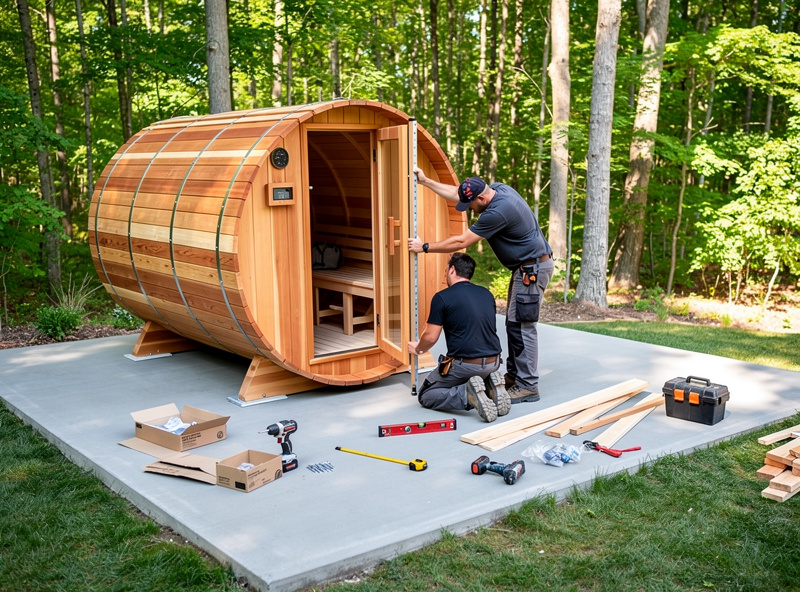
Most outdoor infrared saunas ship in 8 to 14 cardboard panels and assemble in 90 to 240 minutes with two people, no specialized tools beyond a Phillips screwdriver and a level. The work splits into pre-delivery prep (foundation and electrical, done weeks ahead) and assembly day (the cabin itself).
The standard sequence is:
- Pour or build the foundation and let it cure to spec — typically 7 days for concrete.
- Have a licensed electrician run the dedicated circuit and install a weatherproof receptacle within 6 feet of the planned cabin location.
- Unbox cabin panels, separate hardware bags, and check the manifest against the parts list.
- Assemble floor and frame on the pad, then walls (back, side, side, front).
- Install ceiling, then roof panels with the supplied flashing.
- Hang the door, install the heaters and benches, and run the wiring harness through the sealed passthrough.
- Plug into the dedicated circuit and run a 60-minute burn-in session before normal use.
The deeper assembly walkthrough lives in our infrared sauna installation guide — most steps apply to outdoor units with the addition of weatherproofing checks.
Maintenance and Care for Outdoor Saunas
Outdoor sauna maintenance breaks into 5 tasks across the calendar: monthly interior wipedown, quarterly hardware check, annual cedar sealant inspection, biennial sealant reapplication, and a winterization routine if you live north of the 40th parallel. Total annual maintenance cost: $40–$120 in supplies, roughly 4 hours of labor.
The interior cleaning routine is identical to indoor cabins — a damp microfiber cloth on cedar surfaces after every 5-10 sessions, no chemical cleaners. The exterior care is what’s different: cedar weathers from honey-amber to silver-grey within 12 months unless you apply a sealant. A clear penetrating oil sealant like Cabot Australian Timber Oil or CWF-UV preserves the original color and adds 3–5 years of life to the cedar.
For winterization, drain any optional water features, vacuum the heater grilles, run a dehumidifier session for 30 minutes to drive out moisture, and slip a breathable cabin cover over the unit if it will sit unused for more than 6 weeks. Avoid impermeable plastic covers — they trap condensation against the cedar and accelerate rot. Always pair outdoor sauna use with the safety guidance in our infrared sauna safety guide, especially around hydration in cold-weather sessions where dry-out symptoms develop faster than indoors.
Heater Types in Outdoor Cabins: What Actually Heats You
Outdoor cabins use the same three heater technologies as indoor units: carbon panel, ceramic rod, and full-spectrum (carbon plus halogen). Carbon panels dominate the outdoor market because they tolerate thermal cycling better and produce a consistent 4-14 micron far-infrared wavelength across the entire panel surface.
The choice between carbon, ceramic, and full-spectrum changes the session experience more than the cabin shell does. Our full-spectrum benefits guide and far-infrared benefits guide cover the wavelength science in detail. For outdoor use specifically, look for these three heater spec lines:
- Surface temperature: 150–170°F at the panel face. Lower temperatures mean a more comfortable session at higher cabin air temperature.
- EMF reading at 6 inches: Under 1 milligauss for premium brands, under 3 mG for mid-range. Higher than 3 mG suggests cheaper heater windings. This is one spec I always confirm myself rather than trust the brochure — a TriField TF2 meter at 6 inches off the panel reads it in seconds, and outdoor wiring runs are exactly where a sloppy install can push the number up.
- Panel coverage area: Front, side, calf, and back panels. Look for at least 6 panels in a 2-person cabin, 8+ in a 3-person.
Cheaper outdoor cabins ($2,000–$3,500) typically skip the calf and floor panels, which means your legs heat 30–40% slower than your torso. The session still works — you just need 10 extra minutes to reach core temperature. For most buyers this is an acceptable tradeoff at the price point.
Cold Plunge Integration: Why Outdoor Wins
The fastest-growing reason buyers choose outdoor over indoor is the ability to pair the sauna with a cold plunge tub. The 30-second cold-water finish after a 30-minute infrared session triggers a 250–300% spike in norepinephrine and a measurable boost in brown fat activation, according to multiple cold-exposure studies. Indoors, this protocol is impractical because of water management.
The standard contrast setup is a 6-foot infrared cabin and a 50–70 gallon cold plunge tub set 4 feet apart on the same pad. Plunge tubs run $899 (basic stock-tank conversion) to $7,000 (chiller-equipped premium units like the Cold Plunge or Sun Home Cold Plunge Pro). For most users, an $1,800 chiller-equipped tub strikes the right balance — water temperature holds at 39–55°F year-round without manual ice swaps. I will say from the Nordic side of this that the contrast cycle is the reason an outdoor sauna earns its footprint — stepping from 130°F cedar straight into cold water is a different animal than either alone. A chiller-equipped cold plunge tub is what saves you from hauling ice every session once you actually commit to it.
If you’re going to integrate cold plunge, plan for it during the foundation pour. The plunge tub adds 600–900 lbs of water weight on top of its own 200-lb dry weight, so you need a foundation rated for at least 100 lbs/sq ft under the plunge zone. Run a second 15-amp circuit for the chiller pump (it draws 600–900 watts continuous) and include a frost-free hose bib within 8 feet for water changes.
Five Common Mistakes Outdoor Sauna Buyers Make
After watching dozens of installs go wrong, the same five errors show up over and over. Most are recoverable with extra cost; one is fatal to the cabin. The order below is rough frequency: most-common first.
- Skipping the dedicated circuit and running on a shared kitchen or laundry line. Sauna heaters draw a continuous load and trip GFCI breakers within minutes when sharing with other appliances. The fix is a dedicated circuit installed before delivery — never afterward.
- Setting the cabin directly on grass or pavers without a moisture barrier. Even pressure-treated frame lumber rots in direct ground contact within 5–7 years. Always lay landscape fabric and 3 inches of compacted gravel under any pad, regardless of pad type.
- Using a plastic tarp as a winter cover. Plastic traps condensation against cedar and accelerates rot. Use breathable canvas or a manufacturer-supplied cover only. Better yet, use the cabin year-round — the heaters double as a humidity-control system. For Nordic and other sub-freezing climates specifically, the cold climate performance page covers how panels behave below freezing and what changes in the warmup cycle.
- Buying a 4-person cabin “for resale value” when 2 people will use it. The 4-person model costs roughly 70% more, runs on 240V instead of 110V, doubles the warmup time at idle, and burns 35–50% more electricity per session. Match the cabin to actual use, not theoretical use.
- Skipping cedar sealant for the first two years. Untreated cedar weathers from honey to silver in 12 months and starts to develop micro-cracks at 24 months. By year three you’re sanding to bare wood instead of just adding a maintenance coat. The fatal version of this mistake — never sealing at all — drops cabin life from 18 years to roughly 8.
Frequently Asked Questions
Can an outdoor infrared sauna be used year-round in cold climates?
Yes. Quality outdoor cabins are rated to -22°F operating temperature with a 25-minute pre-warm cycle in winter. Running cost increases about 35% in January versus July, but session quality is unchanged once the cabin reaches 120°F.
Do outdoor infrared saunas need a permit?
Usually only the electrical circuit needs a permit, costing $75-$200. The cabin itself is treated as movable property in most US municipalities, similar to a hot tub. Always call your county building department before ordering, especially if you live in an HOA or historic district.
What size electrical circuit does an outdoor sauna need?
1-2 person cabins draw 1,500-2,400 watts on a dedicated 20-amp 110V circuit. 3-4 person cabins draw 3,400-4,800 watts and require a 240V 30-amp circuit. Always use a dedicated circuit installed by a licensed electrician — never share with other appliances.
How long does an outdoor cedar sauna last?
With proper sealing every 2-3 years and quarterly hardware checks, expect 15-20 years of cabin life. Heaters typically last 10-15 years and are warranty-covered for life on premium brands like Sun Home, Clearlight, and Health Mate. Door gaskets need replacement every 5-7 years.
Outdoor or indoor infrared sauna — which should I buy?
Outdoor wins if you have 36+ square feet of yard, can run a dedicated circuit, and want cold plunge integration. Indoor wins if you live in an apartment, lack outdoor power, or won’t walk outside in winter. About 60% of buyers with the space choose outdoor for humidity reasons alone.
What foundation works best for an outdoor infrared sauna?
For 1-2 person cabins, concrete pavers on compacted sand cost $300-$700 and last 20+ years. For 3-4 person cabins, a 4-inch poured concrete pad with #4 rebar at 16-inch centers ($800-$2,500) is the professional standard. Composite decks work only if rated for 60+ lbs/sq ft.
How much does it really cost to install an outdoor infrared sauna?
The cabin is roughly 60% of the total project cost. A $5,500 cabin typically lands at $7,000-$10,500 installed once foundation, electrical, permits, and sealant are included. Premium 4-person builds with cold plunge integration regularly exceed $14,000 all-in.
Related Guides
The full Outdoor Saunas cluster:
- Best Outdoor Infrared Saunas 2026 — top 7 cabins ranked by build, EMF, and warranty
- Backyard Infrared Sauna Setup Guide — site selection, privacy, drainage, lighting
- Exterior Sauna Weatherproofing Guide — sealing, gaskets, freeze-thaw protection
- Outdoor Sauna Foundation, Power & Permits — code-compliant prep work
Broader infrared sauna context:
- The Ultimate Guide to Infrared Saunas — master pillar covering benefits, types, and buying decisions
- How to Choose the Best Infrared Sauna — the broader buying framework
- Infrared vs Traditional Sauna — heat type comparison if you’re still deciding
- Best Infrared Sauna Brands 2026 — top 10 manufacturer comparison
- Sun Home Saunas Review — detailed look at the leading outdoor brand