Choosing the right infrared sauna requires understanding what separates quality units from marketing hype. With dozens of brands and hundreds of models available, making an informed decision means knowing which specifications matter, what red flags to avoid, and how to match a sauna to your specific needs and budget.
This comprehensive buying guide walks you through every factor to consider, from EMF levels and heating technology to wood quality and warranty terms. By the end, you will have a clear framework for evaluating any sauna and knowing exactly what to look for in your price range.
How to Evaluate Infrared Saunas: The Complete Criteria
Before considering any purchase, understand these evaluation criteria that separate quality saunas from inferior products:
EMF Levels (Non-Negotiable)
Electromagnetic field exposure is a critical safety factor often overlooked by buyers. Quality manufacturers invest in shielding and low-EMF heating elements. The low-EMF infrared sauna guide goes deeper on how that shielding actually works and what readings are reasonable to expect.
What to look for:
- Third-party EMF testing results showing under 3 milligauss at seating position
- Independent lab certification (not just manufacturer claims)
- “Low-EMF” or “Ultra-Low-EMF” designations with documentation
Red flags:
- No EMF data provided
- Vague claims like “low radiation” without numbers
- Units emitting 30+ milligauss (10x higher than quality units)
Testing tip: For $50-150, you can purchase an EMF meter (Trifield TF2) to verify manufacturer claims yourself. Quality units should read under 5 mG where you sit; premium units under 3 mG.
Heating Technology: Carbon vs Ceramic
The heating elements determine heat distribution, efficiency, and safety. Understanding the differences helps you evaluate any unit — the full carbon vs ceramic comparison covers surface temp, footprint, and longevity by heater type in more depth than the summary below:
Carbon Fiber Panels (Preferred)
- How they work: Large, flat panels distribute infrared evenly across surface
- Advantages: Even heat distribution, lower surface temperature (safer), energy efficient, larger surface area coverage
- Best for: Most home users seeking comfort and efficiency
- Price range: Found in units $1,200+
Ceramic Rods/Heaters
- How they work: Tubes or rods that emit intense localized heat
- Advantages: Higher surface temperature (some prefer this intensity), often lower cost
- Disadvantages: Can create hot spots, uneven heating, often higher EMF, older technology
- Best for: Budget buyers who prefer intense heat sensation
- Price range: Common in units $800-1,500
Hybrid Systems
- Combine carbon panels for even heat with ceramic for intensity
- Found in some mid-to-high-range units
- Offer balance of comfort and intensity
Evaluation checklist:
- ☐ Ask manufacturer: “What type of heating elements?”
- ☐ Carbon panels should be visibly large and flat (not tiny rods)
- ☐ Panel count matters: more panels = better heat distribution
- ☐ Total wattage should be disclosed (higher = faster heating)
- ☐ Avoid units that won’t specify heating technology
Wood Quality and Construction
The wood type affects durability, air quality when heated, and aesthetics. This is where many budget units cut corners.
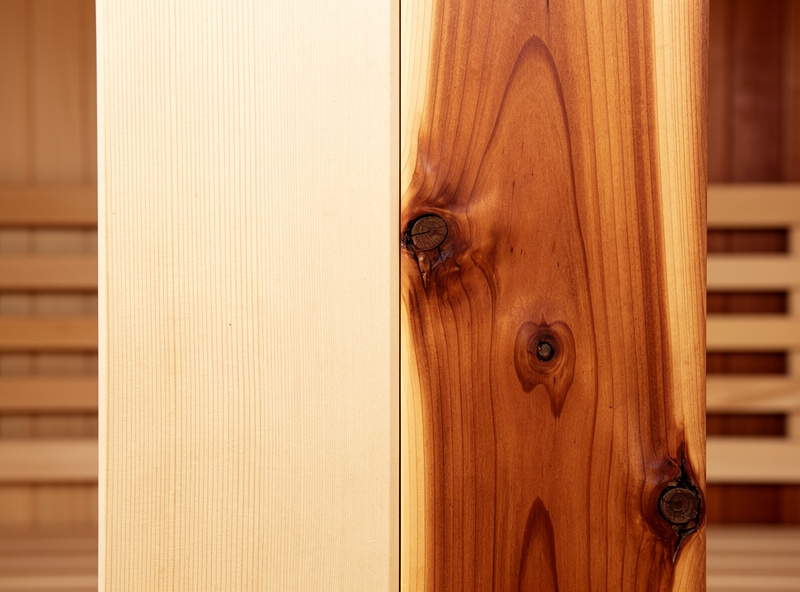
Acceptable Wood Types
| Wood | Properties | Price Tier | Best For |
|---|---|---|---|
| Canadian Hemlock | Non-toxic, durable, affordable, neutral scent | Entry to mid-range | Most buyers; standard industry choice |
| Western Red Cedar | Natural antimicrobial, aromatic, premium appearance, very durable | Mid to high-end | Those wanting premium quality/natural aroma |
| Basswood | Non-aromatic, hypoallergenic, light color | Mid-range | Those with chemical sensitivities/allergies |
| Aspen | Non-aromatic, bright appearance | Mid-range | Commercial settings; those wanting light interior |
Wood Quality Red Flags
- Particle board or plywood: Off-gasses formaldehyde when heated – NEVER acceptable
- Chemically treated woods: Can release toxic compounds when heated
- Thin panels: Less than 6mm thickness suggests poor construction
- Visible defects: Knots, cracks, warping in photos
What to ask: “What specific wood type is used? Is it solid wood or engineered/particle board? Is the wood treated with any chemicals?”
Warranty and Support
A warranty reflects manufacturer confidence in their product. Short warranties or vague terms suggest corners were cut.
Minimum Acceptable Warranties
- Electronics/Control panel: 1 year minimum
- Heating elements: 5 years minimum (premium: lifetime)
- Wood structure: 1-3 years (premium: 5+ years or lifetime)
- Glass/door: 1 year
Support Quality Indicators
- Phone/email support with reasonable response times
- Clear warranty claim process
- Replacement parts available (check before buying)
- Assembly support/instruction quality
Test before buying: Email the company with a pre-sales question. If they don’t respond within 24-48 hours, reconsider. Poor pre-sales support predicts poor post-sales support.
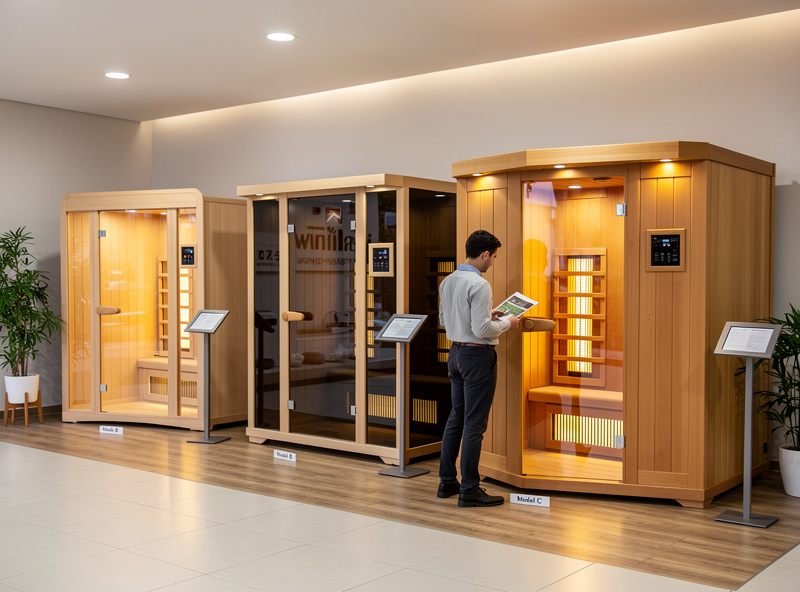
Size and Capacity: Choosing the Right Fit
Selecting the appropriate size prevents the most common buyer’s remorse: “I wish I had gotten the larger/smaller one.”
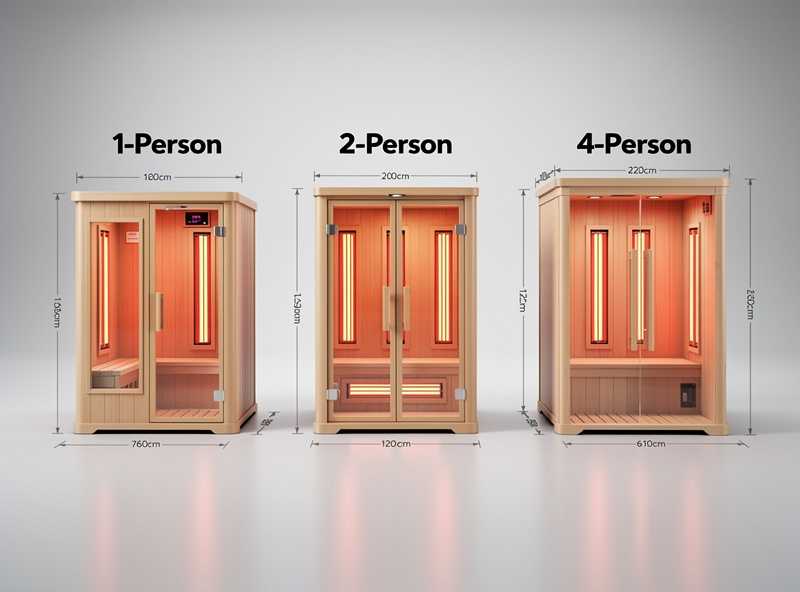
1-Person Saunas (3×3 to 3×4 feet)
Best for:
- Solo users only
- Small spaces (apartments, small bedrooms)
- Budget-conscious buyers
- Those who prefer intimate, cozy sessions
Interior space reality: 3×3 feels compact. You can stretch legs or cross them, but not much movement. Consider 3×4 if you are tall (6+ feet) or want slight extra room.
Typical specs:
- Power: 1,200-1,500 watts
- Outlet: Standard 120V
- Price: $900-2,000
2-Person Saunas (4×4 to 4×5 feet)
Best for:
- Couples or partners who sauna together
- Those who want occasional guest capacity
- People wanting comfortable solo space
- Medium-sized rooms
Interior space reality: Comfortable for two sitting side-by-side or across. Solo users have room to recline or stretch. The “sweet spot” for most home users.
Typical specs:
- Power: 1,600-2,000 watts
- Outlet: Standard 120V or 240V depending on model
- Price: $1,500-3,500
3-4 Person Saunas (5×5 to 6×6 feet)
Best for:
- Families
- Social sauna users
- Dedicated wellness rooms
- Those with ample space
Interior space reality: Spacious for 2-3, comfortable for 4. Allows movement, changing positions, social interaction.
Typical specs:
- Power: 2,500-3,500+ watts
- Outlet: 240V dedicated circuit required
- Price: $3,000-6,000+
- Installation: Professional electrical work needed
Size Selection Decision Tree
- How many people will use it simultaneously?
- Just me → 1-person
- Me + partner occasionally → 2-person
- Family/group → 3-4 person
- What space is available?
- Small bedroom/closet → 1-person only
- Standard bedroom corner → 1 or 2-person
- Spare room/basement → Any size
- Budget ceiling?
- Under $1,500 → 1-person
- $1,500-3,000 → 2-person
- $3,000+ → 3-4 person options
For a deeper size-by-size walkthrough including real interior bench dimensions, dual-zone heater control, and 240V-versus-110V wiring decisions, see the infrared sauna sizes hub. Buyers comparing single-person cabinets specifically should jump to the best 1-person infrared saunas roundup; renters and apartment dwellers will find the right format in the mini and small infrared saunas for apartments roundup.
Infrared Types: Which Wavelength for Your Goals
We covered this in detail in our infrared spectrum guide, but here is how to apply that knowledge when shopping:
Far Infrared Only ($1,000-3,000)
Best choice if your priorities are:
- Deep detoxification through sweating
- Cardiovascular conditioning
- Weight management support
- Chronic pain relief (deep tissue)
- Stress reduction and relaxation
What you get:
- Most proven, well-researched type
- Lower cost than full spectrum
- Excellent for core therapeutic benefits
- No skin-specific benefits
Full Spectrum ($3,000-6,000+)
Best choice if your priorities include:
- Skin health and anti-aging (near infrared benefit)
- Wound healing
- Comprehensive therapy (want all benefits)
- Future-proofing (all wavelengths in one)
What you get:
- All three wavelengths (near, mid, far)
- Skin benefits from NIR
- Deep therapy from FIR
- Premium pricing
Verification tip: Ask for specific wavelength output data. Quality manufacturers disclose exact nm ranges for NIR, MIR, and FIR. Vague “full spectrum” claims without specifics may indicate token NIR elements that provide minimal benefit.
Price Tiers: What to Expect at Each Level
Understanding what features and quality levels correspond to each price bracket helps you evaluate whether a sauna offers fair value.
$1,000-1,500: Entry Level
What you can expect:
- Far infrared only (carbon or ceramic)
- 1-person capacity
- Canadian Hemlock construction
- Basic digital controls
- EMF: 5-15 mG (verify before buying)
- 1-year warranty typical
What you sacrifice:
- No full spectrum
- Higher EMF than premium
- Basic features only
- Shorter warranty
- Lesser-known brands
Best use: Testing infrared therapy, budget constraints, first-time buyers
$1,500-2,500: Mid-Range Sweet Spot
What you can expect:
- Carbon fiber panels (quality)
- 1-2 person capacity
- Canadian Hemlock or Red Cedar
- EMF: 3-8 mG
- Better construction and fit/finish
- Some features (chromotherapy, basic audio)
- 3-5 year heating element warranty
Best use: Serious long-term use, best value for most buyers
$2,500-4,000: Premium Far-Infrared
What you can expect:
- High-quality carbon panels
- EMF: Under 3 mG (excellent)
- Red Cedar or premium Hemlock
- Full feature set (chromotherapy, quality audio, reading lights)
- 5+ year or lifetime warranties
- Established brand reputation
- Superior customer support
Best use: Those prioritizing low EMF, premium features, long-term reliability
$3,500-6,000+: Full Spectrum Territory
What you can expect:
- True full spectrum (verified wavelengths)
- All premium far-infrared features PLUS
- Adjustable wavelength ratios
- Advanced controls
- Maximum therapeutic coverage
- Best warranties and support
Best use: Skin health priority, comprehensive therapy needs, maximum budget
Features and Add-Ons: What’s Worth Paying For
Manufacturers offer many features. Here is which actually enhance your experience versus marketing fluff:
Worth the Money
Chromotherapy (Color Light Therapy)
- Cost: Usually included in mid-range+
- Value: Creates relaxing ambiance, may support mood
- Verdict: Nice to have, not essential
Quality Audio System
- Cost: $100-300 add-on
- Value: Significantly enhances long sessions
- Verdict: Worth it if you enjoy music/podcasts during sessions
Interior Reading Light
- Cost: Usually included
- Value: Practical for evening use
- Verdict: Useful feature
Ergonomic Backrest
- Cost: $50-150
- Value: Significantly improves comfort during long sessions
- Verdict: Highly recommended
Not Worth Extra Cost
“Smart” App Control
- Cost: $200-500 premium
- Value: Limited practical benefit
- Verdict: Gimmick for most users
Luxury Wood Finishes
- Cost: $500-1,000+ premium
- Value: Aesthetic only
- Verdict: Standard Hemlock performs identically
Excessive Heating Elements
- More is not always better
- Quality distribution matters more than raw count
- Verdict: Verify coverage area, not just element count
Red Flags: Brands and Models to Avoid
Watch for these warning signs that indicate inferior or potentially unsafe products. For the brands that consistently pass these criteria, see our ranked review of the top 10 infrared sauna brands covering Sunlighten, Clearlight, HigherDose, and seven other manufacturers.
Absolute Deal-Breakers
- No EMF data: Will not provide third-party EMF testing
- Chemically treated woods: Can off-gas toxins when heated
- Particle board/plywood construction: Formaldehyde risk
- No certifications: No UL, ETL, or CE safety certification
- No warranty information: Or extremely short warranties
- Unrealistic claims: “Cures cancer,” “melts fat instantly,” etc.
Major Warning Signs
- Extremely low prices: Quality infrared technology has real costs; under $700 for a cabin is suspicious
- No brand information: Amazon-only brands with no website, no support contact
- Vague specifications: “Infrared heating technology” without specifying carbon vs ceramic, wattage, etc.
- Impossible specs: Claims of heating to 170°F in 5 minutes, or 10-year warranties on $500 units
- No reviews or only fake reviews: All 5-star reviews posted same day, no verified purchase badges
Suspicious Marketing Language
- “Proprietary blend of wavelengths” without specifics
- “NASA technology” (misleading – NASA researched infrared, did not design saunas)
- “Doctor recommended” without naming the doctors
- “As seen on TV” (often indicates mass-market low quality)
Shopping Checklist: Before You Buy
Use this comprehensive checklist when evaluating any sauna — for the fuller version of this checklist with the reasoning behind each line item, see the what to look for when buying guide:
Pre-Purchase Verification
Safety Essentials
- ☐ Third-party EMF test results provided (under 10 mG, ideally under 3 mG)
- ☐ UL, ETL, or CE electrical safety certification
- ☐ Untreated natural wood (Hemlock, Cedar, Basswood, or Aspen)
- ☐ Tempered glass door (not regular glass)
- ☐ Proper ventilation design
Quality Indicators
- ☐ Specific heating element technology disclosed (carbon fiber panels preferred)
- ☐ Minimum 1-year electronics warranty
- ☐ Minimum 5-year heating element warranty
- ☐ Responsive customer service (test with pre-sales question)
- ☐ Consistent positive reviews mentioning long-term durability
Specifications to Verify
- ☐ Exact dimensions (interior and exterior)
- ☐ Power requirements (120V vs 240V)
- ☐ Total wattage
- ☐ Maximum temperature capability
- ☐ Infrared type (far only vs full spectrum)
- ☐ Wood type and thickness
Practical Considerations
- ☐ Dimensions fit your available space (including clearances)
- ☐ Doorways wide enough for panel delivery
- ☐ Electrical matches your home
- ☐ Floor can support weight
- ☐ Assembly complexity within your capability (or budget for help)
Where to Buy: Dealer Types Compared
Manufacturer Direct
Advantages:
- Best prices (no middleman markup)
- Direct support from people who built it
- Warranty handled directly
Disadvantages:
- Can not comparison shop multiple brands in one place
- May lack local showroom
Best for: Buyers who have researched and know what they want
Online Retailers (Amazon, etc.)
Advantages:
- Easy comparison shopping
- Customer reviews visible
- Return policies (usually)
- Fast shipping
Disadvantages:
- Many low-quality units mixed with good ones
- Harder to verify manufacturer legitimacy
- Support may go through retailer first
Best for: Budget-conscious buyers willing to carefully vet products
Specialty Spa/Wellness Stores
Advantages:
- Can see/try before buying
- Expert guidance
- Professional installation available
Disadvantages:
- Higher prices
- Limited selection
- Geographic constraints
Best for: High-budget buyers wanting hands-on evaluation and white-glove service
Making Your Final Decision
After evaluating all criteria, narrow your choices using this framework:
Step 1: Define Your Non-Negotiables
What absolutely MUST your sauna have?
- Example: “Must be under $2,000”
- Example: “Must have EMF under 3 mG”
- Example: “Must fit in my 5×5 foot corner”
- Example: “Must be 2-person capacity”
Step 2: Rank Your Priorities
What matters most to you?
- Price/budget
- EMF levels
- Infrared type (far vs full spectrum)
- Size/capacity
- Brand reputation
- Features (audio, chromotherapy)
- Warranty length
Step 3: Shortlist 3-5 Options
Using your criteria, identify 3-5 saunas that meet your non-negotiables and score well on priorities.
Step 4: Deep Dive Comparison
For your shortlisted options:
- Request EMF test results from each manufacturer
- Read 20+ reviews looking for patterns (ignore outliers)
- Compare warranty terms side-by-side
- Test customer service responsiveness
- Verify electrical requirements match your home
Step 5: Make the Choice
Select the sauna that:
- Meets all safety requirements
- Fits your budget
- Aligns with your priority ranking
- Has responsive support
- Feels like the right long-term investment
After Purchase: Getting Started
Once you have selected your sauna:
- Read our complete setup guide to prepare your space
- Review safety protocols before first use
- Start with beginner sessions and gradually build tolerance
- Track your experience to optimize your routine
Last updated: February 2026. Prices and specifications subject to change. Always verify current information with manufacturers before purchasing.
Frequently Asked Questions
What is the difference between carbon and ceramic heaters?
Carbon heater panels are the modern standard—they produce gentle, even heat across a large surface area. Ceramic heaters get much hotter in small, concentrated areas, which can feel harsh on the skin.
Do I need full-spectrum infrared?
Far-infrared is the wavelength most cabins are built around, and it’s what produces the deep, comfortable sweat session buyers are usually after. Full-spectrum saunas add a near-infrared (NIR) emitter; some early research has looked at near-infrared light and skin or recovery effects, but the findings are preliminary and shouldn’t be read as a guarantee—treat any skin or cellular claim as studied, not proven. A full-spectrum unit costs more for that extra emitter, and a well-built far-infrared sauna is still a strong, simpler choice for most buyers.
What does “low-EMF” actually mean?
EMF (electromagnetic fields) are given off by any electrical heater, including sauna panels. The World Health Organization notes that current evidence has not established health effects from the low-level fields typical household electronics produce, though some buyers still prefer to minimize exposure. On a sauna spec sheet, “low-EMF” usually means the panels test below roughly 3 milligauss (mG) at normal sitting distance—worth confirming yourself with a meter rather than taking the spec sheet’s word for it.
How important is the warranty on a sauna?
Extremely important. Replacing individual carbon heater panels or digital control boards can cost hundreds of dollars. Look for lifetime warranties on heaters and at least 5 years on electronics and cabinetry.