Not all infrared light is the same. The infrared spectrum spans a wide range of wavelengths, and where a sauna’s heater falls on that spectrum determines how deeply the energy penetrates, which tissues it warms or interacts with, and what kind of session you actually get. Understanding near infrared versus far infrared versus full spectrum is the foundation for matching hardware to your interests — and for spotting overpriced gimmicks before you buy.
This guide breaks down the electromagnetic science, what the research reports (attributed, not asserted) for each wavelength, the hardware that actually produces each band, EMF characteristics by heater type, and how to buy without falling for marketing.
The Electromagnetic Spectrum: Where Infrared Fits
To understand infrared saunas, you need basic familiarity with the electromagnetic spectrum. Light exists as waves of different lengths, measured in nanometers (nm) or micrometers (μm). The spectrum ranges from short, high-energy gamma rays to long, low-energy radio waves.
Visible light occupies a narrow band from approximately 380nm (violet) to 700nm (red). Just beyond red light, at wavelengths longer than 700nm, lies the infrared region — invisible to human eyes but detectable as heat.
The infrared spectrum is conventionally divided into three categories:
- Near Infrared (NIR): 700-1400nm
- Mid Infrared (MIR): 1400-3000nm
- Far Infrared (FIR): 3000nm-1mm (1,000,000nm)
Some researchers further subdivide these categories, but for sauna purposes, this three-part framework is most practical.
Why Wavelength Determines Penetration
The key principle: shorter wavelengths penetrate less deeply; longer wavelengths interact more with surface water and heat the body from outside in. The relationship is not perfectly linear, and different tissues absorb different wavelengths at different rates.
Water in your body absorbs certain infrared wavelengths strongly, while other wavelengths pass through more easily. This selective absorption is why near and far infrared are studied for different things — they’re not interchangeable versions of the same effect.
Near Infrared (NIR): 700-1400nm
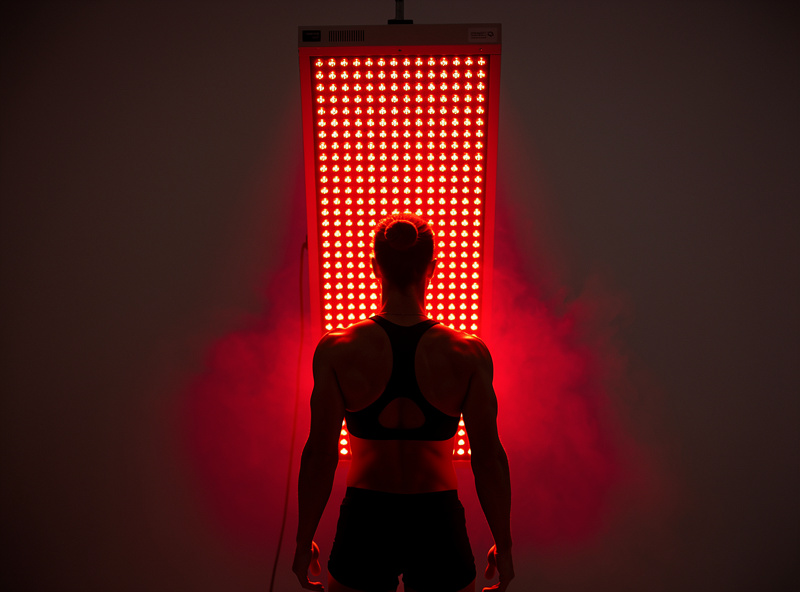
Near infrared sits closest to visible red light on the spectrum. It overlaps significantly with red light therapy (photobiomodulation) and works through a different mechanism than far infrared entirely.
Penetration Depth
Near infrared penetrates only a few millimeters into the skin surface, reaching the epidermis and upper dermis. It does not meaningfully raise core body temperature. Its studied effects work through cellular light absorption rather than bulk thermal heating.
How NIR Works: Photobiomodulation
Near infrared light is absorbed by chromophores including cytochrome c oxidase in mitochondria — the energy-producing structures inside cells. That absorption is linked in the research to changes in adenosine triphosphate (ATP) production and downstream cell signaling. This mechanism, known as photobiomodulation, is genuine cellular biology — it’s the outcome claims layered on top of it that need to stay attributed rather than promised.
What NIR Research Reports
The following are studied effects reported in the literature — not outcomes this sauna, or any sauna, guarantees you. Treat them as research summaries, not a treatment plan.
Skin Appearance
A controlled trial on red and near-infrared light exposure reported improved patient-rated skin texture, fewer fine lines, and increased intradermal collagen density over the study period — the trial is indexed on PubMed here. That’s a specific study with a specific device and exposure schedule, not a blanket guarantee any NIR panel replicates the result — dose (wavelength, irradiance, session count) is part of what the study controlled for.
Wound Healing Research
Photobiomodulation research has looked at wound healing and cellular proliferation, with proposed mechanisms tied to the ATP-production pathway above. This is an active but still-developing research area — promising signal, not settled clinical guidance, and nothing here substitutes for a clinician managing an actual wound.
Cellular Energy Research
Some researchers have proposed that mitochondrial effects from NIR exposure could extend beyond the treated skin area. This is speculative and explicitly flagged as needing more research in the sources that raise it — it is not an established systemic benefit.
Inflammatory Signaling
Photobiomodulation studies report changes in inflammatory signaling markers in treated tissue. Reported, not asserted as a health outcome — this is cellular-marker research, not a clinical claim that NIR treats an inflammatory condition.
How NIR Is Delivered in Saunas
Pure NIR saunas are less common than far infrared models. NIR delivery typically uses:
- LED panels: Emit specific NIR wavelengths, often combined with red light
- Heat lamps: Incandescent bulbs that emit some NIR along with broad-spectrum heat
- Halogen/incoloy emitters: Produce intense NIR plus significant radiant heat — this is what feeds the NIR emitter in my own full-spectrum unit
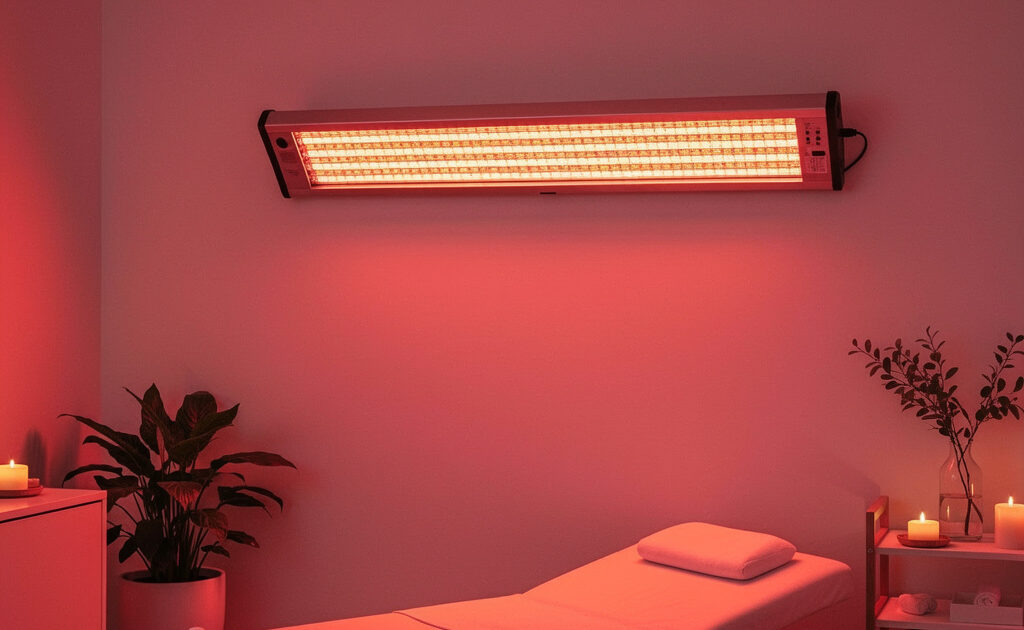
NIR-focused setups often look different from traditional sauna cabins — flat panels mounted on walls or stands rather than an enclosed cabin, which allows targeting specific body areas rather than whole-body sessions.
Limitations of NIR
- Does not raise core body temperature significantly
- Produces minimal sweating — not the heat-and-sweat experience most sauna buyers are actually shopping for
- Research on effects beyond the treated area remains limited and is not established
- Direct-view LED and halogen NIR sources can carry eye safety concerns without proper protection
Mid Infrared (MIR): 1400-3000nm
Mid infrared sits between near and far on the spectrum. It’s the band I hedge hardest on — I don’t own or meter a dedicated MIR-only unit, and neither does most of the market, because standalone MIR products are genuinely rare.
Penetration Depth
Mid infrared penetrates deeper than NIR, reaching soft tissue beneath the skin. In practice almost no commercial heater emits a spectrally pure MIR band — it shows up as part of the emission curve of carbon and ceramic far-infrared heaters and full-spectrum systems, not as its own dedicated product category.
What MIR Research Reports
Dedicated MIR research is thin compared to NIR photobiomodulation or FIR thermal studies, largely because so few products isolate the band. Where MIR is discussed, it’s usually in the context of circulation and soft-tissue blood flow changes from the heat itself, not a wavelength-specific mechanism distinct from general infrared heating. I’d treat any product marketed specifically around “MIR benefits” with more skepticism than a straightforward far-infrared or NIR claim — the evidence base for MIR as its own category is the weakest of the three.
MIR in Sauna Technology
Standalone MIR saunas are essentially nonexistent as a retail product. Most commonly, MIR wavelengths are an incidental part of what carbon and ceramic far-infrared heaters emit, or a small slice of a full-spectrum system’s overall curve, not a dedicated element you’re buying separately.
Heater Hardware by Band: What’s Actually Inside Each Emitter Type
Wavelength band and heater hardware are two different questions people conflate — the band tells you what the light does, the hardware tells you what you’re actually installing, wiring, and living with. Here’s how the four emitter types I distinguish by hand break down, based on the heaters I run and have pulled panels on in my own cabin and add-on unit.
| Emitter type | Primary band | Typical surface temp | Ramp time | Radiant footprint |
|---|---|---|---|---|
| Ceramic rod/tube | Far infrared | Higher, more localized | Fast to feel heat, slower to even out | Narrow — creates hot spots directly in front of the rod |
| Carbon-fiber panel | Far infrared | Lower, more even | Slower initial ramp, more uniform once warm | Broad, flat panel — fewer cold spots |
| Carbon/ceramic hybrid | Far infrared | Between the two | Balanced | My daily driver — even coverage with a bit more punch than pure carbon |
| Halogen/incoloy emitter | Near infrared | Very high at the source (direct-view) | Near-instant | Narrow, directional — targeted rather than ambient |
| LED array | Near infrared / visible red | Cool to the touch | Instant, no thermal ramp | Flat panel, no cabin-heating effect |
The daily-driver cabin I run uses a ceramic/carbon hybrid panel for exactly the “even coverage without losing the punch of a hotter element” reason above. The full-spectrum add-on unit I also run adds a halogen NIR emitter on top of a carbon far-infrared panel — that’s the honest architecture behind most “full spectrum” cabins: a far-infrared panel doing the bulk of the thermal work, plus one or a few NIR emitters bolted on for the near-infrared claim. A cheap “full spectrum” sticker on a single weak NIR bulb next to a full carbon wall is a very different product from a cabin that actually balances the two, and reading the wattage split between elements (not just the marketing copy) is how you tell the difference. For the deeper breakdown of every emitter type by wavelength band, see the near, mid, and far infrared heater guide; for a head-to-head on the two far-infrared hardware options specifically, see the carbon vs ceramic heater comparison.
Far Infrared (FIR): 3000nm-1mm
Far infrared represents the longest wavelengths used in sauna therapy. This is what most people mean when they refer to “infrared saunas” — FIR is the most common heater band and the most-researched of the three.
Penetration Depth
Far infrared interacts with water in the outer tissue layers and, through that surface absorption and re-radiation, raises core body temperature over a session — reported penetration figures in the marketing literature (often “1.5-2 inches”) are frequently overstated; the mechanism below is the part that’s well established.
How FIR Works: Resonance Absorption
FIR operates through a different mechanism than NIR. Rather than photobiomodulation, FIR works through resonance absorption — the idea that FIR wavelengths overlap with the natural vibrational frequencies of water molecules in tissue.
When FIR waves hit tissue, water molecules absorb the energy and convert it to heat, warming the surface and (through normal heat-transfer and thermoregulation) raising core temperature over the course of a session. This is why FIR can make you sweat heavily even though the surrounding cabin air stays cooler than a traditional sauna’s air temperature.
What FIR Research Reports
Sweat Composition Research
FIR-induced sweating is real and heavy — that part isn’t in question. What “detox” marketing claims and what the sweat-composition research actually shows are two different things. Studies monitoring heavy metal elimination via sweat and urine, such as this analysis of heavy metal levels and sweat/urine elimination in an exposed population, do find trace elements present in sweat. What they don’t establish is that sweating is a meaningful elimination pathway compared to the kidneys and liver, which do the overwhelming majority of that work in a healthy person. I’d rather say plainly that the “sweat it out” framing oversells a real but minor mechanism than let a page here imply a sauna is doing your kidneys’ job.
Cardiovascular Research
The largest sauna-and-cardiovascular cohort research, the Finnish KIHD study reported in Laukkanen et al.’s analysis of sauna bathing and cardiovascular mortality, is worth being precise about: that population used traditional Finnish (high-humidity, hot-air) saunas, not infrared cabins. The two heat you by different physical mechanisms — traditional saunas heat the air which heats you by convection at 150-195°F, infrared cabins heat tissue more directly by radiation at a lower air temperature around 120-150°F. Infrared-specific cardiovascular research exists but is smaller and less studied than the traditional-sauna literature; I’d treat “infrared saunas are proven cardiovascular medicine” claims with real skepticism until the infrared-specific evidence catches up to the traditional-sauna cohort data.
Weight and Metabolism
Raising core body temperature and driving a sustained heart-rate response does cost energy, and vendor marketing routinely quotes calorie-burn figures for a session. I don’t publish a specific number here because the honest answer is that credible, session-specific calorie figures for infrared sauna use are thin and vary enormously by body size, session length, and set temperature — nowhere close to precise enough to plan a diet around. Treat any infrared sauna as heat exposure, not a workout substitute.
Pain and Muscle Comfort Research
Some of the more rigorous heat-and-pain research comes out of Japan’s Waon therapy program — a supervised, dry far-infrared protocol developed for cardiac rehabilitation that’s since been studied in chronic pain populations, including a trial on Waon therapy for fibromyalgia. Worth flagging directly: Waon therapy uses purpose-built medical-grade far-infrared equipment under clinical supervision with a defined session protocol — it is not the same product or setting as a home infrared cabin, and the study results shouldn’t be read as a direct guarantee for a consumer unit. What it does establish is that far-infrared heat exposure is a legitimate, actively studied research area for pain and comfort, not fringe wellness content.
Relaxation
Warm, quiet, enclosed sessions are reported anecdotally and in some research to support a subjective sense of relaxation and stress relief. This is squarely a “reported experience” category rather than a measurable clinical outcome, and it’s honestly the effect I’d stand behind most confidently from my own session log — not because it’s clinically proven, but because it’s the one claim that doesn’t need to be.
FIR Heating Technology
Modern FIR saunas use carbon-fiber panels or ceramic rod/tube heaters, sometimes blended into a hybrid — see the heater hardware comparison above for surface temp, ramp time, and radiant footprint differences between the two. In short: carbon panels run cooler and more evenly, ceramic rods run hotter and more localized, and hybrids split the difference.
Limitations of FIR
- Minimal skin-specific, photobiomodulation-style effects compared to NIR
- No photobiomodulation mechanism — the biology is thermal, not cellular-light-absorption
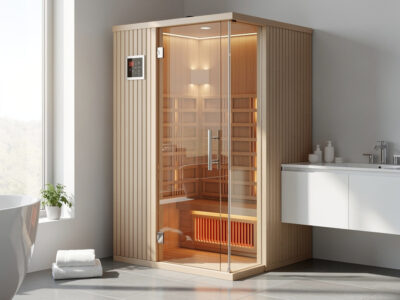
- Requires an enclosed cabin structure for meaningful core temperature elevation
- Some lower-quality units run higher EMF than their marketing discloses — see the EMF section below
Full Spectrum: The All-in-One Approach
Full spectrum saunas combine NIR and FIR elements (and, incidentally, some MIR) in a single unit, marketed as delivering the combined range of infrared effects in one session.
How Full Spectrum Works
Full spectrum systems combine two heating technologies, not three distinct ones in practice:
- Carbon or ceramic heaters for the far-infrared thermal load
- LED or halogen/incoloy emitters for the near-infrared element
- MIR shows up incidentally as part of the far-infrared heater’s emission curve, not as a separately engineered element
The pitch is simultaneous access to NIR’s studied cellular effects and FIR’s thermal/sweat response in one session rather than two separate sessions with two separate products.
Reported Interest in Full Spectrum
- Combined access: both wavelength categories in one cabin, one session
- Time efficiency: no need to run two separate pieces of equipment
- Customization: many units let you adjust the ratio or run the NIR emitter independently
- Optionality: if either body of research develops further, you already have access to both bands
The Full Spectrum Debate: Worth the Premium?
Full spectrum saunas typically cost $1,000-2,000 more than a comparable far-infrared-only model. Whether that premium is worth it depends on what you’re actually interested in:
Consider full spectrum if:
- The NIR/skin-appearance research above is genuinely interesting to you
- You want combined access to both bands rather than buying two separate products later
- Budget allows for the premium and you plan long-term use
Far infrared alone may suffice if:
- Your interest is mainly the heat/sweat session experience, cardiovascular research, or general relaxation
- Budget is the primary constraint
- You’re new to sauna sessions and want to test whether you’ll actually use it before spending more
Marketing Gimmicks to Watch For
Not all “full spectrum” claims are equal:
- Verify wavelengths: credible manufacturers specify exact NIR/FIR wavelengths and the wattage of each emitter, not just a marketing label
- Check power distribution: some budget “full spectrum” units have a token NIR bulb that contributes minimally next to a full carbon wall — the hardware table above is how you catch this
- Research the brand: look for third-party testing and real certifications, not just marketing copy
- Avoid vague marketing: “proprietary blend of wavelengths” without specifics is a red flag, not a selling point
EMF by Band and Heater Type: What My Meter Actually Shows
EMF is the one place the wavelength conversation and the hardware conversation collide directly, and it’s the measurement almost no infrared content actually takes. On my TriField TF2, the field a heater produces has almost nothing to do with its wavelength band and almost everything to do with its wiring and element construction.
By heater type, in order of what I typically see on my meter, low to high magnetic field at seating distance:
- LED NIR panels: lowest of the group at treatment distance — most of the field comes from the driver board, not the diode array itself, and it drops off fast once you’re a foot or two back.
- Carbon-fiber far-infrared panels: generally the lowest of the thermal heater types when wired with opposing-loop routing — this is what “low-EMF” cabin marketing is usually referring to.
- Carbon/ceramic hybrid panels: lands between carbon and ceramic — my daily-driver cabin’s hybrid panel reads low but not as low as a pure carbon-only unit.
- Ceramic rod/tube heaters: tend to run the highest magnetic-field readings of the far-infrared group at close range, because the current runs through a smaller, more concentrated element.
- Halogen/incoloy NIR emitters: can spike close to the element itself, but at typical sitting distance the reading is more about the ballast/transformer than the emitter tube.
Two things move the number more than the heater type does: wiring routing (opposing-current-loop wiring cancels a meaningful chunk of the magnetic field; a straight run doesn’t) and distance (field strength drops off fast — the difference between 6 inches and 18 inches from a panel is large). A cabin marketed as “low-EMF” should publish an actual milligauss figure at a stated distance, not just the label. Third-party EMF testing, if the manufacturer publishes it, is worth more than the sticker. For general background on electric and magnetic field exposure from household electronics, the NIEHS overview page is a neutral reference point, not a sauna-specific source. For the full low-EMF buying breakdown — what readings are reasonable, how to meter your own unit, and which configurations minimize exposure — see the low-EMF infrared sauna guide.
Buying Guidance by Band
Use this as a starting framework, not a guarantee that any category delivers a specific health outcome — it’s a way to match hardware to what you’re actually interested in reading more about.
Consider NIR or full spectrum if you’re interested in:
- The skin-appearance and photobiomodulation research above
- Localized treatment of a specific body area rather than whole-body sessions
- Shorter, targeted sessions (10-20 minutes) rather than a full 30-45 minute cabin session
Consider far infrared if you’re interested in:
- The heat/sweat session experience itself
- The cardiovascular and pain-research areas covered above (attributed, not guaranteed)
- A lower cost of entry than a full-spectrum cabin
- Whole-body sessions rather than targeted panel use
Consider full spectrum if:
- You want combined access to both research areas without buying two products
- Budget allows for the $1,000-2,000 premium over far-infrared-only
- You plan long-term, frequent use where the added flexibility pays for itself
Red flags regardless of band
- No wavelength specifications: credible manufacturers specify exact wavelengths and emitter wattages
- Medical claims: “cures,” “treats,” or disease-specific promises on a consumer sauna listing are a hard pass — no legitimate manufacturer makes those claims
- No certifications: look for UL, ETL, CE, or RoHS certification on the heater and electrical components
- Unrealistically low prices: quality heater panels and cabin wood have real material costs; a $300 “infrared sauna” on a marketplace listing is unlikely to match the hardware described above
- No warranty: quality units carry meaningful warranties, often 5+ years on the heater panels specifically
- High EMF without disclosure: a manufacturer that won’t publish a milligauss figure at a stated distance is telling you something
Technical Considerations by Type
Heating Element Quality
Higher quality heating elements:
- Distribute heat more evenly across the panel
- Last longer — quality carbon panels are commonly rated 5,000+ hours
- Tend to run lower EMF when wiring is done right
- Produce more consistent output across the panel rather than hot and cold zones
Temperature Range
Effective temperature ranges vary by type:
- NIR-focused: cabin air stays cooler (100-130°F); the panel itself is the point, not the room
- FIR-focused: 120-150°F is the typical operating range where the thermal response is the goal
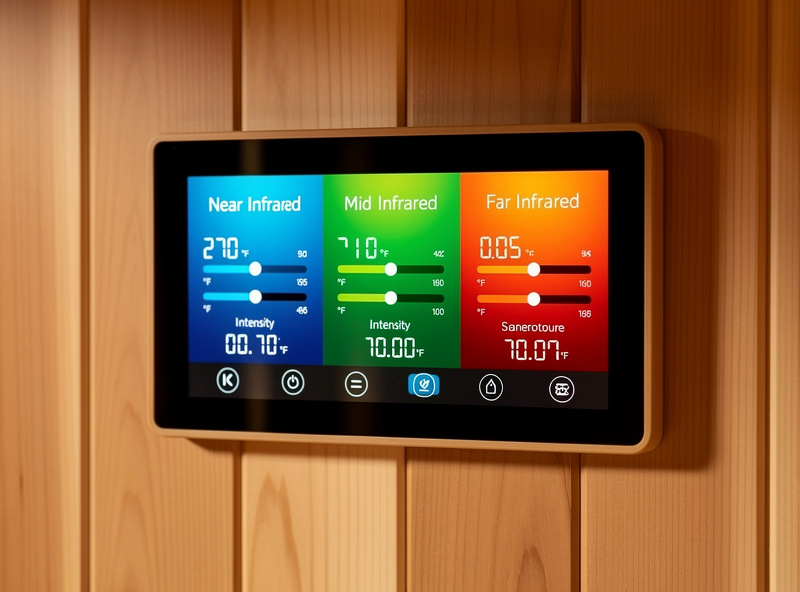
- Full spectrum: 120-150°F cabin temp with an independently adjustable NIR emitter
Combining Types: A Layered Approach
Some owners use multiple infrared types rather than choosing one, and this is genuinely just a workflow preference, not a documented protocol with a proven optimal sequence:
Option 1: NIR Panel + FIR Sauna
Run a dedicated NIR LED panel for 10-15 minutes before your FIR sauna session — dry skin and an un-fogged panel are the practical reasons to go NIR first, not a physiological requirement.
Option 2: Targeted NIR + Whole-Body FIR
Use NIR panels for specific areas of interest while using the FIR cabin for the whole-body heat/sweat session.
Option 3: Rotating Focus Days
If you own a full-spectrum sauna, alternate between FIR-dominant sessions and sessions that lean more on the NIR emitter, depending on which research area you’re more interested in that day.
Summary: The Bottom Line
The infrared type you choose should align with your actual interests, budget, and usage pattern — not a promised outcome:
| Type | Studied for (attributed, not guaranteed) | Penetration | Price Range |
|---|---|---|---|
| Near Infrared | Skin appearance, wound-healing and inflammatory-signaling research, localized use | Surface (skin layers) | $200-800 (panels) |
| Mid Infrared | Thin, mostly incidental research bundled into FIR/full-spectrum products | Soft tissue | Rarely standalone |
| Far Infrared | Sweat/heat response, cardiovascular and pain-research areas, session relaxation | Surface, with core temp rise over a session | $1,000-4,000 |
| Full Spectrum | Combined NIR + FIR research areas | Both, via two emitter types | $2,500-6,000+ |
For most first-time buyers, a quality far-infrared sauna with a carbon or hybrid panel offers the best balance of session experience, reasonable cost, and low EMF when properly wired. Add a full-spectrum NIR emitter if the skin-appearance research is a genuine draw or budget allows for the premium. Supplement with a dedicated NIR panel if you want targeted, shorter sessions on a specific area rather than a full cabin.
Next Steps
Now that you understand the different infrared types and the hardware behind them, you are ready to explore specific sauna options:
- See our top-rated infrared saunas for home use organized by wavelength type
- Compare infrared vs traditional saunas if you are still deciding on the broader category
- Explore budget-friendly options to get started affordably
- Review our safety guidelines before beginning any sauna use
- Go deeper on every emitter type by wavelength band if the hardware side is what you’re actually shopping for
Frequently Asked Questions
What is the difference between infrared and traditional saunas?
Infrared saunas heat your body more directly using radiant energy at a lower cabin air temperature (roughly 120-150°F), while traditional saunas heat the air itself to a higher temperature (roughly 150-195°F) and warm you by convection. Infrared cabins typically warm up faster and cost less to run per session.
Which type of infrared sauna is best?
There’s no single best answer — it depends what you’re interested in. Far infrared is the most common, most-researched, and most affordable starting point for the heat/sweat session experience. Full spectrum adds a near-infrared emitter on top of that for the skin-appearance research, at a $1,000-2,000 premium.
How long do infrared sauna sessions last?
Most home users run 20-40 minute far-infrared sessions once comfortable, after starting shorter (10-15 minutes) to build heat tolerance. Dedicated NIR panel sessions for a specific body area are typically shorter, around 10-15 minutes.
Does far-infrared sweating actually detox the body?
Sweat does carry trace amounts of some compounds, but the research doesn’t support sweating as a meaningful detox pathway compared to the kidneys and liver, which handle the large majority of elimination in a healthy person. Treat heavy sweating as the expected physiological response to heat, not a cleanse.
Is near-infrared good for skin and anti-aging?
Photobiomodulation research, including controlled trials on red and near-infrared light exposure, has reported improvements in skin texture and collagen density under specific study conditions. That’s a real, attributed research finding — not a guarantee any NIR panel replicates the exact result outside a controlled study.
What should I look for when buying an infrared sauna?
Check heater hardware (carbon, ceramic, or hybrid panels), an actual published EMF figure at a stated distance rather than just a low-EMF label, wood quality, warranty length (5+ years on heaters is a good sign), and whether wavelength specs are stated precisely rather than vaguely.
Are full-spectrum saunas worth the extra cost?
If the near-infrared research genuinely interests you and you’d rather not buy a separate NIR panel later, yes. If your interest is mainly the heat/sweat session and general relaxation, a standard far-infrared cabin covers that at a lower price with typically lower EMF.