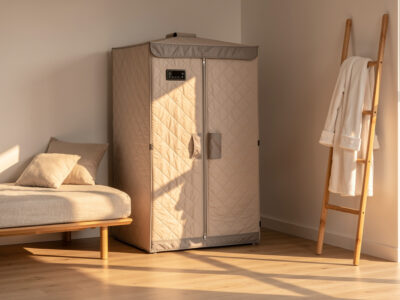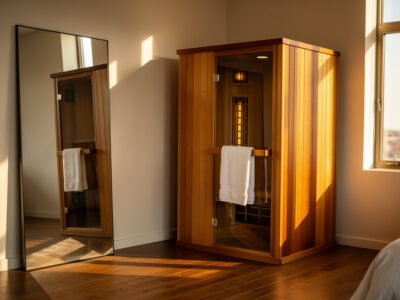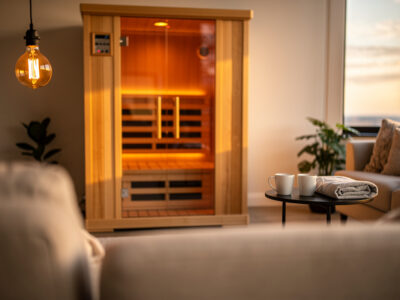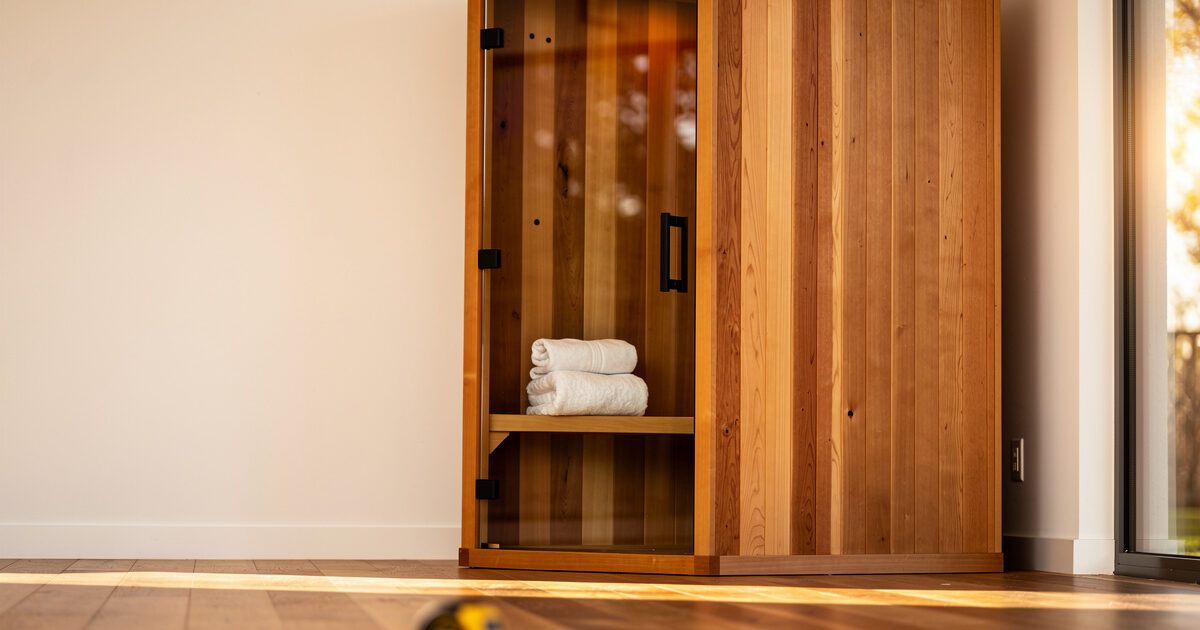
A 2-person infrared sauna typically measures 47 by 39 inches, draws 15 amps on a standard outlet, and holds two seated adults at roughly 38 inches of bench width per person. It is the best-selling size because it fits a 5-foot wall, plugs into a regular receptacle, and still allows occasional couple or solo use without the cost or wiring of a larger cabin.
That single decision — how many people you actually plan to seat — cascades into every other sauna spec you will compare. Cabinet footprint, heater wattage, breaker capacity, heat-up time, weight on the floor, and price all rise in step with capacity. This guide breaks down 1, 2, 3, and 4-person infrared saunas the way a buyer needs to see them: usable bench space, real electrical demand, room clearance, and which size matches which household.
Why Sauna Size Matters More Than Most Buyers Assume
Sauna capacity is the single spec that drives cost, wiring, footprint, and warm-up time. A 1-person cabin runs on a 110-volt outlet and warms in 12 minutes; a 4-person typically needs a dedicated 240-volt circuit and 35 minutes. Picking too big wastes money and electricity; picking too small forces solo-only sessions in a household that wanted to share.
Most first-time buyers default to “bigger is better” because the price spread between a 1-person and a 2-person model is usually only $400 to $700. The hidden cost lands later in the form of higher run costs (a 4-person cabin draws roughly 2.4 kW versus 1.6 kW for a 2-person), longer pre-heat that erodes session frequency, and a footprint that locks the cabin into one room of the house. Capacity should follow how the sauna will actually be used week to week, not how many guests might theoretically come over.
Sauna Sizes Compared at a Glance
The four common capacities split cleanly by power requirement, footprint, and typical use case. The table below summarizes the spec ranges across major brands such as Sunlighten, Clearlight, Sun Home, Dynamic, and Health Mate, drawn from current 2026 product listings.
| Capacity | Typical footprint (W × D) | Power | Heat-up time | Typical price (2026) | Best for |
|---|---|---|---|---|---|
| 1-person | 36″ × 36″ | 110V / 15A | 10–15 min | $1,200–$2,500 | Apartments, solo wellness, small home offices |
| 2-person | 47″ × 39″ | 110V / 15A | 15–20 min | $1,800–$4,500 | Couples, small primary bedrooms, the everyday best-seller |
| 3-person | 59″ × 45″ | 110V / 20A or 240V / 15A | 20–28 min | $3,200–$6,500 | Small families, basements, occasional shared use |
| 4-person | 71″ × 47″ | 240V / 20–30A | 25–35 min | $4,500–$8,500 | Larger families, group wellness, partial commercial |
| 5+ person | 75″+ × 60″+ | 240V / 30A+ | 30–45 min | $7,500–$15,000 | Outdoor cabins, gyms, recovery studios |
Notice the inflection between 2-person and 3-person: that is where most cabinets cross from a standard 110V plug to a dedicated circuit. If your only available outlet is a normal wall receptacle, the practical ceiling is a 2-person cabin without an electrician. The full choose-the-right-infrared-sauna guide walks through the wiring decision in detail.

1-Person Infrared Saunas: Solo Wellness in 7 Square Feet
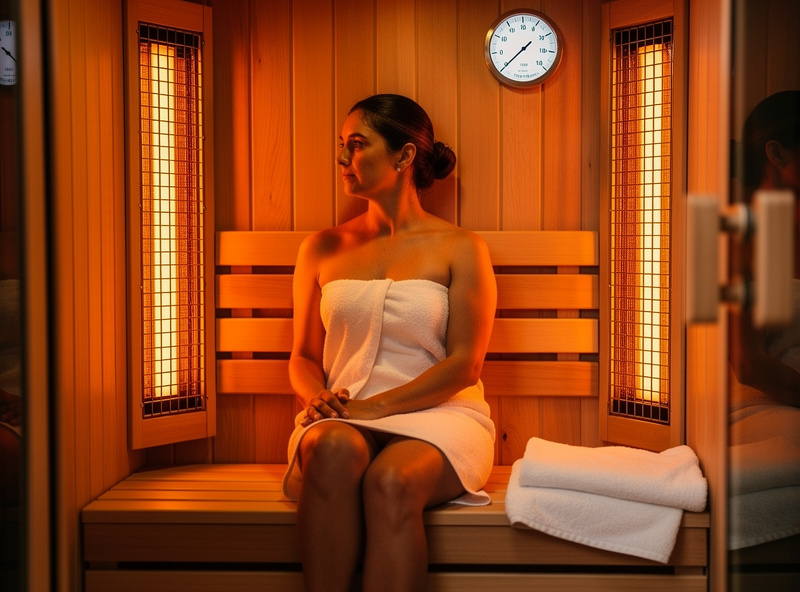
A 1-person infrared sauna fits in a 36-inch-square footprint, runs on a normal 110V/15A outlet, and reaches operating temperature in 10 to 15 minutes. It is the right capacity for apartment dwellers, anyone seating only one user 95% of the time, and buyers who want sub-$2,500 entry into a real wood cabin rather than a sauna blanket.
The trade-off is bench depth. Most 1-person cabins use a 17-inch bench so the cabinet itself stays under 36 inches deep, which means tall users (above 6′1″) tend to sit knees-forward against the front-wall heaters. That works for sweating but limits stretching. Brands like Sunlighten Solo, Health Mate Enrich, and Dynamic Barcelona all sit in this class, and the Health Mate review covers the compact Enrich line specifically. For a model-by-model ranking across the nine strongest single-person cabinets, see the best 1-person infrared saunas roundup. For renters who can’t install a cabinet at all, a flat-fold infrared sauna blanket is the next step down in commitment and cost.
2-Person Infrared Saunas: The Best-Selling Size
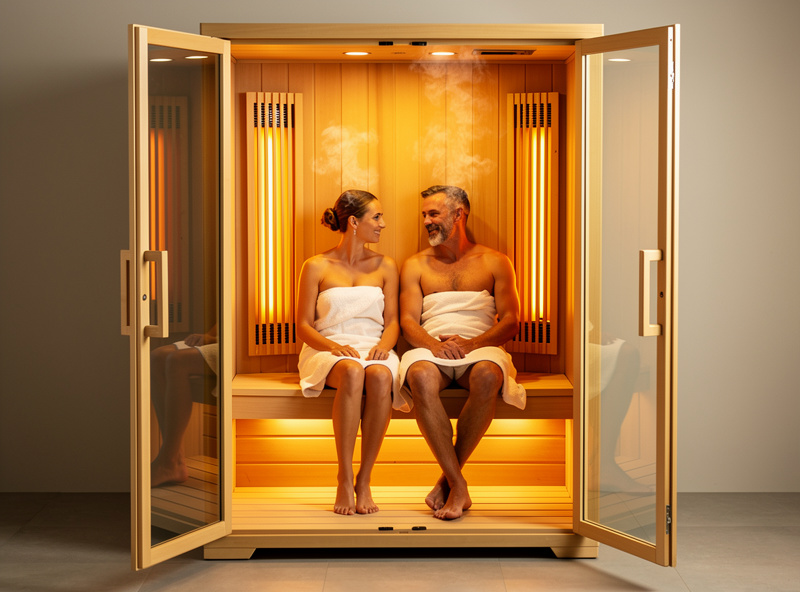
The 2-person infrared sauna is the volume leader of the category. A typical model is 47 inches wide, 39 inches deep, 75 inches tall, runs on a 110V/15A plug, and heats two seated adults in 15 to 20 minutes. It outsells every other capacity because it covers solo, couple, and rotating-guest use without forcing a 240V circuit upgrade.
Where 2-person cabinets diverge is bench length. A 47-inch wide unit gives each user about 22 inches of personal width — enough to sit upright shoulder-to-shoulder but not lie down. Some brands (Sunlighten mPulse Discover, Clearlight Sanctuary 2) stretch the cabinet to 50″–52″ wide to allow a single user to recline diagonally. The Clearlight Sanctuary 2 review measures both seated and reclined dimensions, and the Sunlighten review compares the Solo, mPulse Aspire, and Discover footprints side by side. Couples cross-shopping the eight strongest 2-person cabins on bench width, dual-zone heater control, and price should see the best 2-person infrared saunas for couples roundup.
3-Person Infrared Saunas: The Family Compromise
A 3-person infrared sauna sits in the awkward middle: too wide for most bedrooms (59 inches or more), still narrow enough that a third occupant means a tight 19 inches of bench per person. Power demand jumps to a 110V/20A or 240V/15A circuit on most models, which usually means an electrician. Heat-up extends to 20 to 28 minutes.
This size makes sense in two specific scenarios: small families with two children who want occasional combined sessions, and basement installs where the floor and the wiring are already prepared for higher draw. For most other households, two 2-person sessions back-to-back is cheaper, faster to heat, and easier to wire than a single 3-person cabin. Compact 3-person models such as the Sun Home Equinox 3 and Clearlight Sanctuary 3 ship with full-spectrum heaters; the Sun Home review details the Equinox 3 footprint and the best home infrared saunas roundup ranks the strongest options at this capacity.
4-Person and Larger: Group Sessions and Commercial Territory
Once you cross 4-person capacity, you are in 240V territory. A 4-person cabinet measures roughly 71 inches wide by 47 inches deep, draws between 20 and 30 amps on a dedicated 240V circuit, and weighs 450 to 600 pounds assembled. Heat-up climbs to 25–35 minutes because the cabin volume nearly doubles versus a 2-person.
4-person and 5+ person cabins are the right call for three buyer profiles: families of four or more who want one shared evening session, recovery athletes who lie down rather than sit (a 4-person bench is long enough for a 6′2″ user to stretch out), and home-gym owners who run informal partner sessions. They are also the standard size for outdoor infrared sauna cabins, where the 240V wiring is already part of the installation. For commercial considerations, the best outdoor saunas roundup covers 5 and 6-person backyard cabins.
How to Match Sauna Size to Your Space
Measure the wall the cabin will sit against and add 4 inches of clearance behind for power and ventilation, then add 24 inches of swing in front for the door. A 2-person sauna therefore needs a wall at least 51 inches wide and a clear floor zone of 47 + 24 = 71 inches deep — a footprint about the size of a queen-bed sidewall.
The rooms that work in a typical North American home, in order of frequency: spare bedroom (handles up to 3-person), finished basement (any size), large primary bedroom corner (1 or 2-person), garage with insulation (any size with 240V), and screened porch (outdoor-rated only). Apartments typically max out at 2-person against a long living-room wall; the dedicated indoor sauna for apartments guide walks through landlord rules, weight on subfloors, and venting. Whole-house placement is covered in the where to put your infrared sauna walkthrough.
Ceiling Height Requirements by Sauna Size
Most cabin saunas need 80–84 inches of clear ceiling height regardless of capacity, because interior height barely changes across 1- through 4-person models — people sit side by side, they don’t stack, so it’s the footprint that grows with capacity, not the headroom. A basement with exposed joists, ductwork, or a drop ceiling is the single most common ceiling-height failure point I hear about after the fact.
Exterior cabin height on most indoor models runs 75–77 inches, and the roof cap that houses the ventilation port and any overhead lighting typically adds another 2–4 inches on top of that — which is why brands quote an 80-inch-plus clearance rather than the bare cabinet height. In my own basement install, the number that actually mattered wasn’t the cabinet spec sheet, it was the lowest hanging duct run between the stairs and the wall I wanted to use — measure the worst point in the ceiling, not the average. The where to put your infrared sauna guide covers joist-clearance and duct-routing checks room by room. Buyers eyeing the taller Sanctuary Y hot-yoga configuration or any model with a raised bench should add another 2–3 inches of margin, since those cabins run closer to 78–80 inches exterior.
Door Swing and Clearance: The Space Buyers Forget to Measure
Sauna doors swing outward 24–30 inches and need that entire arc kept completely clear — no shelving, no adjacent furniture leg, no second door overlapping the swing path. Inward-swinging or sliding-door models solve tight galley-style rooms but trade some ventilation and ease-of-entry for the space savings.
Most cabin doors are hinged and tempered glass, 24–28 inches wide, and swing outward by design — an infrared cabin’s door is not meant to swing inward because a user overheating or feeling faint needs to be able to push straight out without fumbling a pull-handle. That single design choice is why the “door swing zone” in front of the cabin is non-negotiable floor space, not flexible like a closet door. A handful of premium 2-person and larger cabins (Sunlighten mPulse Discover among them) offer a sliding-track door as an upgrade specifically for corner installs and tight basement stairwells where a full outward swing would clip a stair rail or a furnace. Before ordering, mock the swing arc in painter’s tape on the actual floor — it catches problems a tape-measure line down the wall never will.
Fitting a Sauna in a Garage, Basement, or Closet
The three most common non-bedroom install spots each carry a different failure mode: garages fail on temperature swings and moisture, basements fail on ceiling height and humidity, and closets fail on ventilation and door-swing conflict — know which one applies before you measure anything else.
Garage installs
A garage gives you the easiest access to a 240V subpanel run, which makes it the natural home for a 3-person-or-larger cabin. The trade-off is thermal: an uninsulated garage in a cold climate makes the cabin fight ambient temperature on every preheat, which is real electricity cost, not a marketing footnote — the same logic that makes a Swedish winter the season an infrared cabin actually earns its keep also means an unheated garage install eats into that efficiency. Insulate the garage bay at minimum, and put a moisture barrier under the cabin base if the slab is bare concrete; humidity wicking up through an uninsulated floor is a slow, quiet way to warp cabinet wood over a couple of winters. The flooring and clearance guide covers base materials and moisture barriers by installation surface.
Basement installs
Basements solve the temperature problem gyms and garages don’t — a conditioned basement holds a stable ambient year-round — but they reintroduce the ceiling-height check above, plus a humidity variable most buyers don’t think about until the wood cabinet starts smelling musty. Run a dehumidifier in the room if the basement isn’t already dry, and confirm the joist line clears 80 inches at the lowest point, not just the open-ceiling area you’re picturing the cabin in.
Closet conversions
Closets are the tightest legitimate option and only work for the 1-person size class — a 36-inch-square footprint is close to what a reach-in closet already offers, but the door-swing rule above still applies, and most closet doors are hinged the wrong direction or bifold, neither of which clears a 24-inch outward swing without modification. Ventilation is the bigger issue: a closet is by definition a sealed box inside another box, so the room the closet opens into needs its own air exchange, not just a gap under the door. The dedicated closet-to-sauna conversion guide walks through the door-swap, venting, and electrical steps specific to this scenario in more depth than fits here.
Cost by Size: What to Actually Expect to Pay
2026 retail pricing scales roughly $700 to $1,500 per added person across mid-tier brands. A 1-person cabin starts near $1,200 (Dynamic Barcelona); a 2-person reaches $4,500 at the premium end (Clearlight Sanctuary 2 full spectrum); a 4-person crosses $8,000 in cedar with chromotherapy and audio. Outdoor-rated cabins add $1,500–$3,000 for thicker walls and weather sealing.
| Capacity | Budget tier | Mid-tier | Premium tier | Outdoor-rated |
|---|---|---|---|---|
| 1-person | $1,200–$1,600 | $1,800–$2,400 | $2,500–$3,500 | $3,500+ |
| 2-person | $1,800–$2,400 | $2,800–$3,800 | $4,000–$4,500 | $4,500–$6,000 |
| 3-person | $3,200–$3,900 | $4,200–$5,200 | $5,500–$6,500 | $6,500–$8,500 |
| 4-person | $4,500–$5,500 | $5,800–$7,000 | $7,500–$8,500 | $8,500–$11,000 |
Run-cost matters too: at the U.S. residential average of $0.16/kWh, a daily 30-minute session costs about $0.13 in a 2-person cabin and $0.21 in a 4-person, which adds up to $50–$80/year of additional electricity for the bigger size. The full infrared sauna home cost breakdown calculates 12-month operating spend by size and climate. Tight budgets should also see the infrared saunas under $1,000 roundup.
Power Requirements by Size
Power is where size selection becomes a wiring decision. 1 and 2-person infrared saunas almost always run on a standard 15-amp 110V receptacle, the same outlet that feeds a microwave. 3-person cabins typically need either a 20-amp 110V circuit (so the sauna is the only thing on the breaker) or a 240V/15A plug. 4-person and up require a dedicated 240V/20–30A line.
Two practical rules. First, never run a sauna on a circuit that already feeds anything substantial — a 1500-watt 2-person heater pulls 12.5 amps, leaving only 2.5 amps of headroom on a 15-amp breaker before nuisance trips. Second, factor an electrician’s install fee ($300–$1,200 depending on panel distance) into any 3-person-or-larger purchase. The outdoor sauna power and permits guide covers 240V runs and dedicated subpanels for outdoor installs.
Heat-Up Time and Performance by Size
Heat-up time scales almost linearly with cabin volume. A 1-person sauna reaches a usable 110°F in 10–12 minutes; a 2-person needs 15–20; a 3-person 20–28; and a 4-person 25–35. Because infrared heats objects rather than air, the user can begin the session at 110°F — you do not need to wait for the full 140°F set point.
Larger cabins also lose more heat through the door seal and glass area, which means the heaters cycle longer to maintain temperature during a session. In practice, a 4-person cabin used by one person draws nearly the same energy as it would loaded with four occupants. If the household reality is mostly solo sessions with occasional partner use, a 2-person cabin run lightly will out-perform a 4-person cabin run hot on time, money, and frequency. The ultimate guide to infrared saunas covers heater technology and warm-up physics in more depth.
One specific failure mode is worth flagging: glass-door cabins lose 20–30% more heat than solid-wood-door cabins of the same size, because the laminated tempered glass panel acts as a radiator on the way out. A “3-person” cabin with a full glass front behaves thermally more like a leaky 4-person box. Buyers picking the largest cabin that will fit a room, then layering on a glass front for aesthetics, end up with the longest heat-up time and the highest run cost in the entire size class — the opposite of what they expected when they ordered.
Common Mistakes When Choosing a Sauna Size
The five most expensive sizing mistakes, ranked by frequency of return shipments and aftermarket complaints: oversizing for theoretical guests, undersizing for height, ignoring the door swing in tight rooms, missing the 240V upgrade in the budget, and forgetting that interior bench width is 5–8 inches less than exterior cabinet width because of wall thickness.
The fix on each: ask honestly how many sauna sessions in the past 30 days at a friend or gym had two-or-more people in the cabinet (almost always zero); measure your seated-knee-to-back distance and add 4 inches; mock the door swing in painters’ tape on the floor before ordering; ask the brand for the rated amperage in writing; and look at “interior bench dimensions” in the spec sheet, not “exterior cabinet width.” A pre-purchase room walk-through using the at-home setup guide catches most of these before money changes hands. Safety considerations that scale with cabin size (oxygen, hydration, signage) are covered in the sauna safety guide.
A sixth mistake worth its own paragraph: ignoring resale and relocation. A 1 or 2-person sauna fits through a 32-inch standard interior doorway in pieces and resells in 48 hours on Facebook Marketplace at roughly 50–60% of MSRP. A 4-person cabin’s assembled side panels are 71 inches wide and will not pass through interior doorways — some have to be partially disassembled to leave the room they were built in. Buyers planning to sell a starter home within five years almost always come out ahead with the smaller cabin even if the larger one would technically fit the current basement.
When a Cabin Is Wrong: Alternatives by Size Need
If the sizing exercise above keeps pushing the answer toward “1-person but I can’t spare 7 square feet,” a cabinet may not be the right format at all. Three alternatives map cleanly onto the smallest end of the size spectrum: an infrared sauna blanket (zero floor footprint, 0–person cabin), a fold-up sauna tent or box (folds to a 30″ tube), and a near-infrared lamp (treats one body zone at a time).
The sauna blanket vs cabin decision guide walks through which compromise hurts least for solo apartment users, and the sauna box and tent reviews measure the actual interior space inside fold-up alternatives. The dedicated mini and small infrared saunas for apartments roundup ranks fold-up boxes, blankets, and sub-36-inch cabinets specifically for renters and studio dwellers. Buyers who already own equipment but want the room around it to support a sustainable solo routine should see the personal infrared sauna setup guide. For brand-by-brand size offerings across all four capacities, the best infrared sauna brands hub lists which brands sell which sizes.
Pricing scales with size: the prices by size guide shows the cost jump from 1-person to 4-person cabins.
For help choosing capacity, the 1 vs 2 vs 4 person comparison breaks down footprint and session comfort by size.
Frequently Asked Questions
What is the most popular infrared sauna size?
The 2-person infrared sauna is the best-selling capacity. It fits a standard 5-foot wall, runs on a regular 110V/15A outlet without an electrician, and supports both solo and couple sessions. About 60% of home infrared sauna sales are 2-person units according to retail tracking from major brands.
How much space does a 2-person infrared sauna need?
A 2-person infrared sauna typically needs a 51-inch-wide wall plus 24 inches of door swing in front, for a total floor footprint of about 51 by 71 inches. Add 4 inches of clearance behind the cabin for ventilation and the power cord. Ceiling height must be at least 80 inches.
Can a 1-person infrared sauna fit two people?
No. A 1-person infrared sauna has a 17 to 19-inch bench, which seats only one adult. Two adults will not fit comfortably side by side. If you regularly want to share sessions, the 2-person size is the correct purchase even for a small apartment.
Do larger infrared saunas use more electricity?
Yes. A 1-person sauna draws about 1.4 kW, a 2-person 1.6 kW, a 3-person 2.0 kW, and a 4-person 2.4 kW. At $0.16/kWh and a 30-minute daily session, that is roughly $40, $50, $60, and $75 per year respectively, plus the larger cabin’s longer heat-up time.
What size infrared sauna do I need for one tall person?
A user above 6 feet should choose a 2-person cabin even for solo use. The longer 47-inch bench allows a 6-foot-2 user to sit with knees comfortably clear of the front heaters and to recline diagonally during the session. A 1-person cabin’s 36-inch interior is too tight for tall users.
Is a 4-person infrared sauna worth it for a couple?
Usually no. A 4-person cabin requires a 240V dedicated circuit, costs roughly twice as much as a 2-person, takes 35 minutes to heat up, and uses 50% more electricity per session. Couples almost always get more sessions per month from a 2-person cabin’s lower friction.
What is the smallest infrared sauna available?
The smallest cabinet-style infrared sauna is roughly 36 by 36 inches at the base — 1-person cabins from Dynamic, Health Mate, and Sunlighten Solo. Below that, fold-up sauna boxes (28 by 28 inch footprint when erect) and infrared sauna blankets (zero floor space) are the only options.
Related Guides
- Best 1-Person Infrared Saunas — nine strongest single-person cabinets ranked across budget, premium, tall-user, and compact tiers
- Best 2-Person Infrared Saunas for Couples — eight cabinets ranked on bench width, dual-zone heaters, and couple-use performance
- Personal Infrared Sauna Setup — how to build a solo wellness routine that survives month two
- Mini & Small Infrared Saunas for Apartments — fold-up boxes, blankets, and compact cabins under 36 inches wide
- The Ultimate Guide to Infrared Saunas (2026) — master pillar covering benefits, types, setup, and safety
- How to Choose the Best Infrared Sauna — full buying decision walkthrough
- Home Infrared Sauna Guide — indoor cluster hub with placement, cost, and apartment-specific advice
- Best Infrared Sauna Brands 2026 — brand-by-brand size availability across the major manufacturers