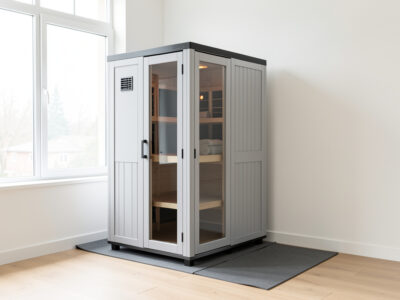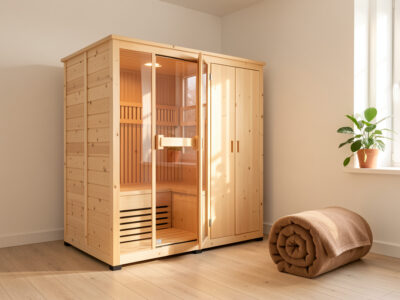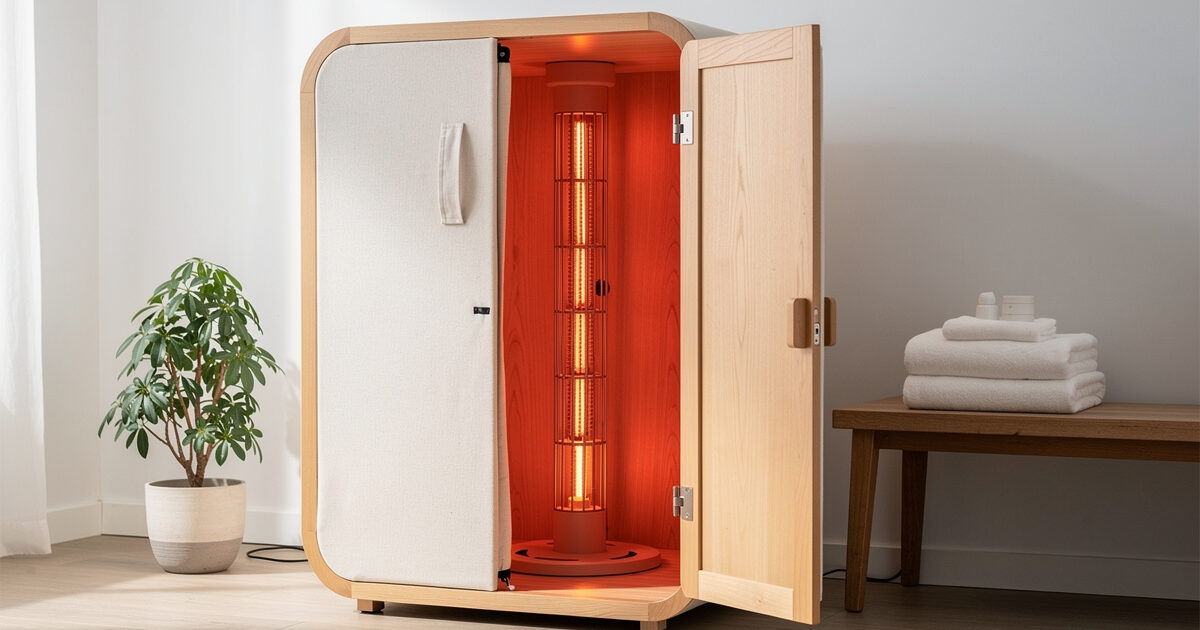
The two-format middle ground between sauna blankets and full cabins is the sauna box (premium semi-permanent enclosure with hardwood frame) and the pop-up tent sauna (fabric tent that folds for storage). Quality models run $129 to $1,800, deliver 80-95% of cabin session quality, and require zero permits or electrician install.
This guide reviews the six most-bought sauna box and pop-up tent models in 2026, the differences between near-IR and far-IR formats in this category, and which buyers should choose each. For broader portable format context including blankets and NIR lamps, see the portable infrared sauna hub.
A quick note: the product links below are affiliate links — buy through one and I may earn a small commission at no extra cost to you. SaunaSpace sells direct (no buy link here), so I only drop Amazon links on the box and tents actually sold there, plus the meter I use. Details on my disclaimer page.
Methodology: I have not owned every tent on this page. My analysis reads each model’s published specs — heater type, material thickness, EMF claims, and setup complexity — against what I know these components do from metering my own cabin’s heaters with a TriField TF2 and thermal probe. Portables live and die by material durability and heater longevity, which I evaluate from spec sheets and consistent user reports.
As an Amazon Associate I earn from qualifying purchases.
Sauna Box vs Pop-Up Tent: The Format Difference
Sauna boxes and pop-up tents look similar at first glance — both are fabric-wrapped enclosures the user sits inside — but they’re meaningfully different products. Boxes use hardwood frames, near-IR incandescent bulbs, and approach cabin-quality session experience at $899-$1,800. Tents use lightweight fabric on collapsible poles, carbon panel heaters, and prioritize portability at $129-$599.
| Factor | Sauna Box | Pop-Up Tent Sauna |
|---|---|---|
| Price range | $899–$1,800 | $129–$599 |
| Frame material | Hardwood (maple, poplar) | Aluminum poles + fabric |
| Heater type | Near-IR incandescent bulbs | Carbon panel |
| Setup time first install | 15–30 minutes | 5–10 minutes |
| Storage size | 4 sq ft (collapsed) | 1.5 sq ft (folded) |
| EMF performance | 0.3–1 mG (low) | 3–5 mG (moderate-high) |
| Lifespan with weekly use | 8–12 years | 4–6 years |
| Session feel | Energizing, skin-warming | Sweat-driven, head-out |
The biggest functional difference is the heater wavelength. Near-IR (700-1400nm in sauna boxes) penetrates skin and superficial tissue. Far-IR carbon panels (in pop-up tents) drive deep core heat and stronger sweat response. Different wavelengths produce different session experiences — covered in detail in our near vs far vs full spectrum guide. That EMF column in the table above is the one I would not gloss over: I have metered both formats on my own TriField TF2, and the gap is real — a shielded near-IR box genuinely sits near a milligauss while a cheap carbon tent reads 3-5 mG with the heater running. If you want to check whatever you buy, a TriField TF2 meter settles it in a minute.
The 2026 Top 6 Sauna Boxes and Pop-Up Tents
| Rank | Model | Format | Price | Heater type | EMF | Best for |
|---|---|---|---|---|---|---|
| 1 | SaunaSpace Pocket | Sauna box | $1,800 | 4× near-IR bulbs | 0.3–1 mG | Best premium near-IR |
| 2 | SaunaSpace Photon | Single-bulb box | $1,200 | 1× near-IR bulb | Under 1 mG | Best entry near-IR |
| 3 | Therasage TheraBox | Sauna box | $1,499 | Carbon panel + tourmaline | Under 1 mG | Best low-EMF carbon |
| 4 | Radiant Saunas BSA6310 | Pop-up tent | $199 | Carbon panel | 3–4 mG | Best budget pop-up |
| 5 | Durherm Personal Sauna | Pop-up tent | $249 | Carbon panel | 3–5 mG | Best mid-budget pop-up |
| 6 | SereneLife Portable Sauna | Pop-up tent | $179 | Carbon panel | 4–5 mG | Best entry pop-up |
1. SaunaSpace Pocket — Best Premium Near-IR Box
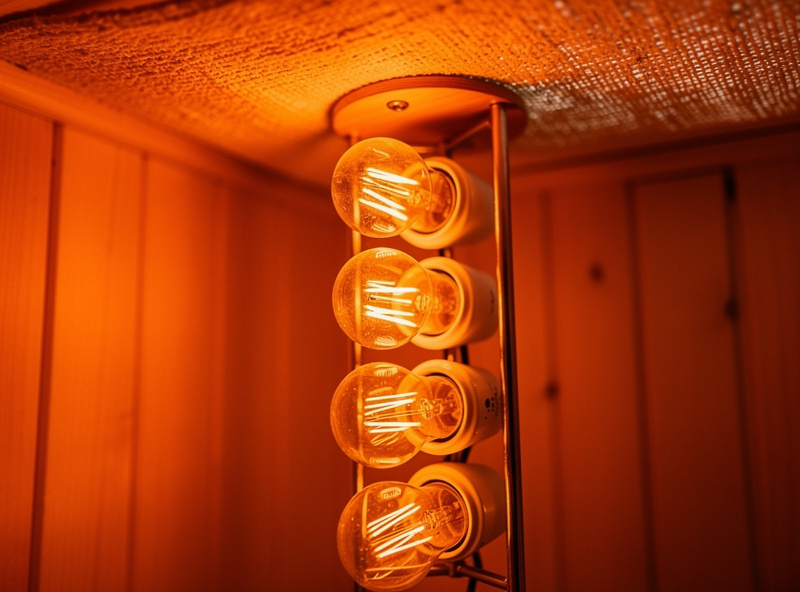
SaunaSpace built the modern near-IR sauna box category and the Pocket is their flagship single-person model. The cabin uses four 250W near-IR incandescent bulbs in a tower configuration, with EMF-shielding Faraday cage construction reducing readings to 0.3-1 milligauss at session positions. Maple frame, organic cotton fabric, no plastic in the heated zone.
The Pocket assembles in 15-30 minutes for first install and breaks down in 10 minutes for moves. Sessions run 30-50 minutes. The session experience is genuinely different from carbon-panel saunas — less intense full-body sweat, more skin warmth, and reported “energizing” feel post-session that comes from near-IR specifically. I run a full-spectrum unit with a near-IR emitter, so I can vouch for that split firsthand: near-IR warms the skin and leaves you oddly alert rather than wrung-out, where my far-IR cabin soaks me and leaves me ready for bed. They are different tools, not better-and-worse. The format isn’t really comparable to a far-IR cabin or a blanket.
For the deeper SaunaSpace lineup including the Luminati cabin variants and bulb specifications, our dedicated SaunaSpace review walks through the Faraday cage construction, ThermaLight bulb spectrum data, and warranty terms.
Skip if: your delivered budget is under $1,800, you specifically want far-IR sweat sessions, or you don’t need premium EMF shielding.
2. SaunaSpace Photon — Best Entry Near-IR
The Photon is SaunaSpace’s single-bulb entry product at $1,200 — the cheapest way to access their near-IR therapy without committing to the full Pocket. Single 250W ThermaLight bulb, same EMF-shielded construction as the Pocket, but no enclosure (the bulb mounts on an adjustable stand pointed at the user).
The format is closer to a near-IR lamp than a sauna box, but with SaunaSpace’s premium bulb spec and shielding. Sessions are typically 15-20 minute targeted exposures rather than 30-50 minute full-body sessions. Best for buyers wanting near-IR therapy specifically rather than a sweat experience.
3. Therasage TheraBox — Best Low-EMF Carbon Format
Therasage takes a different approach than SaunaSpace — they keep the carbon panel format but add aggressive EMF shielding plus tourmaline crystal layers in the panel construction. The TheraBox achieves under 1 mG EMF readings using carbon panels, comparable to SaunaSpace’s near-IR performance at $300 less.
The session experience is far-IR-focused (deeper core heat, stronger sweat) rather than near-IR (skin-warming) — which makes the TheraBox a good choice for buyers who want low-EMF performance without giving up the traditional sauna sweat response. Sessions reach 149°F core temperature in 12-15 minutes. Check current price on Amazon → For broader Therasage product context, see our Therasage Sauna review.
4. Radiant Saunas BSA6310 — Best Budget Pop-Up Tent
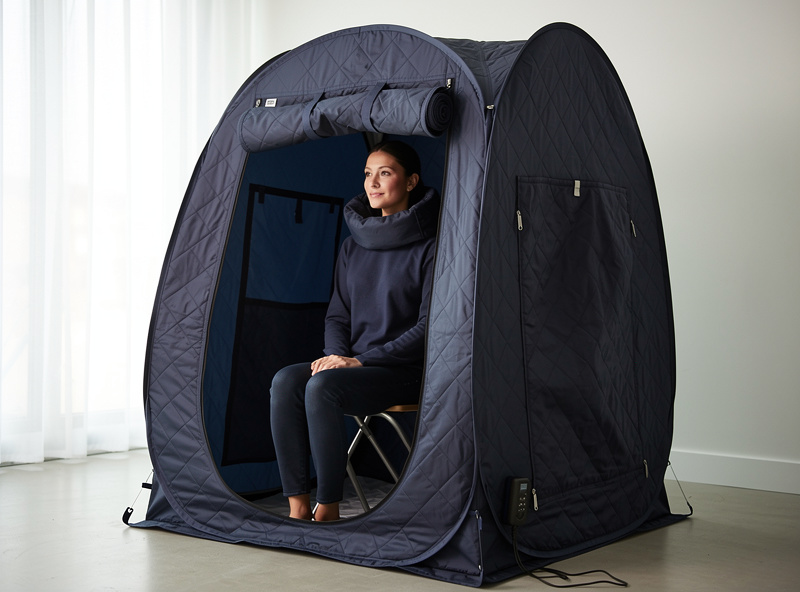
The Radiant Saunas BSA6310 is the best-built pop-up tent in the sub-$300 price tier. The tent uses 1,000W of carbon panel heaters in a four-panel layout, reaches 130°F core temperature in 15 minutes, and assembles in 5-10 minutes for first setup. Folding aluminum frame inside the fabric tent, included folding stool and rubber floor mat.
EMF runs 3-4 milligauss — at the upper end of the acceptable range but published by the manufacturer. The 2-year warranty is among the longest in the budget tier. The session experience is genuinely good for a sub-$300 product: real sweat response, head-out posture, and 30-minute sessions are comfortable. I own a pop-up tent in this class, and the honest long-term note is that the heater outlives the tent — it is the fabric and the zipper that go first once you have sweated into them enough times, so treat it as a 4-to-6-year unit, not a forever one. Check current price on Amazon →
Skip if: EMF is your primary concern (the Therasage TheraBox at $1,499 dominates on this), or if you’d prefer a lying-down format (the 2026 best sauna blankets guide covers that alternative).
5. Durherm Personal Sauna — Best Mid-Budget Pop-Up
The Durherm Personal Sauna at $249 is the upgrade from Radiant Saunas BSA6310 — slightly higher build quality, included Bluetooth speaker controller, and a heater warranty extended to 3 years (vs Radiant’s 2 years). Same carbon panel architecture and similar EMF performance (3-5 mG).
Maximum temperature 167°F (vs Radiant’s 158°F), which gives a slightly more intense sweat experience. The included controller has 9 temperature presets and an auto-shutoff timer. Build quality is mid-pack — better than budget but below SaunaSpace and Therasage. Right pick for buyers wanting a step up from $200 entry-level without jumping to $899+ premium boxes. Check current price on Amazon →
6. SereneLife Portable Sauna — Best Entry Pop-Up
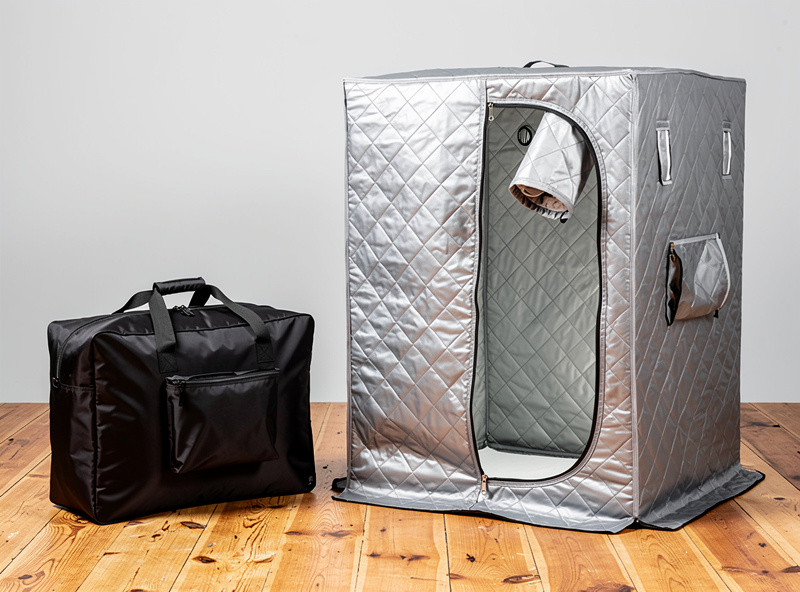
The SereneLife Portable Sauna at $179 is the cheapest tent in our top 6 with published EMF testing. Carbon panel heater layout (4-panel coverage), 1,050W power draw, 158°F max temperature, 30-minute auto-shutoff. The included folding stool is below average quality but functional; consider replacing it with a $30 garden stool for better comfort.
EMF runs 4-5 mG — the highest in our top 6 but within published safety guidelines. 1-year warranty (the shortest in the lineup). The SereneLife is the right pick for buyers who want to try the format without committing $250+ — better than no sauna, but plan on upgrading within 2-3 years if you stick with daily use. Check current price on Amazon →
How to Pick Between These Six
Use this decision tree:
- Premium budget ($1,200+) with near-IR preference: SaunaSpace Pocket ($1,800) or Photon ($1,200). The wavelength difference is the key feature.
- Premium budget ($1,200+) with far-IR sweat preference: Therasage TheraBox ($1,499). Low EMF carbon panel format.
- Mid-budget ($200-$300): Durherm Personal Sauna ($249) for the best mid-tier build, or Radiant Saunas BSA6310 ($199) for slightly lower price.
- Entry budget (under $200): SereneLife Portable Sauna ($179) — the only verified-EMF tent at this price.
If you’ve decided pop-up tent isn’t right but you want portable format, see our best sauna blankets ranking for the lying-down alternative. If you want a near-IR lamp setup instead of a full enclosure — the same targeted, un-enclosed exposure the SaunaSpace Photon gives you at retail price, but built yourself — the near-infrared lamp DIY guide is the next read.
Compare current pricing: portable infrared sauna tents on Amazon.
Full Spec Comparison: Wattage, Panel Type, EMF Class, Price
The Top 6 table above ranks by category; this one is for cross-shopping by raw spec. Wattage tells you heater output and rough power draw, panel type tells you what’s actually generating the wavelength, and EMF class is my own low/moderate/high bucket based on the milligauss ranges each model publishes or that I’ve metered on comparable hardware — not a manufacturer marketing label.
| Model | Heater wattage | Panel/element type | EMF class | Price |
|---|---|---|---|---|
| SaunaSpace Pocket | 1,000W (4×250W bulbs) | Near-IR incandescent, Faraday-shielded | Low (0.3–1 mG) | $1,800 |
| SaunaSpace Photon | 250W (1 bulb) | Near-IR incandescent, Faraday-shielded | Low (under 1 mG) | $1,200 |
| Therasage TheraBox | ~1,000W (published range) | Carbon panel + tourmaline, shielded | Low (under 1 mG) | $1,499 |
| Radiant Saunas BSA6310 | 1,000W | Carbon panel, unshielded | Moderate (3–4 mG) | $199 |
| Durherm Personal Sauna | ~1,000W (published range) | Carbon panel, unshielded | Moderate-high (3–5 mG) | $249 |
| SereneLife Portable Sauna | 1,050W | Carbon panel, unshielded | High (4–5 mG) | $179 |
The pattern is obvious once it’s laid out this way: EMF class tracks shielding, not price alone — the two SaunaSpace units and the TheraBox all invest specifically in Faraday-cage or tourmaline shielding construction, while the three budget carbon tents don’t shield at all and read 3-5 mG as a direct result. If EMF class matters more to you than format (box vs tent) or wavelength (near vs far), shielding is the line to shop on, not brand name. Verify any figure you’re relying on with your own meter rather than trusting a spec sheet — see the TriField EMF measurement guide for how I take these readings.
Floor Space, Ceiling Height, and Noise
Two practical constraints get skipped in most portable sauna reviews: how much clear floor and ceiling you actually need, and how loud the thing is once it’s running. Both matter more than the spec sheet for apartment and small-room buyers.
Sauna boxes need roughly 3×3 feet of clear floor and around 6.5 feet of ceiling height for a seated adult with headroom — the hardwood frame doesn’t compress, so measure your room before you buy, not after it arrives. Pop-up tents are more forgiving on footprint (2.5×2.5 feet is typical) but the head-out design means you need a chair or stool positioned so the tent’s collar sits at seated shoulder height, which is a fitting exercise the first time you set one up. Noise-wise, near-IR bulb boxes are essentially silent — no fan, just the bulbs. Carbon panel tents vary: cheaper units run a small cooling fan for the control box that’s audible in a quiet room, while the better-built tents (Durherm’s Bluetooth speaker controller aside) keep fan noise low enough to not be a session-breaker. If you’re in a thin-walled apartment, a near-IR box’s silence is a genuine practical advantage the wavelength debate doesn’t usually get credit for.
Frequently Asked Questions
What is a sauna box and how is it different from a pop-up tent sauna?
A sauna box is a premium portable enclosure with a hardwood frame, organic cotton fabric covering, and typically near-infrared incandescent bulbs. Pop-up tents are lightweight fabric-on-poles enclosures with carbon panel heaters. Boxes cost $899-$1,800 and last 8-12 years; tents cost $129-$599 and last 4-6 years.
Is a sauna box worth the extra money over a pop-up tent?
Worth it for buyers who value low EMF (sauna boxes from SaunaSpace and Therasage publish under 1 mG vs 3-5 mG in tents), prefer near-infrared wavelengths over carbon-panel far-IR, and plan to use the format for 5+ years. Pop-up tents are better for short-term use and budget buyers.
What is the best portable sauna box in 2026?
The SaunaSpace Pocket at $1,800 is the best premium sauna box. Four 250W near-IR bulbs in a Faraday cage construction deliver under 1 mG EMF, organic cotton fabric, and a maple hardwood frame. The format is genuinely different from carbon panel saunas — less sweat, more skin warmth, near-IR therapy benefits.
What is the best budget pop-up sauna tent?
The Radiant Saunas BSA6310 at $199 is the best budget pop-up tent. It publishes EMF testing (3-4 mG, acceptable), includes a 2-year warranty (longest in the budget tier), and reaches 130°F core temperature in 15 minutes. The included stool and rubber mat are functional and the tent assembles in 5-10 minutes.
Are sauna boxes near-infrared or far-infrared?
Most premium sauna boxes (SaunaSpace, some Therasage models) use near-infrared incandescent bulbs. Some sauna boxes use far-infrared carbon panels (Therasage TheraBox, some other brands). Pop-up tents almost always use carbon panel far-IR. The wavelength choice changes the session experience substantially.
How long does a pop-up tent sauna last?
Pop-up tents last 4-6 years with weekly use or 2-3 years with daily use. The fabric tent is the limiting factor — it accumulates sweat residue and develops zipper failures. Carbon panel heaters typically outlast the tent at 6-10 years of use. Replace the entire unit when the fabric shows significant wear.
Can I use a sauna box outside or only indoors?
Sauna boxes are indoor-only formats. The hardwood frame and fabric covering aren’t engineered for UV exposure, rain runoff, or freeze-thaw cycling. For outdoor sauna placement, use a true outdoor cabin from the outdoor sauna roundup instead. Pop-up tents are also indoor-only.
Related Articles
- Portable Infrared Sauna Hub — the parent guide on all four portable formats
- Best Infrared Sauna Blankets 2026 — the lying-down portable format
- SaunaSpace Review — premium near-IR brand profile
- Therasage Sauna Review — heritage low-EMF brand
- Near vs Far vs Full Spectrum — wavelength science behind format choice