If you live in a flat, rent, or simply do not have a spare corner to lose to a two-person cabin, this portable compact sauna guide is the buying map I wish I had before I started metering small units myself. The short version: a good portable infrared setup runs on a normal 10A wall socket, weighs under 30 kg, and folds or rolls away — but you trade radiant footprint, EMF control, and shoulder coverage for that convenience, and those trade-offs are exactly where most buyers get burned.
I run a 2-person low-EMF far-infrared cabin as my daily driver, but over the winters I have also lived with a full-spectrum unit, a single-person carbon-panel cabin, and a portable sauna tent and blanket kept side by side for the travel-and-small-room comparison. That stable is why I can tell you where a folding unit feels genuinely warm and where it is a marketing sticker on a weak emitter. The polymath honesty up front: the same TriField TF2 and thermal camera I use to map a 3D-print bed are what I point at these portable panels, and the numbers do not lie even when the brochure does.
What “Portable” and “Compact” Actually Mean Here
Portable and compact are not the same claim, and conflating them is the first mistake. Compact means small footprint — a cabin that fits a 1.0 x 1.0 m floor patch but is still a fixed, assembled box. Portable means you can take it down, move it, and store it without tools — tents, blankets, and folding-frame units. A compact 1-person cabin can weigh 70 kg and still be “small”; a sauna blanket weighs 4 kg and stores in a cupboard. Decide which constraint you actually have — floor area, or the need to pack it away — because they push you toward different hardware.
In my setup the dividing line is the wall circuit. Anything that draws under about 1,500 W lives happily on a standard socket, and almost every true portable does, by design. The moment a unit needs a dedicated circuit it stops being “plug-and-play portable” no matter what the listing says. That single number — wattage versus your socket — sorts the field faster than any feature list, and I will come back to it under running cost.
The Five Small-Space Form Factors
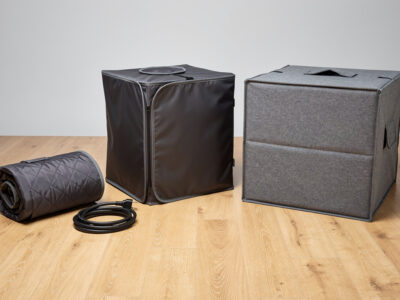
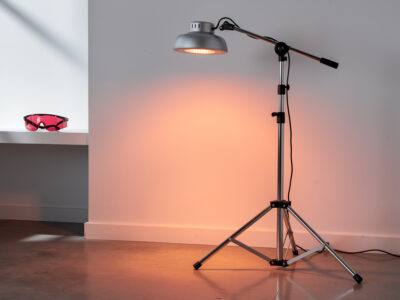
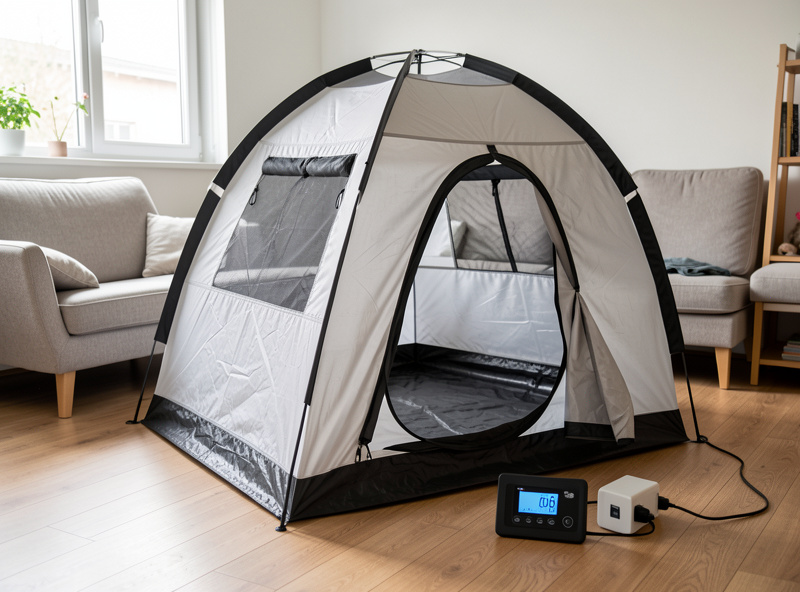
There are really only five shapes the small-space market sells, and each one solves a different problem. A sauna blanket wraps the body and stores flat. A pop-up sauna tent seats you with head out, frame and fabric over a heating element or panel chair. A folding-panel unit gives you carbon panels on a collapsible frame. A 1-person compact cabin is a real wooden box scaled to a single bench. And a closet-sized cabin is a compact cabin specifically dimensioned to slot into an alcove or wardrobe gap. The table below is the comparison I hand people first, drawn from the units I have actually lived with rather than spec sheets.
| Form factor | Typical footprint | Weight | Power draw | Stores away? | EMF control |
|---|---|---|---|---|---|
| Sauna blanket | Body-sized, folds flat | 4-7 kg | 600-900 W | Yes, in a cupboard | Hard — wiring sits against you |
| Pop-up sauna tent | 0.7 x 0.7 m | 8-12 kg | 800-1,300 W | Yes, packs down | Moderate, depends on element |
| Folding-panel unit | 0.9 x 0.9 m | 15-25 kg | 1,000-1,500 W | Partly, folds thin | Good carbon panels possible |
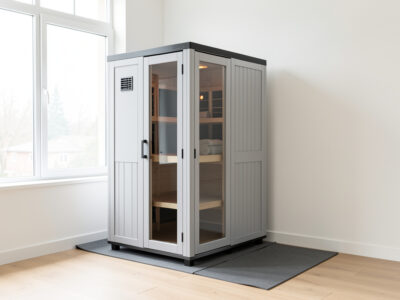
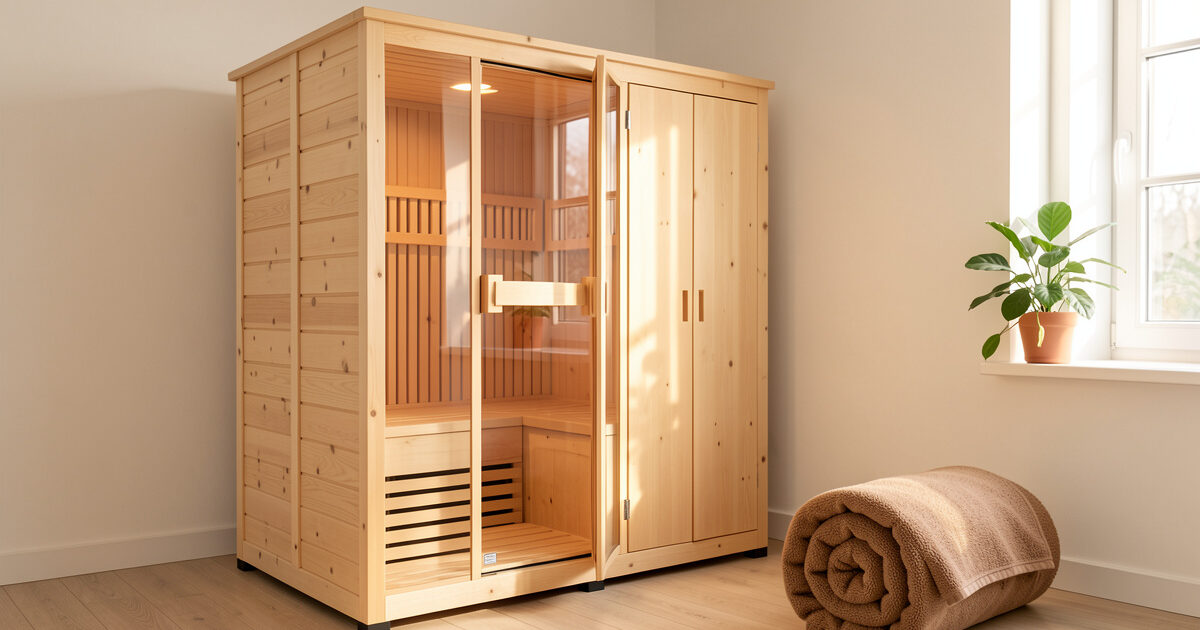
| 1-person compact cabin | 1.0 x 1.0 m | 55-80 kg | 1,200-1,750 W | No, stays put | Best of the small group |
| Closet-sized cabin | 0.9 x 1.1 m alcove fit | 60-90 kg | 1,300-1,800 W | No | Best, full panels |
Notice the pattern: the more portable the unit, the less control you have over the EMF and the radiant footprint, because the heating element has to sit closer to your body to warm you in a small enclosed pocket of air. That is not a flaw you can fix with a coupon — it is geometry. The buying decision is really a slider between “stores away” on one end and “feels like a real sauna with clean fields” on the other. My job here is to help you stop at the right point on that slider for your space.
How I Test a Small Unit: Heat, EMF, and Footprint
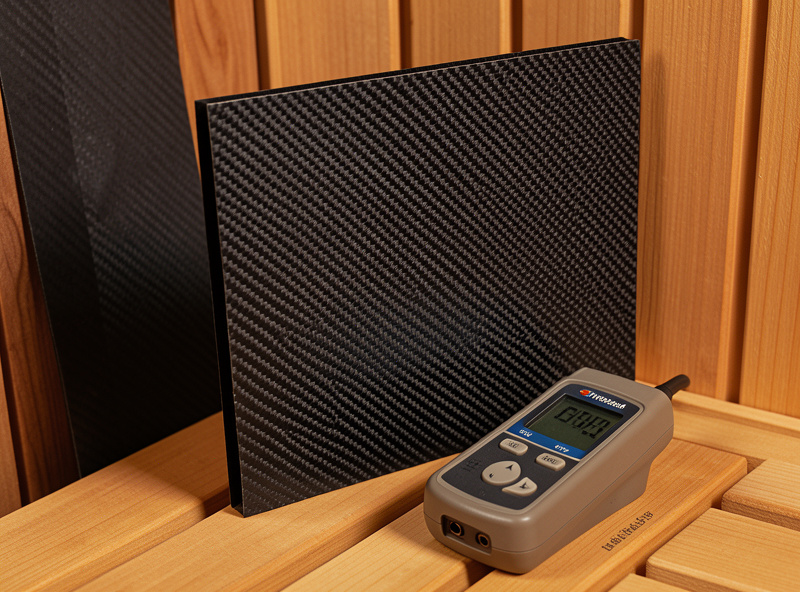
My bench routine for any portable is the same three measurements. First, panel surface temperature with an IR thermometer and a thermal camera, taken at the points your skin actually sits near — for a blanket that is the back and calves, for a tent the chair element. Second, EMF with the TriField TF2 held where your torso rests, logged in milligauss for the magnetic field and V/m for the electric field, because in a portable the wiring is centimetres from you rather than behind a cabin wall. Third, the real footprint with the unit deployed and a person inside, because the listed dimensions never include the swing room you need to actually get in.
What that routine catches that a star rating never will: a tent that ramps to a comfortable felt heat in eight minutes but whose controller throws a magnetic field spike every time the element cycles, or a blanket that reads beautifully cool on the outer shell while the inner wiring layer sits high. I report those numbers per heater type, and you can repeat them — I wrote a full walkthrough on how to measure infrared sauna EMF with a TriField meter so you are not taking my word for it.
Sauna Blankets vs Tents vs Folding Cabins
If you only remember one distinction, make it this one. A sauna blanket is the most portable and the cheapest entry, but it is also the form where your body is closest to the heating layer, so EMF and material quality matter most and you get zero face-out airflow. A tent gives you head-out comfort and packs down, but the seated element heats unevenly and the fabric holds moisture you must dry out. A folding-panel cabin is the sweet spot for people who want carbon-panel radiant heat and clean fields but still need to reclaim the floor — it folds thinner than a real cabin without dropping to blanket-level compromises.
I keep a blanket purely for travel and a tent for the spare-room comparison, and neither replaced my cabin — but for a renter who cannot install anything, a good folding-panel unit is the closest you get to the real thing on a wall socket. I break the blanket field down in detail in the sauna blanket comparison guide, and the folding-frame options in the folding infrared sauna options piece, so this hub stays the map and those stay the detail.
The Renter’s Reality: Power, Floors, and Landlords
Renting changes the whole calculus, and it is the most common situation I get asked about. You cannot pull a dedicated circuit, you cannot drill the wall for ventilation, and you may have to move the whole thing in a year. That rules out anything needing 16A or hardwiring and pushes you hard toward plug-in portables under 1,500 W. It also means you care about floor protection — a portable on a wood or laminate floor wants a mat under it, both for moisture and for the small heat load at the base. I walk through the renter-specific traps, including what a lease actually allows and how to avoid annoying the people downstairs, in the infrared sauna for apartment renters guide.
The honest renter answer is usually a folding-panel unit or a good tent on the existing socket, sited near the consumer unit so you are not daisy-chaining through a thin extension lead. I never run any sauna through a cheap extension — a 1,300 W continuous load wants a heavy-gauge lead or, better, a direct socket, and that is a safety line, not a preference.
EMF in Portable Units — Why the Wiring Sits Closer
This is the section the affiliate-review sites skip because they never put a meter on the thing. In a fixed cabin the heater panels and the controller wiring sit behind benches and walls, often half a metre from your skin. In a portable, the geometry collapses — the element is in the chair you sit on, or the panel is the wall your shoulder leans against, or in a blanket the wiring layer is one fabric layer from your back. Same emitter, far less distance, so the field you actually absorb can be higher even when the hardware is identical.
“Low-EMF” labelling helps, but it describes the panel, not your distance from it, and on a portable distance is the variable you cannot increase. What I look for: carbon panels over bare resistance wire, a controller cord routed away from the seat rather than under it, and a magnetic-field reading at torso height I can live with. If a brand will not publish field numbers for a body-contact product, that silence tells you something. For the deeper engineering, the low-EMF label explainer and the carbon vs ceramic heater breakdown cover why panel type changes the signature, and the hardware behind the near, mid and far bands explains what the wavelengths even are.
Electricity and Running Cost in a Small Footprint
Small units are cheap to run, and that is a genuine advantage worth quantifying. A portable drawing 1,000 W for a 30-minute session uses about 0.5 kWh; even a tent that preheats for ten minutes first rarely tops 0.7 kWh per session. Put a plug-in energy meter on it for a week and you will see the real number rather than the nameplate wattage, which only ever shows the peak. In my session log the portables consistently land well under a full cabin precisely because there is so little air and wood mass to heat.
That low draw is also why they live on a normal socket. I keep a kill-a-watt meter inline on every unit I test and the portables almost never sustain their rated peak — they cycle. If you want the full ownership-economics picture across sizes, including how a compact cabin compares to a full one, the electricity cost breakdown and the complete cost guide run the line items. A basic plug-in power meter is the cheapest test gear you can own — you can find a plug-in kWh meter on Amazon for the price of a couple of takeaways and it pays for itself in clarity.
As an Amazon Associate I earn from qualifying purchases.
Matching a Form Factor to Your Space
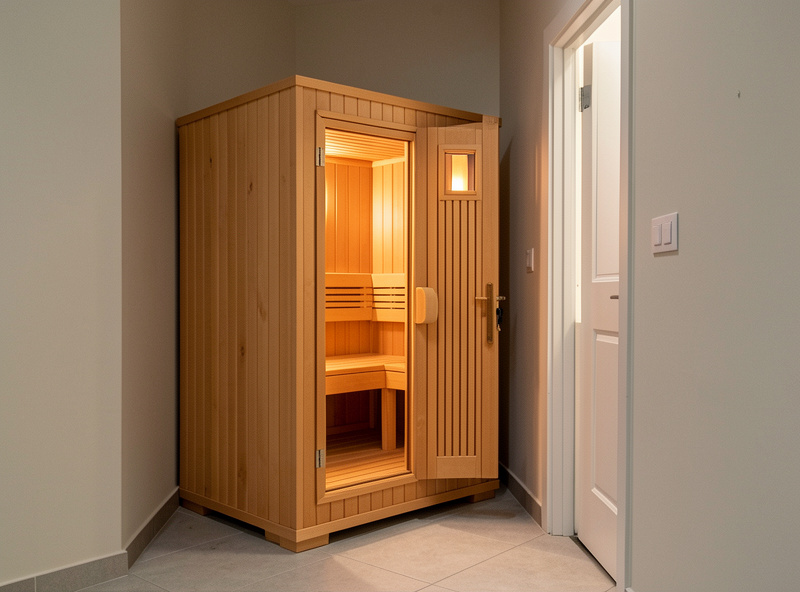
Here is the decision the way I would walk a friend through it. If you have no floor to spare and must pack it away daily, you are choosing between a blanket and a tent — pick the tent if you want head-out comfort, the blanket if storage is the absolute priority. If you have a square metre you can dedicate but still rent, a folding-panel unit is the best balance of real radiant heat and clean fields without installation. If you own the place and have an alcove or a wardrobe-depth gap, a closet-sized or 1-person compact cabin gives you the nearest thing to a full sauna in the smallest honest footprint.
The form factors I would not stretch: do not buy a blanket expecting cabin-like heat, and do not buy a closet cabin expecting to ever move it. Each shape is good at one job. I dig into the single-bench sizing in the 1-person small-footprint guide and the alcove-fit dimensions in the closet-sized options piece. And if you are still weighing whether to go portable at all versus a fixed install, I have a dedicated portable vs fixed buying decision that runs the long-term trade-off.
My Short List by Use Case
Rather than crown one “best,” I sort by the job. For travel and the smallest possible storage, a quality far-infrared blanket — the one category where I would spend up for better materials because it touches your skin. For a renter who wants the real radiant feel on a wall socket, a folding carbon-panel unit. For a small spare room you can dedicate, a 1-person compact cabin with proper panels, which is where the experience finally stops feeling like a compromise. I keep the specific picks in the best portable infrared sauna picks spoke so this hub does not turn into a product catalogue.
Whatever you choose, the first accessory I would add is a meter, not an upgrade. A cheap portable infrared sauna search on Amazon will show you the field, but the gear that actually protects your money is a power meter and, if you go body-contact, an EMF meter to check what you bought. Buy the sauna for the heat; buy the meter so you know what the heat is costing you and what the wiring is doing.
Where a Compact Unit Fits the Bigger Setup
One polymath note, because it genuinely changes how I run mine: a portable still draws real current, and if you are on solar or a smart-home setup it pays to treat it like any other big resistive load. I schedule preheat through the same smart-plug rule engine that runs the grow lights, and on the off-grid side a sauna is a surge load worth sizing for. If that is your world, the smart pre-heat routine and the solar inverter surge sizing pieces cover it, and the VLAN isolation note covers keeping a cheap wellness gadget off your main network. None of that is required to enjoy a portable — it is just where the small unit slots into a bigger house if you have one.
On the wellness side I stay deliberately careful: the heat-and-health research is studied and reported, not something a portable will “do” for you, and I keep this site on the engineering — gear, EMF, install, comfort, and cost — precisely so the buying advice stays trustworthy. Get the form factor right for your space and the rest of the experience follows.
Comfort, Heat-Up Feel, and Materials in a Small Box
The thing nobody warns you about with a small enclosure is how differently the heat feels. In my 2-person cabin the radiant heat surrounds you and the air mass buffers the swings; in a tent or a 1-person box the panels are right there, so you feel the ramp more sharply and you notice every cold spot. That is why panel placement matters more in a compact unit, not less — a single back panel with nothing on the calves leaves your lower legs cool while your shoulders cook. When I map a small cabin with the thermal camera, the uneven units show up instantly as a hot band across the bench-back and a cold floor.
Materials are the other quiet variable. Most compact cabins use Canadian hemlock or basswood; the cheap end uses thin ply that off-gasses a plastic-glue smell on the first few heat cycles. I run any new wooden unit empty at temperature for a couple of sessions with the vent open before I sit in it, which clears most of that. For tents and blankets the fabric and the inner liner are what you live against, so that is where I would not cheap out. None of this changes the health story — I treat the studied wellness side as exactly that, studied — but it absolutely changes whether you enjoy sitting in the thing, which is the only reason to own one. Set temp versus felt heat, ventilation, and a sane beginner ramp are covered in the session guide, the temperature breakdown, and the beginner schedule.
Frequently Asked Questions
Can a portable infrared sauna run on a normal wall socket?
Yes. Almost every true portable draws between 600 and 1,500 watts, which a standard 10A socket handles. The line to watch is whether a unit needs a dedicated circuit; the moment it does, it stops being plug-and-play portable regardless of the listing.
Is a sauna blanket or a folding cabin better for a small flat?
A blanket stores in a cupboard and is cheapest, but the wiring sits against your body so EMF and materials matter most. A folding carbon-panel cabin gives real radiant heat and cleaner fields while still reclaiming floor space, which makes it the better balance for most renters.
Why is EMF higher in portable saunas than in fixed cabins?
Geometry. In a fixed cabin the panels and wiring sit behind benches half a metre away. In a portable the element is in the chair, the panel, or one fabric layer from your back, so the same emitter delivers a higher field simply because it is closer to you.
How much electricity does a portable infrared sauna use per session?
A portable drawing about 1,000 watts for a 30-minute session uses roughly 0.5 kWh; with a short preheat, rarely above 0.7 kWh. They cost less to run than a full cabin because there is far less air and wood mass to heat. A plug-in power meter shows your real number.
What is the smallest footprint that still feels like a real sauna?
A 1-person compact cabin at about 1.0 by 1.0 metres is where the experience stops feeling like a compromise, because it uses full carbon panels rather than a single seated element. Below that, tents and blankets trade radiant footprint for storability.
Do I need a meter to buy a portable sauna?
Not to buy, but it is the first accessory I would add. A plug-in energy meter shows real kWh per session, and for any body-contact unit an EMF meter confirms what the wiring is doing at torso height. Both cost little and turn marketing claims into numbers you can check.