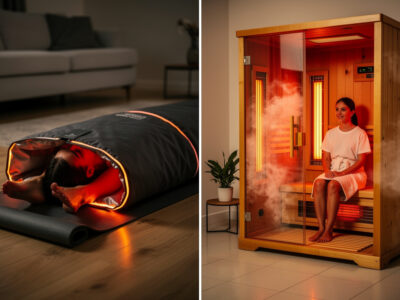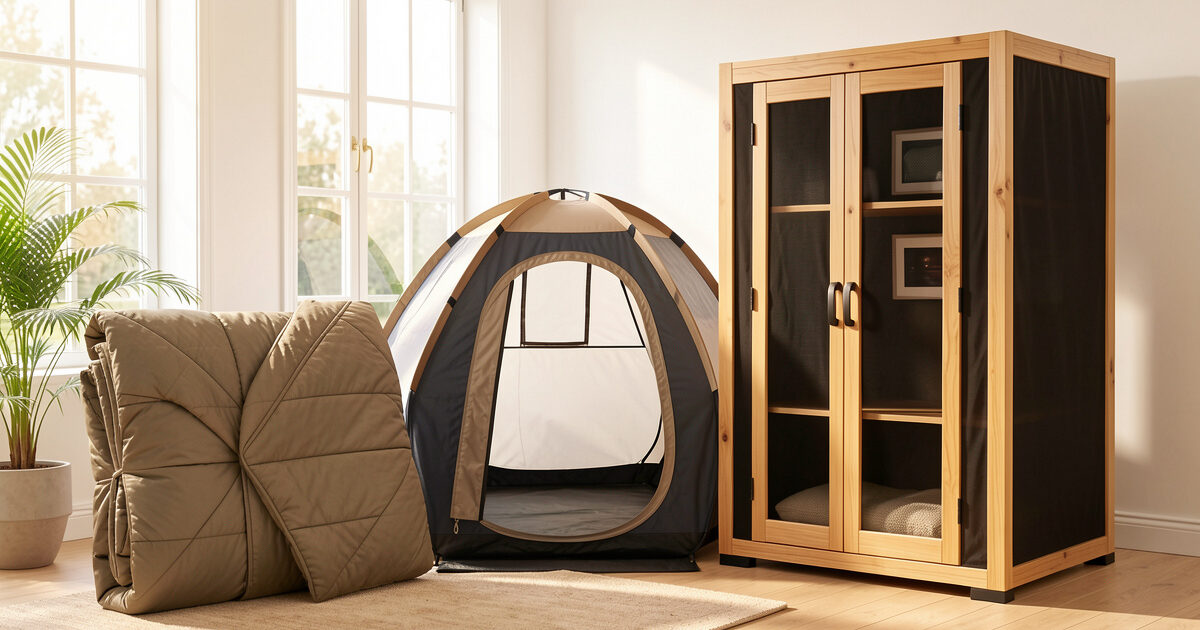
The best portable infrared sauna is not a single product — it is whichever form factor matches your space, your socket, and how much you care about the EMF reading at your back. After living with a blanket, a tent, and a folding carbon-panel unit through Swedish winters alongside my fixed cabin, my honest answer sorts into three category winners rather than one crowned model, because a blanket and a folding cabin solve completely different problems.
I am going to give you my picks by job, what separates a good unit from a gimmick in each class, and the one number — wattage against your wall socket — that quietly decides whether a “portable” sauna is actually portable. This sits under my portable compact sauna guide, which maps all the small-space form factors if you are not sure which class you even want.
How I Judge a Portable Worth Buying
Three things decide it for me, in order. First, does it run on a normal socket — anything over roughly 1,500 W stops being plug-and-play and needs a dedicated circuit, which defeats the point. Second, what is the EMF at body distance, because in a portable the heating element sits centimetres from you rather than behind a cabin wall, so the magnetic field you actually absorb can be higher than a big cabin’s even with identical panels. Third, does the heat feel even, or does one panel cook your shoulders while your calves stay cool.
Star ratings never capture any of that. I put a TriField TF2 at torso height and a thermal camera on the panels, and that is what separates my picks — not the listing copy. If you want to repeat the field test yourself, I wrote the full method in how to measure infrared sauna EMF with a TriField meter.
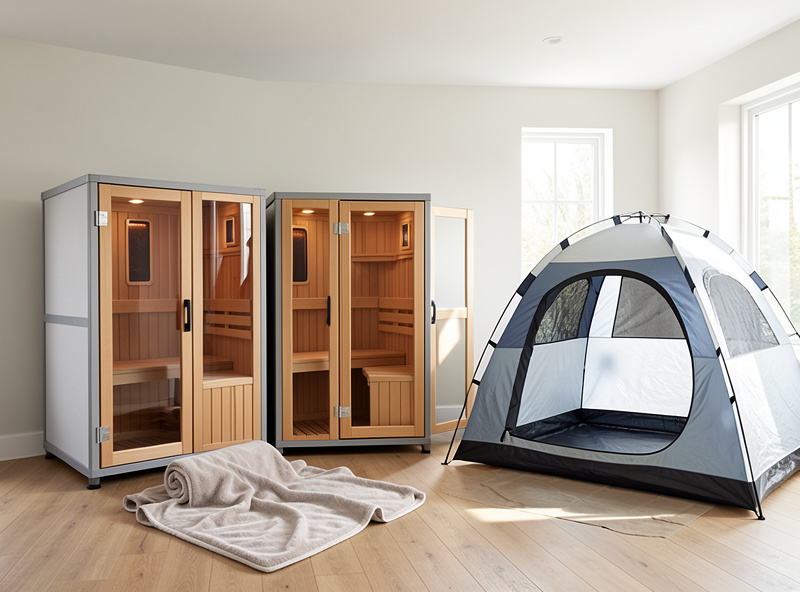
Best for Travel and Smallest Storage: A Far-Infrared Blanket
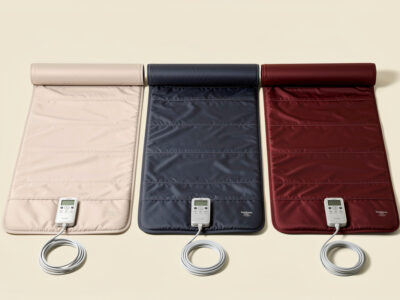
If storage is the absolute priority and you want something that lives in a cupboard, a far-infrared sauna blanket is the pick — and it is the one category where I would spend up rather than save, because the heating layer touches your skin. A good blanket draws 600 to 900 W, heats in well under ten minutes, and folds to the size of a rolled yoga mat. The compromises are real: no airflow, your body is closest to the wiring, and a cheap inner liner is unpleasant against bare skin.
What I look for: a low-EMF carbon heating layer rather than bare resistance wire, a wipe-clean medical-grade inner liner, and a controller cord that exits away from your torso. The materials matter more here than in any other form. I break the whole class down in the sauna blanket comparison guide. If you are shopping, start from an infrared sauna blanket search and filter hard on the liner and the field claims.
Best for Renters Who Want Real Radiant Heat: A Folding Carbon-Panel Unit
This is my pick for the largest group of people — renters and small-flat owners who want the actual radiant-cabin feel without installing anything. A folding carbon-panel unit puts proper carbon panels on a collapsible frame, runs on a wall socket at 1,000 to 1,500 W, and folds thin enough to slide behind a sofa or wardrobe. You get head-out comfort, far cleaner fields than a blanket because the panels can sit a sensible distance away, and a footprint around 0.9 x 0.9 m when deployed.
The things that separate a good one: genuine carbon panels (not a single seated element pretending to be a sauna), a controller that does not throw a field spike each time it cycles, and a frame that actually holds the fabric taut so the heat does not leak. This is the closest a plug-in unit gets to my fixed cabin. The full class is in folding infrared sauna options, and the renter-specific traps — leases, floors, neighbours — are in the apartment renter guide.
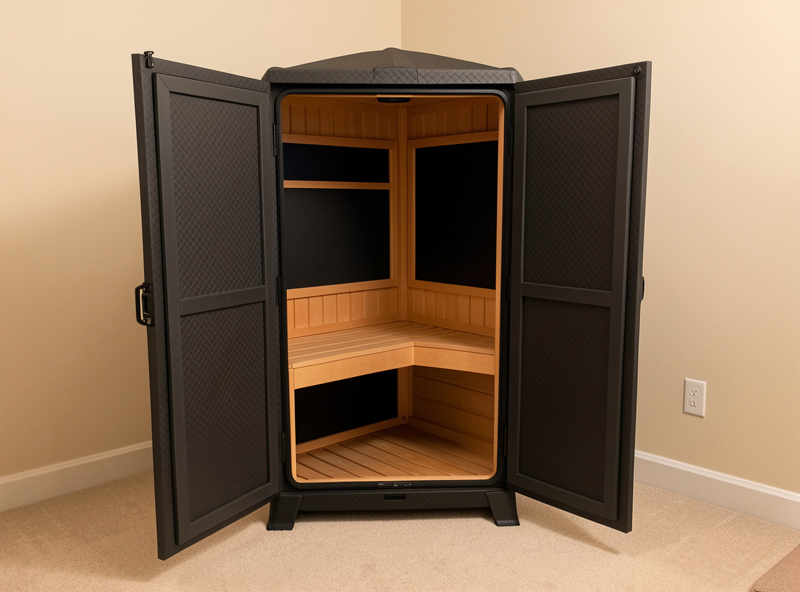
Best If You Can Dedicate a Square Metre: A 1-Person Compact Cabin
If you own the space or can give up a permanent square metre, a 1-person compact wooden cabin is where the experience stops feeling like a compromise. Real hemlock or basswood walls, full carbon panels front and back, and an enclosed air pocket that holds heat the way a tent never will. It is not portable in the pack-away sense — 55 to 80 kg, assembled and staying put — but it is “compact” in footprint and it is the best small heat you can buy short of a full two-person box.
Here the differentiators move toward build quality: panel coverage on the calves and not just the back, a low-EMF wiring routing you can verify, and wood that does not off-gas a glue smell for a month. I cover the single-bench sizing in the 1-person small-footprint guide and the alcove-fit version in closet-sized options.
The Picks Compared
| Pick | Best for | Power draw | Footprint | EMF at body | Stores away? |
|---|---|---|---|---|---|
| Far-infrared blanket | Travel, tiny storage | 600-900 W | Folds flat | Highest — touches you | Cupboard |
| Pop-up tent | Head-out on a budget | 800-1,300 W | 0.7 x 0.7 m | Moderate | Packs down |
| Folding carbon-panel | Renters wanting real heat | 1,000-1,500 W | 0.9 x 0.9 m | Low if panels sit back | Folds thin |
| 1-person compact cabin | Dedicated square metre | 1,200-1,750 W | 1.0 x 1.0 m | Lowest of the group | No |
The pattern is the slider I keep coming back to: the more it stores away, the closer the heat sits to you and the harder the EMF is to control. Pick the row that matches your real constraint — storage, socket, or floor — and you will not regret it.
What I Would Skip
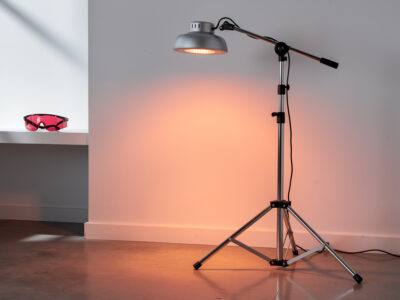
I would skip any “full-spectrum portable” sticker that turns out to be one weak near-infrared bulb bolted to an otherwise ordinary far-infrared box — the wavelength claim is doing marketing work the hardware does not back up. I would skip ultra-cheap tents with a bare-wire foot heater and no published field numbers, because a body-contact product whose maker will not state an EMF reading is telling you something by omission. And I would skip anything rated above your socket’s capacity that quietly expects a dedicated circuit, unless you are ready to wire one.
None of these picks is a health device, and I will not pretend otherwise — the heat-and-recovery research is studied and reported, not a result a blanket delivers. Buy the form factor that fits your space and your socket, verify the field if it touches you, and the rest follows. A quick portable infrared sauna search on Amazon shows the field at every price; the table above tells you which row to trust.
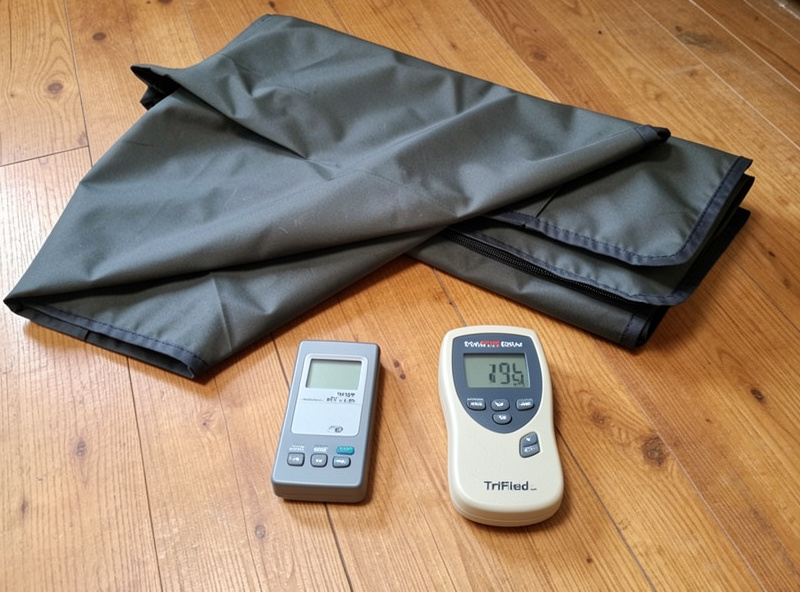
The Accessories Worth Buying With It
Whatever class you land on, two cheap tools change the deal more than any upgrade. A plug-in energy meter tells you the real kWh per session instead of the nameplate peak — mine consistently shows the portables cycling well under their rated wattage, landing around 0.5 kWh for a half-hour blanket session. And for any body-contact unit, an EMF meter turns a marketing claim into a number you can live with or return. Those two cost less than a single accessory bundle and they are the only “accessories” that tell you the truth about what you bought.
Past that, keep it simple: a moisture mat under a unit on wood or laminate, a towel layer you can wash, and electrolytes for after a longer session so you are replacing what you sweat — comfort and hydration, not a protocol. I run the kWh numbers across sizes in the electricity cost breakdown, and what “low-EMF” labelling actually changes is in the low-EMF explainer.
As an Amazon Associate I earn from qualifying purchases.
Frequently Asked Questions
What is the best portable infrared sauna overall?
There is no single best — it depends on your constraint. For travel and tiny storage, a far-infrared blanket; for renters wanting real radiant heat on a wall socket, a folding carbon-panel unit; for a dedicated square metre, a 1-person compact cabin. Match the form to your space and socket.
Do portable infrared saunas need special wiring?
Most do not. True portables draw 600 to 1,500 watts and run on a standard 10A socket. Only larger compact cabins approach the point of wanting a dedicated circuit. If a unit is rated above your socket’s capacity, it is no longer plug-and-play portable.
Are portable infrared saunas as good as a fixed cabin?
For heat evenness and EMF control, a fixed cabin still wins because the panels sit further from your body. A folding carbon-panel unit gets closest among portables. The trade you make is footprint and storability against radiant footprint and clean fields.
Is a sauna blanket worth it or a gimmick?
A good far-infrared blanket is genuinely useful for travel and minimal storage, but it is the form where your body is closest to the wiring, so material and EMF quality matter most. Spend up on the liner and field claims; the cheap end is where it becomes a gimmick.
How do I check a portable sauna’s EMF myself?
Hold a TriField TF2 at torso height where you would sit, with the unit running, and read the magnetic field in milligauss and the electric field in volts per metre. Body-contact products deserve this check most, because distance is the one variable you cannot increase.