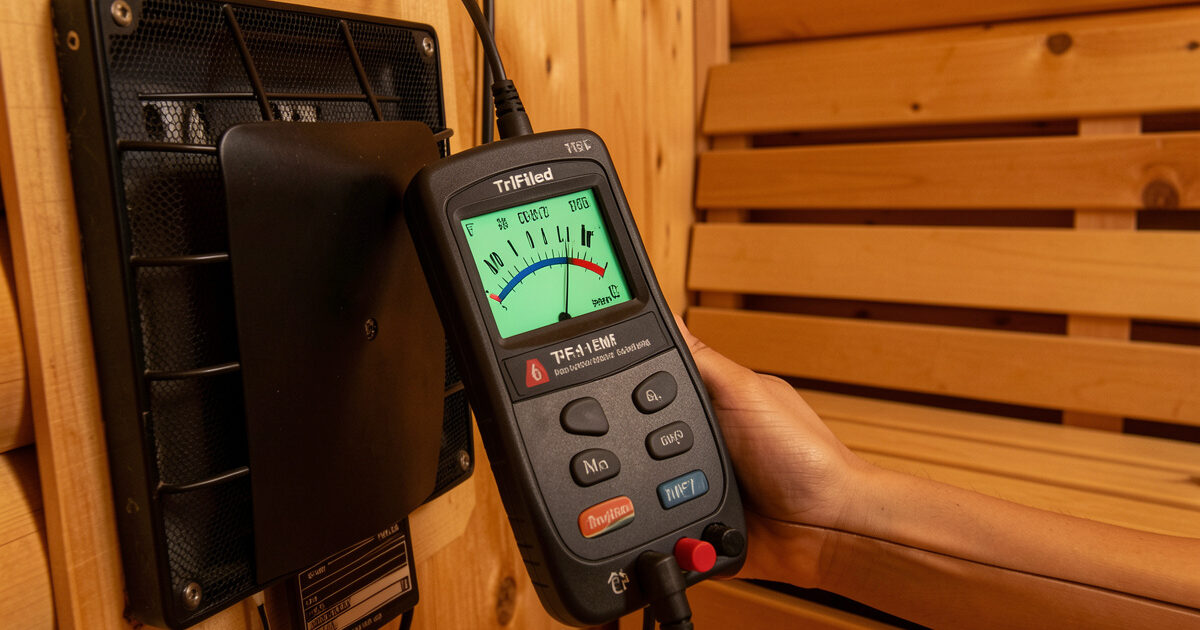
Almost nobody who reviews infrared saunas actually meters them. They quote the brand’s “low-EMF” claim, maybe show a stock photo of a meter, and move on. I do the boring thing instead: I put a TriField TF2 on the panels of every cabin I’ve owned and read the numbers at the seat. It costs the price of a meter and twenty minutes, and it tells you more about a sauna’s engineering than any spec sheet. Here’s exactly how I do it, what each reading means, and how to interpret what you see — framed as the measurement exercise it is, not a health scare.
First, the three things you’re actually measuring
“EMF” is a sloppy catch-all. There are three distinct quantities, they come from different places, and a good meter reads them on different settings. Lump them together and you’ll misread everything.
- Magnetic field (milligauss, mG): generated by current flowing through the heater elements and wiring. This is the reading “low-EMF” heater design is mostly aimed at.
- Electric field (volts per metre, V/m): present around any energised conductor whether or not much current is flowing. Heavily influenced by grounding and shielding.
- Radio frequency (RF): from the controller, any wireless/Bluetooth module, or a phone you carry in — generally not from the heaters themselves.
The single most important thing to understand before you start: most of the field inside a cabin comes from the wiring and the controller, not from the infrared emission. You are measuring the electrical system, not the “infrared rays.” Keep that straight and the readings make sense.
The meter I use, and a cheaper cross-check
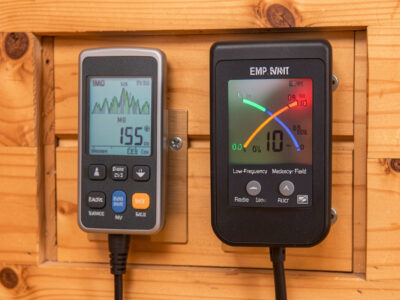
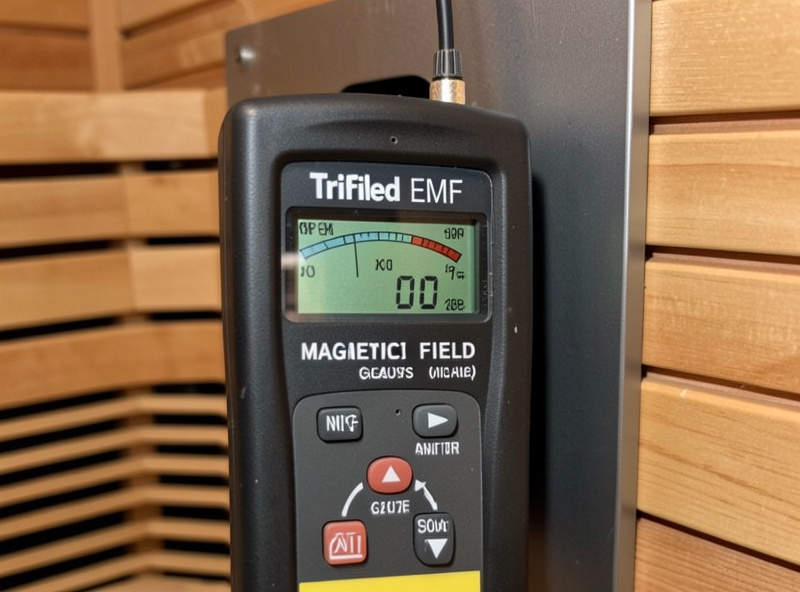
My main meter is a TriField TF2 — it switches between magnetic, electric, and RF modes, which is exactly what you need to separate the three quantities above. As a sanity check I keep a cheaper acoustimeter-style RF meter to confirm the RF readings independently; when two different meters agree, I trust the number. You don’t need lab gear. A single switchable meter that reads all three field types at the seat is enough to tell a well-engineered cabin from a badly wired one.
One honest caveat: cheap single-axis magnetic meters can under-read depending on how you hold them relative to the field. A three-axis meter (or carefully rotating a single-axis one to find the maximum) avoids that trap. This is the kind of detail that separates a real measurement from a number someone made up — orientation matters, and the meter has to be held right.
Step by step: how I meter a cabin
Here’s the routine, in order, and it takes about twenty minutes:
- Meter the empty room first. Before powering the sauna, read the background field where the cabin sits. House wiring, a nearby breaker panel, or an adjacent appliance can contribute, and you want to know the baseline so you don’t blame the sauna for the house.
- Power the cabin and let it reach working heat. Current draw — and therefore the magnetic field — is highest when the heaters are actually running, so measure hot, not cold.
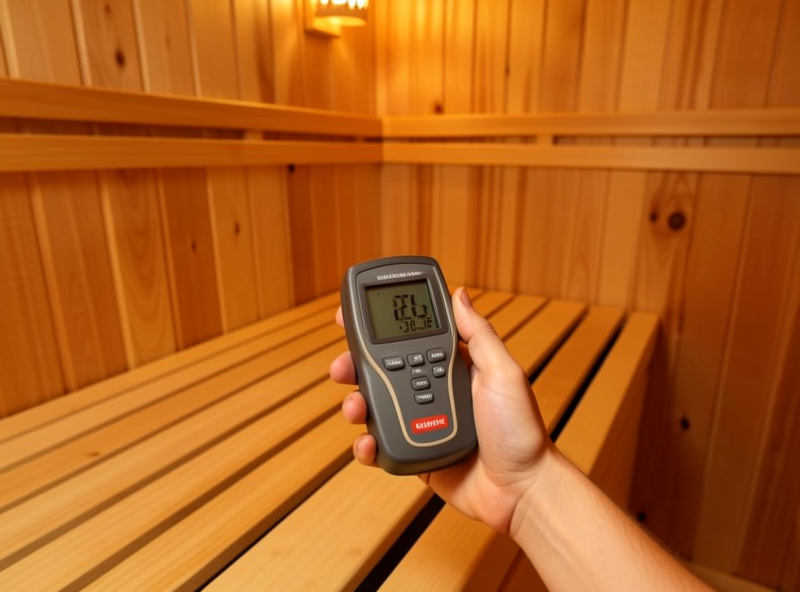
- Read at the seat, at body positions. This is the whole game. Take the magnetic reading where your back, torso, and head actually sit, at the distance you actually sit — not pressed against the panel. The field falls off fast with distance, so the panel-face number is meaningless for how you’ll use the cabin.
- Switch to electric-field mode and repeat at the seat. Electric field responds strongly to grounding; a poorly grounded cabin reads high here even if the magnetic number is fine.
- Switch to RF mode and read with the controller running, any Bluetooth audio on, and your phone where you’d set it. This usually reveals the controller and your own devices as the loudest RF source — not the heaters.
- Map the panels. Run the meter across each panel to find any hotspot, then step back to the seat distance and confirm how much it drops. This tells you whether a single panel or its wiring is an outlier.
The pattern I see every time: readings are highest at the panel face, drop sharply as you move to the seat — which is also why correct wattage sizing and panel placement matter so much; see infrared sauna heater wattage and placement for the full setup guide, and the wiring path and grounding move the numbers far more than the emitter chemistry does. A “low-EMF” cabin that’s properly wired reads dramatically lower at the seat than a bargain unit with lazy wiring — and you can only know which you’ve got by measuring.
What’s a “reasonable” reading?
I won’t hand you a single magic milligauss number, and you should distrust anyone who does without stating the distance and field type. The reading depends entirely on which field you’re measuring and how far from the panel you are. What I can give you is the interpretation framework I use:
- Always compare at the seat, never the panel face. A scary panel-face number that collapses to almost nothing at the seat is normal physics, not a problem.
- Watch the drop-off rate. In a well-engineered cabin, the field falls off fast over a hand’s width. A field that stays stubbornly high as you move away suggests the wiring, not just the panel, is the source.
- Separate the sources. If your RF jumps the moment Bluetooth and your phone come on, that’s your devices — switch them off and the “sauna EMF problem” often disappears.
- Compare like with like. The most useful number is relative: meter two cabins the same way and the difference tells you which is better-engineered, even without an absolute standard.
EMF exposure limits are a contested, jurisdiction-specific topic, and I’m describing measurement, not setting a safety threshold — that’s genuinely outside what a sauna owner should be asserting. What I can tell you with confidence is the engineering: where the field comes from, how to read it, and what reduces it.
What you do with the numbers
Metering isn’t just diagnosis — some of what you find is fixable. If the electric-field reading is high, check grounding; a properly grounded dedicated circuit is one of the biggest levers on that number, and it’s an electrical-install issue covered in the installation requirements guide. If RF is the problem, it’s almost always the controller, the Bluetooth module, or your phone — switch them off or leave the phone outside. For a deeper look at how ELF and RF emissions differ and which matters more in a sauna, see the ELF vs RF sauna EMF breakdown. If a single panel is a magnetic outlier, that’s worth raising with the manufacturer. The point of measuring is that it turns a vague worry into specific, mostly-addressable findings.
And if you’re still shopping rather than diagnosing, the best move is to buy from a brand that publishes its own measured readings at a stated distance — that’s a brand taking the engineering seriously, and it saves you metering blind. For a full buyer’s guide to what genuine low-EMF design looks like, see low-EMF infrared sauna: what actually matters. The deeper engineering picture of where the field originates is in the heater and EMF guide, and the brand comparison notes who actually publishes their numbers.
The bottom line
Metering an infrared sauna is the single most useful thing an owner can do that no review site bothers to. Buy a switchable meter, read magnetic, electric, and RF separately, always compare at the seat rather than the panel face, and remember you’re measuring the electrical system, not the infrared. Do that and “is this sauna low-EMF?” stops being a marketing question you have to take on faith and becomes a number you generated yourself — which is exactly how it should be. For the heater-by-heater context behind these readings, the carbon vs ceramic breakdown explains why the wiring, not the emitter chemistry, drives most of what you’ll measure.
How do you measure infrared sauna EMF?
Use a switchable meter such as a TriField TF2 that reads magnetic field in milligauss, electric field in volts per metre, and RF separately. Meter the empty room first for a baseline, then power the cabin to working heat and read at the seat at the distance you actually sit — not at the panel face. Read magnetic, electric, and RF in turn, with the controller and any Bluetooth on for the RF check.
What EMF meter is best for an infrared sauna?
A meter that switches between magnetic, electric, and RF modes, such as a TriField TF2, because the three fields come from different sources and must be read separately. A three-axis magnetic reading is better than single-axis, which can under-read depending on orientation. A second cheaper RF meter is a useful cross-check — when two meters agree you can trust the number.
Why measure at the seat instead of the panel?
Because the field falls off rapidly with distance, the panel-face reading is far higher than what reaches your body and does not reflect how you use the cabin. The only meaningful number is at the seat, at the distance you actually sit. A scary panel-face reading that collapses to almost nothing at the seat is normal physics, not a fault.
Where does the EMF reading come from in a sauna?
Magnetic field comes from current through the heater wiring, electric field from energised conductors and grounding, and RF from the controller, any wireless module, or a phone you bring in — not from the infrared emission itself. You are measuring the electrical system, not the rays. Wiring routing and grounding move the numbers more than the emitter chemistry.
Can I reduce the EMF I measure in my sauna?
Some of it. High electric-field readings often improve with proper grounding on a dedicated circuit. High RF is usually the controller, Bluetooth module, or your phone — switch them off or leave the phone outside. A single panel reading as a magnetic outlier is worth raising with the manufacturer. Metering turns a vague worry into specific, mostly addressable findings.