Infrared sauna “spectrum” just means which infrared wavelengths a cabin actually emits, split into three engineering bands: near (roughly 0.7–1.4 µm), mid (1.4–3 µm), and far (3 µm and longer). On my meter and my thermal camera, those bands behave like completely different tools, and most of what gets sold as “full spectrum” is one band doing the heavy lifting.
I run a low-EMF far-infrared cabin as my daily driver, a separate full-spectrum unit with a near-infrared halogen emitter, a carbon-panel single, and a portable tent for travel — all in one Swedish home install. After enough winters metering each one, I stopped reading the brochure wattage and started reading the spectrum, because that single number tells you where the heat lands, how the panel ramps, and how much EMF the thing throws. This guide is the engineering map: what each band is, what hardware produces it, how deep it actually goes, and how to measure your own cabin instead of trusting a sticker.
What “Infrared Spectrum” Means in a Sauna
Infrared is the slice of the electromagnetic spectrum between visible red light (about 0.7 µm) and microwaves (about 1 mm). The sauna industry borrows the CIE optical-radiation split: IR-A (near) is 0.7–1.4 µm, IR-B (mid) is 1.4–3 µm, and IR-C (far) runs from 3 µm out past 1000 µm. Worth knowing the competing convention: the ISO 20473 scheme draws the lines differently (near 0.78–3 µm, mid 3–50 µm, far 50–1000 µm), so when two brochures disagree about where “mid” starts, they’re often just citing different standards.
For a buyer, the practical takeaway is that a cabin’s spectrum is set entirely by its heaters. The wood, the glass, the seat height — none of that changes the wavelengths. The emitter material and its surface temperature do, and they do it predictably. That predictability is why I treat spectrum as an engineering spec, not a wellness adjective. If you want the hardware-first version of this, my guide to near, mid and far infrared heaters walks the physical emitters; this page is the wavelength science behind them.
The Three Bands, Measured by Hand
Each band comes from a different emitter running at a different surface temperature, and you can predict the peak wavelength with Wien’s law (peak µm ≈ 2898 ÷ surface temperature in kelvin). That one equation explains every spectrum claim you’ll ever read.
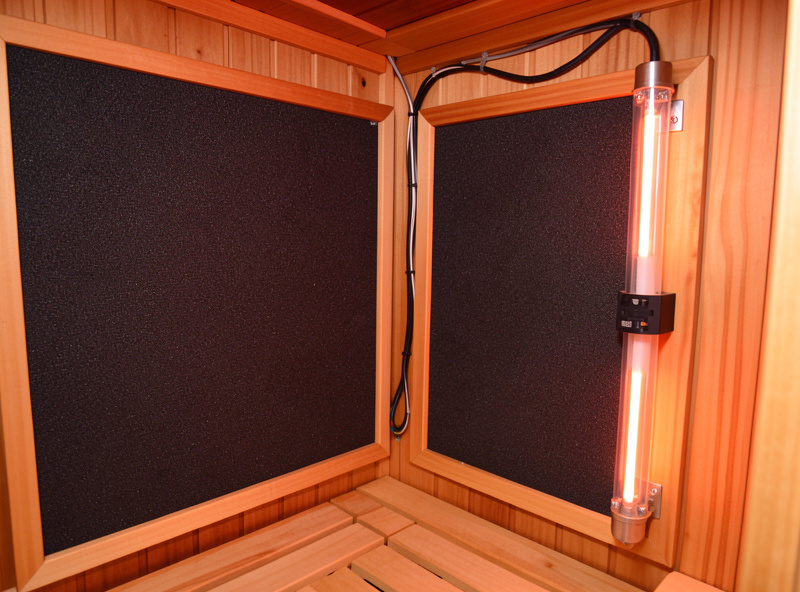
Near-infrared (0.7–1.4 µm) comes from a glowing incandescent or halogen filament running hot — 2000 K and up. Plug 2200 K into Wien’s law and the peak lands near 1.3 µm, squarely in the near band. On my thermal camera a NIR emitter reads off the top of the scale because the quartz tube is genuinely incandescent; you see a visible red-orange glow. It ramps in seconds.
Mid-infrared (1.4–3 µm) is the in-between band you rarely get as a dedicated emitter. It shows up as the tail of a hot ceramic rod or the leading edge of a near-infrared bulb as it warms. A ceramic element at roughly 300–400°C peaks around 4–5 µm, so its output straddles the upper mid and lower far bands rather than sitting cleanly in mid. I cover why a true mid band is hard to buy in the mid-infrared wavelength guide.
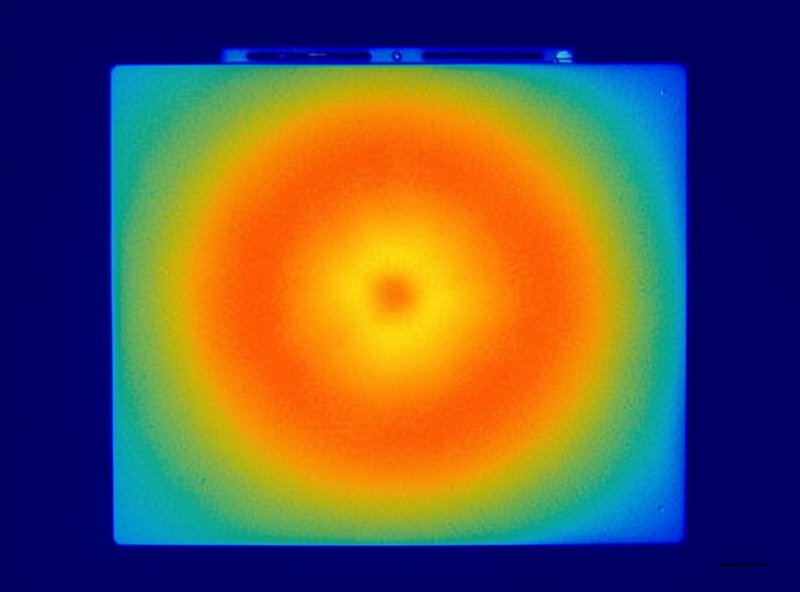
Far-infrared (3 µm and up) is what almost every cabin sauna actually runs. A carbon panel sits around 80–95°C on my IR thermometer; 365 K through Wien’s law gives a peak near 7.9 µm — deep in the far band, invisible, gentle, and large-area. This is the workhorse, and it’s why my daily-driver cabin feels like radiant warmth rather than a heat lamp.
Carbon, Ceramic, and Hybrid: How the Material Sets the Band
The emitter material is the lever that sets a cabin’s spectrum, because material dictates the surface temperature the element can hold, and surface temperature dictates the wavelength. Three materials cover almost everything you’ll meet in a home unit, and I’ve pulled and metered all three.
Carbon-fiber panels are large, thin, and run cool — typically 80–95°C across a big radiating face. That low, even surface temperature is what puts them deep in the far band and gives the gentle, wrap-around warmth I get from my daily driver. Because the heat is spread over a wide area at low current, carbon is also the easiest material to keep low on the EMF meter. The downside is ramp: a big cool panel takes ten minutes or more to come up to temperature, which is why I run a smart plug to preheat before I ever open the door.
Ceramic rods run hotter and smaller — 300–400°C concentrated in a coil or rod. That pushes their peak shorter, into the upper-mid and lower-far overlap, so a ceramic cabin feels more intense and more pointed than a carbon one at the same air temperature. It also ramps faster. Hybrid panels mix carbon and ceramic to chase the best of both: the broad far footprint of carbon with a faster, slightly hotter ceramic contribution. My carbon/ceramic hybrid daily driver is exactly that compromise. None of these touch the near band — for that you need a genuinely incandescent emitter, which is a different animal entirely. The full material teardown lives in the carbon vs ceramic comparison.
How Full-Spectrum Hardware Actually Works
“Full spectrum” is a hardware claim, not a magic mode. A genuine full-spectrum cabin pairs large far-infrared carbon or carbon/ceramic panels (the bulk of the radiant footprint) with one or more dedicated near-infrared emitters — usually halogen tubes mounted on the front wall. The far panels do the steady, full-body warming; the NIR emitter adds a hot, directional spot you face for part of the session.
Here’s the trap I check for on every unit: a cheap “full spectrum” sticker often means a single 150–300 W near-infrared bulb bolted to an otherwise ordinary far-infrared cabin. One small emitter can’t flood a cabin with near-infrared — it’s a spotlight, and you only get the near band on the few centimeters of skin pointed at it. Whether that’s worth the premium is the whole question in my is full-spectrum worth it breakdown. The honest engineering answer: full spectrum is real, but the dose of near-infrared is far smaller and far more localized than the marketing implies.
Penetration Depth: The Claim Everyone Gets Backwards
The most repeated spectrum myth is that far-infrared “penetrates 1.5 inches into the body.” Physically, it’s the opposite. Skin and tissue are mostly water, and water’s absorption of infrared is the controlling factor. Water absorbs far-infrared (7–10 µm) extremely strongly, so that energy is deposited in roughly the first 0.1 mm — the very surface. Near-infrared around 0.8–1.1 µm hits water’s transmission window, where absorption is lowest, so it actually travels several millimeters before being absorbed.
So near-infrared penetrates deeper than far-infrared, full stop — that’s optics, not opinion. The reason a far-infrared cabin still warms your whole body is convective and conductive spread from heated skin and heated air, not deep radiant penetration. I unpack the absorption curves and what “depth” really buys you in the penetration depth guide. Keeping this straight is the fastest way to spot a vendor who doesn’t understand their own product.
Spectrum and EMF Are Linked
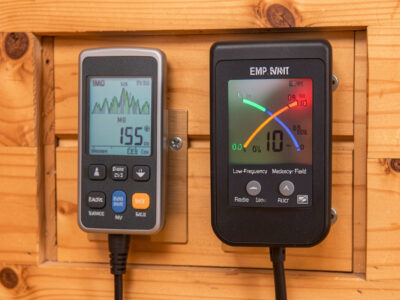
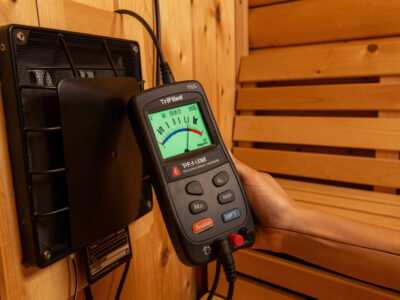
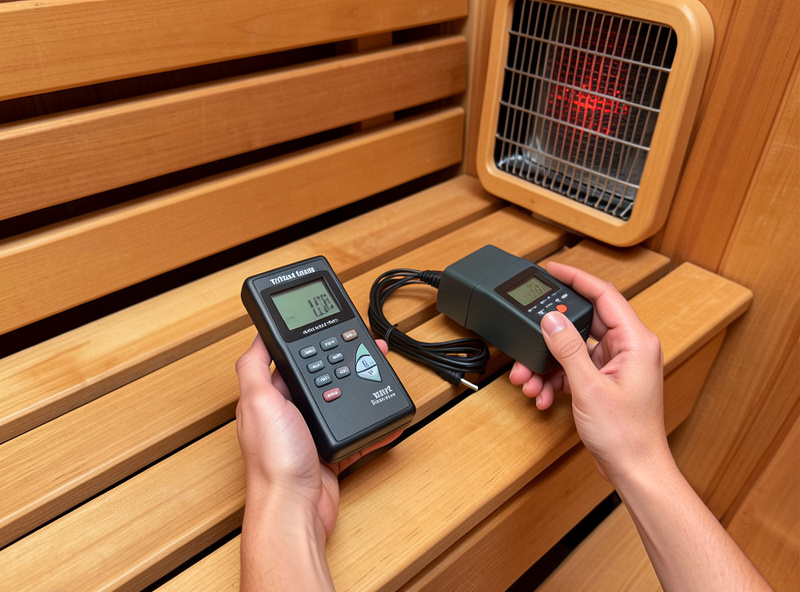
The band a heater produces is tied to how it’s built, and how it’s built drives its electromagnetic field. On my TriField TF2, large low-current carbon far-infrared panels with sensibly routed wiring read low — often a milligauss or two at seat distance once the wiring is dressed away from your back. Near-infrared halogen emitters draw more concentrated current through a small element and tend to read higher right at the tube, though the field falls off fast with distance.
This is why “low-EMF” and “full-spectrum” can pull against each other: adding a hot NIR emitter adds a localized field source the all-far-infrared cabins don’t have. None of that is inherently a problem — it’s a measurement question, and I’d rather know the number than guess. The full method is in my low-EMF label guide and the ELF vs RF breakdown, and the band-by-band metering lives in measuring your sauna’s spectrum.
Spectrum Bands Compared
| Property | Near (0.7–1.4 µm) | Mid (1.4–3 µm) | Far (3 µm and up) |
|---|---|---|---|
| Typical emitter | Halogen / incandescent tube | Ceramic rod (tail) | Carbon or carbon/ceramic panel |
| Emitter surface temp | 2000 K+ (glowing) | ~300–400°C | ~80–95°C |
| Wien’s-law peak | ~1.1–1.4 µm | ~4–5 µm (straddles) | ~7–9 µm |
| Felt heat | Hot, directional spotlight | Warm, narrow | Gentle, large-area |
| Ramp time | Seconds | 1–2 minutes | 10–15 minutes preheat |
| EMF tendency (on my TF2) | Higher at the tube | Moderate | Low with good wiring |
| Where you find it | Full-spectrum units, NIR lamps | Rarely standalone | Almost every cabin |
Near-Infrared, Red Light, and the Overlap
Near-infrared sits right next to visible red light on the spectrum, which is why red-light panels and NIR sauna emitters get conflated. They overlap at the edge: deep red is around 0.63–0.67 µm and near-infrared photobiomodulation panels run roughly 0.8–0.85 µm and 0.85–0.94 µm. A sauna’s halogen NIR emitter is a broadband heat source; a red/NIR LED panel is narrowband and barely warm. They are different hardware aimed at different jobs, and stacking them is a real setup decision, not a gimmick.
I keep a separate LED red/NIR panel and use it independently of the heat — the engineering of running both is in combining NIR and red light, and the “are these the same thing” question is settled in red light vs infrared sauna. The short version: same neighborhood of the spectrum, very different emitters and intensities.
What the Spectrum Costs to Run
Spectrum also shows up on the electricity bill, and it’s the line most buyers never run. My far-infrared daily driver pulls around 1.6 kW once warm; on my kill-a-watt a 40-minute session including preheat lands near 1.0–1.3 kWh. A full-spectrum unit with an added halogen emitter draws more during the near-infrared phase because that filament is power-hungry for its size. Carbon far panels are the efficiency champ per unit of felt warmth because they run cool and large.
If you’re sizing a circuit, the spectrum choice matters: a full-spectrum cabin with a high-wattage NIR emitter is the one most likely to need its own 20A line. I run mine on a dedicated 16A circuit with GFCI; the numbers and wiring are in the installation guide and the running-cost math is in electricity cost per session.
Spectrum Myths I Stopped Believing After Metering
Living with four units and a TriField turns marketing copy into testable claims, and several popular ones don’t survive contact with the meter. The “deeper penetration” myth I already covered — near beats far, not the reverse. Here are the others I check buyers out of.
“More wattage means more infrared benefit” is wattage gaming. Wattage is electrical power drawn, not spectrum quality or even radiant output; a 2.5 kW cabin packed with cheap heaters can deliver a worse, patchier radiant field than a well-designed 1.6 kW carbon cabin. I trust the thermal camera’s cold-spot map over the wattage number every time. “Full spectrum heats you faster” is half-true: the near-infrared emitter feels hot on facing skin almost instantly, but the cabin air and the far panels still take their normal ten-minute ramp. And “low-EMF means no EMF” is marketing shorthand — every powered heater produces some field; low-EMF means the builder engineered the wiring and panel layout to keep it down, which you confirm with a meter, not a sticker. The label-versus-reality gap is the whole subject of my low-EMF guide.
The throughline is that spectrum, EMF, and felt heat are all measurable, and the measurement almost always tells a more modest story than the brochure. That’s not a knock on infrared cabins — I own four — it’s the reason I’d rather sell you a meter than a wellness promise.
Preheat and Ramp Change With the Spectrum
Spectrum even reshapes how you run a session. A far-infrared carbon cabin needs a real preheat — I give mine 12 to 15 minutes before I sit, because the panels themselves have to reach temperature before the radiant field is steady. There’s no shortcut; a cool panel emits at a longer wavelength and lower intensity until it’s up to temperature. This is the single most common beginner complaint (“it doesn’t feel hot”) and it’s almost always an impatience-with-ramp problem, not a faulty cabin.
A near-infrared emitter is the opposite: it’s incandescent in seconds, so a full-spectrum cabin gives you instant directional heat the moment you flip the NIR tubes on, even while the far panels are still warming. I treat the two phases separately in my own session log — far panels for the steady body warmth, the NIR emitter switched in for a portion of the sit when I want the hot, facing spotlight. Either way the comfort routine is the same: set temp is a target, felt heat is what matters, and hydration with electrolytes makes a longer sit far more comfortable. The session mechanics that go with each spectrum are in the broader full-spectrum band explainer.
How to Read a Spec Sheet for Spectrum
When I evaluate a cabin’s spectrum claim, I ignore the adjectives and look for four things. First, the emitter type and count — carbon panels (far), ceramic rods (mid/far), halogen tubes (near). Second, the wattage of any near-infrared emitter, because a 150 W bulb and a 500 W emitter are not the same product. Third, whether “full spectrum” means dedicated NIR hardware or just a warm ceramic element relabeled. Fourth, published EMF figures and the distance they were measured at — a number with no distance is meaningless.
Everything downstream of those four facts is predictable physics. A cabin built on large carbon far panels will run gentle, ramp slowly, and meter low. A unit leaning on near-infrared will feel hotter on the skin it faces, ramp fast, and read higher near the emitter. The marketing can’t change the wavelengths; the hardware sets them, and the hardware is on the spec sheet if you know what to read. For the deepest emitter teardown see the heater types and EMF engineering guide and the carbon vs ceramic comparison.
Choosing a Spectrum for Your Use
There’s no single best band — there’s the band that matches what you want from the cabin. If you want a calm, even, whole-room warmth on a low EMF budget, an all-far-infrared carbon cabin is the straightforward pick and the one I reach for most. If you specifically want a hot, directional near-infrared element to face, full spectrum earns its premium only when the NIR emitter is genuinely powerful, not a token bulb. If you’re chasing the red/near-infrared edge of the spectrum specifically, a dedicated LED panel does that job better and cooler than any sauna emitter.
Match the spectrum to the use, verify it with a meter rather than a brochure, and size the circuit for the real draw. That’s the whole discipline. The deeper comparisons — near vs far infrared, NIR panels vs a full cabin, and the original three-type overview — break each decision down further, and the full-spectrum band explainer covers what each band brings to a session.
Frequently Asked Questions
What are the three infrared bands in a sauna?
Near-infrared (0.7 to 1.4 micrometers), mid-infrared (1.4 to 3 micrometers), and far-infrared (3 micrometers and longer). The sauna industry uses the CIE optical split; ISO 20473 draws the lines differently, which is why brochures sometimes disagree on where mid begins.
Which infrared wavelength penetrates the deepest?
Near-infrared around 0.8 to 1.1 micrometers penetrates deepest because it sits in water’s low-absorption window and travels several millimeters. Far-infrared at 7 to 10 micrometers is absorbed in the first 0.1 millimeter of skin, the opposite of the common marketing claim.
Is full-spectrum infrared better than far-infrared?
Not automatically. Full spectrum adds a near-infrared emitter to a far-infrared cabin, but a token 150 watt bulb delivers little near-infrared. Far-infrared carbon panels handle whole-body warmth efficiently; full spectrum only earns its premium when the near-infrared emitter is genuinely powerful.
What produces each infrared band?
Surface temperature sets the band via Wien’s law. A glowing halogen filament above 2000 kelvin peaks near 1.3 micrometers (near), a ceramic rod near 300 to 400 Celsius straddles mid and far, and a carbon panel near 85 Celsius peaks around 8 micrometers (far).
Does spectrum affect EMF readings?
Yes. Large low-current carbon far-infrared panels with tidy wiring read low on my TriField TF2, often one to two milligauss at seat distance. Near-infrared halogen emitters concentrate current through a small element and read higher at the tube, though the field falls off quickly with distance.
Can I measure my sauna’s spectrum at home?
You cannot read exact wavelengths without a spectrometer, but you can infer the band. An IR thermometer gives emitter surface temperature, which Wien’s law converts to a peak wavelength, and a TriField meter shows the EMF signature each emitter type produces.
Related Guides
- Near Infrared vs Far Infrared: The Real Difference
- Is a Full-Spectrum Infrared Sauna Worth It?
- Infrared Wavelength Penetration Depth
- Mid-Infrared Wavelength in Saunas
- Measuring Your Infrared Sauna Spectrum
- Near, Mid and Far Infrared Heaters
As an Amazon Associate I earn from qualifying purchases. If you want to read your own panels, a TriField TF2 EMF meter and a basic infrared thermometer are the two tools that turn a spectrum brochure into measured fact.