Red light and infrared sauna are NOT the same thing. Red light therapy uses LEDs at specific visible-light wavelengths (typically 660nm red and 850nm near-infrared) that target skin cells and mitochondria. Infrared saunas use far-infrared heat at 4-14 microns to raise core body temperature and trigger sweat. The two technologies overlap in name only — they target different biological mechanisms with different equipment.
This guide clarifies the differences across wavelength, mechanism, equipment, and outcome. For broader category coverage, see our red light sauna hub and the near vs far vs full spectrum guide.
As an Amazon Associate I earn from qualifying purchases.
The Quick Answer
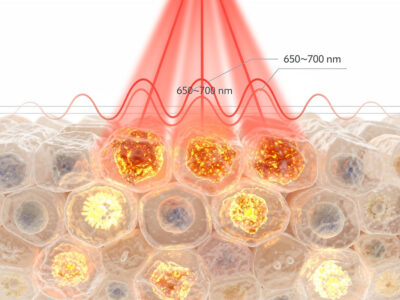
Red light therapy uses LED panels emitting at specific peak wavelengths (660nm red and 850nm near-infrared). The light penetrates 1-50mm into skin and tissue, activating cellular targets like cytochrome c oxidase in mitochondria. Used for skin, joint, and recovery protocols. Does not produce heat or sweat.
Infrared sauna uses carbon panel or ceramic heaters emitting in the far-infrared range (4-14 microns wavelength). The radiation heats the body surface, raising core temperature and triggering sweat. Used for cardiovascular adaptation, recovery, and relaxation. Does not target specific cellular wavelengths.
Red light sauna combines both technologies in one cabin — a far-infrared sauna with added 660nm/850nm LED panels. Delivers both therapies in a single 30-45 minute session.
Head-to-Head Comparison
| Factor | Red Light Therapy | Infrared Sauna |
|---|---|---|
| Primary technology | LEDs (660nm + 850nm) | Carbon panel or ceramic heaters |
| Wavelength range | 620-900nm (visible to near-IR) | 4-14μm (far-IR) |
| Heat output | Minimal — LEDs stay cool | High — cabin reaches 130-150°F |
| Sweat response | None | Strong |
| Penetration depth | 1-50mm into tissue | Surface heating only |
| Primary target | Skin cells, mitochondria, joints | Core body temperature, cardiovascular |
| Session length | 10-20 minutes | 30-45 minutes |
| Equipment cost (home) | $300-$2,500 (panel) | $1,800-$8,500 (cabin) |
| Documented outcomes | Skin, joint, recovery | Cardiovascular, sweat-driven detox, relaxation |
| Eye protection needed | Yes (direct LED exposure) | No |
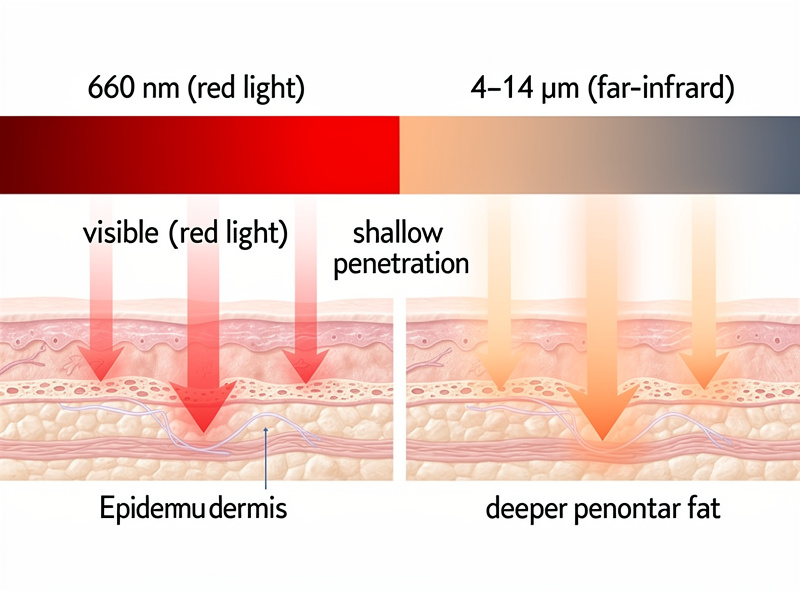
Why the Wavelength Difference Actually Matters
The wavelength difference between red light therapy and infrared sauna isn’t a marketing distinction — it’s the fundamental biological mechanism. Light at different wavelengths interacts with tissue differently because biological molecules absorb specific frequencies and ignore others.
660nm red light is absorbed by chromophores in skin cells and mitochondria. The energy gets transferred to specific cellular processes — collagen synthesis, ATP production, anti-inflammatory signaling. The light itself doesn’t significantly heat the tissue; the energy goes into biochemistry rather than thermal motion.
4-14 micron far-infrared, by contrast, is absorbed by water molecules in skin. The absorbed energy converts directly to heat (water molecule vibration), warming the surface tissue and triggering sweat. The heat then triggers downstream cardiovascular and recovery responses through normal heat-shock pathways.
Different absorbers, different mechanisms, different outcomes. The two therapies aren’t substitutes for each other — they target different goals.
Equipment Differences
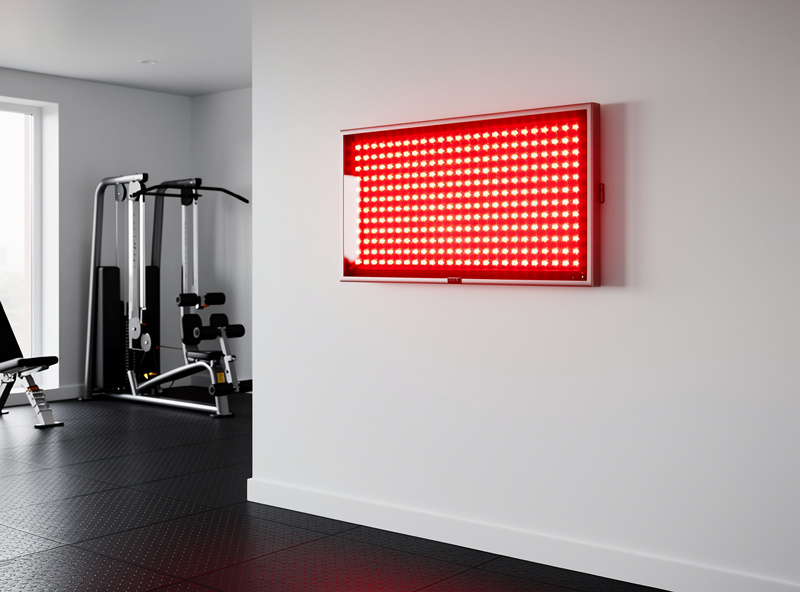
Red light therapy equipment is dramatically different from infrared sauna equipment despite the marketing overlap.
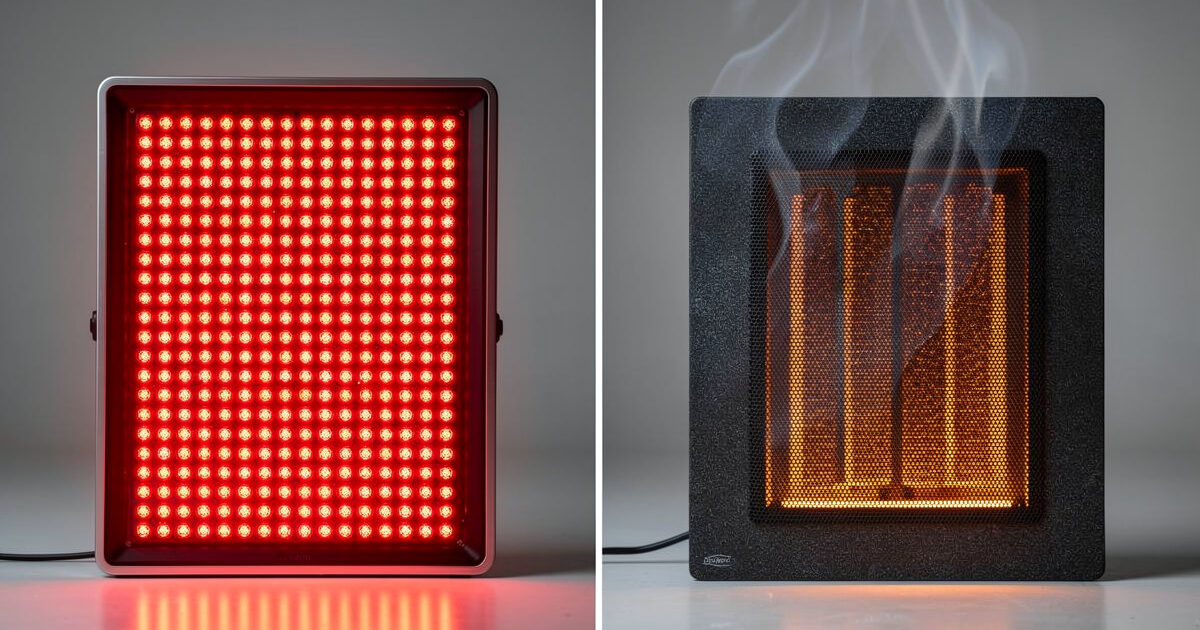
Red light therapy panels are flat LED arrays mounted on stands or walls. Brand examples include Joovv, PlatinumLED, Mito Red Light, and BIOMAX. Equipment characteristics:
- Hundreds of individual LEDs in a flat panel array
- Specific peak wavelengths (typically 660nm and 850nm)
- Irradiance measured in mW/cm² (target 30-100 at panel surface)
- Cool to the touch — no significant heat output
- Sessions typically 10-20 minutes per body region
- Eye protection required during sessions
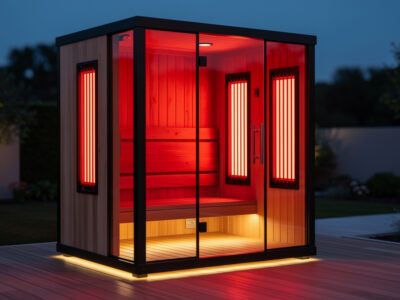
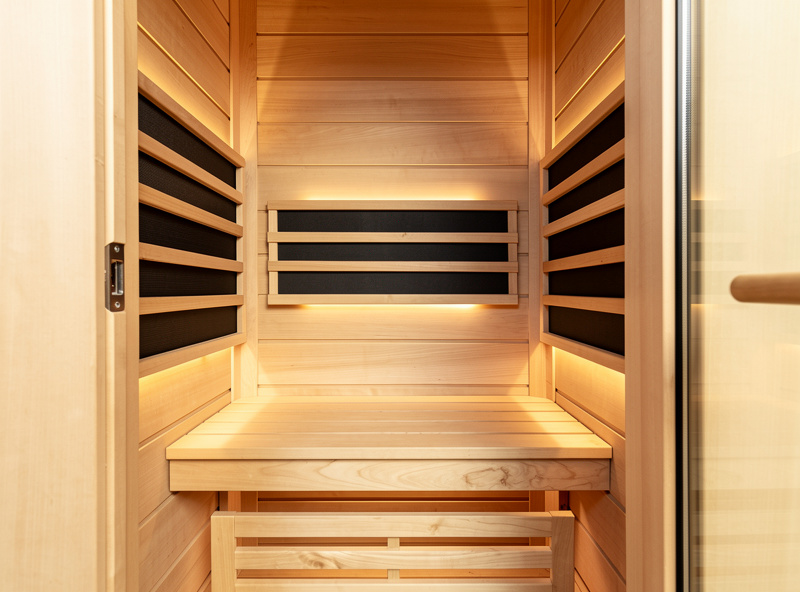
Infrared sauna cabins are enclosed wood structures with heater panels emitting far-infrared. Brand examples include Sunlighten, Clearlight, Sun Home, Health Mate, HigherDose. Equipment characteristics:
- Carbon panel or ceramic rod heaters along cabin walls
- Far-infrared wavelength range 4-14 microns
- Cabin temperature 120-150°F during sessions
- Strong heat output drives sweat response
- Sessions 30-45 minutes for full body coverage
- No eye protection required
The “red light sauna” combines both equipment types in one cabin — the infrared cabin shell with added LED panels mounted on a wall. Detailed in our red light sauna hub.
When to Use Each Therapy
Pick red light therapy alone if your goals are:
- Skin and collagen outcomes (anti-aging, acne, scars)
- Targeted joint pain relief on specific knees, shoulders, hips
- Post-workout recovery on specific muscle groups
- Lower budget ($300-$2,500 panel vs $1,800+ cabin)
- Apartment or small space without room for a cabin
If apartment space is the actual constraint but you still want the heat side occasionally, an infrared sauna blanket is the one full-body-heat format that packs away in a closet — it won’t give you the LED wavelengths, but it solves the space problem a cabin can’t.
Pick infrared sauna alone if your goals are:
- Sweat-driven detox and relaxation experience
- Cardiovascular adaptation and blood pressure improvement
- Heat-shock protein response and longevity protocols
- Traditional sauna social or solo relaxation experience
- Multi-person household sessions
Pick a red light sauna (combined) if you want both therapies in a single product without buying separate equipment. The integrated cabin saves space and simplifies session protocols at premium-tier pricing ($4,800-$8,500).
Cost Comparison
| Approach | Equipment cost | Session frequency | Best for |
|---|---|---|---|
| Red light panel only | $300-$2,500 | 3-5 sessions/week | Targeted therapy goals, apartment dwellers |
| Infrared sauna only | $1,800-$8,500 | 3-5 sessions/week | Heat and sweat goals, relaxation |
| Both as separate products | $2,100-$11,000 | 3-5 sessions/week of each | Both goal sets, space available |
| Red light sauna integrated | $4,800-$8,500 | 3-5 sessions/week combined | Both goals in single product |
For broader cost analysis including running costs and ROI, see our infrared sauna at home cost guide. The integrated red light sauna often delivers better long-term value than separate products for users who actually use both therapies regularly. For session-length, dose-by-wavelength, and weekly frequency guidance on red light alone, see our red light therapy protocol.
Common Confusion Points Cleared Up
Three persistent confusion points deserve direct answers:
- “Aren’t infrared saunas just red light therapy?” No. Infrared saunas use far-infrared wavelengths (invisible to the eye) that produce heat. The cabins typically have a faint visible glow from the heater panels but that’s not the same as the targeted 660nm red light used in photobiomodulation. The wavelengths and mechanisms are different.
- “My sauna heaters glow red — is that red light therapy?” No. The red glow you see in some infrared cabins is from the heater elements warming up and emitting some visible light along with the far-infrared heat. This visible red is broad-spectrum incidental light, not the specific 660nm peak used in clinical photobiomodulation. It does not deliver red light therapy benefits.
- “Can I just use a heat lamp instead of red light therapy?” No. Heat lamps emit broad-spectrum infrared and incidental visible light at varying wavelengths. They produce heat without the wavelength specificity needed for photobiomodulation outcomes. Red light therapy specifically requires LED panels with verified peak wavelengths at 660nm and 850nm.
The Hybrid Strategy
For premium-budget buyers wanting both therapies, three approaches work:
- Buy a red light sauna (integrated cabin): $4,800-$8,500. Single product, unified session experience, slightly higher cost than infrared cabin alone.
- Buy a regular infrared cabin plus a standalone red light panel: $2,100-$7,000 combined. More flexibility (use therapies separately or together), takes more floor space.
- Buy a regular infrared cabin first, add red light panel later: Spread cost across 6-18 months. Standalone panels mount inside existing cabins via wall brackets.
For broader buying guidance, see our how to choose framework and 2026 best home cabins ranking. The right choice depends on whether you want both therapies regularly or are primarily interested in one outcome category.
Wavelength and Hardware Comparison
| Property | Red Light Panel | Infrared Sauna Cabin |
|---|---|---|
| Primary wavelength | 660nm (visible red) + 850nm (NIR) | Far-infrared 3-1000µm (some add NIR) |
| Heat produced | Minimal — photobiomodulation, not thermal | Significant — raises core temp 0.6-1.0°C |
| Sweating | No | Yes — primary mechanism |
| Session duration | 5-15 minutes per area | 20-40 minutes full body |
| Equipment cost | 0-700 (panel) | 0-5,000+ (cabin) |
| Best for | Skin, local tissue, surface-level PBM | Full-body heat, cardiovascular, relaxation |
The two are complementary, not competing — red light targets surface tissue without heat, while an infrared sauna delivers full-body thermal stress. Many users run both in sequence. For deeper wavelength coverage, the red light sauna guide covers combined units, and the near-mid-far infrared heater guide breaks down every emitter type by wavelength band.
EMF Output: Red Light Panels vs Infrared Heaters
On my TriField, a red light panel reads close to background once you back off a foot or two — the LED junctions themselves aren’t the field source, the driver and power supply are. An infrared cabin’s field depends entirely on heater construction and wiring, and that’s where the readings that actually vary by product live.
A red light panel’s EMF signature comes almost entirely from its AC/DC driver board and any cooling fan, not the diode array — meter it close to the driver housing and the reading climbs; meter it at treatment distance (6-24 inches) and it usually drops close to what any household electronics puts out. Infrared cabins are a different animal because the heater itself carries current across a large panel area. On my bench, ceramic rod heaters tend to run a higher magnetic-field reading than carbon-fiber panels at the same wattage, and hybrid carbon/ceramic panels land in between. “Low-EMF” cabin marketing usually means the wiring is routed to cancel the field (opposing current loops) rather than that the heater draws less power — worth checking a manufacturer’s actual milligauss spec at 12 inches rather than trusting the label alone. For the general-public context on electric and magnetic field exposure from household devices, the NIEHS overview is the reference I point people to rather than a sauna brand’s marketing page.
What the Research Actually Studies for Each
The evidence bases for these two technologies don’t overlap and don’t answer the same question. Photobiomodulation research is mostly cellular and dermatological; infrared/traditional sauna cohort research is mostly cardiovascular. Treat each body of research as answering a different question, not as a combined case for one product doing both jobs.
The mechanism research behind red light and near-infrared photobiomodulation centers on light absorption by cytochrome c oxidase in the mitochondrial membrane, with downstream effects on ATP production and cell signaling — this is described in detail in a widely-cited review of low-level light therapy mechanisms. That’s cellular-level research, not a clinical outcome guarantee, and the review is explicit that dose (wavelength, irradiance, and exposure time) changes the result — which is exactly why panel distance and session length matter more than marketing claims about a single “magic” wavelength.
The largest sauna-and-cardiovascular cohort research, the Finnish KIHD study reported in Laukkanen et al.’s sauna bathing and cardiovascular mortality analysis, is worth being precise about: that population used traditional Finnish (wood/electric-stove, high-humidity) saunas, not infrared cabins specifically. Infrared and traditional saunas heat the body by different physical mechanisms — traditional saunas heat the air which then heats you by convection, infrared cabins heat your tissue more directly by radiation at a lower air temperature. The research is frequently cited in infrared sauna marketing as if it were infrared-specific; it isn’t, and I’d rather say that plainly than let the citation imply more than the study measured.
Dosimetry and Session Mechanics: Getting the Dose Right
Red light therapy is dose-dependent in a way infrared heat mostly isn’t — panel distance and session length change the delivered energy more than people expect, while an infrared cabin’s dose is mostly just set temperature times time. Get the red light distance wrong and you can under- or over-dose the same panel by several multiples.
Irradiance falls off sharply with distance from an LED panel — roughly inverse-square in open air, though panel arrays don’t behave like true point sources at close range. Most panels are rated for a specific irradiance (mW/cm²) at a stated distance, commonly 6 inches; move back to 24 inches and you can lose the majority of that intensity. That’s the practical reason panel spec sheets that only advertise irradiance “at the diode” without a distance are close to meaningless — always look for the distance the number was measured at. Session length on my panels runs 10-15 minutes per body area at 6-12 inches; further back, some users stretch to 20 minutes to compensate, though I’ve never found a reason to push past what the panel’s own irradiance-at-distance chart suggests.
Infrared cabin dosimetry is simpler because it’s whole-body and thermal rather than targeted and optical: set temp, preheat time, and session duration are the three variables, and none of them require the precision a red light panel does. That’s part of why I run the cabin as the daily-driver session and treat red light panel time as the more deliberate, targeted add-on rather than the other way around.
Which First If You Own Both
If you own both, sequencing is a matter of practical comfort, not a documented protocol — I run red light before the cabin, not after, and that order is about sweat and lens fogging more than anything else. There’s no research establishing an optimal order; this is workflow, not physiology.
Doing red light first means dry skin and a clean, un-fogged panel — sweat on skin and condensation on LED lenses both cut into delivered irradiance, so a dry pre-sauna session gets the panel’s rated dose more reliably. Going into the infrared cabin afterward means the heat and any humidity in the room don’t interfere with the red light exposure. Some owners prefer the reverse — red light on relaxed, post-sweat skin — and there isn’t research settling which order changes outcomes, because the two technologies weren’t studied as a sequence in the first place. Pick the order that fits the room: if the red light panel lives outside the cabin, dry-skin-first is the practical default; if it’s LED panels mounted inside the cabin itself (a red light sauna, covered in the red light sauna hub), the order is set by the cabin design, not by you.
Frequently Asked Questions
Are red light therapy and infrared sauna the same?
No. Red light therapy uses LEDs at specific wavelengths (660nm red and 850nm near-infrared) targeting skin cells and mitochondria with minimal heat. Infrared saunas use far-infrared heaters at 4-14 microns to raise core temperature and trigger sweat. Different wavelengths, different mechanisms, different outcomes.
What is the difference between red light therapy and infrared sauna?
Red light therapy delivers targeted photobiomodulation via LED panels — minimal heat, 10-20 minute sessions, skin and joint focused. Infrared saunas deliver full-body heat via carbon panel heaters — strong sweat, 30-45 minute sessions, cardiovascular focused. Equipment, wavelengths, and outcomes are entirely different despite similar marketing.
Can I use a heat lamp instead of red light therapy?
No. Heat lamps emit broad-spectrum infrared without the wavelength specificity needed for photobiomodulation outcomes. Red light therapy requires LED panels with verified peak wavelengths at 660nm and 850nm. The light dose and wavelength precision matter — heat lamps don’t deliver therapeutic effect at the same wavelengths.
Is the red glow inside my infrared sauna red light therapy?
No. The faint red glow visible in some infrared cabins comes from the heater elements warming up — broad-spectrum incidental light, not the specific 660nm peak used in clinical photobiomodulation. Red light therapy requires dedicated LED panels designed for that specific wavelength.
Should I buy red light therapy or an infrared sauna?
Pick red light therapy panels for skin and joint goals at lower cost ($300-$2,500). Pick infrared sauna for sweat, cardiovascular adaptation, and relaxation ($1,800-$8,500). Pick both as a red light sauna integrated cabin if you want both therapies and have premium budget ($4,800-$8,500). Goals determine the right choice.
Does red light therapy make you sweat?
No, not meaningfully. LED panels at therapeutic doses produce minimal heat — your skin may feel warm but you won’t experience the strong sweat response of an infrared sauna. If you want both photobiomodulation effects and sweat sessions, you need either both products or an integrated red light sauna cabin.
Can I do red light therapy in my infrared sauna?
Only if your sauna includes dedicated 660nm/850nm LED panels (a red light sauna). Standard infrared saunas without LED panels don’t deliver red light therapy regardless of marketing claims about red glow from heater elements. You can add a standalone red light panel inside an existing sauna for $300-$2,500.
Related Articles
- Red Light Sauna Hub — combined therapy cabin format
- Red Light Sauna Benefits Science — what the evidence supports
- Near vs Far vs Full Spectrum — wavelength science deep dive
- Infrared vs Traditional Sauna — heat type comparison
- How to Choose the Best Infrared Sauna — buying framework