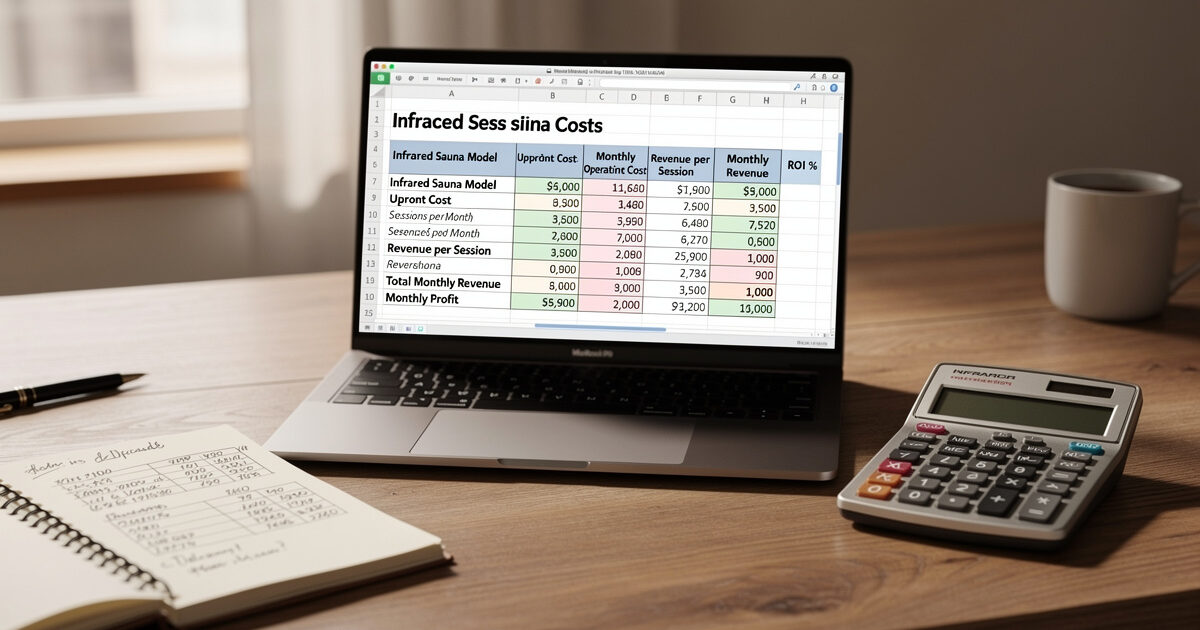
The real all-in cost of an infrared sauna at home is $2,500 to $9,500 — cabin sticker price plus optional accessories, dedicated circuit if needed, and floor mat for basement installs. Running cost is $0.25-$0.40 per session at US average electricity rates. At 4 sessions per week, a home sauna pays for itself in 5-7 months versus $35/session commercial spa visits.
This guide breaks down every line item in a realistic home sauna budget, calculates running cost by cabin size and electricity rate, runs the ROI math against gym and spa alternatives, and identifies which optional upgrades are worth the money. For broader cabin selection, see the home infrared sauna setup guide and our 2026 best home cabins ranking.
As an Amazon Associate I earn from qualifying purchases.
Upfront Cost: What Actually Lands at Your Door
Home infrared sauna upfront cost has six components: the cabin itself, shipping, optional dedicated circuit, optional floor mat, optional Bluetooth/chromotherapy upgrades, and the first cleaning supplies kit. About 75% of home sauna projects come in within $200 of the cabin sticker price, dramatically simpler than outdoor saunas where the cabin is roughly 60% of the all-in cost. For readers comfortable building rather than buying, the DIY infrared sauna cost breakdown prices every component if the $2,710 budget-cabin floor above is still more than you want to spend.
| Cost item | Budget cabin | Mid-range cabin | Premium cabin | Required? |
|---|---|---|---|---|
| Cabin sticker price | $2,495 | $4,400 | $5,795 | Yes |
| Shipping (curbside) | $0 (included) | $0 (included) | $0 (included) | Included |
| Inside-delivery upgrade | $150 | $200 | $250 | Optional but recommended |
| Dedicated 110V circuit (if needed) | $200–$400 | $200–$400 | $200–$400 | Sometimes required |
| Dedicated 240V circuit (4-person only) | n/a | $400–$900 | $400–$900 | 4-person only |
| Rubber floor mat (basement) | $60 | $80 | $140 | Recommended for basement |
| Chromotherapy lighting upgrade | $150 | $250 | $0 (often included) | Optional |
| Bluetooth audio upgrade | $80 | $295 | $0 (often included) | Optional |
| Cleaning supplies kit | $25 | $25 | $35 | Recommended |
| Realistic delivered total | $2,710–$2,960 | $4,705–$5,200 | $6,180–$6,600 |
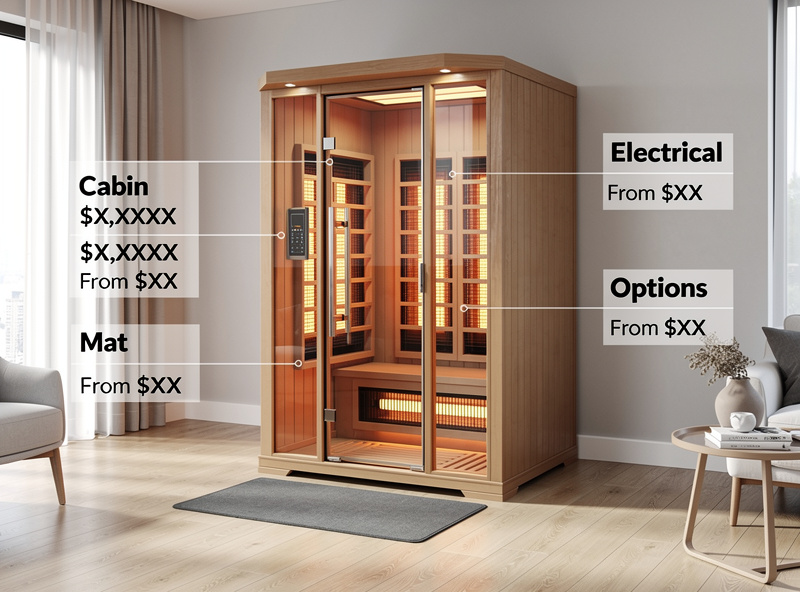
Inside-delivery upgrade is worth the $150-$250 for any cabin over 250 lbs — most freight carriers default to curbside drop, leaving you to move the panels into the house yourself. For premium cabins, white-glove delivery (full assembly included) typically costs $300-$600 extra and is worth it if you don’t want to spend 90 minutes on assembly. Two cheap line items from that table are worth doing on day one if your cabin lands in a basement or on hard flooring: a rubber floor mat under the cabin to stop moisture and scuffing, and a basic cleaning kit so you are wiping cedar down from the first session, not the tenth. Cabin sticker price is the biggest lever in that total, and it scales directly with capacity — the infrared sauna prices by size breakdown is worth a look if you are still deciding between 1-, 2-, 3-, and 4-person cabins before you run the rest of this math.
Adding a Dedicated Circuit: When and How Much
About 60% of home sauna installs need a dedicated electrical circuit added because the existing room outlets are shared with other appliances. The dedicated circuit rule from our home sauna hub requires that nothing else share the breaker — sauna heaters draw a continuous load that trips shared circuits within minutes.
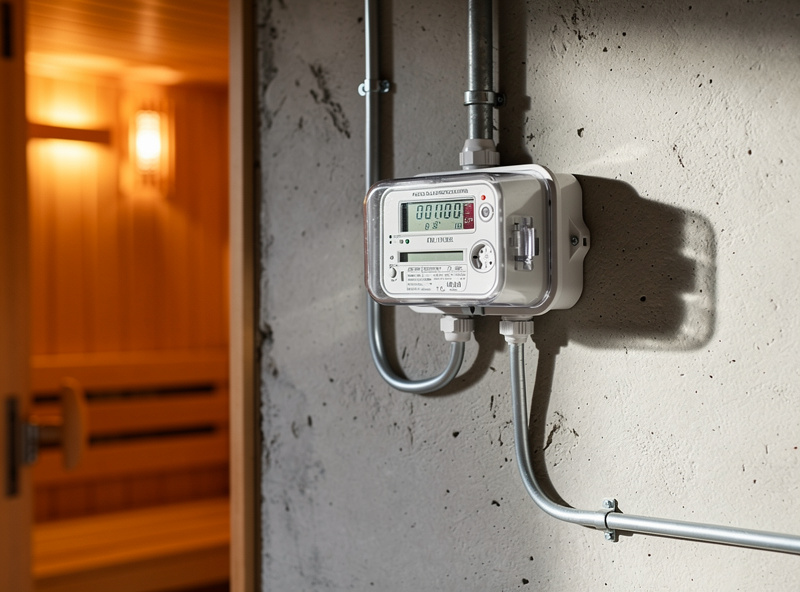
Cost ranges by circuit type and run distance:
- 20-amp 110V circuit, 25-foot run from panel: $200-$300 for materials and labor. Typical 2-hour electrician visit.
- 20-amp 110V circuit, 50-foot run from panel: $300-$500. Typical 3-4 hour visit.
- 30-amp 240V circuit, 25-foot run (4-person cabin): $400-$700. Heavier wire, double breaker.
- 30-amp 240V circuit, 50-foot run (4-person cabin): $700-$1,200. Most expensive scenario.
The cost driver is wire run distance and conduit complexity, not circuit type per se. A 25-foot run through accessible attic space costs the lower end; a 50-foot run through finished walls costs the higher end. Get two quotes before scheduling — electrician hourly rates vary widely ($75-$150/hour) by region. I wired the dedicated circuit for my own cabin, and the one thing I would not cut is the “dedicated” part — sharing a heater this hungry with a laundry or kitchen line is how you trip a breaker mid-session and slowly cook the connections. Pay for the dedicated run; it is the cheapest reliability you will buy. Before your electrician visit, run through the complete installation requirements guide — it covers clearance rules, breaker sizing, and permit steps in one place.
Running Cost: Per-Session and Annual
Infrared saunas use less electricity than most household appliances per session. The math is straightforward: cabin wattage × session length in hours × your electricity rate per kWh. At US average rates of $0.16/kWh, here is what each session and annual usage looks like. I do not estimate this number — I read it. A plug-in kill-a-watt energy meter on the sauna circuit shows the real draw and the real kWh per session, and in my own log a 2-person carbon cabin lands right around the figures below. If you ever want to settle a running-cost argument, a meter beats a spec sheet. The table below is the fast version — for the full math by region and cabin size, our electricity cost guide breaks it down further:
| Cabin size | Wattage | 30-min session cost | 45-min session cost | Annual cost (4 sessions/week) |
|---|---|---|---|---|
| 1-person | 1,200W | $0.10 | $0.14 | $22–$30 |
| 2-person | 1,500W | $0.12 | $0.18 | $25–$38 |
| 3-person | 1,950W | $0.16 | $0.23 | $33–$48 |
| 4-person (240V) | 3,400W | $0.27 | $0.41 | $56–$85 |
For comparison: a hot water heater runs $300-$500/year, a clothes dryer runs $80-$150/year, and a typical home gym treadmill runs $40-$70/year. The infrared sauna sits in the same category as the treadmill — a meaningful but small line item on your electric bill.
Adjust the table by your local rate: California averages $0.30/kWh (multiply by 1.875), Texas averages $0.13/kWh (multiply by 0.81), and most of the Midwest averages $0.14/kWh (multiply by 0.875). Rates above $0.25/kWh push annual cost into the $50-$100 range for a 2-person cabin at 4 sessions/week.
ROI: Payback Period vs Spa or Gym Sauna Access

The ROI calculation depends on your alternative. Three scenarios cover most home sauna buyers:
Scenario 1: Replacing a wellness spa drop-in
Wellness spa infrared sauna sessions average $25-$45 in major US metros, with $35 a reasonable national midpoint. At 4 sessions per week, that’s $7,280/year in spa visits. A $4,400 mid-range home cabin pays for itself in 7.6 months at this usage rate. The break-even drops to under 6 months at $40+/session pricing.
Scenario 2: Replacing a gym sauna membership
Gyms with infrared saunas typically charge $60-$120/month for full membership. The sauna access is part of the membership rather than the only reason to belong, so the ROI here is fuzzier. If you already pay for the gym primarily for the sauna, a $4,400 home cabin pays for itself in 36-72 months. If the sauna is a bonus to a gym membership you’d keep anyway, the home cabin is purely additive cost.
Scenario 3: Adding sauna access you didn’t have before
This is the largest buyer segment — about 65% of home sauna buyers had no regular sauna access before purchasing. ROI math doesn’t apply directly because there’s no baseline cost to replace. Instead, calculate cost-per-session over the cabin’s expected 12-25 year lifespan: a $4,400 cabin used 4 times per week for 15 years runs at $1.41 per session, including running cost. Spa drop-in equivalents start at $25.
Hidden Costs Worth Budgeting For
Three “hidden” costs catch some buyers off-guard. None are large, but they’re easier to plan for than to absorb after delivery.
- Door gasket replacement at year 5-7. A replacement gasket rolls into normal maintenance. Skipping this leads to slower warmup and possible heater corrosion.
- Optional whole-house surge protector. $150-$400 installed. Not required, but the dedicated 240V circuit on a 4-person cabin is a logical place to add panel-level surge protection while the electrician is already there.
- Increased homeowner’s insurance for cabins over $5,000. Some carriers consider premium home saunas a “scheduled item” requiring an endorsement ($30-$60/year). Check with your insurance carrier when delivered cabin value exceeds $5,000.
For full safety and use considerations during your first 30 days with a new cabin, see our first 30 days guide. The session length and frequency you choose drives the running cost above — most buyers settle into 30-45 minute sessions 3-5 times per week after a 2-week ramp-up period.
Where the Value Stacks Up Best
Three buyer profiles get the strongest value from a home infrared sauna:
- Daily users: 5-7 sessions per week. The per-session cost on a $4,400 cabin drops to under $0.85 over 15 years, against $25-$45 spa equivalents. Highest ROI tier.
- Recovery athletes: Pairing sauna sessions with workouts amplifies the recovery benefit. Home sauna eliminates the post-workout commute to a gym sauna and allows immediate session timing within 30 minutes of training.
- Multi-person households: A 2-person cabin used by two adults effectively halves the per-session cost while requiring zero additional running cost beyond a single user. Family households scale this further with 3-4 person cabins.
For broader buying considerations including how cost interacts with cabin features and warranty, see our how to choose framework and the budget cabins under $1,000 guide for absolute-cheapest formats.
Frequently Asked Questions
How much does an infrared sauna cost installed at home?
Realistic delivered cost runs $2,710-$6,600 depending on cabin tier. Budget cabins land at $2,710-$2,960 fully delivered, mid-range at $4,705-$5,200, and premium at $6,180-$6,600. Add $200-$400 for a dedicated circuit if needed, or $400-$900 for 240V on 4-person cabins.
How much electricity does a home infrared sauna use per session?
At US average rates of $0.16/kWh, a 30-minute session in a 2-person cabin costs about $0.12, and a 45-minute session costs $0.18. Larger 4-person cabins at $0.27-$0.41 per session. Annual cost at 4 sessions/week ranges from $22 (1-person) to $85 (4-person).
Is a home infrared sauna worth the money?
For users running 4+ sessions per week, yes — payback period versus $35 spa drop-ins is 5-7 months on a $4,400 cabin. The cabin then costs $1.41 per session over 15 years. For users with no current sauna access, the cabin adds $2,710+ of equipment cost; ROI math doesn’t apply but per-session cost still drops below any commercial alternative.
How long until a home sauna pays for itself?
5-7 months for buyers replacing $35/session wellness spa visits at 4 sessions per week. Faster (3-5 months) for $40+/session pricing or daily use. Slower if your alternative was a gym membership where the sauna was bundled — calculate based on the gym fee allocated specifically to sauna value.
Do I need to add a dedicated circuit for a home sauna?
About 60% of home sauna installs need a dedicated circuit because existing room outlets are shared with other appliances. Cost is $200-$400 for 110V (1-3 person cabins) or $400-$900 for 240V (4-person cabins). Verify dedicated circuit availability with the breaker test before ordering.
Will a home sauna increase my electric bill noticeably?
For typical 2-person cabin use at 4 sessions/week, the annual cost is $25-$38 — about $2-$3/month added to your electric bill. Comparable to a treadmill or kitchen mixer. Heavy users at 7 sessions/week see $4-$6/month added. Larger 4-person cabins push to $5-$8/month at the same usage rate.
What hidden costs should I budget for with a home sauna?
Three hidden costs: door gasket replacement at year 5-7 ($30-$80), optional whole-house surge protector ($150-$400 installed during dedicated circuit work), and homeowner’s insurance endorsement for cabins over $5,000 ($30-$60/year). None are large but easier to plan for than to absorb after delivery.
Related Articles
- Home Infrared Sauna Setup Guide — the parent hub
- Best Home Infrared Saunas 2026 — top 7 cabins by price tier
- Where to Put Your Infrared Sauna — room-by-room placement
- Best Infrared Saunas Under $1,000 — cheapest acceptable formats
- How to Choose the Best Infrared Sauna — buying framework