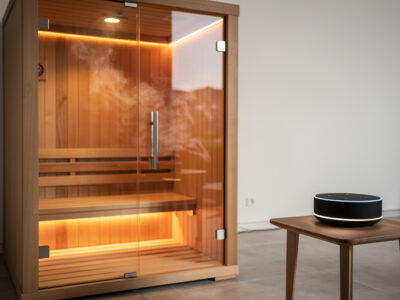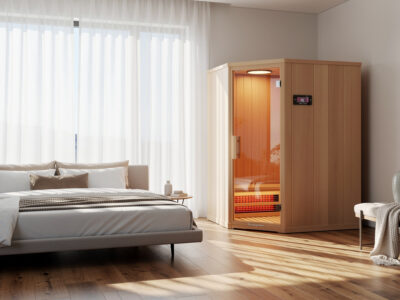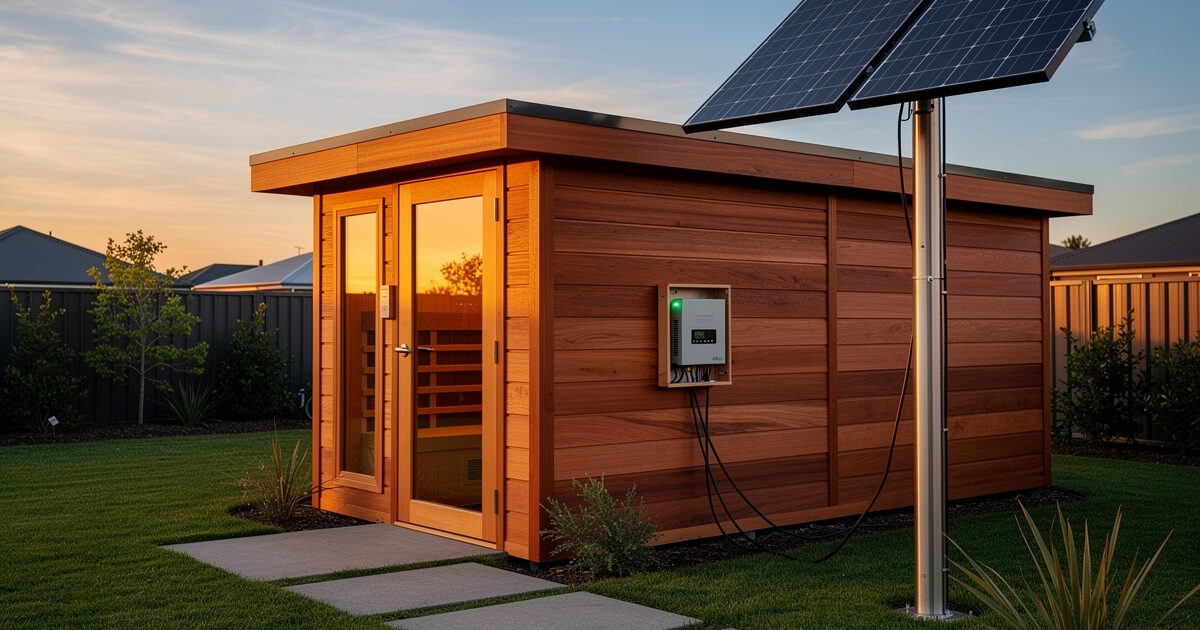
An infrared sauna draws less power than people expect — and far less than a traditional steam sauna — but the load profile is brutal for off-grid systems. A typical 2-person infrared cabin pulls 1,500 watts during heat-up and cycles between 600–1,200 watts to hold target temperature for the rest of a 30–60 minute session. That is a high-amperage continuous load on resistive elements, and it is the wrong shape for most undersized off-grid setups. If your cabin runs on grid power and you need to size the dedicated circuit, the 240V breaker requirements guide covers load calculation, double-pole spec, and the continuous-load 80% rule step by step.
This guide covers the actual sauna power numbers (peak amps, session watt-hours, surge requirements), how solar + battery systems handle this load profile, and the inverter and battery sizing math that determines whether your sauna runs in winter or trips the system. The hardware-side implementation lives on the battery and inverter selection side — this article focuses on the sauna-specific numbers that feed those decisions.
What an Infrared Sauna Actually Draws
Infrared saunas pull 1,200–2,400 watts at peak depending on size, with thermostatic cycling reducing average power to 50–70% of peak during a session. The hidden number that matters more than peak: how the load behaves over time.
Power-draw breakdown by typical infrared sauna size:
| Sauna size | Peak watts | Voltage | Peak amps | Session avg watts | Watt-hours per 45-min session |
|---|---|---|---|---|---|
| 1-person portable | 800–1,000 | 120V | 7–9 A | 500–700 | 375–525 |
| 1-person cabin | 1,200–1,500 | 120V | 10–13 A | 700–950 | 525–710 |
| 2-person cabin | 1,600–1,900 | 120V | 14–16 A | 900–1,300 | 675–975 |
| 3-person cabin | 2,000–2,400 | 120V or 240V | 17–20 A (120V) | 1,200–1,600 | 900–1,200 |
| 4-person cabin | 2,400–3,200 | 240V (typical) | 10–14 A (240V) | 1,400–1,900 | 1,050–1,425 |
Two patterns are worth highlighting. First, peak-watts numbers are usually for the first 15 minutes during heat-up, after which the thermostatic cycling drops average draw to 50–70% of peak. Second, anything above 2,000W typically runs on a dedicated 20A circuit in plug-in installations, and the 4-person sizes usually need a 240V hardwire — important detail for off-grid sizing because most home hybrid inverters have separate continuous and surge-watt ratings that the sauna’s heat-up phase will probe.
Why Saunas Are a Hard Off-Grid Load
Three properties make resistive heat loads (saunas, heaters, electric kettles, and anything else that uses NiCr coils to generate heat) the worst-case load for solar+battery systems.
1. They are nearly 100% resistive. No motor inrush, no power-factor weirdness, but no part of the energy is recoverable as something other than heat. Every watt drawn is a watt the battery must deliver.
2. The duty cycle is awkward. Sauna sessions are 30–60 minutes — long enough that battery-only operation is meaningful but too short for solar to top up during the session itself. The load is a “battery sprint,” not a continuous draw.
3. They prefer to run when solar production is low. Sauna sessions concentrate in early morning or evening — exactly when the panels are not producing full power. A noon sauna would be easy off-grid; the realistic 7pm session pulls entirely from battery storage.
Compare to a refrigerator’s load profile (continuous low draw, mostly during daylight when panels produce) or LED lighting (low evening draw spread across hours). The sauna’s high-power, time-shifted draw forces a battery bank sized for the worst-case session, not the average daily kilowatt-hours.
Calculating the Watt-Hour Budget for Off-Grid Sauna Use
Three numbers determine whether your existing or planned solar system can support a sauna:
Per-session watt-hours. Average session watts × session hours. A 2-person cabin at 1,100W average × 0.75 hours = 825 Wh per session. Use the table values for your sauna size or measure with a Kill-A-Watt during a real session.
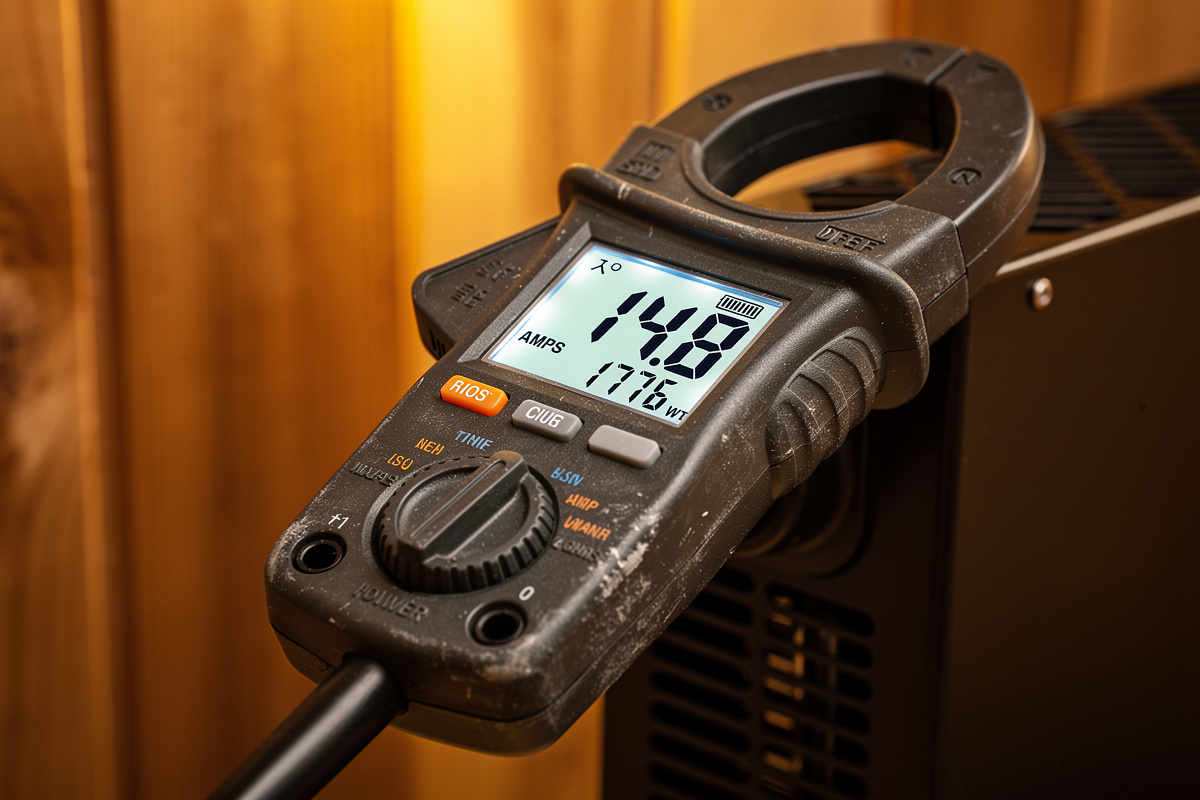
Sessions per week. Most home sauna users settle into 3–5 sessions per week. The 30-day-detox protocol sometimes runs daily; vacation-home use might be 2–3 per week.
Days of autonomy. How many cloudy days the battery should support without solar input. For a system that already supports a house, sauna sessions can ride the existing autonomy. For a sauna-only off-grid build (for example, a backyard sauna shed with its own panels), 1–2 days autonomy is typical.
Worked example for a 2-person backyard sauna shed in central Iowa, 4 sessions per week, 1.5 days autonomy:
- Per-session: 825 Wh
- Average daily: 825 × 4 ÷ 7 = 471 Wh/day from sauna alone
- Plus shed lighting and outlet load: ~100 Wh/day
- Total daily Wh: ~570 Wh/day for the shed
- Battery sizing: 570 × 1.5 ÷ 0.8 (DoD) = 1,070 Wh — about 100Ah of LiFePO4 at 12V
The trap: this average-day math hides the worst-case session demand. The battery must also be able to deliver 1,500–2,000 watts continuous for 45 minutes during a single session. A 100Ah LiFePO4 battery at 12V can do this (max continuous discharge is typically 100A × 12.8V = 1,280W — already too low for a 2-person cabin). For the actual session demand, step up to 200Ah at 12V, or move to a 24V or 48V system where the same 100Ah battery delivers 2,500W or 5,000W respectively.
Inverter Sizing: The Surge-Watt Trap
Sauna installations need an inverter with continuous-watts at least 1.3× the sauna’s peak watts and surge capacity at least 2× peak. Undersized inverters trip on heat-up and never reach session temperature.
For typical sauna sizes, the matching inverter:
| Sauna size | Peak watts | Min continuous inverter | Min surge inverter |
|---|---|---|---|
| 1-person portable | 1,000W | 1,500W | 3,000W |
| 2-person cabin | 1,800W | 2,500W | 5,000W |
| 3-person cabin | 2,200W | 3,000W | 6,000W |
| 4-person cabin (240V) | 3,000W | 4,000W | 8,000W |
The cheapest inverters that meet these specs are pure-sine-wave 12V → 120V or 24V → 120V models from Renogy, AIMS, and Victron in the $300–800 range for the smaller sizes, climbing to $1,500+ for hybrid 240V split-phase units that handle 4-person cabins. The hybrid inverter buyer’s guide covers the brand-specific spec comparisons; for sauna applications specifically, look for inverters listed with 2× surge ratings sustained for 5+ seconds, not the often-marketed 200% surge for 200ms which is irrelevant for resistive heat loads.
Modified-sine-wave inverters work technically but waste 5–8% of the energy as harmonic distortion. The savings versus pure sine wave are small ($50–100); the energy waste is permanent. Use pure sine wave.
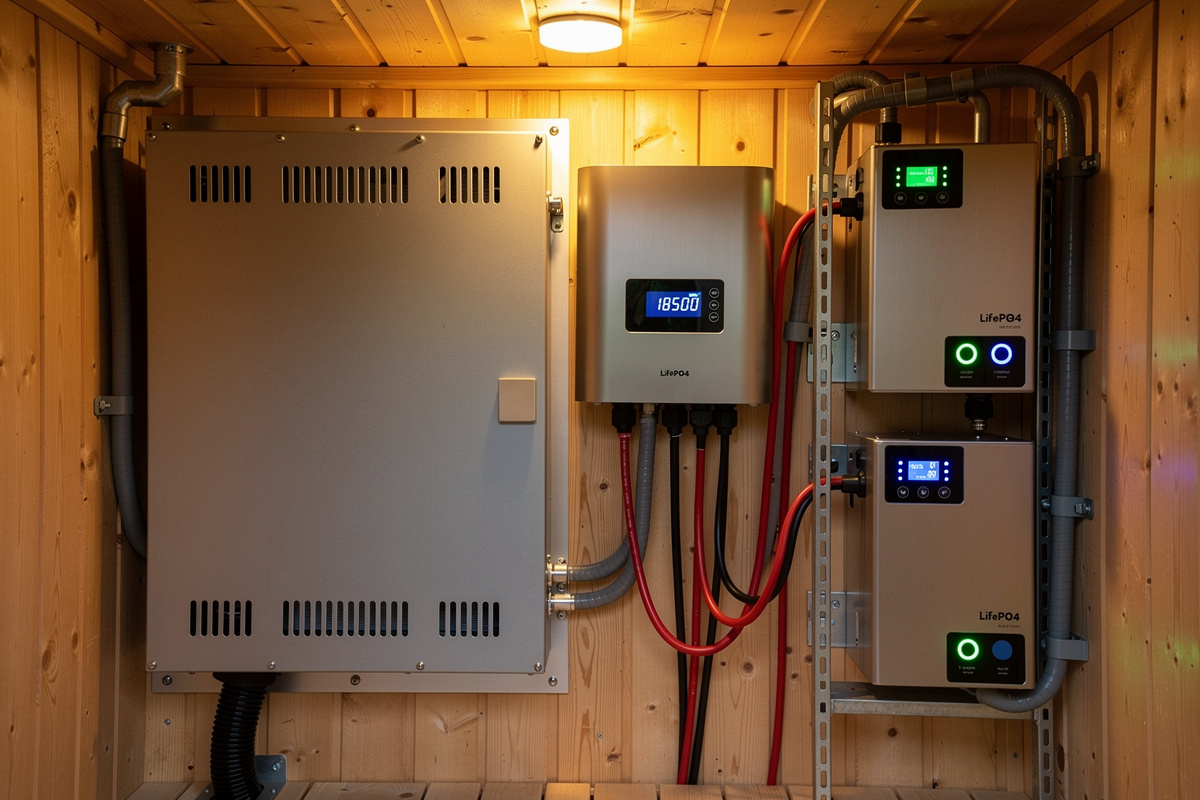
Solar Panel Array Sizing for a Sauna-Capable System
Once the battery and inverter are sized, the panel array determines how many days the system can sustain the load before drawing the battery below the autonomy floor.
For the 2-person Iowa sauna example (570 Wh/day):
- December peak sun hours: 2.8
- Required panel watts: 570 ÷ 2.8 ÷ 0.7 (system efficiency) = 291W
- Round up to commercial sizes: two 200W panels in parallel, or one 400W panel
For comparison, the same setup in Phoenix (5.0 December PSH) needs only 163W of panel — a single 200W panel comfortably covers the load. The climate multiplier dominates the sizing decision; sauna-side details (cabin size, session frequency) only adjust the load number, not the dramatic difference between northern and southern winter sun.
Where most undersized systems fail: panels picked for summer-average production. A 200W panel that produces 700 Wh/day in June produces 250 Wh/day in December at the same latitude. Always size against the December PSH for off-grid loads that you actually want to run year-round.
Battery Chemistry: Why LiFePO4 Wins for Sauna Loads
The continuous high-current discharge profile of a sauna favors LiFePO4 over every alternative chemistry available to home off-gridders.
The chemistry-by-load tradeoffs:
- LiFePO4 (LFP): Handles sustained 0.5C–1C discharge cleanly (a 100Ah battery delivers 50–100A continuous without thermal stress). Cycle life 4,000–6,000 cycles at 80% DoD. The right choice.
- NMC lithium: Higher energy density but reduced cycle life under continuous high-current discharge. Better for EV and short-burst applications. Acceptable for backup but expensive per usable cycle for daily sauna use.
- Lead-acid (flooded or AGM): Drops voltage significantly under sauna-class loads. The Peukert effect (capacity loss at high discharge rates) means a 200Ah AGM delivers only 130–150Ah of usable capacity at sauna current draw. Usable but oversized 1.4–1.7× compared to equivalent LiFePO4.
The detailed chemistry comparison lives in the battery chemistry guide for home storage, but the short answer for sauna applications is: LiFePO4 every time, sized for the worst-case session, paired with a battery management system rated for the inverter’s surge current.
Wiring, Circuit Protection, and Code
Three areas where off-grid sauna installs go wrong (and trigger insurance issues):
1. Wire gauge from battery to inverter. The inverter pulls high DC current — for a 2,500W inverter at 12V battery, that is 200+ amps. Required cable: 2/0 or 4/0 AWG copper, kept under 3 feet of total run length. Most off-grid sauna failures are wire-related, not battery-related.
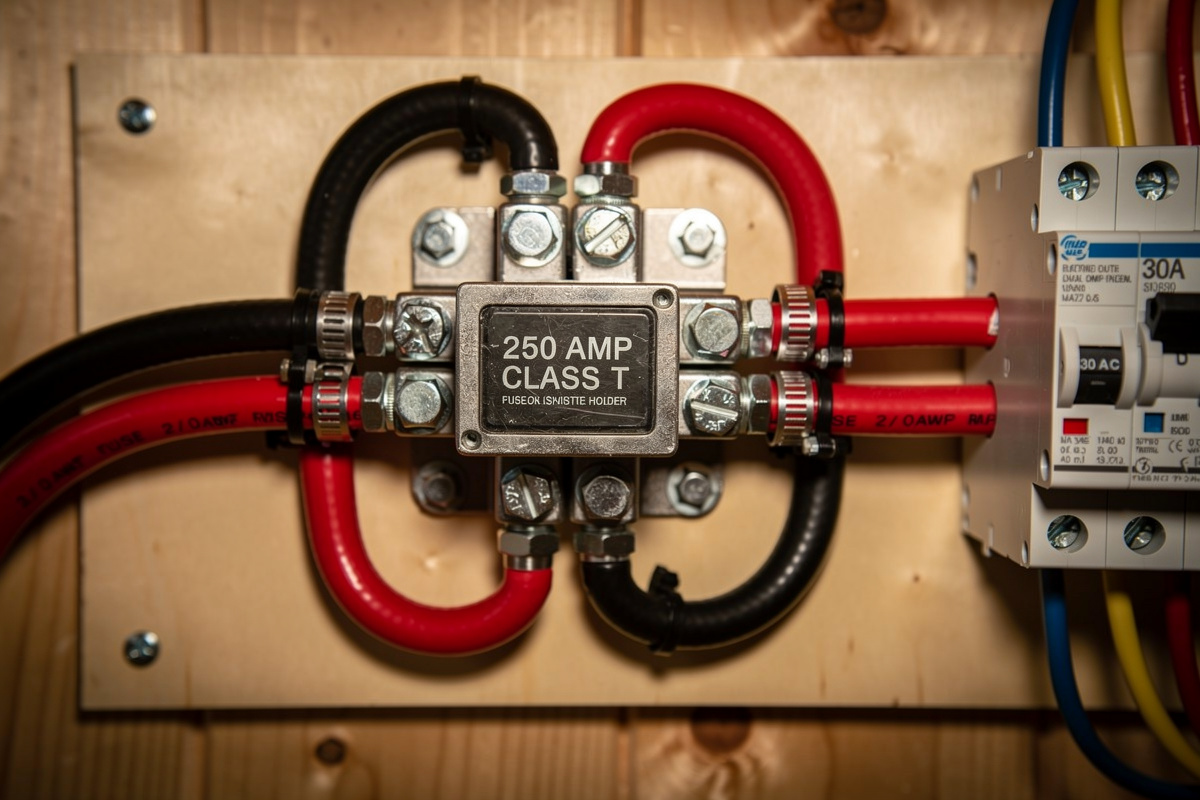
2. DC fuse / breaker between battery and inverter. Required by NEC and required for fire safety. A Class T fuse at 1.25× the inverter’s continuous DC draw is the standard solution. For a 2,500W inverter at 12V, that is a 250A Class T fuse ($30–60).
3. AC circuit breaker before the sauna receptacle. The sauna pulls high resistive current; the circuit needs a 20A breaker minimum (15A typical kitchen circuit will trip). For sauna installations on shared circuits with other heat loads (waterers, heaters, electric kettles), you may need a dedicated breaker. The outdoor sauna foundation and permits article covers the permit and inspection side that off-grid installs sometimes try to skip — and shouldn’t.
Real-World System Costs
For a 2-person infrared sauna running 4 sessions per week off solar+battery, the ballpark hardware cost (excluding the sauna itself):
- 2× 200W solar panels: $200–280
- 30A MPPT charge controller: $80–150
- 200Ah 12V LiFePO4 battery (or 100Ah 24V): $500–900
- 3,000W pure-sine inverter: $400–700
- Wiring, fuses, mounts, breakers: $200–400
- Total: $1,400–2,400
That assumes a sauna-only off-grid setup. If the sauna runs off an existing whole-home off-grid system, the marginal cost is just the additional battery capacity and possibly the inverter upgrade — often $400–800 to retrofit sauna support onto an existing solar setup.
For grid-tied homes adding a backup-power sauna (sauna runs off battery during outages or during peak rate hours), the math is different — the battery and inverter pay back across all loads, not just the sauna. The at-home sauna cost guide covers the broader cost picture for grid-tied installs.
Common Mistakes
Three sizing mistakes account for most off-grid sauna failures:
Sizing battery for energy but not power. A 100Ah 12V battery has 1,280Wh of usable energy — plenty for a session by Wh count. But its max continuous discharge of 100A × 12.8V = 1,280W is below a 2-person cabin’s peak draw. The session will trip the battery management system. Size battery for both energy AND continuous power.
Underestimating the heat-up phase. The first 15 minutes of a session pull peak watts continuously. If your inverter is right at the sauna’s nameplate rating, the heat-up phase will trip it. Inverter continuous-watts should be at least 1.3× sauna peak.
Running sauna sessions on cloudy-day reserves. Battery state of charge below 30% combined with a 2-hour session can pull below the BMS protection threshold. Build a habit: check battery SOC before starting a session in winter; postpone if below 50%.
Can I run an infrared sauna entirely on solar power?
Yes, but only with adequate sizing. A 2-person infrared sauna running 4 sessions per week needs roughly 400W of panels, 200Ah of LiFePO4 battery, and a 3,000W pure-sine inverter — about $1,400-2,400 in hardware. Northern climates need 1.5-2x the panel wattage compared to southern climates.
How much battery do I need for a sauna?
For a 2-person infrared cabin (1,800W peak), 200Ah of 12V LiFePO4 covers a 45-minute session with margin. Or 100Ah at 24V. The constraint is continuous discharge current, not just energy capacity — verify the battery BMS supports at least 150A continuous discharge.
What size inverter for a 2-person infrared sauna?
3,000W continuous, 6,000W surge, pure sine wave. The continuous rating must exceed the sauna peak draw by 1.3x; the surge rating must handle the heat-up current spike for at least 5 seconds. Modified-sine inverters technically work but waste 5-8% as harmonic distortion.
Will an infrared sauna work on a generator?
Yes for short use, but resistive heat loads consume fuel quickly. A 2,000W generator running a 2-person sauna for 45 minutes burns roughly 0.4 gallons of gasoline. Solar+battery is far cheaper per session if usage exceeds 2-3 sessions per week.
How long does a battery last during a sauna session?
A 200Ah 12V LiFePO4 battery (2,560Wh) supports 2-3 full 45-minute sessions for a 2-person cabin before recharging. Pulling beyond 80% depth of discharge in a single day shortens cycle life noticeably; size for sessions per day, not just per week.
Can I add a sauna to an existing off-grid home system?
Often yes, but verify three things first: the inverter surge capacity exceeds sauna peak draw, the battery continuous-discharge rating handles the load, and the panel array can recharge what the sauna consumes. Most retrofits need a battery upgrade — sauna sessions concentrate at evening when panels are not producing.
Related Articles
- Infrared Sauna at Home: Real Costs, Power, and ROI — broader at-home cost picture
- Outdoor Sauna Foundation, Power, and Permits — code and permitting
- Backyard Infrared Sauna Setup Guide — pad, power, privacy
- Best 2-Person Infrared Saunas 2026 — cabin selection
- Infrared Sauna Sizes: 1-4 Person Compared — size and load reference