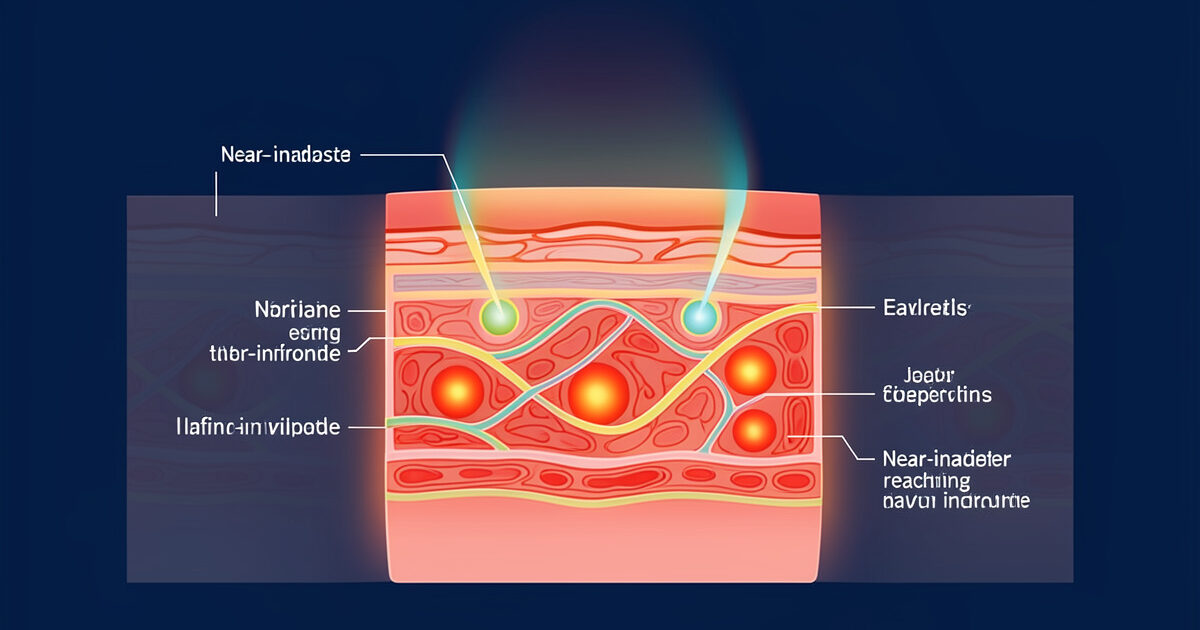
Infrared penetration depth is set almost entirely by how strongly water absorbs each wavelength — and the answer flips the most common sauna marketing claim on its head. Near-infrared around 0.8–1.1 µm penetrates several millimeters into tissue because it sits in water’s low-absorption window. Far-infrared at 7–10 µm is absorbed in roughly the first 0.1 mm of skin. So near penetrates deepest, not far, despite the brochures.
This is the one piece of spectrum physics I see vendors get backwards most often, and it’s the fastest way to tell whether a seller understands their own product. I’m not a physicist selling theory — I run far, near, and full-spectrum units at home and the penetration story is what reconciles “far-infrared warms my whole body” with “far-infrared barely gets under the skin.” Here’s how it actually works.
Penetration Is Really About Water Absorption
Skin and soft tissue are mostly water, so how deep infrared reaches is governed by water’s absorption coefficient at each wavelength — and that coefficient varies enormously across the infrared range. Where water absorbs weakly, the radiation travels further before being absorbed; where it absorbs strongly, the energy is deposited right at the surface. This is why “penetration depth” isn’t one number for “infrared” — it’s a different number for every wavelength.
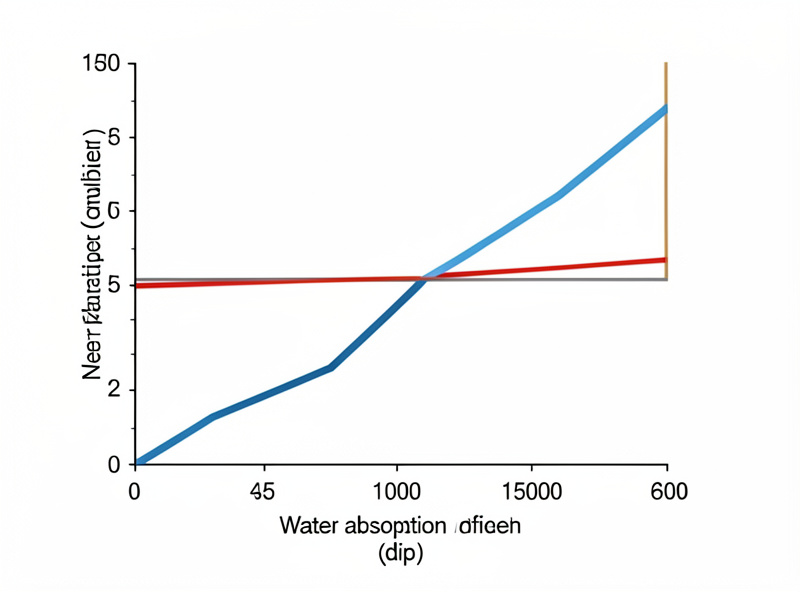
Water has a pronounced transmission window in the near-infrared, roughly 0.7–1.3 µm, where absorption is at a local minimum. Move to the far-infrared and water becomes intensely absorbing. That single curve explains the whole penetration ranking. The full band map is in my infrared sauna spectrum guide, and the near-versus-far feel that follows from it is in near vs far infrared.
The Depth Ranking, Band by Band
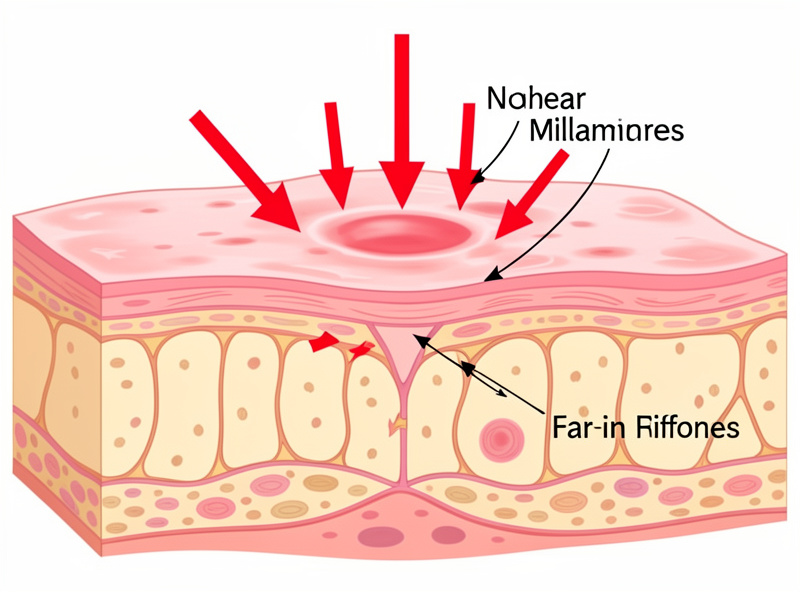
Near-infrared (0.7–1.4 µm) penetrates deepest — millimeters into tissue — because of that low-absorption window. It’s the same physics that lets near-infrared light be used to see through a fingertip. Mid-infrared (1.4–3 µm) penetrates less; absorption climbs as wavelength increases. Far-infrared (3 µm and up, typically 7–10 µm from a sauna panel) penetrates least, depositing its energy in the outermost fraction of a millimeter of skin and the moisture on it.
So the honest ranking is near > mid > far for depth — the exact opposite of the “far-infrared penetrates 1.5 inches” claim you’ll see plastered across product pages. That claim isn’t a small exaggeration; it’s physically backwards. The penetration of mid specifically is covered in the mid-infrared guide, and the emitters behind each band are in near, mid and far infrared heaters.
Then Why Does Far-Infrared Warm My Whole Body?
This is the part the depth obsession misses. A far-infrared cabin warms you thoroughly not by reaching deep, but by depositing energy across your entire skin surface at once, plus warming the air. That surface heat then spreads inward by ordinary conduction and is carried around by your circulation, exactly the way standing by any warm surface heats you. Whole-body warming is a coverage-and-time effect, not a penetration effect.
That reframes what “depth” is even worth. For comfortable, even, sustained warmth — what most people actually want from a sauna — broad surface coverage from cool far panels beats deep narrow penetration every time. Depth is a property to understand, not a feature to chase. The session-level comfort that follows is in the full-spectrum band explainer.
Penetration Depth by Band
| Band | Wavelength | Water absorption | Approx. penetration |
|---|---|---|---|
| Near (IR-A) | 0.7–1.4 µm | Low (window) | Several mm (deepest) |
| Mid (IR-B) | 1.4–3 µm | Rising | Sub-mm |
| Far (IR-C) | 3 µm and up | High | ~0.1 mm (surface) |
Penetration vs Intensity: Two Different Things
People conflate “penetrates deep” with “feels strong,” and they’re unrelated. A near-infrared emitter penetrates deeper but you experience it as an intense surface heat on the skin facing it, because the energy is high and concentrated. A far-infrared panel penetrates barely at all yet feels gentle and pleasant, because the same energy is spread thinly over a huge area. Depth describes where the energy lands; intensity describes how much arrives per square centimeter. A heat lamp can penetrate deeper than a far panel and still feel harsher on the skin.
This is why chasing “depth” as a proxy for quality leads people wrong. The sensation you enjoy in a sauna is mostly about even, moderate intensity over your whole body — which is a coverage and emitter-temperature story, not a penetration story. Once you separate the two, the spec sheet reads very differently.

How to Infer Penetration From Your Own Heaters
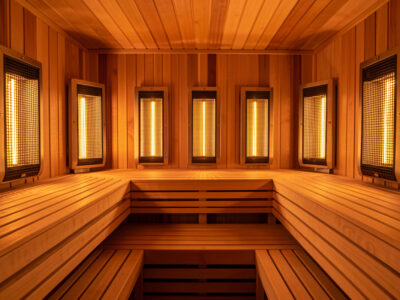
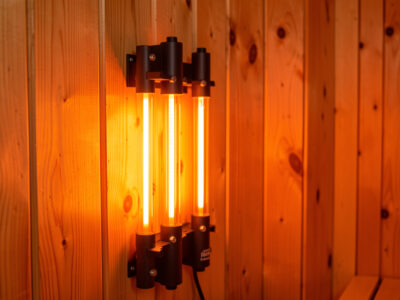
You can estimate which penetration regime your cabin is in without any lab gear. Point an IR thermometer at the emitter surface. A reading around 80–95°C means a cool carbon panel — far-infrared, surface-deposited, gentle. A glowing emitter you can’t even read properly because it’s incandescent means near-infrared — deeper-penetrating, intense, directional. A dull-orange ceramic rod in the 300–400°C range sits between, leaning toward the shallow far end with some shorter-wavelength tail.
That single surface-temperature reading, run through Wien’s law, tells you the peak wavelength, and the peak wavelength tells you the penetration regime via water’s absorption curve. It’s the same chain of logic I use to characterize any cabin I meet, and it’s far more reliable than the brochure. The full DIY method, including the EMF side, is in measuring your sauna’s spectrum.
What This Means When You Shop
Two practical rules fall out of the physics. First, distrust any seller who claims far-infrared penetrates inches into the body — it’s a competence tell, and a vendor who’s wrong about this is often wrong about EMF and wattage too. Second, if deep penetration genuinely matters to you, the band that delivers it is near-infrared, which means a real near emitter or a dedicated near-infrared panel, not a far cabin with a depth sticker.
For everyone else — the majority who want even, relaxing warmth — penetration depth simply isn’t the spec to optimize. Far-panel coverage, low EMF, comfortable ramp, and a circuit you can supply matter far more to a good session. Whether to add near-infrared for its depth is the full-spectrum question I work through in is full-spectrum worth it, and the standalone-panel route is in NIR panels vs a full cabin.
Frequently Asked Questions
Which infrared wavelength penetrates the deepest?
Near-infrared, around 0.8 to 1.1 micrometers, penetrates deepest because it sits in water’s low-absorption window and travels several millimeters into tissue. The ranking is near deeper than mid deeper than far, the opposite of common sauna marketing.
How deep does far-infrared actually penetrate?
Far-infrared at 7 to 10 micrometers is absorbed in roughly the first 0.1 millimeter of skin and surface moisture, because water absorbs those wavelengths very strongly. The claim that far-infrared reaches 1.5 inches into the body is physically backwards.
Why does penetration depend on wavelength?
Because tissue is mostly water and water’s absorption varies enormously across infrared wavelengths. Where water absorbs weakly, like the near-infrared window, radiation travels further. Where it absorbs strongly, like the far-infrared, energy is deposited right at the surface.
If far-infrared is shallow, why does it warm my whole body?
Because it heats your entire skin surface at once and warms the air, and that surface heat then spreads inward by conduction and circulation. Whole-body warming is a coverage and time effect, not deep radiant penetration.
Does deeper penetration make a better sauna?
Not for most goals. For even, comfortable, sustained warmth, broad surface coverage from cool far panels matters more than deep narrow penetration. Depth only matters if you specifically want near-infrared, which needs a real near emitter or panel.
Can I trust a sauna that claims deep far-infrared penetration?
Be cautious. Claiming far-infrared penetrates inches into the body is a competence tell, since the physics says the opposite. A seller wrong about penetration is often also unreliable on EMF figures and wattage, so verify everything they state.
Related Guides
- Infrared Sauna Spectrum Explained
- Near Infrared vs Far Infrared: The Real Difference
- Mid-Infrared Wavelength in Saunas
- Near, Mid and Far Infrared Heaters
- Is a Full-Spectrum Infrared Sauna Worth It?
As an Amazon Associate I earn from qualifying purchases. A simple infrared thermometer reads your panel’s surface temperature, the number that tells you which band — and which penetration behavior — you’re actually getting.