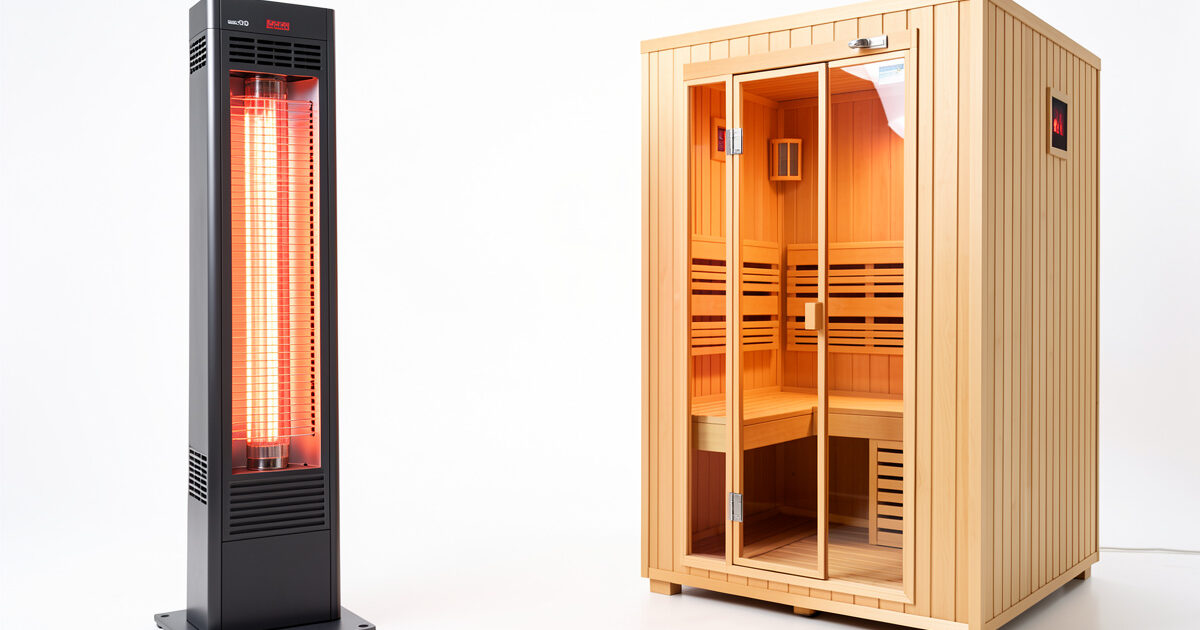
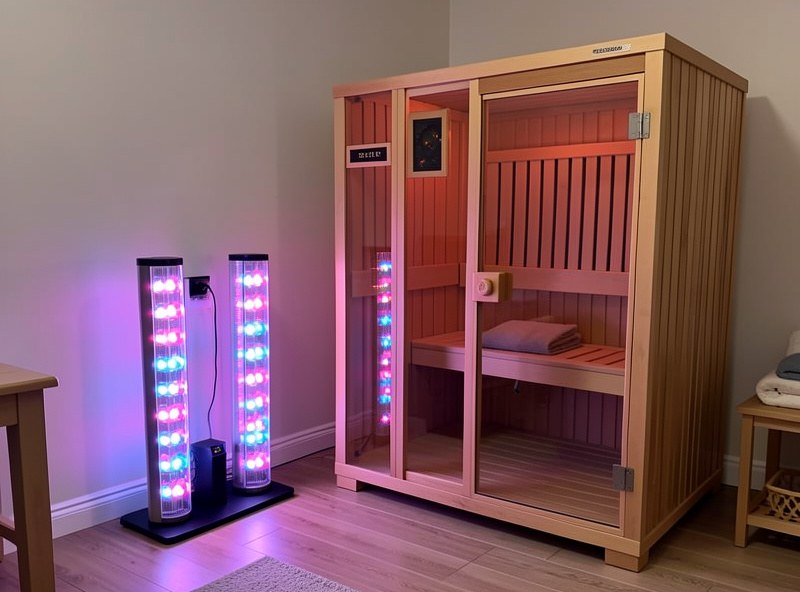
A near-infrared panel and a full infrared sauna cabin solve two different problems. A standalone NIR panel or lamp is a directional radiant source you stand or sit in front of — cheap, compact, no enclosure. A full cabin is an insulated box of far-infrared panels that builds an even, whole-body heat you sit inside. One is a spotlight; the other is an environment. Picking between them is about space, budget, and whether you want directional near-infrared or enveloping warmth.
I run both ends of this: a far-infrared carbon cabin as my daily driver and a separate near-infrared emitter setup, plus a portable tent for travel. After living with each, the choice is rarely “which is better” — it’s “which job are you buying for.” Here’s the engineering and ownership breakdown so you don’t pay cabin money for a panel’s job, or vice versa.
What a Near-Infrared Panel Actually Is
A near-infrared panel — whether a single incandescent heat-lamp setup or a multi-bulb NIR array — emits in the 0.7–1.4 µm band from glowing filaments running 2000 K and up. There’s no enclosure. You position yourself in front of it and rotate, because the heat is intensely directional: hot on the skin facing the bulbs, nothing on the side turned away. It ramps in seconds, takes minimal space, plugs into an ordinary outlet, and costs a fraction of a cabin.
What it doesn’t do is build an ambient hot environment. Air temperature in the room barely moves; the experience is radiant, local, and one-sided unless you keep turning. That’s not a flaw — it’s the design. The band physics is in my infrared sauna spectrum guide, and a DIY near-infrared setup is covered in the near-infrared lamp guide.
What a Full Cabin Does Differently
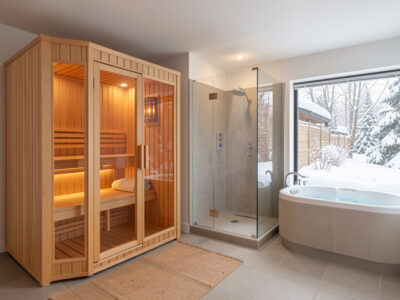
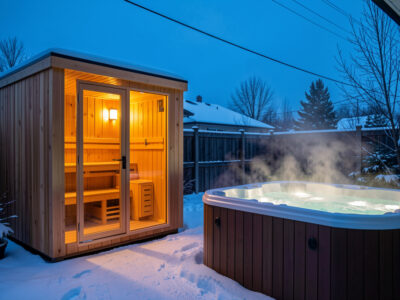
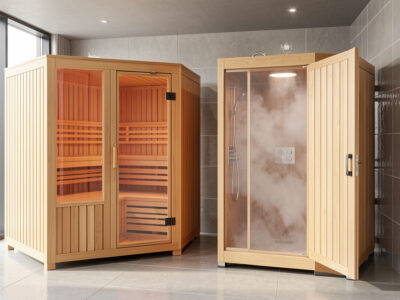
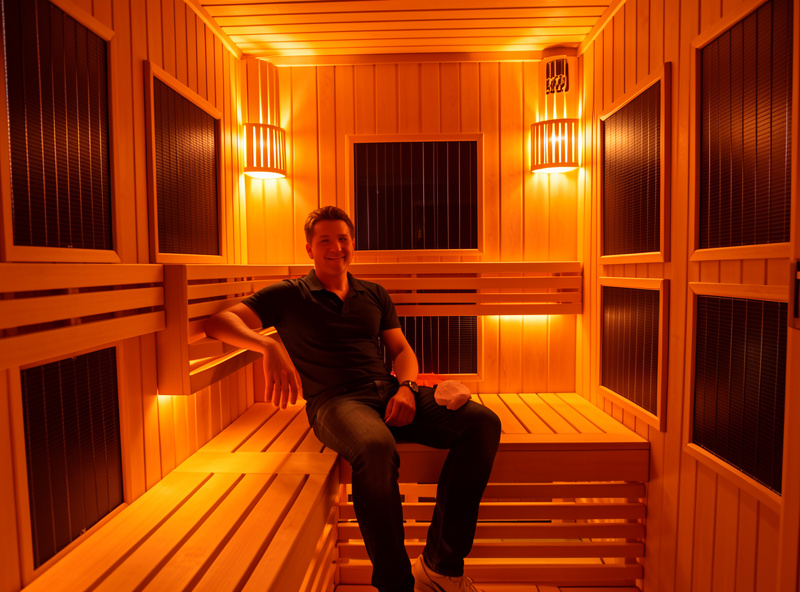
A full infrared cabin is an insulated wooden enclosure lined with large far-infrared carbon or carbon/ceramic panels. The panels run cool (around 85°C) and cover most of the walls, so the whole space becomes a gentle, even radiant field. Crucially, the enclosure traps heat: the air warms, your whole body is surrounded, and there’s no need to rotate. You sit, you stay put, you sweat evenly.
That enclosure is the cabin’s whole advantage and its whole cost. It needs floor space, a longer preheat (10–15 minutes), often a dedicated circuit, and a much bigger budget. In return you get the comfortable, immersive, long-sit experience that a bare panel can’t replicate. The cabin-versus-portable framing carries over here too, and I cover it in sauna blanket vs cabin.
Coverage, Comfort, and the Rotation Problem
The single biggest practical difference is coverage. With a panel you’re managing a one-sided heat — front for a few minutes, then turn. It works, but it’s active; you’re never just relaxing because one side is always cooling. A cabin removes that entirely: the radiant field comes from every wall, so warmth is even front to back without thinking about it.
For a short, focused near-infrared session a panel is fine and even preferable for its immediacy. For a relaxed 30-to-40-minute whole-body sit through a dark winter evening, the cabin wins on comfort by a wide margin — it’s the difference between facing a campfire and sitting in a warm room. This maps directly onto the near-versus-far feel I break down in near vs far infrared.
EMF, Power, and Install
On my TriField TF2 the two read differently. A near-infrared panel concentrates current through glowing filaments, so it reads higher right at the bulbs, falling off as you step back — easy to manage since you control your distance. A far-infrared cabin’s large low-current panels read low, a milligauss or two at seat distance with tidy wiring, but the cabin’s controller and internal wiring add their own sources to check.
On power and install, the panel is trivially simple: standard outlet, no preheat, move it anywhere. A cabin is a project — floor space, ventilation, often a dedicated 16A or 20A circuit with GFCI, and assembly. If you rent or you’re tight on space, that alone can decide it. The wiring side is in my installation guide, and the metering method is in how to measure sauna EMF.
Panel vs Cabin at a Glance
| Factor | Near-infrared panel | Full infrared cabin |
|---|---|---|
| Band | Near (0.7–1.4 µm) | Far (3 µm and up) |
| Coverage | Directional, one-sided | Even, whole-body |
| Enclosure | None | Insulated cabin |
| Ramp / preheat | Seconds | 10–15 minutes |
| Space needed | Minimal | Floor footprint |
| Power | Standard outlet | Often dedicated 16–20A |
| EMF (on my TF2) | Higher at the bulbs | Low with good wiring |
| Relative cost | Low | High |
Cost Over Time and Real Estate
The price gap is bigger than the sticker suggests once you fold in everything a cabin asks for. A near-infrared panel is a low upfront cost, no install fee, and a standard outlet — the running cost is just the bulbs’ wattage for the minutes you use them. A cabin adds the purchase price, possibly an electrician for a dedicated circuit, the floor space it permanently occupies, and a 10–15 minute preheat every session that quietly shows up on the bill. My far-infrared cabin lands near 1.0–1.3 kWh for a 40-minute session including that preheat; a short panel session is a fraction of that simply because there’s nothing to warm up but you.
Real estate is the underrated factor. A panel tucks into a corner or a closet and disappears; a cabin claims a square meter or two of a room for good. If you’re in an apartment or sharing space, that footprint can settle the decision before EMF or coverage ever enter into it. I run the full ownership math in electricity cost per session.
Which Should You Buy?
Buy a near-infrared panel if you want directional near-infrared specifically, you’re short on space or budget, you rent, or you want something you can set up and use in seconds. It’s the efficient way to get the near band without committing to a room-sized appliance. Buy a full cabin if you want immersive, even, whole-body warmth for relaxed long sits, you have the space and a suitable circuit, and comfort over a whole winter matters more than upfront cost.
There’s also a middle ground worth knowing about: the portable infrared tent. I keep one for travel, and it splits the difference — it gives you an enclosure that traps far-infrared heat like a cabin but folds away and runs off a standard outlet like a panel. It’s not as immersive or as comfortable as a fixed cabin, and the panels are smaller, but for renters or travellers it’s a genuine third option rather than a compromise nobody wants.
And if you want both bands in one box, that’s the full-spectrum route — a cabin with an added near-infrared emitter — which I weigh up in is full-spectrum worth it. For a worked near-infrared bulb cabin example, the SaunaSpace review shows what a dedicated NIR enclosure looks like in practice.
Frequently Asked Questions
What is the difference between a near-infrared panel and a sauna cabin?
A near-infrared panel is a directional radiant source with no enclosure, emitting the 0.7 to 1.4 micrometer band from glowing bulbs. A full cabin is an insulated box of far-infrared panels that builds even, whole-body warmth you sit inside. One is a spotlight, the other an environment.
Is a near-infrared panel as good as a full sauna?
For directional near-infrared in seconds with no install, a panel is excellent and cheaper. For immersive, even, whole-body warmth over a long relaxed sit, a full cabin is clearly better because the enclosure surrounds you and traps heat. They suit different goals.
Do near-infrared panels heat the whole body?
Not at once. A panel is directional, so it heats the skin facing the bulbs while the side turned away stays cool, meaning you rotate through a session. A full cabin heats the whole body evenly from panels on every wall with no rotation needed.
Which has higher EMF, a panel or a cabin?
A near-infrared panel reads higher right at the glowing bulbs on my TriField TF2 because current concentrates through small filaments, but it falls off as you step back. A far-infrared cabin’s large low-current panels read low, around one to two milligauss at seat distance.
Does a near-infrared panel need special wiring?
Usually no. Most near-infrared panels and lamps run on a standard outlet with no preheat and no dedicated circuit, which is a big part of their appeal. A full cabin often needs a dedicated 16 to 20 amp circuit with GFCI and proper ventilation.
Can I get both near and far infrared without two devices?
Yes, a full-spectrum cabin combines large far-infrared panels with a dedicated near-infrared emitter. The value depends on the near emitter being genuinely powerful rather than a token bulb, which is the key thing to check before paying the premium.
Related Guides
- Infrared Sauna Spectrum Explained
- Near Infrared vs Far Infrared: The Real Difference
- Is a Full-Spectrum Infrared Sauna Worth It?
- Near-Infrared Lamp DIY Setup
- Sauna Blanket vs Cabin
As an Amazon Associate I earn from qualifying purchases. A compact near-infrared heat lamp panel is the low-commitment way to try the near band before buying a cabin.