The difference between near and far infrared comes down to one number: wavelength. Near-infrared runs about 0.7–1.4 µm and comes from a glowing emitter; far-infrared runs 3 µm and longer and comes from a cool, large panel. That single split decides how the heat feels, how deep it travels, how fast it ramps, and what it reads on an EMF meter.
I run both in the same Swedish home — a far-infrared carbon cabin as my daily driver and a full-spectrum unit with a near-infrared halogen emitter — so I’m not comparing spec sheets, I’m comparing two heaters I’ve metered and lived with. Most articles frame this as “which is better.” That’s the wrong question. They’re different tools, and once you understand the physics of the gap, the right one for your room is obvious. This is the engineering breakdown of what actually separates the two bands.
The Core Difference Is Wavelength and Emitter Temperature
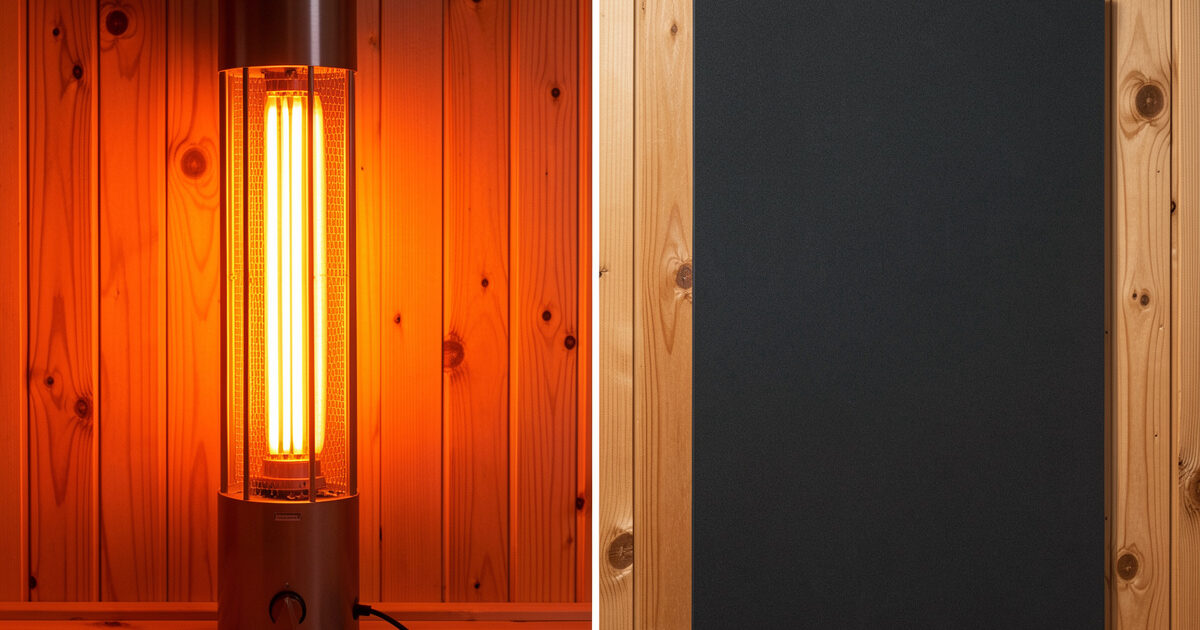
Near and far infrared are the same kind of radiation — invisible heat — separated only by wavelength, and wavelength is set by how hot the emitter runs. Wien’s law makes it concrete: peak wavelength in micrometers is roughly 2898 divided by the emitter’s surface temperature in kelvin. A near-infrared halogen tube glows at 2000 K and up, which puts its peak near 1.3 µm. A far-infrared carbon panel sits around 85°C (358 K), which puts its peak near 8 µm — six times longer.
That’s the whole root of every other difference. A hot, small, glowing source gives you near-infrared; a cool, large, invisible panel gives you far-infrared. Everything downstream — felt heat, penetration, ramp, EMF — flows from those two facts. The broader band map is in my infrared sauna spectrum guide, and the physical emitters behind each band are covered in near, mid and far infrared heaters.
How Each Band Feels in the Cabin
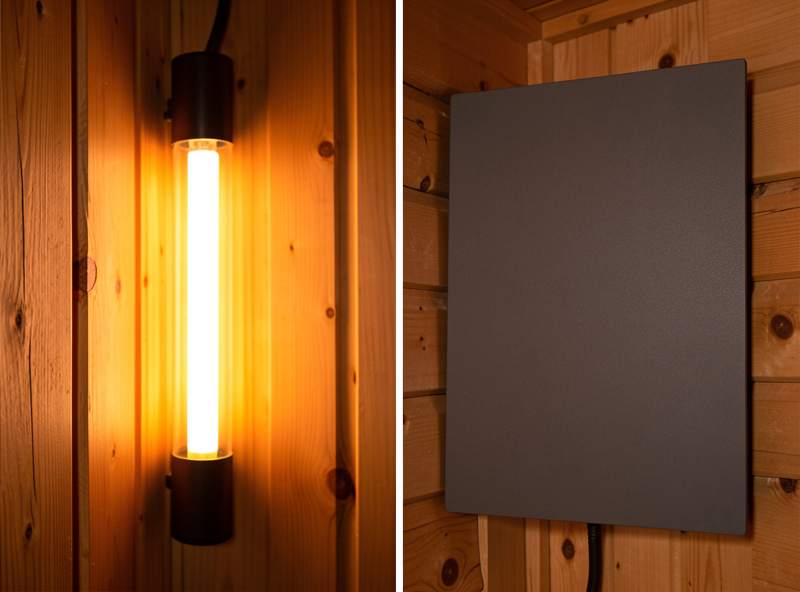
Near and far infrared feel completely different from the seat. The near-infrared emitter in my full-spectrum unit is a directional spotlight: hot, immediate, and concentrated on whatever skin faces the tube. Turn your back and that side goes cool. It’s the same sensation as a patio heat lamp — intense where it points.
Far-infrared from my carbon cabin is the opposite. The panels are large and cover most of the wall, so the warmth is even, gentle, and wraps the whole body. There’s no glowing spot to face; the entire enclosure becomes a mild radiant field. At the same air temperature the far-infrared cabin feels softer and more tolerable for a long sit, while the near-infrared emitter feels hotter faster but only where it’s aimed. Neither is “more heat” — they distribute it differently, and that distribution is the thing most buyers actually react to.
Penetration: Near Goes Deeper, Not Far
This is where the marketing gets the physics backwards, so it’s worth being precise. The popular claim is that far-infrared penetrates deepest, often quoted as “1.5 inches into the body.” Optically, near-infrared penetrates deeper. Tissue is mostly water, and water’s absorption is lowest in a window around 0.8–1.1 µm — exactly where near-infrared sits — so near-infrared travels several millimeters before being absorbed. Water absorbs far-infrared (7–10 µm) very strongly, so that energy is deposited in roughly the first 0.1 mm, right at the surface.
Far-infrared still warms your whole body, but by heating the skin surface and the air, which then spread heat by conduction and convection — not by deep radiant reach. So if “depth” is your criterion, near wins, but depth is far less important to a comfortable sauna session than even coverage is. I work through the absorption curves in detail in the penetration depth guide.
Ramp, Preheat, and Daily Use
Near-infrared is instant. The filament is incandescent within seconds, so the moment I switch the NIR tubes on I get heat. Far-infrared needs patience: a big cool carbon panel takes 10–15 minutes to reach temperature, and until it does the field is weak and the wavelength slightly longer. This is the single most common beginner complaint — “it doesn’t feel hot” — and it’s almost always impatience with the ramp, not a fault.
In practice I preheat my far-infrared cabin on a smart plug before I open the door, so the panels are up to temperature when I sit. The near-infrared emitter needs no preheat at all. If you want heat the instant you step in, near has the edge; if you’re happy to schedule a preheat, far gives you a steadier, more even sit. The session mechanics for each are in the full-spectrum band explainer.
EMF: The Two Bands Read Differently
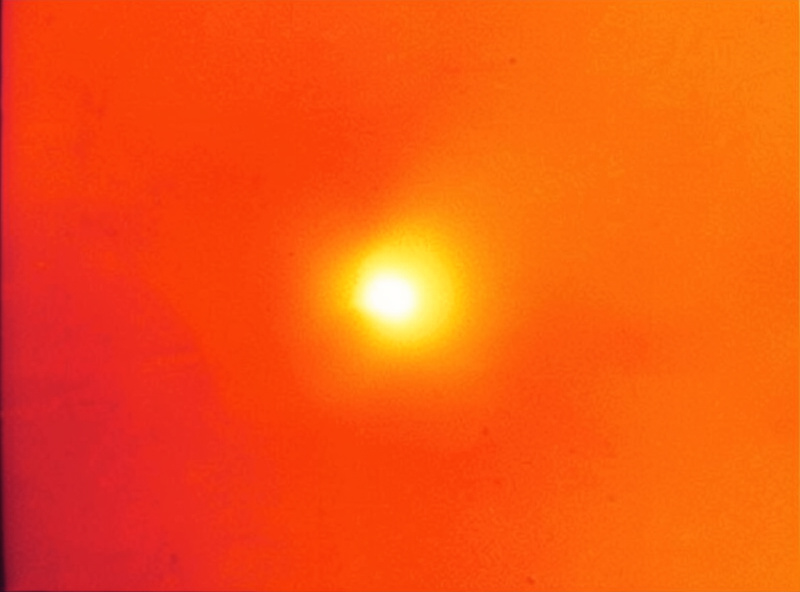
On my TriField TF2 the two bands behave differently because of how they’re built. The large, low-current carbon far-infrared panels in my daily driver read low — often a milligauss or two at seat distance once the wiring is dressed away from the bench. A near-infrared halogen emitter concentrates current through a small element, so it reads higher right at the tube, though the field drops off quickly as you move away.
This is why all-far-infrared cabins are the easy choice for anyone prioritizing low EMF: there’s simply less concentrated current in the design. Adding a near-infrared emitter adds a localized field source you don’t otherwise have. It’s not a reason to avoid near-infrared — it’s a reason to measure it and sit at a sensible distance. The metering method is in how to measure sauna EMF and what the labels mean is in the low-EMF guide.
Near vs Far Infrared at a Glance
| Property | Near-infrared | Far-infrared |
|---|---|---|
| Wavelength | 0.7–1.4 µm | 3 µm and longer (~8 µm typical) |
| Emitter | Halogen / incandescent tube | Carbon or carbon/ceramic panel |
| Surface temp | 2000 K+ (glowing) | ~80–95°C (invisible) |
| Felt heat | Hot, directional spotlight | Gentle, even, whole-body |
| Penetration | Several mm (deeper) | ~0.1 mm (surface) |
| Ramp | Seconds | 10–15 min preheat |
| EMF (on my TF2) | Higher at the tube | Low with good wiring |
Running Cost and Efficiency
The two bands also land differently on the electricity bill. A near-infrared halogen emitter is power-hungry for its size — that incandescent filament draws hard while it’s on — but you typically run it for only part of a session and it covers a small area. Far-infrared carbon panels run cool and spread their draw over a large radiating surface, which makes them the efficient choice per unit of felt, whole-body warmth.
In my own setup the far-infrared daily driver pulls around 1.6 kW once warm and a 40-minute session including preheat lands near 1.0–1.3 kWh on the kill-a-watt. A full-spectrum cabin draws more during its near-infrared phase. None of this is a deal-breaker either way, but if you’re sizing a circuit, the unit most likely to want its own 20A line is the one with a high-wattage near-infrared emitter. The full math is in electricity cost per session.
Which One Should You Choose?
For a whole-body, low-EMF, comfortable-for-a-long-sit cabin, far-infrared carbon is the straightforward pick, and it’s what I use most nights through the winter. For a hot, immediate, directional element you face for part of a session, a genuine near-infrared emitter adds something far panels can’t — but only if it’s a real, powerful emitter rather than a token bulb. Many buyers end up wanting both, which is what “full spectrum” is supposed to deliver; whether it delivers honestly is the subject of is full-spectrum worth it.
The decision isn’t near-versus-far as rivals. It’s matching the wavelength’s behavior — coverage, ramp, depth, EMF — to how you’ll actually use the room. Get that right and the brochure adjectives stop mattering. For the broader three-way framing including full spectrum, see the original near vs far vs full spectrum overview.
Frequently Asked Questions
What is the main difference between near and far infrared?
Wavelength and emitter type. Near-infrared is 0.7 to 1.4 micrometers from a glowing halogen tube above 2000 kelvin. Far-infrared is 3 micrometers and longer from a cool carbon panel around 85 Celsius. That gap sets felt heat, depth, ramp and EMF.
Does near or far infrared penetrate deeper?
Near-infrared penetrates deeper. Around 0.8 to 1.1 micrometers it sits in water’s low-absorption window and travels several millimeters. Far-infrared at 7 to 10 micrometers is absorbed in the first 0.1 millimeter of skin, contrary to the common deep-penetration marketing claim.
Which infrared feels hotter in a sauna?
Near-infrared feels hotter faster because the emitter is incandescent and directional, like a heat lamp on the skin facing it. Far-infrared feels gentler and more even because large cool panels spread the warmth over the whole body at once.
Is far infrared lower EMF than near infrared?
Usually yes. Large low-current carbon far-infrared panels read low on my TriField TF2, often one to two milligauss at seat distance with tidy wiring. Near-infrared halogen emitters concentrate current and read higher at the tube, though the field drops off with distance.
Why does my far infrared sauna take so long to feel warm?
Far-infrared carbon panels are large and run cool, so they need 10 to 15 minutes to reach temperature. Until then the radiant field is weak. Preheating on a smart plug before you sit fixes the most common beginner complaint about far-infrared cabins.
Can one sauna have both near and far infrared?
Yes, that is what full-spectrum cabins do: large far-infrared panels for whole-body warmth plus one or more near-infrared emitters for directional heat. The catch is that a token low-wattage near-infrared bulb delivers very little of the near band.
Related Guides
- Infrared Sauna Spectrum Explained
- Infrared Wavelength Penetration Depth
- Is a Full-Spectrum Infrared Sauna Worth It?
- Near, Mid and Far Infrared Heaters
- Carbon vs Ceramic Infrared Sauna
As an Amazon Associate I earn from qualifying purchases. If you want to see the EMF gap between the two bands for yourself, a TriField TF2 meter is the tool I reach for.