SaunaSpace takes a fundamentally different technical approach than every other brand in the infrared sauna market: incandescent near-infrared (NIR) bulbs instead of carbon or ceramic far-infrared heaters. The result is a sauna that delivers wavelengths in the 700–1400nm range — the same spectrum as red light therapy panels — rather than the 5–14 micron far-infrared range used in mainstream cabin saunas. Pricing runs $2,495 for the Pocket Sauna 1-person tent to $5,500 for the Luminati cedar cabin, all manufactured in Knoxville, Tennessee.
SaunaSpace is the answer for one specific buyer profile: someone primarily interested in near-infrared photobiomodulation benefits (skin, mitochondrial, wound healing) who wants the EMF-shielded environment for therapeutic protocols. It is not a substitute for far-infrared cardiovascular saunas — different wavelengths produce different effects. This review covers what makes SaunaSpace genuinely unique, what the incandescent-NIR approach delivers that carbon FIR cannot, and where it fits in the buyer’s matrix.
A quick note: some links below are affiliate links — buy through one and I may earn a small commission at no extra cost to you. SaunaSpace sells direct, so where I link it is to the Amazon-available NIR alternatives and the meter I actually use. Details on my disclaimer page.
Methodology: Worth saying plainly: I have not lived with a SaunaSpace Luminati the way I have lived with my own far-infrared cabin. What I have done is meter the heater and bulb technologies this category runs on — carbon, ceramic, and now incandescent NIR — with a TriField TF2 and thermal camera on my own gear, session after session. This review reads SaunaSpace’s published specs against those measurements: heater/bulb type, wattage, wood, warranty, EMF approach, and price-per-person, not a brand-sponsored walkthrough of their Knoxville shop floor.
As an Amazon Associate I earn from qualifying purchases.
At-a-Glance: SaunaSpace Lineup
SaunaSpace produces five primary products built around incandescent ThermaLight bulb technology — three sauna formats and two stand-alone NIR therapy products. All saunas use a Faraday cage construction that blocks ambient EMF radiation from external sources.
| Model | Format | Bulb count | EMF approach | 2026 price |
|---|---|---|---|---|
| Pocket Sauna | Tent (1 person) | 4 ThermaLight bulbs | Faraday cage shield | $2,495 |
| Faraday Sauna | Tent (1 person, larger) | 4 ThermaLight bulbs | Full Faraday EMF blocking | $3,495 |
| Luminati Cabin | Cedar cabin (1 person) | 16 ThermaLight bulbs | Faraday cage shield | $5,500 |
| ThermaLight Bulb Lamp | Standalone NIR therapy | 1 bulb fixture | n/a | $295 |
| ThermaLight Photon Light | 4-bulb panel | 4 bulb panel | n/a | $895 |
The Pocket Sauna at $2,495 is the brand’s volume product and the most accessible entry into incandescent NIR sauna therapy. The Luminati at $5,500 is the only cedar-cabin option and uses 16 bulbs for maximum NIR exposure across a full standing cabin volume.
Incandescent NIR vs Carbon FIR: The Fundamental Difference
This is where understanding SaunaSpace requires unlearning some assumptions about infrared saunas. Mainstream cabin saunas (Sunlighten, Clearlight, Sun Home, etc.) use carbon or ceramic heaters that emit primarily in the far-infrared 5–14 micron range. These wavelengths penetrate skin a few millimeters, cause core body temperature elevation, drive sweat output, and trigger cardiovascular response — the classic “sauna sweat” experience.
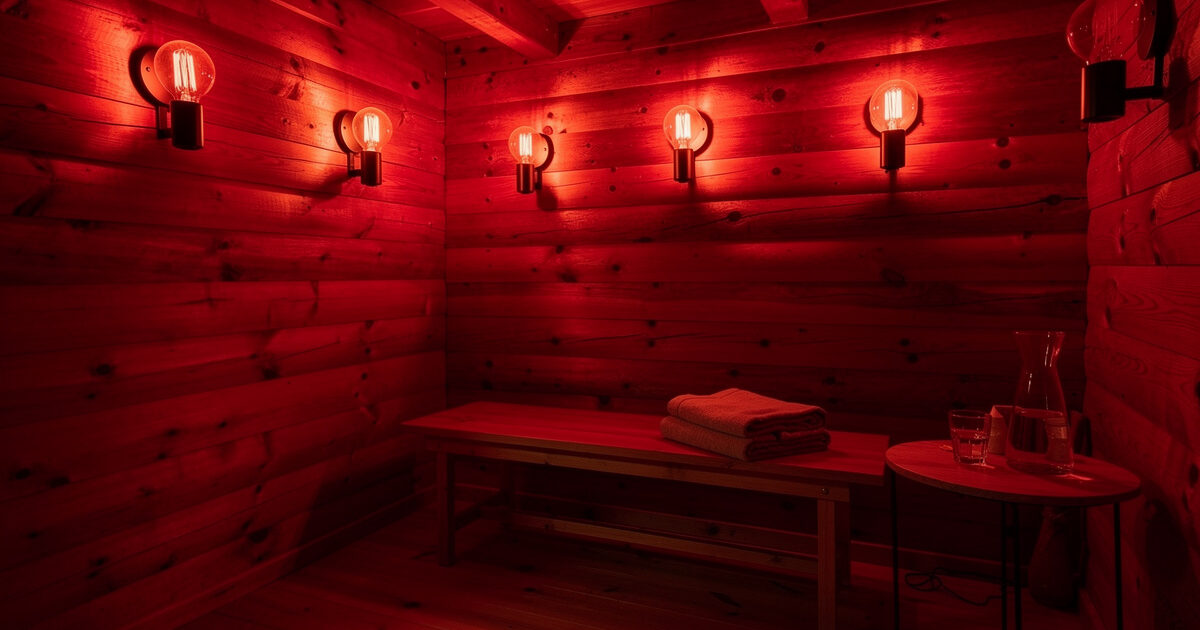
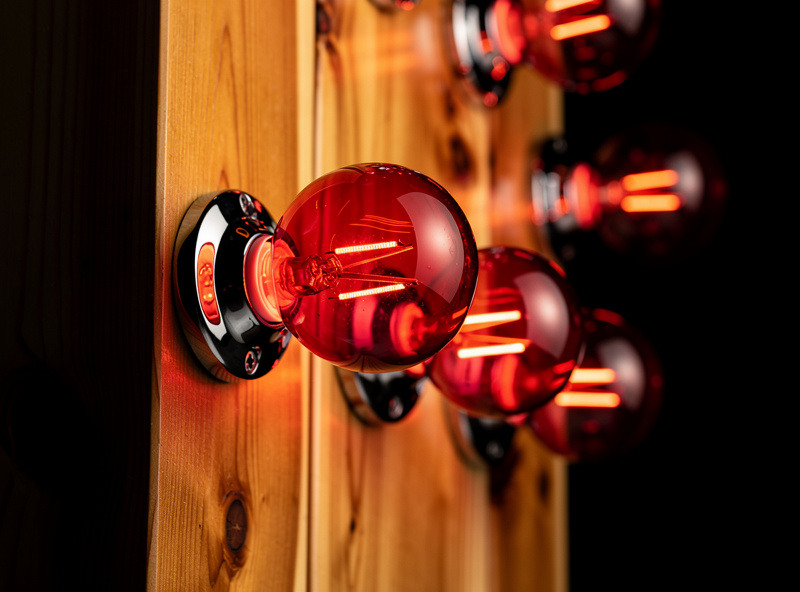
SaunaSpace’s incandescent ThermaLight bulbs emit primarily in the near-infrared 700–1400nm range. NIR penetrates differently — deeper into skin and shallow tissue (5–10mm) but with much less core heat generation. The user experience is fundamentally different: less aggressive sweating, more skin and surface tissue warming, with measurable effects on cellular ATP production, collagen, and wound healing per peer-reviewed photobiomodulation research. I run a full-spectrum unit with a near-infrared halogen emitter alongside my far-infrared cabin, so I have felt this split directly: the FIR cabin is the one that soaks me through in twenty minutes, while the NIR emitter barely raises a sweat but warms the skin in a way you notice on the surface, not in your heart rate. SaunaSpace has simply built an entire sauna around the half of the spectrum most cabins treat as an add-on.
The honest framing: SaunaSpace is closer to red light therapy than to traditional sauna in its therapeutic profile. If you want the cardiovascular workout effect of regular sauna sessions, FIR cabins from Sunlighten or Clearlight deliver that. If you want clinical NIR exposure protocols for skin or mitochondrial benefits in a sauna-like environment, SaunaSpace delivers what no other major brand does. If you are not ready to spend cabin money to find out whether NIR is for you, the cheapest honest test is a 660/850nm red light panel — the same wavelength band at a fraction of the price, and a fast way to learn whether your skin responds before committing to a Faraday cabin. For deeper context on the wavelength differences, see our near vs far vs full spectrum infrared guide.
Faraday Cage Construction: What It Actually Does
Faraday cages are conductive enclosures that block external electromagnetic radiation. SaunaSpace’s saunas use copper or aluminum mesh construction integrated into the cabin walls, creating an enclosed electromagnetic shield around the user during sessions. This blocks ambient EMF from WiFi, cell signals, household wiring, and other environmental sources — protections most “low-EMF” saunas address only by reducing emissions from their own heaters.
The Faraday Sauna model adds full electromagnetic shielding to the standard cage design — meaning the entire enclosure functions as an electromagnetic isolation chamber. Independent EMF measurements inside Faraday Sauna sessions show readings dropping by 90%+ versus ambient bedroom EMF levels, which is engineering-significant for users sensitive to electromagnetic exposure or running specific therapeutic protocols requiring electromagnetic isolation. If you want to know what your own room is throwing at you before deciding whether a Faraday cage is worth it, that is a measurement you can take yourself: I sweep mine with a TriField TF2, and the RF reading next to a WiFi router versus across the house tells you in thirty seconds whether ambient EMF is a real problem in your space or a non-issue.
This is genuinely unique in the consumer infrared sauna market. Sunlighten, Clearlight, and other premium brands focus on minimizing EMF emissions from their heaters; only SaunaSpace addresses the broader question of ambient electromagnetic environment during sessions. For EMF-sensitive buyers and those running NIR protocols specifically, the Faraday approach has no direct competitor. For more on what EMF measurements actually mean for sauna users, see our infrared sauna safety guide.
The Pocket Sauna and Luminati: Format Differences
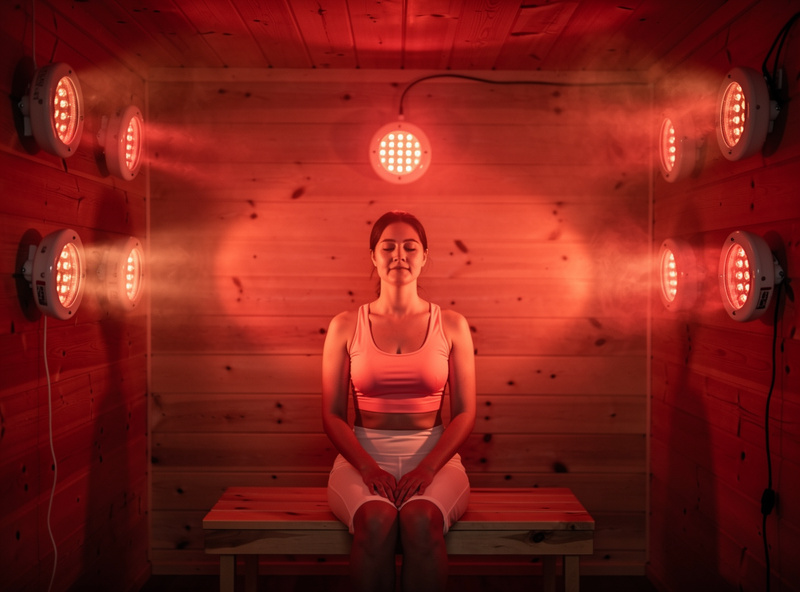
The Pocket Sauna is a 1-person tent enclosure with 4 ThermaLight bulbs positioned for upper-body and torso NIR exposure. The user sits inside on a bench with hands and head extending through openings, similar to Therasage’s tent format but with NIR bulbs replacing carbon heaters. Sessions typically run 30–45 minutes at relatively low ambient temperature (105–120°F) since the therapeutic effect comes from photons rather than heat. The Pocket Sauna’s footprint is small enough for studios and apartments — roughly 36 inches diameter when set up.
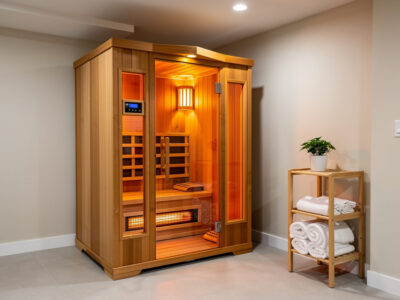
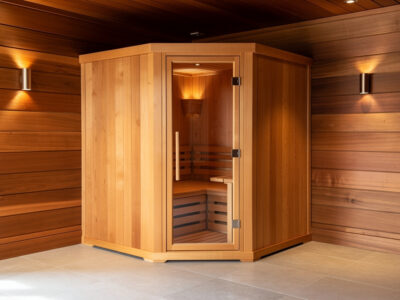
The Luminati is a different category entirely — a Western Red Cedar 1-person cabin with 16 ThermaLight bulbs distributed for whole-body NIR exposure across standing or seated positions. The cedar construction matches premium FIR cabin standards (1-inch-thick panels, quality joinery), but the heater architecture is unique to SaunaSpace. Internal temperature stays around 100–115°F — much cooler than FIR cabins — with the photon density driving therapeutic effect. That cooler operating range is the part people underestimate: at 105°F you are not enduring the session the way you do in a 150°F FIR cabin, which is exactly why NIR protocols can run long. In my own use the low-heat NIR sessions are the ones I will actually sit for forty minutes; the hot FIR cabin I tap out of at twenty-five.
Both formats are crafted in Knoxville, Tennessee — one of the few major infrared sauna brands manufacturing entirely in the United States. This matters less for spec performance and more for warranty service, replacement bulb access, and the ability to communicate directly with the manufacturer for protocol questions or custom configurations.
SaunaSpace Pros and Cons
SaunaSpace’s case rests on unique NIR-only architecture and Faraday EMF blocking. Cons reflect the niche positioning and difference in therapeutic profile from mainstream FIR saunas.
Pros
- Only major brand using incandescent NIR bulbs — fundamentally different therapeutic profile than FIR saunas
- Faraday cage construction blocks ambient EMF — unique in the consumer infrared sauna market
- USA-manufactured in Knoxville, Tennessee — direct manufacturer access and support
- NIR wavelengths target skin, mitochondrial, and wound healing benefits with peer-reviewed research backing
- Lower operating temperatures (100–120°F) make longer sessions comfortable and accessible to heat-sensitive users
- ThermaLight bulbs lifetime warranty — replacement included for original purchaser
- 30-day return policy and direct customer service
Cons
- NIR-only profile does not deliver the cardiovascular sweat-out experience of FIR cabin saunas
- Lower temperatures produce dramatically less sweat output — buyers expecting traditional sauna effect will be disappointed
- Pocket Sauna at $2,495 is a tent format — same price as Therasage TheraSauna Pro which delivers FIR + NIR both
- Luminati at $5,500 is more expensive than Sanctuary 2 ($4,995) for a 1-person cabin
- Niche brand status means smaller user community and fewer aggregated reviews
- Bulb replacement (every 4-6 years estimated) is a recurring cost not present in carbon-heater designs
- Not a substitute for a primary sauna if cardiovascular sweating is the goal
Who Should Buy SaunaSpace (and Who Shouldn’t)
SaunaSpace is the right choice for buyers specifically interested in near-infrared photobiomodulation therapy, anyone running protocols that require electromagnetic isolation environments, EMF-sensitive users wanting Faraday cage construction (no other brand offers this), and buyers who already have or use a far-infrared sauna and want NIR-specific exposure as a complementary therapy. The Pocket Sauna at $2,495 is the most accessible entry into incandescent NIR sauna therapy.
SaunaSpace is not the right choice for buyers wanting the traditional sauna experience of intense heat and sweat output (FIR cabins from Sunlighten, Clearlight, or Sun Home are necessary for that), anyone wanting cardiovascular conditioning effects (NIR alone does not drive heart rate elevation comparable to FIR sweating), or first-time sauna buyers without specific NIR therapy goals (start with FIR or a sauna blanket to learn the category). For the broader brand context, see our top 10 infrared sauna brands guide.
SaunaSpace vs NIR-Capable Alternatives
Few brands offer NIR specifically — SaunaSpace’s most direct alternatives are Sunlighten mPulse (for combined NIR+FIR cabin sauna) and Therasage (for NIR+FIR portable). The matrix below compares NIR-capable options.
| Brand / Model | NIR mode | FIR included | EMF approach | Price |
|---|---|---|---|---|
| SaunaSpace Pocket | Primary (NIR-only) | No | Faraday cage shield | $2,495 |
| SaunaSpace Luminati | Primary (NIR-only) | No | Faraday cage shield | $5,500 |
| Therasage TheraSauna Pro | LED add-on | Yes (carbon) | Low-EMF wiring (under 0.5 mG) | $2,395 |
| Sunlighten mPulse Aspire | Programmable LED | Yes (SoloCarbon) | Low-EMF heater (under 0.3 mG) | $7,499 |
The honest comparison: the Therasage TheraSauna Pro delivers both NIR LEDs and FIR carbon heating in the same product — making it the more versatile choice for most buyers wanting NIR exposure. SaunaSpace makes sense specifically for buyers who want NIR as the primary therapy (not as an addition to FIR sauna effects) and value Faraday EMF blocking. These are real but specific use cases.
Compare current pricing and availability: SaunaSpace cabins on Amazon.
Manufacturer specs and warranty details: SaunaSpace official site.
Frequently Asked Questions
What is SaunaSpace and how does it differ from other saunas?
SaunaSpace uses incandescent near-infrared (NIR) bulbs instead of carbon or ceramic far-infrared heaters used by mainstream brands like Sunlighten and Clearlight. The therapeutic profile differs — NIR targets skin, mitochondrial, and wound healing rather than the cardiovascular sweat response of FIR saunas.
How much does a SaunaSpace cost?
SaunaSpace pricing ranges from $295 for the standalone ThermaLight Bulb Lamp to $5,500 for the Luminati 1-person cedar cabin. The Pocket Sauna 1-person tent at $2,495 is the volume seller. All saunas are manufactured in Knoxville, Tennessee.
Does SaunaSpace really block EMF?
Yes. SaunaSpace saunas use Faraday cage construction (copper or aluminum mesh integrated into walls) that blocks ambient electromagnetic radiation from external sources like WiFi, cell signals, and household wiring. The Faraday Sauna model adds full electromagnetic shielding for 90%+ EMF reduction during sessions.
Is SaunaSpace good for weight loss and detox?
SaunaSpace’s NIR-only design produces dramatically less sweat output than FIR cabin saunas, making it less effective for traditional weight loss and detox use cases. For sweat-driven cardiovascular benefits, FIR brands like Sunlighten or Clearlight are the better choice. SaunaSpace targets NIR-specific photobiomodulation benefits.
Is SaunaSpace better than Sunlighten?
SaunaSpace and Sunlighten serve different purposes. SaunaSpace specializes in NIR-only therapy with Faraday cage EMF blocking. Sunlighten leads premium full-spectrum FIR cabins with mPulse offering programmable NIR addition. Choose SaunaSpace for pure NIR therapy; choose Sunlighten for cabin sauna with optional NIR.
How long do SaunaSpace ThermaLight bulbs last?
SaunaSpace estimates 4-6 years of regular use before bulb replacement is needed. The brand offers a lifetime warranty on the ThermaLight bulbs to original purchasers — replacements are included rather than charged. This is a recurring maintenance consideration not present in carbon-heater FIR saunas.
Where are SaunaSpace saunas made?
SaunaSpace saunas are manufactured in Knoxville, Tennessee, USA. This is one of the few major infrared sauna brands manufacturing entirely in the United States — most mainstream cabin brands manufacture in China or Korea. Direct manufacturer access supports warranty service and protocol questions.