The honest split: a portable infrared sauna—a blanket, a fold-up tent, or a pop-up box with your head out—asks for almost nothing (a plug, a corner, a few minutes of setup), while a fixed infrared cabin asks for floor space, sometimes wiring, and a permanent home. Portables win on price, storage, and mobility; fixed cabins win on comfort, even heat, and longevity. Which is right comes down to one question: how much are you willing to commit?
I run a fixed two-person far-infrared cabin as my daily driver and keep a portable infrared blanket for travel and small-room use, so I have lived on both sides of this. They are not the same purchase with different price tags—they are different commitments that suit different lives. Here is how I’d help a friend choose.
What “Portable” and “Fixed” Actually Mean
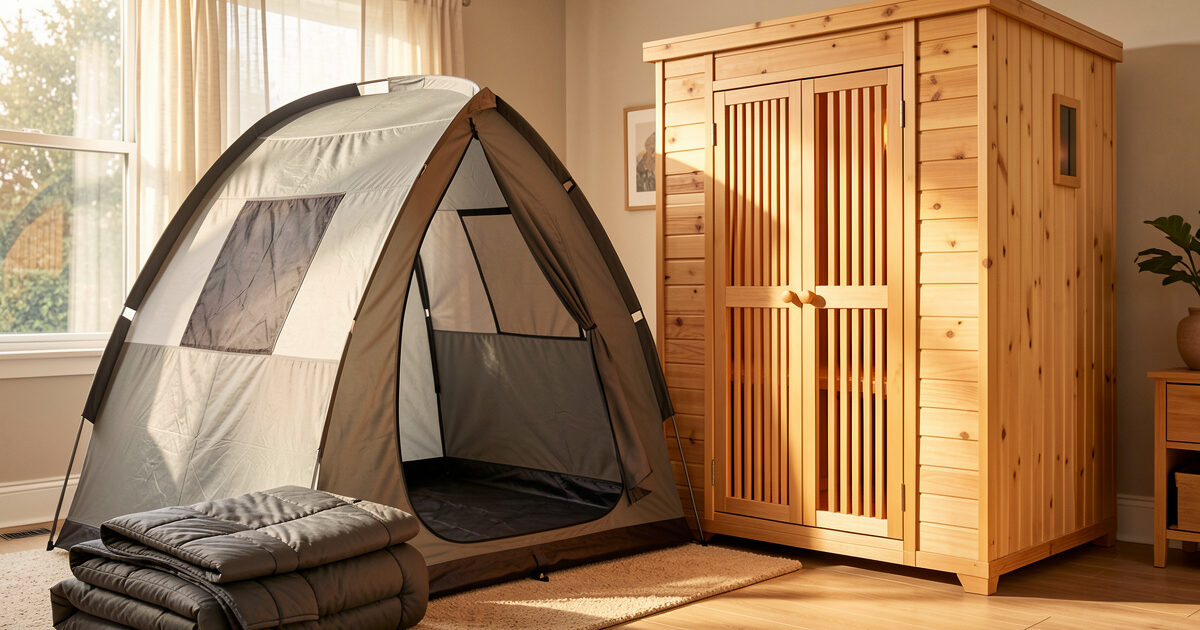
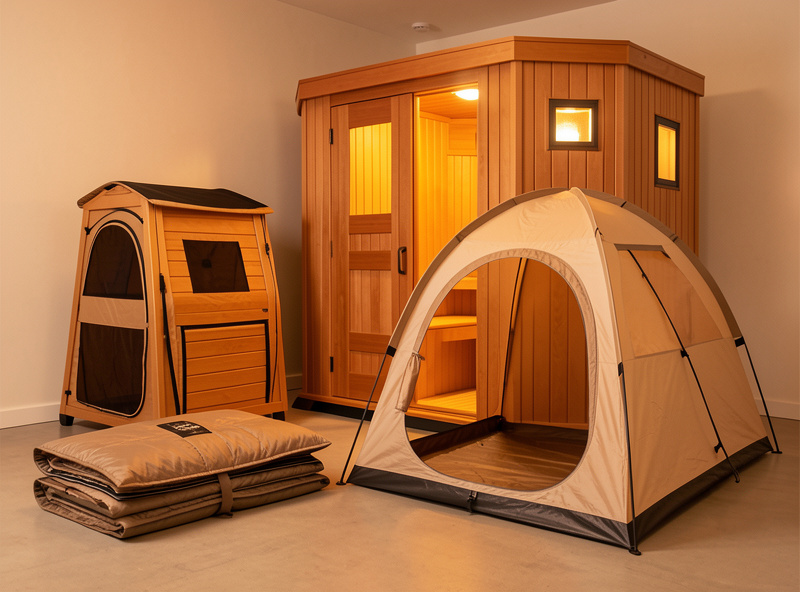
Portable covers any infrared unit you can move and store: a sauna blanket you zip into lying down, a fold-up tent or pop-up box you sit in with your head sticking out, or a lightweight cabin you could in theory relocate. The defining trait is that it does not need a permanent spot—it sets up when you want it and packs away when you don’t.
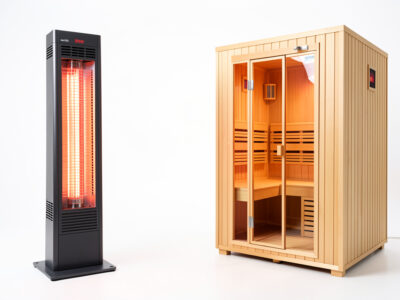
Fixed means a cabin that lives in one place: assembled wood panels, bench seating, full enclosure, and a heater array wired or plugged into a dedicated spot. You walk into it and sit upright. It is furniture, not gear—you site it once and it stays. That permanence is the root of every trade-off that follows, from heat quality to EMF to how long it lasts.
Heat Quality and Comfort
This is where fixed cabins earn their footprint. In my cabin the panels surround me, the air reaches a stable set temperature, and I can sit upright, shift position, and breathe comfortably—and when I map it with my thermal camera the heat is reasonably even once it is up to temperature. A portable tent or blanket cannot do that as well. The enclosed volume is smaller and less insulated, so cold spots and uneven heat are more pronounced, and the posture is fixed: you lie still in a blanket or sit hunched in a tent with your head out in cool room air.
None of that makes portables bad—a blanket delivers genuine contact heat and a tent gets you sweating—but the experience is more “session you endure” than “ritual you relax into.” If sitting in even, enveloping heat matters to you, the fixed cabin is noticeably more comfortable. If you just want to sweat and don’t mind a tighter, less even environment, a portable does the job. I break down the portable formats themselves—blankets, tents, and boxes—in portable infrared sauna: blankets, tents, and boxes compared.
The EMF Difference
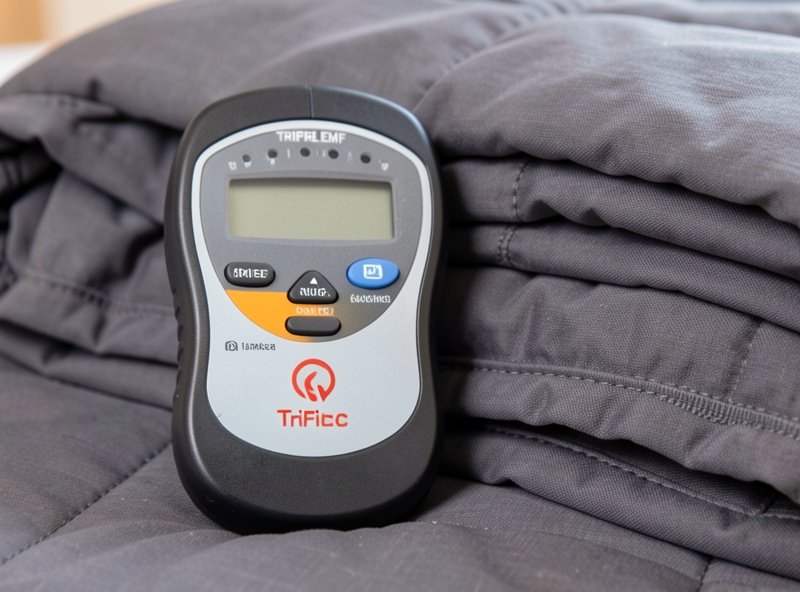
This is the part most comparisons skip, and it genuinely favors a well-built fixed cabin. In a fixed unit the heating panels sit a foot or two from your body and the wiring can be routed for low EMF, so on my TriField the magnetic field at sitting distance reads low. A blanket is the opposite case: the heating elements are inches from your torso, wrapped against you, so even a well-made blanket puts the source much closer to your body, and positioning matters far more.
That does not make portables unsafe—it means the format changes the EMF picture and you should know that going in. With a blanket, how the elements are laid out and how you position yourself in it carry more weight than they do in a cabin where you can simply sit back from the panels. If EMF is something you take seriously, it is worth metering whatever you buy; I walk through the method in how to measure infrared sauna EMF with a TriField and what a low-EMF claim is really worth in low-EMF infrared sauna.
Cost, Space, and Install
The price gap is the headline reason portables exist. A sauna blanket can cost roughly a tenth of a fixed cabin and stores in a closet; a tent is similarly cheap and folds away. A fixed cabin is a real purchase that wants permanent floor space and, for many units, a dedicated circuit—mine runs on its own 16A line. Portables mostly run off a standard outlet and draw far less power, in the few-hundred-watt range rather than the kilowatts a cabin pulls.
So the calculus is clear: if budget is tight, space is scarce, or you rent and move often, a portable removes almost every barrier to owning infrared at all. If you have the room and plan to use it daily for years, the cabin’s higher cost and install effort buy you a better-made object that lasts. I cover the cabin’s wiring and siting in the installation requirements guide, and the broader money picture sits in the comparison hub.
Portable vs Fixed at a Glance
| Factor | Portable (blanket/tent) | Fixed cabin |
|---|---|---|
| Price | Low (often ~1/10 of a cabin) | Higher, a real purchase |
| Space | Stores away | Permanent floor space |
| Power | ~0.2–0.6 kW, standard outlet | 1.5–2.5 kW, often dedicated circuit |
| Heat quality | Tighter, less even, fixed posture | Even, upright, room to move |
| EMF | Elements inches from you | Panels routable, sit back from them |
| Longevity | Lighter build, shorter life | Built to last years |
| Best for | Renters, small spaces, travel, budget | Daily use, owners with room |
Setup, Cleanup, and Daily Friction
Day to day, the two formats feel different in a way the spec sheets miss. A fixed cabin has near-zero friction once it is installed: I open the door, hit the preheat from the smart plug on my way past, and ten to fifteen minutes later it is ready—no assembly, no putting anything away. The friction was all paid once, at install.
A portable trades that for setup every session. A blanket has to be unrolled, plugged in, and preheated, then wiped down and rolled back up afterward; a tent has to be popped up and broken down. It is only a few minutes each way, but small friction repeated daily is what quietly decides whether a thing gets used. In my experience the cabin gets used more precisely because it is always ready, while the portable comes out when there is a specific reason. If you know yourself to be someone who skips anything with setup steps, weight that honestly—the most-used sauna is the one that is easiest to start.
Travel, Renting, and Trying Before You Commit
There are real cases where a portable is not the compromise—it is the right tool. If you travel and want infrared on the road, a blanket packs into a suitcase in a way no cabin ever will. If you rent and cannot wire a circuit or give up permanent floor space, a portable lets you own infrared at all without touching the building. And if you are not sure infrared is for you, a cheap blanket is a low-stakes way to find out before committing to a cabin’s price and footprint.
That last case is one I genuinely recommend: plenty of people start with a portable to test whether they will actually use infrared regularly, then graduate to a fixed cabin once they know it has become a habit. The portable is not wasted money in that path—it becomes the travel unit. It is the same logic I’d apply to any gear: buy cheap to learn the niche, buy well once you know you’ll live in it.
Longevity and Who Each One Suits
A fixed cabin is built to be used hard for years—solid wood, replaceable panels, serviceable components—which is why I treat mine as a long-term fixture rather than a gadget. A portable is a lighter-built object by design; a blanket’s fabric and elements and a tent’s frame and zips simply will not take a decade of daily use the way a cabin will. That is a fair trade for the price and convenience, not a flaw, but it should shape your expectation of how long the thing lasts.
So: choose a portable if you rent, move often, share a small space, want to spend a little to try infrared, or need something for travel. Choose a fixed cabin if you have the room, want the most comfortable and even heat, care about keeping the EMF source at a distance, and plan to make this a daily habit you keep for years. If you are torn specifically between a blanket and a cabin, that exact decision gets its own deep dive—keep reading with the sauna blanket vs cabin comparison, the best infrared sauna blankets roundup if a blanket is your starting point, and the full infrared vs alternatives hub to see where portables and cabins sit against steam rooms, hot tubs, and traditional saunas.
If you forced me to give one answer: most people who have the space and intend to use infrared regularly are happier, long term, with a fixed cabin—the even heat, the upright comfort, the ability to sit back from the panels, and the years of service add up to a better daily object. The portable wins decisively only when space, budget, mobility, or uncertainty rule the cabin out, and in those cases it is a genuinely good answer rather than a consolation prize. Match the format to your life, not to a spec sheet, and you will not regret either one.
As an Amazon Associate I earn from qualifying purchases. If a portable is where you are starting, an infrared sauna blanket is the lowest-barrier way in.