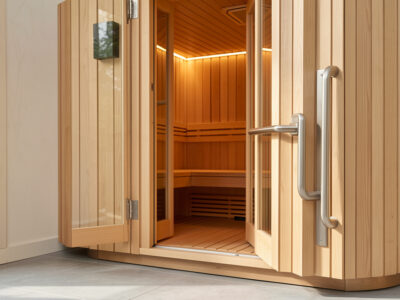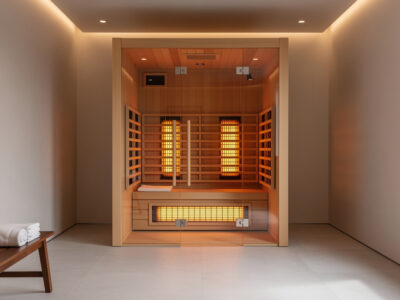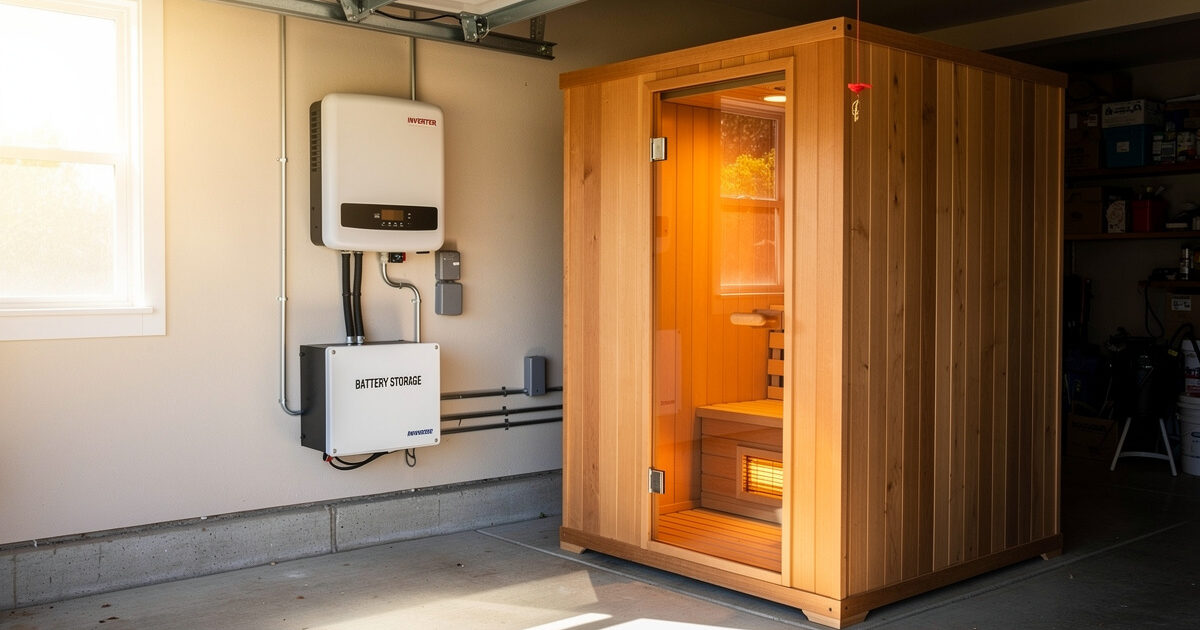
An infrared sauna is a 1500-2400W resistive load that draws steady current the moment its smart plug closes. Solar-plus-battery systems handle that draw cleanly only if the inverter is sized for both the running watts and the small inrush spike at switch-on, and only if the battery bank can sustain the 35-40 minute session without sagging under voltage. The math is simple but unforgiving — undersize either component and the inverter alarms, the heating elements drop output, or the breaker trips mid-session.
This guide covers the inverter sizing rules, battery bank math, and circuit layout for running a 120V or 240V infrared cabin off a hybrid solar system. The target reader has already installed solar panels and a battery bank for general home backup and now wants to add a sauna without compromising the rest of the system. Hardware figures assume 2026 prices for popular hybrid inverter platforms.
Why Saunas Are an Awkward Solar Load
Resistive heat loads behave differently from motors and electronics. They draw their full rated wattage continuously the entire time the element is energized — no duty cycle, no thermostat-driven on/off, no soft-start. A 2000W cabin pulls 2000W from second one until you switch it off, and that draws 2 kWh of battery capacity per hour of session. A 40-minute session therefore consumes roughly 1.3 kWh, every time.
The good news is that resistive loads have minimal inrush — the 1.1-1.3x spike at switch-on is far gentler than a fridge compressor or pool pump. The bad news is that the steady draw means the inverter operates close to nameplate continuously. Inverters rated for “5000W continuous” are often only honest at 80% of nameplate; a 2400W sauna pushes a 5kW inverter past 50% utilization, which is fine, but stack two appliances and you can pin the inverter at peak output.
The third quirk is voltage sag. As the battery bank approaches 50% state-of-charge, voltage at the inverter input drops 5-10%. Cheap inverters lose efficiency under that sag and may pass less voltage to the heating element, dropping the cabin’s actual heat output. This is the reason saunas on solar should run when the bank is above 60% SOC, not at the end of a long evening of consumption.
Sizing the Inverter for a Sauna Load
The minimum inverter for a 1500W cabin is 3000W continuous. For a 2000W cabin, 4000W. For a 2400W cabin, 5000W. The 2x oversizing rule covers inrush, accounts for the inverter’s typical 80%-of-nameplate honest output, and leaves room for a few hundred watts of household lighting and electronics running at the same time. Below this threshold, plan for nuisance shutdowns under simultaneous loads.
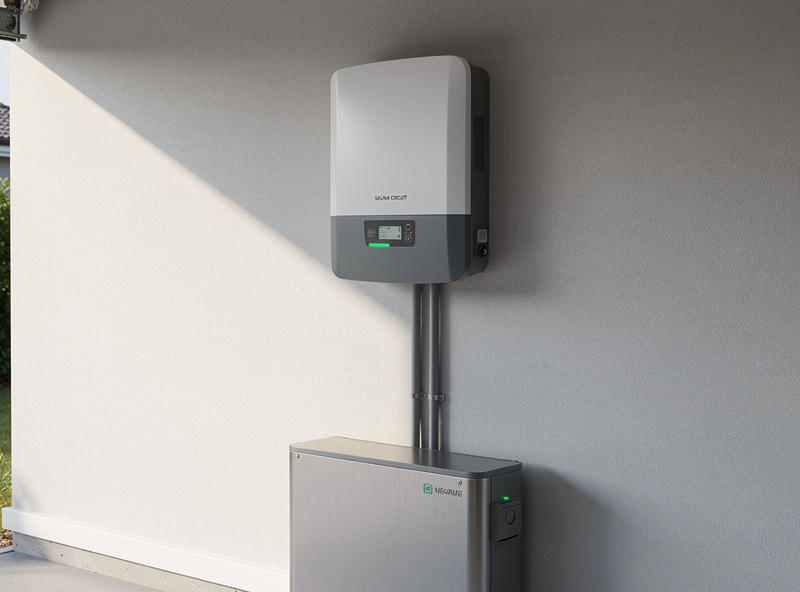
Pure sine wave output is non-negotiable. Modified sine wave inverters waste 8-15% of their output as heat in resistive heating elements and can cause uneven element temperatures inside the cabin. Any reputable hybrid inverter ships pure sine — see the best hybrid inverter for home solar guide for current model picks rated for resistive loads.
For 240V cabins, split-phase inverters or two stacked 120V inverters are required. A single 120V inverter cannot run a 240V cabin no matter the wattage rating. The split-phase question is binary: you either have a 240V-capable inverter or you do not, and the right answer is to spec the system for it from day one if a 240V cabin is on the roadmap.
Battery Bank Sizing for a 40-Minute Session
A 40-minute session at 2000W consumes 1.33 kWh. Adding a 50% reserve to keep battery SOC above 50% during the session, the bank should hold at least 2.7 kWh of usable capacity dedicated to the sauna in addition to whatever runs the rest of the house. For most installs, this means a 5 kWh battery bank minimum, with 10 kWh comfortable for daily evening use.
| Cabin Wattage | Session Length | Energy Used | Min Battery Bank | Min Inverter |
|---|---|---|---|---|
| 1500W | 40 min | 1.0 kWh | 5 kWh | 3000W |
| 1800W | 40 min | 1.2 kWh | 5 kWh | 3500W |
| 2000W | 40 min | 1.33 kWh | 5 kWh | 4000W |
| 2400W | 40 min | 1.6 kWh | 10 kWh | 5000W |
| 3000W (240V) | 40 min | 2.0 kWh | 10 kWh | 6000W split |
LiFePO4 chemistry handles the steady discharge cleanly. AGM batteries can run a sauna once or twice but cycle life collapses under repeated 30-40% depth-of-discharge events; LiFePO4 cycles 3000-5000 times at 80% DoD without measurable capacity loss. The cost difference (LiFePO4 runs 2-3x AGM upfront) pays back inside two years for any household running 3+ sessions per week.
Circuit Layout: One Dedicated 20A Circuit
The sauna gets its own breaker and home-run wiring. A 120V cabin needs a dedicated 20A breaker and 12-gauge copper from the main panel to the cabin’s input plug. A 240V cabin needs a dedicated 30A two-pole breaker and 10-gauge copper. Sharing a circuit with kitchen outlets or laundry is the most common cause of nuisance trips during sessions.
Place the sauna circuit on the inverter’s “essential loads” panel if the system uses one. This keeps the cabin powered during grid outages and ensures the inverter’s grid-tie logic correctly tracks the sauna draw. The wiring approach mirrors the broader cabin-power planning covered in the outdoor sauna foundation, power, and permits guide, including conduit runs for outdoor installs.
Time-of-Use Scheduling: Run on Sun
The most efficient pattern is “run on sun” — schedule sessions for late morning to mid-afternoon when solar production is high. A 4 kW PV array generates 3-4 kW between 11 AM and 2 PM on a clear day, more than enough to cover the cabin’s draw without touching battery storage. Evening sessions consume battery capacity that you would otherwise have for overnight household needs.
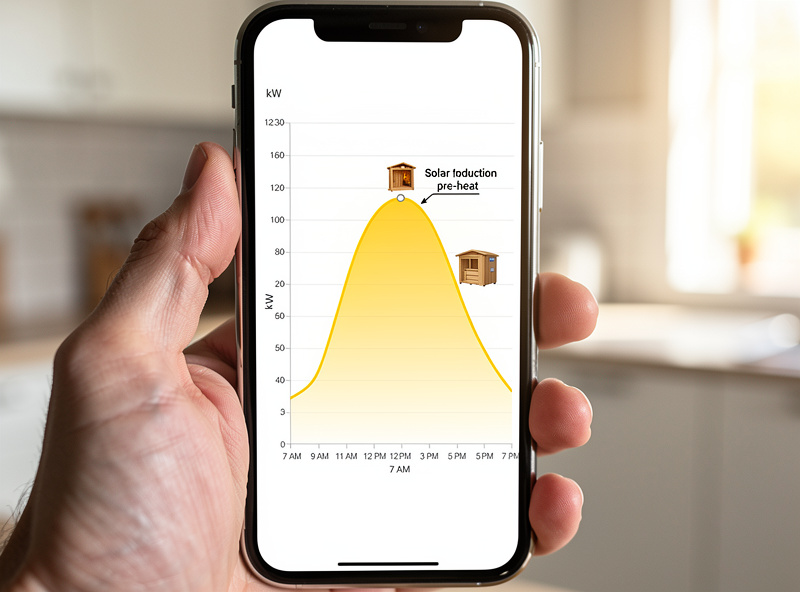
Most hybrid inverters expose a time-of-use schedule that can prioritize solar over battery for specific hours. Set the sauna’s circuit window to “solar-only” between 10 AM and 3 PM, “solar plus battery” before and after, and “no operation” after sunset if you want to preserve evening battery for fridges and lights. The dashboard work is similar to the smart-plug routine setups but lives at the inverter rather than the appliance.
For people who want evening sessions, a daily 90% SOC charge target and a 50% SOC floor protects the bank. The inverter app lets you set both as hard limits — once the bank falls below 50%, the sauna circuit gets cut and the rest of the house keeps running on remaining battery plus grid backup.
Common Sizing Mistakes
Three undersizing patterns cause most failures. First, sizing the inverter to the cabin’s nameplate without margin: a 2000W cabin on a 2000W inverter trips on inrush. Second, sizing the battery bank to one session without the 50% reserve: the bank sags below the inverter’s low-voltage cutoff at the 30-minute mark. Third, ignoring the rest of the house: a fridge plus a sauna can pin a 4kW inverter, and a microwave running concurrently kills the session.
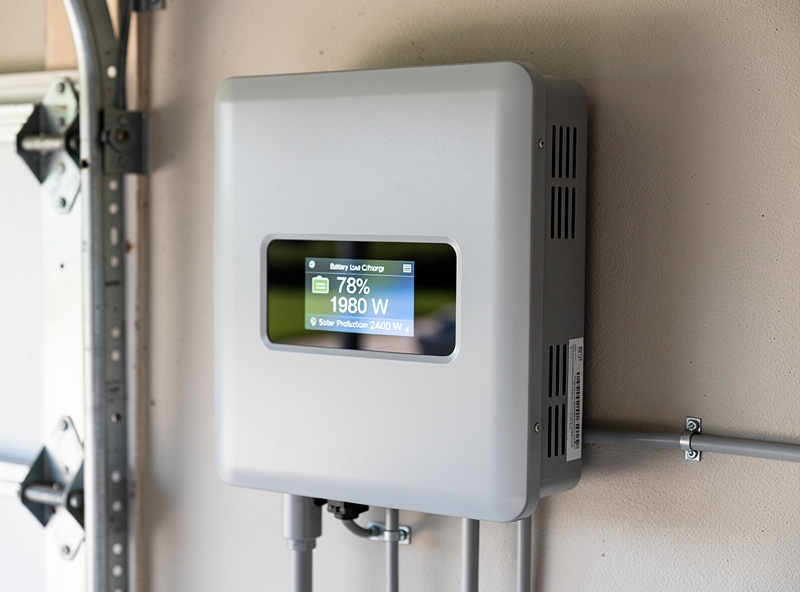
Heat pump water heaters and EV chargers are the third-load patterns to watch. Both are large, both can fire automatically, and both can collide with a sauna session timed by a smart plug. The fix is interlock logic in the inverter or smart-home hub: when the sauna circuit is energized, the EV charger pauses and the heat pump enters defrost-only mode. The detail on safe load layering is covered in the infrared sauna safety guide, which addresses electrical hazards alongside thermal ones.
Frequently Asked Questions
Can I run an infrared sauna on solar power?
Yes. A 2000W infrared cabin on a 4000W hybrid inverter with a 5 kWh LiFePO4 bank handles 40-minute sessions cleanly. Schedule sessions for high-solar hours when possible and reserve battery capacity above 50 percent state-of-charge before the session starts.
What size inverter for a 2000W infrared sauna?
4000W continuous pure sine wave is the minimum. The 2x oversizing rule covers switch-on inrush, the inverter’s typical 80 percent honest-output rating, and a few hundred watts of household lighting running concurrently. Below 4000W, expect nuisance shutdowns.
How much battery do I need for a sauna session?
A 40-minute session at 2000W uses 1.33 kWh. Plan for at least 5 kWh of usable battery so the bank stays above 50 percent state-of-charge through the session. Larger 2400W cabins or back-to-back sessions push the requirement to 10 kWh.
Pure sine vs modified sine inverter for sauna?
Pure sine wave only. Modified sine wastes 8-15 percent of inverter output as heat in resistive heating elements and creates uneven element temperatures across the cabin. Every reputable hybrid inverter ships pure sine output as standard.
Will a sauna damage my hybrid inverter?
No, if sized correctly. Resistive loads have minimal inrush, no surge spikes, and steady draw. Damage scenarios occur only when the inverter is undersized and runs near 100 percent of nameplate continuously, generating heat that shortens component life.
Best time of day to run a sauna on solar?
Late morning to mid-afternoon, when solar production exceeds the cabin’s draw. A 4kW array on a clear day produces 3-4kW between 11 AM and 2 PM, covering the entire session from panels without touching battery storage.