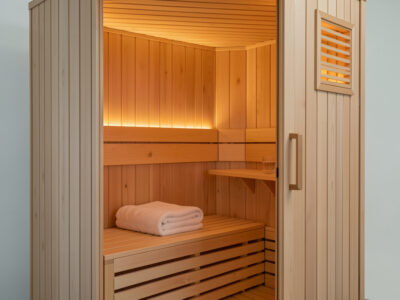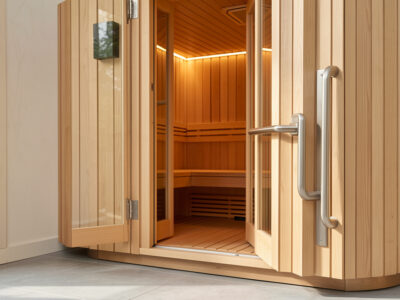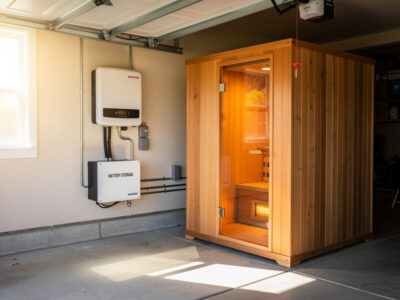
Four numbers decide whether infrared sauna seating works for an older body: a bench seat around 43–46 cm high, a backrest angled roughly 15° off vertical, slatted wood that vents and gives slightly under the back, and back panels placed to warm evenly rather than drill a hot stripe into the spine. Get those four right and a twenty-minute gentle session stops being an endurance test and becomes genuinely restful.
This is the spoke that decides whether the cabin gets used daily or abandoned after a fortnight, because nobody keeps going back to a seat that hurts. The stock bench in most modular cabins is built for a fit thirty-year-old to tolerate for twelve minutes, not for an older body to relax in for twenty, and the difference between the two is measurable in centimetres and degrees. This piece is the deep dive on seating for the senior setup in the main guide; the entry side is covered in the easy-entry guide, and the heat side in the piece on lower set temps for older users.
What Bench Height Is Comfortable for an Older Sauna User?
I set a senior sauna bench at about 43–46 cm seat height — roughly 17–18 inches, in the same range as accessible seating heights — because that is the height an older user can sit down onto and stand up from without a hands-on-the-thighs heave or an uncontrolled drop. Too high and getting up is a struggle for tired legs; too low and the hips flex past comfort and the knees complain, and getting out becomes the hardest part of the session. Forty-three to forty-six centimetres is the sweet spot in my install for almost everyone over sixty.
This is not a number I guessed. Bench height has to be set against panel placement, not in isolation, because the back panels need to land on the torso at the new seat height and a bench shift of even three centimetres moves where the radiant heat hits the spine. I use a tape measure and a spirit level when I set or rebuild a bench, not a visual estimate, because a bench that “looks about right” is rarely level and a tilted bench concentrates pressure on one sit-bone within ten minutes. The ADA Standards specify a similar accessible seating height range, and although a sauna is not an ADA space, the anthropometry is the same.
The stock bench in my first cabin sat at 50 cm with no backrest angle, and it was fine for ten minutes and miserable at twenty. When I rebuilt it I dropped the seat to 45 cm and the same twenty-minute session went from something I endured to something I actively looked forward to. The lesson was that the cabin maker’s default is a compromise for shipping, not a comfort spec, and the bench is the single most worth-rebuilding part of a senior install.
Does the Backrest Angle Actually Matter Over Twenty Minutes?
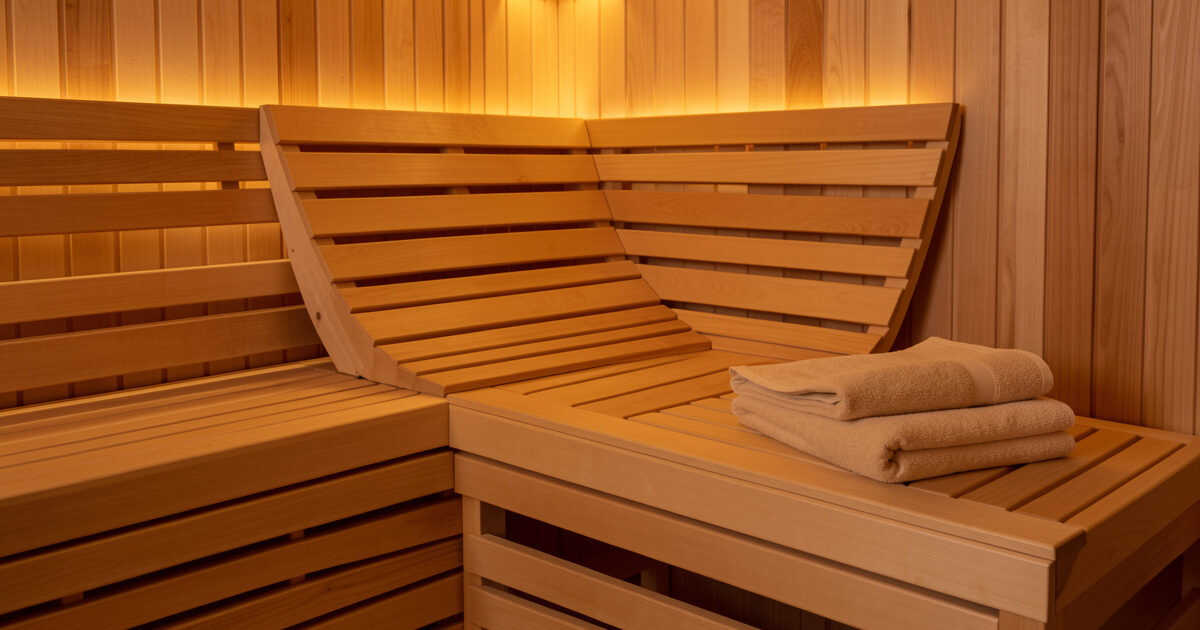
Yes, enormously — a backrest angled about 15° off vertical takes the load off the lower back and lets the spine settle into the panel instead of holding itself rigid, and over a twenty-minute session that is the difference between walking out loosened up and walking out stiffer than you went in. A flat vertical backrest forces the user to hold posture against the wall; a reclined one lets gravity do the work.
Fifteen degrees is the angle I keep coming back to across the cabins I have lived with. Less than about 10° and the backrest may as well be flat; more than about 20° and the head wants support too and the neck starts to complain. At 15° the hips and knees sit near a relaxed 100–110° angle, which is the neutral seated posture ergonomics guidance keeps returning to — OSHA’s ergonomics material frames neutral posture as the posture the body can hold without muscle tension, and a slightly reclined sauna bench is one of the few places that posture comes for free.
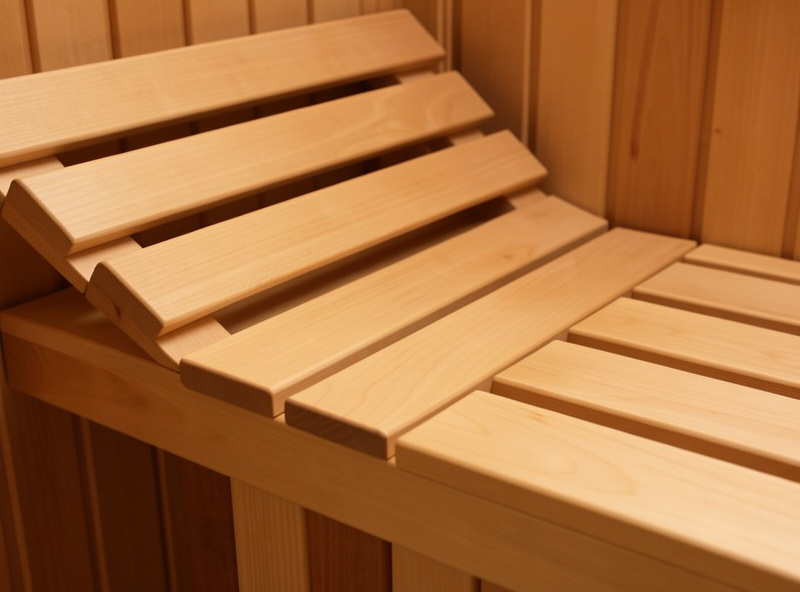
The backrest also has to be slatted, not solid, so the radiant back panel can do its job through the gaps. A solid backrest blocks the very heat the cabin is selling you, and it traps sweat against the skin. Slats with a centimetre or two of gap between them let the warmth through, vent the moisture, and give the wood enough flex to feel forgiving instead of plank-hard.
Slatted Wood, Cushions, or Towels — What Feels Best on the Skin?
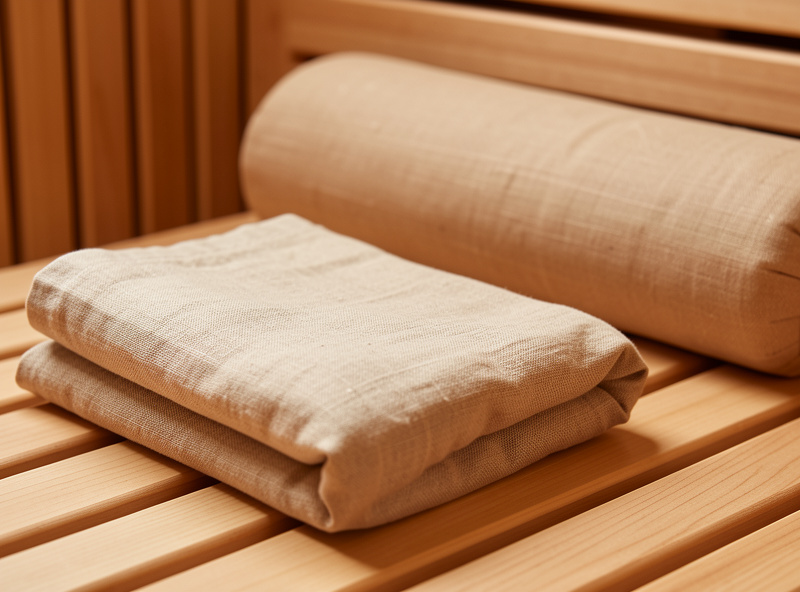
For an older user I rank the surfaces in this order: bare slatted basswood or hemlock first, a thin natural-fibre towel second, and a foam cushion a distant third. Bare slatted wood gives slightly, vents sweat, warms evenly with the cabin, and stays clean; a towel adds a little softness and catches sweat; a foam cushion insulates the user from the warming bench, traps moisture, and gets unpleasant fast.
Wood choice matters more here than people expect, because the backrest is the surface pressed against the spine for twenty minutes. Basswood is my pick for a senior cabin — minimal resin, almost no odour, low off-gassing, and a smooth grain that stays kind to thinner skin. Cedar smells wonderful but is more allergenic, and hemlock is the neutral middle. For anyone with respiratory sensitivity, which is over-represented in older users, the hypoallergenic wood is worth the small premium. A natural-fibre towel or bench cover is the softness layer if the bare wood is too firm, and it is washable, which a cushion glued to a bench is not.
The feel of warm basswood slats against the lower back is one of the genuinely pleasant sensations of a sauna — smooth, dry, and giving just enough to feel supportive without being hard. That sensory detail is part of why people keep using the cabin, and it is entirely a materials choice. A cheap composite bench with glue that off-gasses for the first twenty hours of use is the opposite experience, and it is the corner I would not cut for a senior install.
How Do Bench Depth and Width Change a Gentle Session?
Bench depth around 40–45 cm lets an older user sit fully back against the rest without their knees floating, and a width of at least 50 cm per person gives room to shift position over a long session — because the comfort secret of a twenty-minute sit is the ability to move slightly, not the ability to sit perfectly still. A bench too shallow forces a perched half-seated posture; a bench too narrow makes any repositioning feel like a fall risk.
Longer gentle sessions are the whole point of the low-temp approach, and a longer session means more micro-movements: a shift of the hips, a repositioned arm, a turned head. Posture and small position changes change how the heat feels more than a couple of degrees of set temp do, and the bench has to permit them. For two people sharing, the layout — facing benches versus side-by-side — decides whether either person can comfortably recline, and a senior sharing with a partner who assists them needs the layout that lets the assisting partner reach across without climbing in.
I treat bench depth as a comfort lever, not a footprint decision. If the only way to fit the cabin in the room is a 35 cm deep bench, I would rather find a slightly smaller cabin with a proper 42 cm bench than ship a senior install with a perch. The bench is where the user lives for the whole session, and every centimetre of depth shows up in how the body feels at minute eighteen.
Panel Placement Behind the Back: Radiant Comfort or Hot Spot?
Panel placement decides whether the backrest delivers radiant comfort or a localised burn, and the rule is simple: the back panels should be large-area carbon, mounted at the height the torso actually sits at the chosen bench height, far enough back that the closest skin never sits within a few centimetres of the surface. Carbon’s even footprint is what makes a back panel comfortable; a ceramic rod at backrest height is a hot stripe waiting to happen.
This is where bench height and panel placement have to be set together, and why I measure both before I close up an install. If I rebuild a bench 5 cm lower to make sitting down easier, the back panels that were aimed at the old torso height now hit the shoulders or the neck, and what was an even warmth becomes a hot spot on the trapezius. A DIY interior upgrade is often where this gets fixed — re-aiming or re-mounting the back panel to match the rebuilt bench — and it is one of the highest-comfort changes you can make to a cabin that already works electrically. The goal is an even flush of warmth across the whole back, the kind you stop noticing because nothing about it demands attention.
On my TriField TF2 the back panel of the carbon/ceramic hybrid reads low and even at the bench, which is what I want — a back panel you can lean into for twenty minutes without the skin closest to it protesting. That measurement is the difference between a backrest that warms and a backrest that burns, and it is why I will not put an older user against a high-density ceramic back panel at any set temp.
Can You Recline or Raise Your Legs in an Infrared Sauna?
An L-shaped or full-length bench lets an older user recline or elevate their legs, which spreads body weight off the sit-bones and is dramatically more comfortable for a longer gentle session — but it needs a cabin with at least about 150 cm of interior length, which generally pushes you out of the compact one-person class and into a two-person footprint. For a user who finds any seat uncomfortable past ten minutes, the ability to lie nearly flat is the upgrade that actually changes the experience.
The comfort gain is real and measurable in how the body feels at minute fifteen. Upright, all of a user’s weight concentrates on two small sit-bones, and that pressure is what makes a long sit ache even on good wood. Reclined flat or with the legs up, the same weight spreads across the whole back and thighs, and the session stops being about enduring the seat. In my session log the reclined sessions consistently run longer and rate higher for comfort than the upright ones at the same set temp, which tells me the geometry is doing as much work as the heat. A two-person cabin is usually the cheapest route to that interior length, even if only one person uses it, because the extra footprint buys a bench you can actually lie down on.
The layout decision flows from this. An L-shaped bench — one long run plus a shorter return — gives the recline option without giving up a normal upright seat, and it is the layout I would spec for a senior cabin if the room allows it. A single straight bench is cheaper and smaller but commits the user to sitting upright for every session, and for an older body that is the least comfortable option over twenty minutes. If reclining matters, plan the cabin around it from the start, because retrofitting an L-bench into a cabin built for a straight one is a far bigger job than choosing correctly up front.
What I Would Do Starting Today
If I were making a cabin’s seating senior-comfortable tomorrow, I would set the bench to 45 cm, add or rebuild a 15° slatted basswood backrest, confirm the back panels land on the torso at that new height, and lay a natural-fibre towel over the seat for a little softness. Those four changes, none of them expensive and most of them an afternoon’s woodworking, turn a tolerable bench into one an older user will happily sit in for twenty gentle minutes — and a bench people sit in comfortably is a cabin that gets used.
For a quick comfort upgrade without rebuilding the bench, a natural-fibre sauna bench towel and a loose wooden lumbar block add softness and back support without insulating the user from the warming wood. Skip the foam cushions — they trap heat and moisture exactly where you do not want it.
As an Amazon Associate I earn from qualifying purchases.
Further Reading
Seating is one of six spokes in the senior setup — the full picture is in the infrared sauna for seniors guide. The pieces I would read alongside this one are the bench-height-versus-panel-placement explainer, the bench-cover materials guide, and the lower set-temp and ramp guide.