For an older adult I start an infrared sauna at a set temp of 45°C — not 65°C — and raise it by about 5°C per session as tolerance builds, because aging changes how the body registers and sheds heat. On my daily driver, a 45°C set temp reads only about 48°C at the bench sensor while the radiant panels do the real warming of the skin, and that gap is the whole point of going low.
This single dial decides whether an older user falls in love with the cabin or never gets back in. Crank it to 65°C on the first evening and you lose most people inside eight minutes; start gentle, ramp slowly, and the same person is still using the cabin every evening come February. This spoke is the deep dive on temperature and ramp for the senior setup I describe in the main guide — the other five decisions live there, while here I am only talking about the heat itself.
What Set Temperature Should an Older Adult Start At?
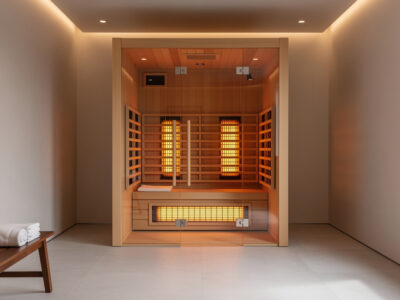
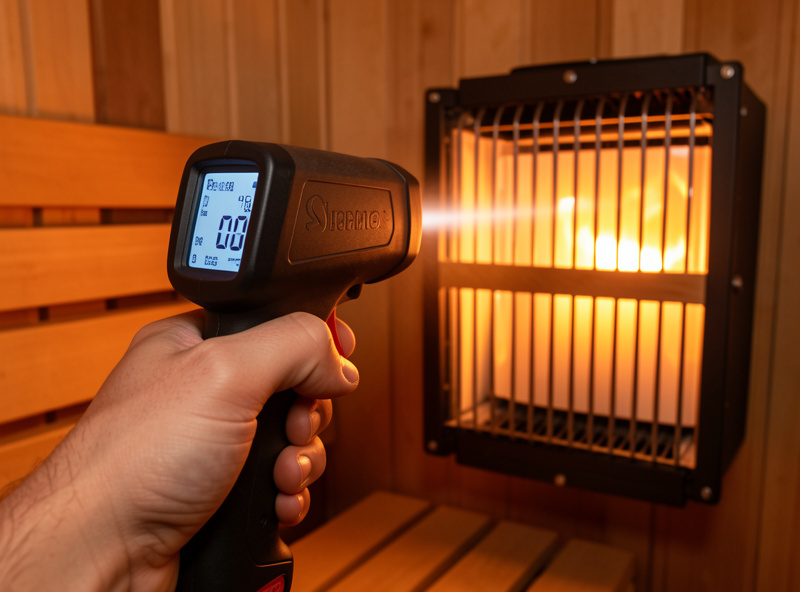
I start an older first-time user at 45°C set temp with a 15-minute preheat, and on the carbon/ceramic hybrid that leaves the panel surface reading 95–110°C on my IR thermometer while the cabin air stays under 50°C. Forty-five is not a magic number handed down from a clinical trial — it is the temperature at which the radiant panels clearly warm the skin without the air itself ever feeling hostile, and across the heaters I have lived with it is the most reliable starting point for someone whose heat tolerance I do not yet know.
A traditional sauna runs its air at 80–90°C and relies on you tolerating that blast; an infrared cabin at 45°C barely heats the air at all and warms the body through radiation instead. That is a different physical experience, not a weaker version of the same one, and it is why the two numbers are not comparable. A 45°C infrared cabin is not “half as hot” as a 90°C sauna — it is a different mechanism operating in a much gentler air envelope. If you want to confirm what your panels actually emit rather than trust a sticker, you can measure the spectrum and see the far-IR peak for yourself.
I keep the first three sessions at 45°C regardless of what the user reports, because “I cannot really feel it yet” at minute five is exactly the correct response to a low radiant setting — the heat is coming, slowly. Patience here pays for weeks of use afterward. The U.S. National Institute on Aging notes that older adults do not handle heat the way younger bodies do, and treating that as a reason to start lower — not a reason to avoid the cabin — is the framing I use.
Why Does Felt Heat Disagree With the Displayed Temperature?
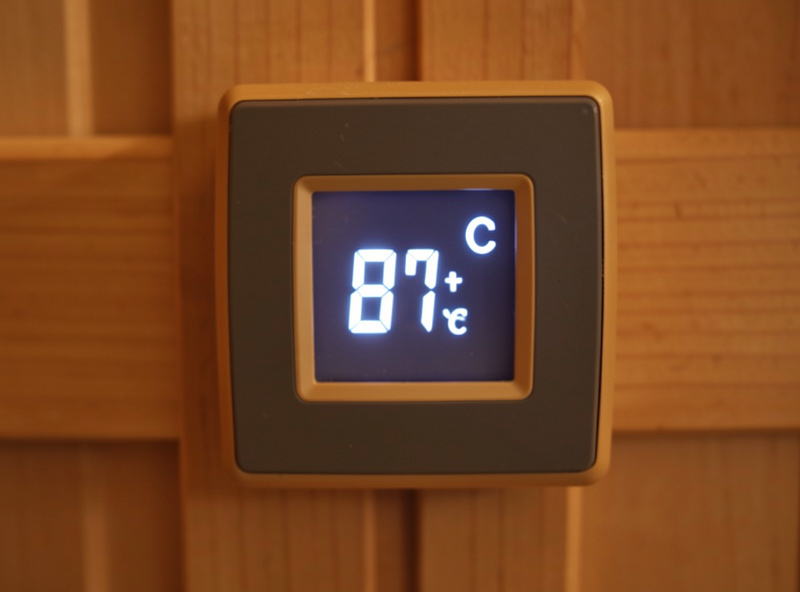
The wall display shows air temperature measured by a sensor sitting in a pocket of relatively cool air, while your skin is being warmed directly by radiant panels emitting in the far-infrared band — roughly 3 to 1000 µm, with most cabin panels peaking around 6–14 µm. Felt heat therefore runs well ahead of the displayed number, which is why a “48°C” cabin can feel thoroughly warming and a “48°C” summer afternoon cannot.
This is the single most common source of confusion for an older user, and it is worth explaining before the first session rather than after. The felt-heat-versus-set-temp gap is a real, measurable thing, not a malfunction. I have had a visitor point at the display and ask whether the cabin was broken because it “only” read 46°C while they were already sweating — and the honest answer is that the sensor is measuring the wrong thing for comfort. The sensor measures the air; the panels measure nothing, they just radiate.
The practical consequence is that you cannot steer an older user’s session by watching the display. You steer it by asking how they feel at the ten-minute mark, by keeping the set temp low, and by trusting that the radiant output is doing more than the number suggests. When I dial mine in for a guest, I set the number and then ignore it — the conversation about comfort is the real instrument panel.
How Quickly Should You Raise the Heat Between Sessions?
I raise the set temp by about 5°C per session, never more, and only once the user has completed a full session comfortably at the previous setting — so the climb from 45°C to 55°C takes at least two sessions over at least two days. This is heat acclimatization in miniature, and it is the same principle occupational safety agencies apply to hot workplaces: gradual exposure, not sudden immersion.
OSHA’s heat-exposure guidance is built around acclimatization for workers in hot environments, and the underlying idea — that the body adapts to heat over repeated, graded exposures and that jumping straight to a high load is where people get into trouble — transfers directly to the sauna ramp. I am not equating a sauna session with manual labour in the sun; I am pointing at a well-studied safety concept that says “increase the heat load gradually” and applying it to the dial. The ramp exists to let thermoregulation catch up, and older thermoregulation catches up more slowly.
I once bumped a relative up 10°C in a single jump after she told me she “could not feel anything” at 45°C. She lasted six minutes at 55°C, came out cross, and did not come back for a week. The lesson was not that 55°C is wrong — it was that 5°C steps respect the adaptation curve and 10°C steps blow past it. Now I treat “I cannot feel it yet” at minute five as a feature, not a complaint, and I hold the line on the small increments.
Which Heater Type Feels Gentlest at a Low Setting?
Carbon-fiber panels feel gentlest at a low set temp because their large surface area runs cooler — 90–120°C surface — and spreads the radiant output evenly, where ceramic rods concentrate heat into hotter stripes and near-infrared halogen emitters feel intense and point-like even with the dial low. For an older user at 45°C I want the soft, even wrap of carbon, full stop.
The difference is something you can feel on your back within thirty seconds of sitting down. The ceramic-rod cabin I tested left two warm lines across my shoulder blades where the rods sat closest, while the carbon cabin produces an even flush with no localised hot spot — and an even flush is what you want for someone whose skin may be thinner or whose heat sensation is reduced. Near-IR halogen has a more penetrating, almost prickly intensity that some people love and that I would not hand to a heat-cautious older user on day one. How long it takes to sweat depends heavily on which heater type you are sitting in front of, and at a low set temp the carbon panels are the slow, gentle option by design.
On my TriField TF2 the magnetic field at the bench of the carbon/ceramic hybrid reads in single-digit milligauss with the routing I have, which is where I want it for a cabin someone sits in daily. I am not claiming that level of EMF is harmless — that is a health question I leave to the research — only that it is low and measurable, and that “low-EMF” on a spec sheet genuinely moves the electric-field reading when the manufacturer has reversed the panel polarity correctly.
How Long Does It Take to Sweat at a Lower Temperature?
At 45°C on the carbon/ceramic hybrid, a thin film of sweat typically appears on the forearms at around the twelve-minute mark, with real sweating building through fifteen to twenty minutes — slower than the six to eight minutes I see at 65°C, and that slower onset is the safety feature, not a drawback. The gradual ramp gives the body time to thermoregulate instead of being hit with a sudden load.
The heat from a carbon panel arrives as a slow, dry prickle on the forearms a good two minutes before the air around you feels warm — there is no blast, no wall of steam, just a gradual flush that creeps up the arms and across the shoulders. I log session length, set temp, panel temp, and comfort in my session log, and the low-temp pattern is consistent: gentle onset, steady mild sweat, comfortable exit. That is the profile I want for an older user, and it is the opposite of the “get in, get blasted, get out fast” pattern a high set temp produces.
The slower sweat onset also means a session does not need to be short to be safe. A twenty-minute session at 45°C can be more comfortable, and arguably gentler, than an eight-minute session at 65°C, because the heat load is spread over time rather than concentrated. How often to repeat that gentle session is its own question, and the answer for an older body is one I defer to a clinician — but the per-session physics favour the long, low approach.
Hydration, Posture, and When to End the Session
I keep water and an electrolyte tab within arm’s reach and sip through the session, because even a gentle 45°C sweat draws down sodium and potassium over twenty minutes; ending the session the moment you feel lightheaded, headachey, or unusually tired is non-negotiable, and any of those signs is a question for a doctor rather than something to push through. Hydration and stopping early are the two controls I will assert from the bench.
The medical side — whether heat is appropriate at all for a given cardiovascular or blood-pressure situation — is not mine to answer, and I will not pretend otherwise. What I can say is that feeling dizzy in the sauna is a specific signal I have learned to read, and it always means the session is over, the set temp was too high, or the ramp was too fast. For an older user I would rather a fifteen-minute session at 45°C that ends comfortably than a heroic thirty-minute session that ends badly. Replacing electrolytes, not just water, is what stops the post-session headache that convinces people the cabin “does not agree with them.”
Posture is the underrated comfort lever at low temps. Small posture and breathing tweaks change how a session feels more than a few degrees of set temp do — sitting back fully against the backrest so the panels do their job evenly, shoulders relaxed, breathing slow. A tense, hunched user feels worse at every temperature, and the low gentle setting is precisely where posture has room to matter because nothing else is demanding your attention.
Frequently Asked Questions
What temperature should an infrared sauna be for older adults?
I start older users at a set temp of 45 degrees Celsius with a 15-minute preheat. The radiant panels warm the skin directly while the cabin air stays under 50 degrees, which is far gentler than the 65 to 80 degree setting many cabins default to.
How fast should I raise the sauna temperature for an older user?
About 5 degrees Celsius per session, and only after a full comfortable session at the previous setting. Gradual acclimatization is safer than a big jump, which is the same principle occupational safety agencies use for heat exposure at work.
Why does the sauna feel hotter than the display says?
The display measures air temperature in a relatively cool pocket, while your skin is warmed directly by radiant far-infrared panels. Felt heat therefore runs ahead of the number on the wall, so a 45 degree cabin can feel thoroughly warming.
Which heater is gentlest at a low infrared sauna temperature?
Carbon-fiber panels. Their large surface area runs cooler, around 90 to 120 degrees Celsius, and spreads heat evenly. Ceramic rods and near-IR halogen emitters concentrate heat into hotter stripes or points and feel more intense at the same dial setting.
How long does it take to sweat at a lower sauna temperature?
On my carbon and ceramic hybrid at 45 degrees, a thin film of sweat appears on the forearms around the twelve-minute mark and builds through fifteen to twenty minutes. The slower onset is a safety feature, not a drawback, because the heat load is spread over time.
What I Would Do Starting Today
If I were dialling in a low-temp setup for an older user tomorrow, I would set the cabin to 45°C, stage a 15-minute preheat so it is mild the moment they sit down, and hold that temperature for the first three sessions no matter what they report. On session four I would bump to 50°C, and on session five or six to 55°C, and I would stop there unless they specifically asked for more. I would put a glass of water and an electrolyte tab on the shelf, set a timer for twenty minutes, and treat any dizziness, headache, or fatigue as an immediate end to the session and a question for their doctor.
The one tool I would not skip is a cheap IR thermometer, so I could read what the panels are actually doing at the skin versus what the wall display claims — it removes the guesswork from a setting where guesswork is exactly what an older user does not need. A basic infrared thermometer costs less than a single month of electricity for the cabin and settles every argument about whether the low setting is “doing anything.”
As an Amazon Associate I earn from qualifying purchases.
Further Reading
This spoke is one of six in the senior setup — the full picture is in the infrared sauna for seniors guide. For the underlying physics and the adjacent decisions, I would read the felt-heat-versus-set-temp explainer, the guide to how long it takes to sweat by heater type, and the piece on hydration and electrolytes around a session.