Six gear decisions turn a standard infrared cabin into one an older body actually wants to use: a set temp around 45–50°C instead of 65°C, an easy step-in, supportive seating, big-button controls, a gentle preheat, and a timer you cannot forget. On my 16A dedicated circuit, dropping the set temp from 65°C to 48°C cut a typical 30-minute session from roughly 1.9 kWh to about 1.1 kWh — and the older relatives who last eight minutes at full heat happily sit twenty at the lower number.
The mistake I see most is treating “senior” as a medical question when it is mostly an engineering one. A conventional sauna drives the air to 80–90°C and bets on you tolerating that blast; an infrared cabin heats your skin and tissue directly with radiant panels and leaves the cabin air 20–30 degrees cooler for the same felt warmth. That physics difference is exactly why infrared suits an older body — but only if you set the cabin up for it. Buy the aggressive full-spectrum unit a thirty-year-old posts about and you have built the wrong machine for a seventy-year-old.
This guide is the six decisions, each with the number behind it. I have wired, metered, and lived with far-, near-, and full-spectrum cabins side by side through enough Swedish winters to know which choices actually move the needle — and the senior setup is the exact configuration I build when my parents come to stay.
Why Does Infrared Heat an Older Body Differently Than a Traditional Sauna?
Infrared panels warm you with radiant energy in the far-infrared band — roughly 3 to 1000 µm, with cabin panels emitting most of their output around 6–14 µm — so the surrounding air only has to reach 45–55°C for the same felt warmth a hot-rock sauna gets from 80–90°C air. Breathing cooler air is the single biggest reason infrared is more tolerable for an older user, and it is a physics fact, not a marketing claim.
The distinction that actually matters on the bench is felt heat versus set temp. The air-temperature display on the wall often reads 15°C below what your skin reports, because the radiant panels are doing the warming and the air sensor sits in a cooler pocket. I have watched visitors panic at a “48°C” reading that feels nothing like a 48°C summer day — because it is not air temperature they are feeling. Once you internalise that, the senior setup stops looking like a compromise and starts looking like the correct tool. You can measure where your panels’ output actually lands with a cheap spectrometer if you want to confirm you bought far-IR and not a near-IR lamp in a fancy box.
The lower air temperature also changes what the session demands of the body. Hot-air saunas raise core temperature partly by making you breathe heated air; radiant cabins heat from the skin inward, more slowly and more evenly. Health effects are studied and reported, not something I will promise you — but the engineering reality, that the cabin air stays tens of degrees cooler, is something I can put a thermometer on and show you.
What Set Temperature and Ramp Time Count as “Gentle”?
For an older user I start at a 45°C set temp with a 15-minute preheat and add roughly 5°C per session as tolerance builds; on my carbon/ceramic hybrid that leaves the panel surface reading about 95–110°C on my IR thermometer while the cabin air is still under 50°C — which is the entire point of radiant heat. That is the configuration I walk older first-time users through in detail.
I learned this one the hard way. Last winter I set the full-spectrum unit to 65°C for a visiting uncle who insisted he “wanted the full experience,” and I watched him last about eight minutes before he bailed. The next morning I had him in the far-IR cabin at 48°C for twenty-two minutes, and he came out saying it was the most relaxing heat he had sat in. The lesson was not that he could not handle a sauna — it was that I had handed him the wrong dial setting and the wrong heater type. The ramp matters as much as the peak: a cabin that hits you with full output the second you sit down feels hostile, where a 15-minute preheat lets the panels and the wood come up together so the heat arrives softly.
Hydration is the other half of the gentle session. I keep a glass of water and an electrolyte tab within arm’s reach and I sip through the session rather than chugging after. Sodium and potassium matter more than water volume once sessions go past fifteen minutes, and that is true at 45°C just as it is at 65°C — the sweat rate is lower, but it is not zero.
The Six Decisions That Make a Cabin Senior-Friendly
Six gear decisions do the majority of the work, and each one maps to a deeper guide where I walk through the measurements. Read this section as the index; read the linked spoke for the build detail.
- Lower set temp and a longer ramp. This is the foundation — a 45–50°C set temp with a gentle preheat instead of a 65°C hammer. I cover the exact dial-in, the per-session progression, and why felt heat lies in the lower-temperature guide for older adults.
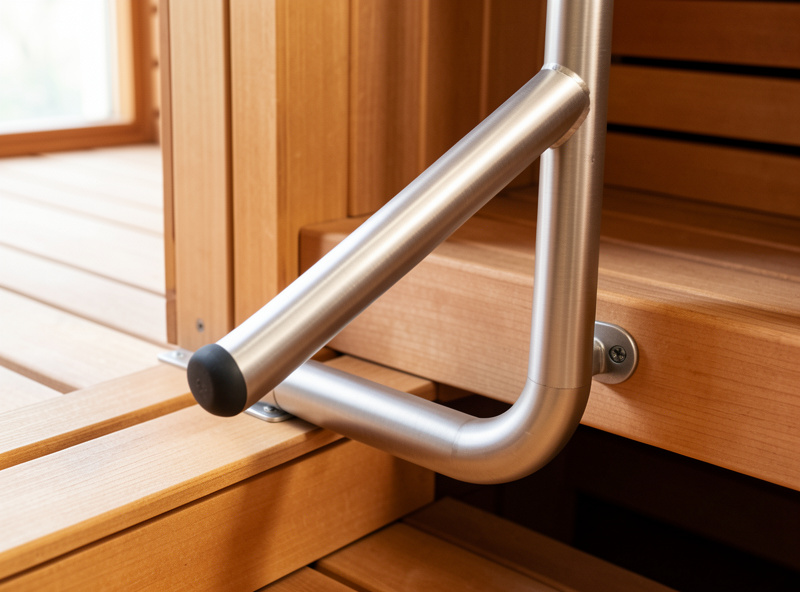
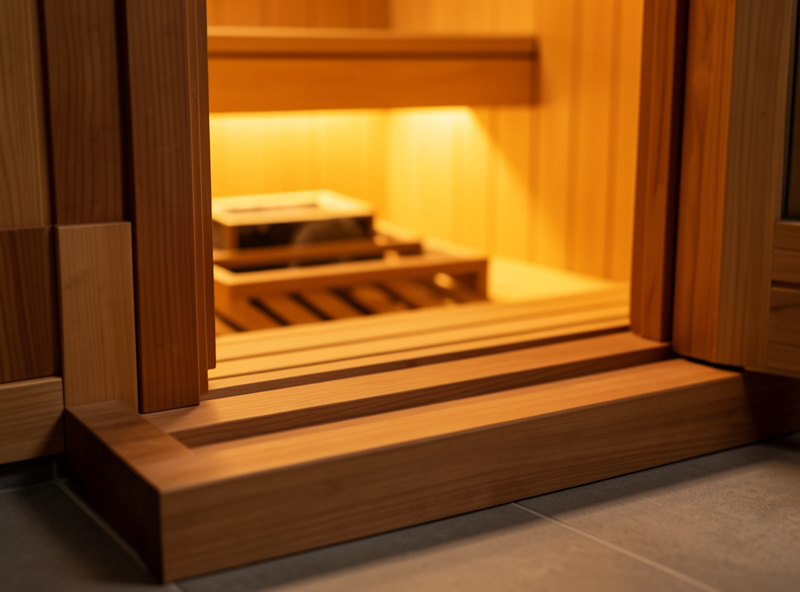
- Easy entry. A flat or near-flat threshold, a door wide enough to clear a walker, and a grab point at the entrance. The measurements that matter — door clear width, step-in lip height, handrail placement — are in the easy-entry accessibility guide.
- Comfortable seating and backrest. Long gentle sessions only work if the bench is supportive; the wrong bench height or a flat plank turns a twenty-minute sit into an endurance event. I detail seat height, backrest angle, and cushion materials in the comfortable-seating guide.
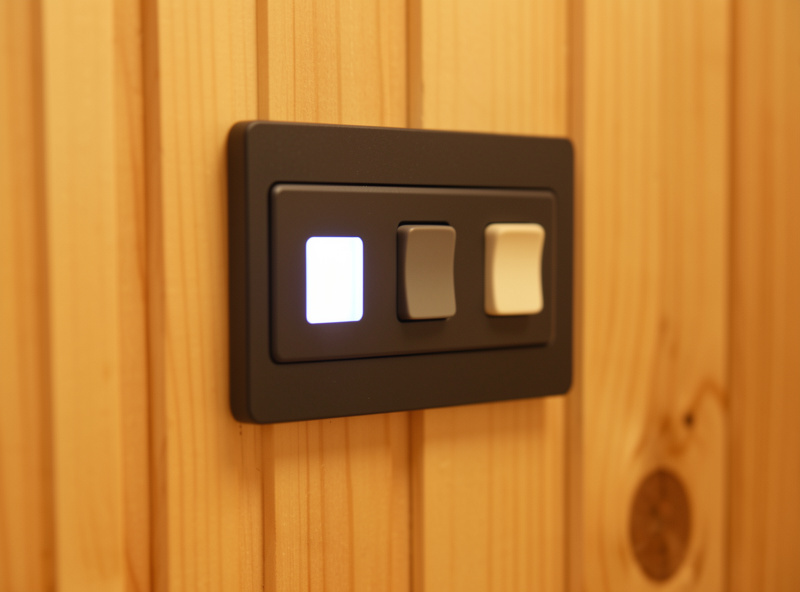
- Simple controls. A fiddly capacitive touch panel is hostile to stiff fingers and poor eyesight; big physical backlit buttons win every time. What actually makes a panel easy to operate is in the easy-to-use controls guide.
- Gentle preheat. A senior should walk into a cabin that is already mild and ready, not sit through a cold-to-hot ramp. How to schedule and stage the preheat is in the gentle-preheat guide.
- Solo safety. A timer that auto-shuts the cabin, a reminder to come out, and someone nearby. The hardware and the routine are in the solo-safety guide.
Get those six right and the cabin works for an older body without anyone having to think about it. Get the first one wrong and none of the others compensate.
Which Heater Type Stays Gentlest When You Lower the Temp?
Carbon-fiber panels give the softest radiant footprint at low set temps because their large surface area runs at a lower surface temperature — typically 90–120°C — and spreads the heat evenly across the back and legs. Ceramic rods run hotter per square centimetre and create localised hot spots, and near-infrared halogen emitters feel intense and point-like even when the dial is low. For a senior cabin my pick is carbon, every time.
I have lived with all four heater types over full winters, and the difference is not subtle. The ceramic rod cabin I tested would leave two red stripes across my shoulder blades where the rods sat closest, while the carbon panel cabin wraps the whole back in an even warmth with no hot line. That evenness matters more for an older user whose skin may be thinner or whose sensation is reduced — a localised hot spot is exactly what you do not want someone to discover by accident. The near-IR halogen emitters have their fans, and combining near-IR with red light is a real setup, but the intensity is harder to modulate down gently, so I would not put a NIR-heavy unit in a senior cabin.
The other reason I lean carbon is maintenance. Carbon panels have fewer connection points to fail and run cooler at the contacts, which means less thermal cycling stress on the wiring behind them. On my TriField TF2 the magnetic field at the bench of a well-routed carbon panel reads in single-digit milligauss, which is where I want it for a cabin someone sits in daily.
Cabin Features Compared by Accessibility Priority
This is the comparison table I wish I had had before I spec’d my first cabin for an older user. It ranks the features that actually change the experience for a senior, what I would specify, and roughly what each one costs to get right.
| Feature | Why it matters for older users | What I would spec | Cost impact |
|---|---|---|---|
| Set temperature range | A lower starting temp reduces the heat load on the body | Controller that allows down to 40°C, not locked at 60°C minimum | Low — most panels allow it |
| Step-in threshold | A tall lip is a trip and fall hazard on entry and exit | Flat floor or a lip under 2 cm, with a grab point | Low to moderate |
| Door clear width | Walkers, wider stances, and stiff hips need room | At least 32 inches of clear opening, ADA-style | Moderate |
| Seating and backrest | Longer gentle sessions need lumbar and posture support | Ergonomic backrest, seat height 43–46 cm | Moderate |
| Controls | Capacitive touch panels frustrate stiff fingers and tired eyes | Large physical backlit buttons, one-touch start | Low |
| Timer and auto-shutoff | Forgetfulness and dozing off are real solo risks | Hard auto-off at a set time, plus an audible reminder | Low |
| EMF and materials | Chemical sensitivity and daily exposure add up | Low-EMF panels, hypoallergenic basswood or hemlock | Moderate |
Notice that four of the seven rows are low-cost or no-cost — the door width, the timer, the set-temp range, and the controls are configuration choices more than they are purchase decisions. That is the encouraging part of the senior setup: you do not have to buy a purpose-built accessible cabin to get most of the way there. You do have to get the bench height and panel placement right, and you do have to add a grab point if the cabin did not come with one.
Should Seniors Care More About EMF and Wood Choice?
Yes — in my experience older users have more reason to care, not less. On my TriField TF2 the electric field at the bench of a non-low-EMF panel can read two to three times higher than a low-EMF carbon panel at the same set temp, and basswood or hemlock off-gas far less than glue-heavy composite panels that smell for the first twenty hours of use. Daily exposure compounds, and a senior who sits in the cabin every evening for years is the definition of a daily user.
I am not claiming EMF at these levels is harmful — that is a health question I defer entirely to the research and to a doctor. What I can tell you is what the meter reads and how to move the number. “Low-EMF” on a spec sheet usually means the manufacturer reversed the wiring polarity on alternate panels to cancel the electric field, and that genuinely does drop the reading; it does not do much to the magnetic field, which is set by the current and the routing. If you want to know what your cabin actually emits, you meter it yourself rather than trusting a sticker.
Wood choice is the other material question I would weigh more for a senior cabin. Basswood is the hypoallergenic option — minimal resin, minimal odour, almost no off-gassing — and that matters for anyone with respiratory sensitivity. Cedar smells wonderful but is more allergenic; hemlock is the neutral middle. Whatever you pick, a new cabin should go through a proper off-gassing break-in before a senior sits in it for the first time, with the door closed and the panels on, for a few empty sessions.
What Electrical and Ventilation Work Does a Senior Cabin Need?
A dedicated, GFCI-protected circuit sized to the cabin — mine is 16A at 230V on its own breaker — and passive ventilation are non-negotiable on any install, and they matter more for a senior who may be slower to react to a fault. The NFPA 70 National Electrical Code requires GFCI protection on bathroom and spa circuits, and the same logic applies to an indoor infrared cabin: a ground fault should trip the breaker, not the person. Confirm local code with a licensed electrician — this is jurisdiction-dependent and not something to guess at.
Ventilation is the silent killer of cabins, literally. An infrared cabin at a low set temp still puts moisture into a closed room, and a room that cannot vent that moisture will grow mould on the wall behind the unit within weeks. Mould prevention is mostly an airflow problem, not a cleaning problem, and it starts at install time. For a senior cabin I want a passive vent near the unit and a door to the room that is not sealed shut.
The smart-home angle is where this gets genuinely useful for an older user. I run my preheat on a scheduled rule on my Home Assistant hub through a Shelly smart plug, so the cabin is mild and ready at the same time every evening with no button to remember. For someone whose routine is the thing keeping them safe, automating the preheat removes a step they can forget. If you are installing in a rental and cannot wire a dedicated circuit, that constraint drives the whole cabin choice — and it is worth knowing before you buy.
How Much Does a Gentle Setting Cost to Run?
Lower set temp means lower kilowatt-hours, full stop. On my plug-in Kill A Watt meter, a 30-minute session at 48°C uses about 1.1 kWh versus 1.9 kWh at 65°C on the same cabin — a roughly 40 percent reduction, because the panels spend most of their energy holding the set temp rather than chasing a high one. At my local Swedish rate of around 2.2 SEK per kWh, that is a real monthly number for a daily user.
The reason most buyers never run this calculation is that the spec sheet watts the cabin can draw, not the watts it does draw at your setting. A 1,800W panel does not pull 1,800W for thirty minutes; it pulls full power during the ramp and then cycles on and off to hold temp, and the lower the set temp the shorter the on-cycles. A ten-dollar energy meter between the plug and the wall tells you the truth for your specific cabin and setting, and it is the most honest way to compare a gentle senior setup against a full-heat one. A smart plug with energy monitoring does the same job and logs it over time.
Preheat timing affects the bill too. A cabin takes longer to preheat in a cold winter room, and a senior who switches it on and then waits impatiently is tempted to set the temp high to speed it up. The better answer is a longer, scheduled preheat at the low target — it costs marginally more in ramp energy but avoids the high-set-temp session entirely. If you want to skip the wait without being in the room, remote preheat from a phone is the clean solution.
Does Cabin Size and Layout Change the Senior Setup?
It does, and usually in a direction that saves money. A senior rarely needs the biggest cabin on the floor — a smaller one-person or tight two-person unit preheats faster and holds a low set temp more stably because there is less air volume to condition. On my one-person carbon cabin, a 45°C set temp is rock-steady inside twelve minutes; the two-person hybrid takes about eighteen, and a large four-person cabin I tested once took nearly half an hour to settle at the same target. Faster preheat at a low temp is exactly the gentle experience you want.
The layout question is where walker access and door swing come in. A two-person cabin gives a wider, easier interior to turn around in, which matters for stiff hips, but it also needs more floor area in front for the door to swing clear. A one-person unit has a smaller footprint but can feel cramped to someone who values elbow room, and a cramped user tenses up, which defeats the point of a gentle session. My rule of thumb is to size for the body that will use it most, not the guest who might visit twice a year, and to leave at least a metre of clear floor in front of whatever door it has.
If you are buying used for a senior — and used is often the smart move here, since a quality hemlock cabin lasts decades — the inspection matters more, not less. Run the twenty-minute used-cabin checklist before money changes hands: verify every panel heats (a single dead emitter is the most common hidden fault), check the door seal is intact, meter the EMF at the bench, and confirm the controller still responds to every button. There is a real age beyond which a used cabin is a false economy — wiring insulation and panel output both drift over enough years — and a senior user is the wrong person to discover that drift by surprise. Tracing a dead panel is a satisfying fix on my own bench, but I would not hand a senior a cabin with a known-bad emitter and a repair queue.
Sessions, Hydration, and When to Ask a Doctor
Any health question — cardiovascular conditions, blood-pressure medication, recovery expectations, whether heat is appropriate at all — is a doctor’s call, not mine, and I will not pretend otherwise. The National Institute on Aging is the resource I point relatives toward for how aging changes heat tolerance in general, and it is a better source than anything a sauna manufacturer publishes. My lane is the gear: the set temp, the ramp, the seating, the timer. What I can speak to from my own session log is session length, hydration, and the small signs that tell me to dial a session back.
If a user feels lightheaded, headachey, or unusually tired, that is a signal to end the session and a question for a clinician — and feeling dizzy in the sauna is a specific thing I have learned to read, not something to push through. For an older user I would rather a fifteen-minute session at 45°C that ends comfortably than a thirty-minute session at 60°C that ends badly. A simple timer — app or physical — is the cheapest safety device in the cabin, and I treat it as mandatory, not optional.
Frequency is the other question I get. There is no single right answer for an older body, and any therapeutic claim about how often to sauna is a medical one I defer to research and to a clinician. From a pure comfort-and-consistency standpoint, a short, gentle, well-hydrated session most evenings is the pattern I see work, and it is the pattern I run myself through the dark Swedish winter.
Frequently Asked Questions
What temperature should an infrared sauna be set to for seniors?
I start older users at a set temp of 45 degrees Celsius with a 15-minute preheat, then add about 5 degrees per session as tolerance builds. The cabin air stays under 50 degrees while the radiant panels do the warming, which is far more tolerable than a 65 to 80 degree traditional sauna.
Is a lower infrared sauna temperature still effective?
Effectiveness in the therapeutic sense is a medical question for a doctor. In pure heat terms, a lower set temp still raises skin and tissue temperature through radiant energy and produces a gentle sweat, it just does so with less strain from breathing hot air.
Which infrared heater type is gentlest for older adults?
Carbon-fiber panels. They have the largest surface area and the lowest panel surface temperature, around 90 to 120 degrees Celsius, which spreads heat evenly with no hot spots. Ceramic rods and near-IR halogen emitters run hotter per area and feel more intense at the same dial setting.
Do seniors need a special door or step for an infrared sauna?
A flat or near-flat threshold under 2 centimetres and a clear door opening of at least 32 inches make entry safer, especially with a grab bar at the threshold. These are low-cost changes and most of the benefit comes from the threshold and the grab point, not from buying a purpose-built cabin.
How long should a senior stay in an infrared sauna?
I cannot give a medical duration. From a comfort standpoint I start older users at 15 minutes at a low set temp, with water and electrolytes within reach, and a timer set. Any dizziness, headache, or fatigue means ending the session and asking a doctor.
Can an older person use an infrared sauna alone?
Only with hard safeguards: a timer that auto-shuts the cabin, a reminder to come out, and ideally someone nearby or checking in. I treat those three as mandatory for solo use at any age and especially for an older user.
What I Would Do Starting Today
If I were building a senior cabin from scratch tomorrow, here is the order I would do it in. First, I would pick a carbon-panel far-infrared cabin over anything full-spectrum or ceramic — the even, low surface-temp radiant footprint is the single biggest comfort lever, and it costs no extra if you choose the right model up front. Second, I would set the controller to allow a 45°C floor and stage a 15-minute preheat on a smart-plug schedule, so the cabin is mild the moment someone sits down. Third, I would bolt a stainless grab bar at the threshold and confirm the step-in lip is under 2 cm, because that is the cheapest real safety upgrade there is. Fourth, I would put a big physical-button timer in the cabin and a water bottle within arm’s reach, and I would hand the whole thing to a doctor for the medical sign-off before the first real session.
None of that is exotic. The senior setup is not a different product category — it is the same cabin, configured and accessorised with a specific user in mind, and almost all of the wins are in the configuration rather than the price tag. That is the part the wellness marketing never tells you, because there is no upsell in telling someone to turn the dial down and add a grab bar.
For two genuinely useful accessories I would add to a senior cabin, a stainless grab bar rated for bathroom use and a large-button smart plug with a timer cover the threshold-safety and the preheat-scheduling gaps for less than the cost of a single heater panel.
As an Amazon Associate I earn from qualifying purchases.
Keep Building
If you are working through the senior setup one decision at a time, the six spokes below take each gear choice to the level of measurements and part numbers: lower set temps and longer ramps for older users, easy-entry design with door width and grab support, comfortable seating and backrests for longer sessions, simple big-button controls that are easier to use, a gentle preheat so the cabin is ready and mild, and staying safe solo with timers and reminders. For the underlying engineering, the pieces I lean on most are the felt-heat-versus-set-temp explainer, the smart-plug preheat walkthrough, and the real-kWh-per-session measurement guide.