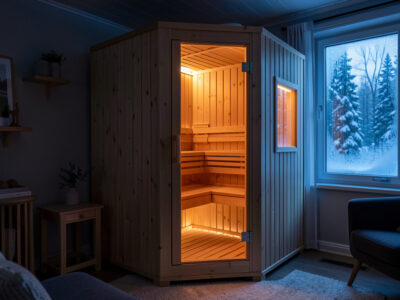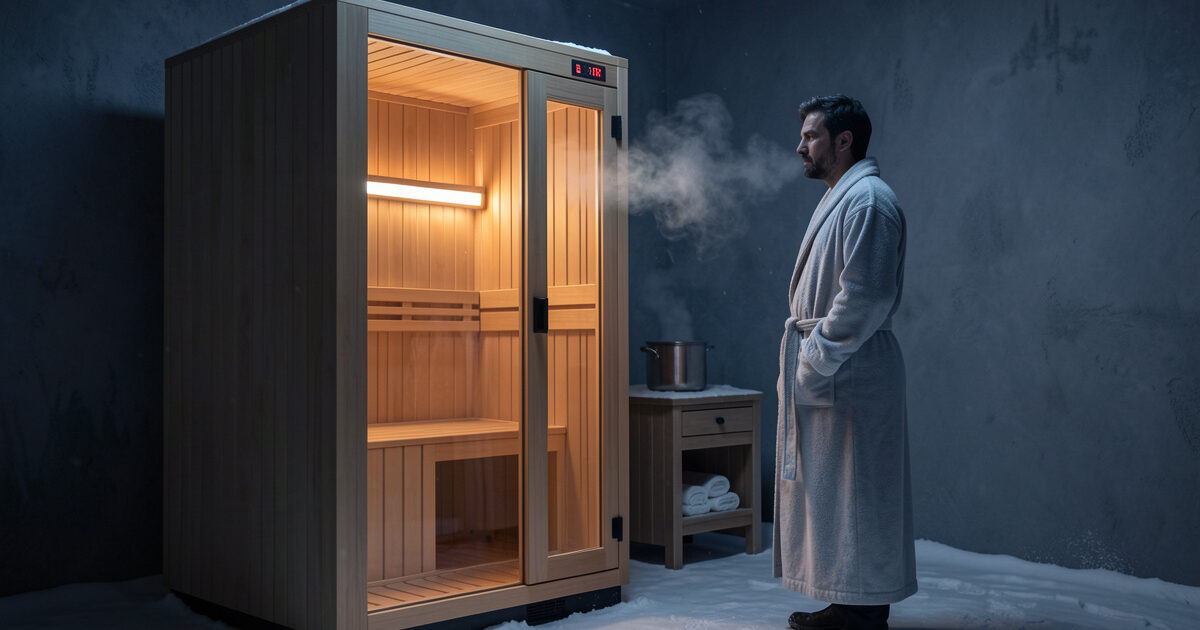
My infrared sauna takes longer to preheat in winter because the panels have to warm a colder box before any heat reaches me. In my session log, a 2-person far-infrared cabin that hits 60°C set temp in about 22 minutes at a 20°C start needs 38 to 45 minutes from a 2°C start — the preheat roughly doubles across a Swedish winter.
Every January I get the same quiet reminder that a sauna is a thermal machine, not a magic box: the same unit that was ready before I finished changing in September now makes me wait most of an hour. I run this cabin on its own 16A circuit and I keep a loose session log — duration, set temp, panel temp, kWh — so instead of guessing I can tell you exactly what the winter preheat penalty looks like on my meter and why it happens.
The Short Answer: Preheat Tracks the Temperature Gap
Preheat time is set by how far the panels have to climb, not by the outdoor number on your phone. An infrared cabin heats by radiant panels warming your body and the interior surfaces, but before the space stabilizes the panels dump most of their early output into the cold air and the cold wood mass. The colder the starting room, the bigger that up-front tax, and the longer you wait for the controller to reach setpoint.
That is why the penalty scales with the temperature difference. Going from a 20°C room to a 10°C room adds a handful of minutes; going to a 2°C garage or an unheated outbuilding near freezing is where it really stretches, because now the wood, the glass, and the air are all starting deep in the cold and every one of them has to come up before the bench feels right.
My Actual Preheat Numbers Across a Winter
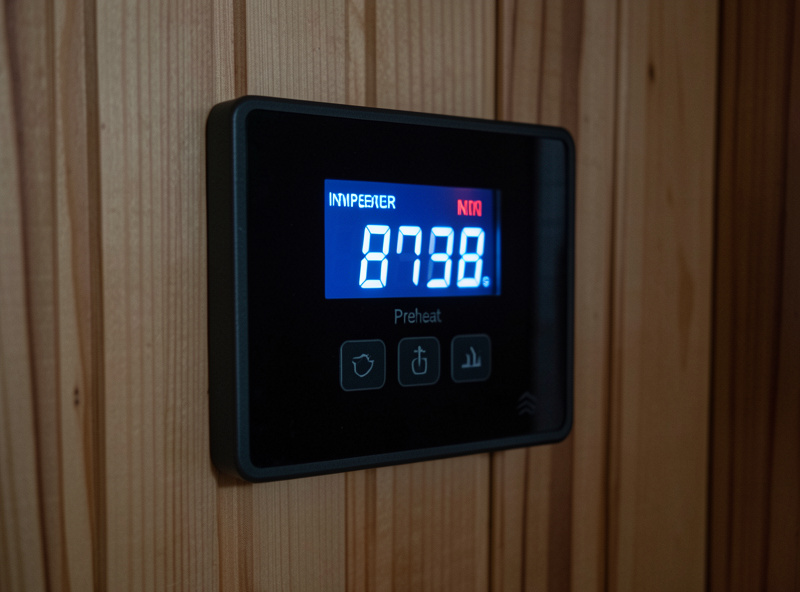
Here is the shape straight out of my session log for the 2-person far-infrared cabin, set temp 60°C, measured cold-start to the controller reaching setpoint. These are my readings on my meter in my room — the absolute minutes will differ for your unit, but the pattern will not.
| Room ambient at start | Preheat to 60°C | Extra vs summer | Approx. kWh to preheat |
|---|---|---|---|
| 20°C | 21–24 min | — | 0.7 kWh |
| 10°C | 28–32 min | +7–9 min | 0.9 kWh |
| 2°C | 38–45 min | +17–21 min | 1.2 kWh |
| -8°C | 50–60+ min | +30–36 min | 1.5–1.8 kWh |
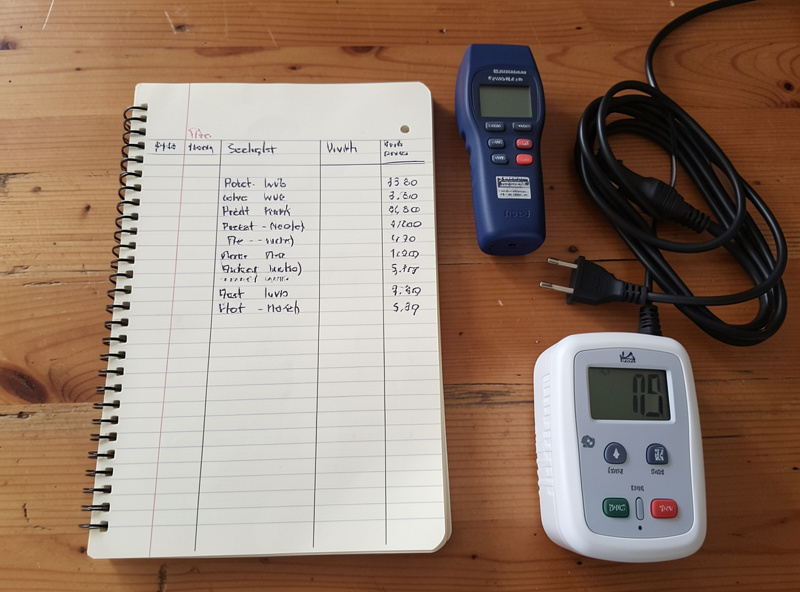
The kWh column is the part most owners never look at, and it is why I keep a plug-in energy meter on the cabin. A cold-start winter preheat can use twice the energy of a summer one before you have even climbed in, and that — not the session itself — is what quietly grows the winter electricity bill. I break the running cost down properly in my infrared sauna electricity cost guide.
Why the Bench Still Feels Cool at Set Temp
Here is the frustrating winter twist: even after the controller reads 60°C, the bench can feel several degrees cooler than it does in summer. The sensor sits near a panel or the ceiling and reports air temperature, but felt heat at your skin is a blend of direct radiant load and the temperature of every surface around you. In a cold-started cabin the far wall, the bench, and especially the glass door are still catching up, and those cold surfaces pull radiant heat back off your body.
In my cabin that felt-heat gap runs 3 to 4°C from a 2°C start and widens past 6°C in an unheated space. It is the reason “set temp reached” and “actually warm” are two different moments in winter, and it is worth understanding in its own right — I dig into it in the write-up on why an infrared sauna feels cooler than the display. The practical takeaway: in winter I give the cabin an extra five to ten minutes past setpoint before I count it ready.
What Actually Shortens the Winter Preheat
The biggest winter preheat gains come from the room, not the heater. When I sealed the door gap and got the surrounding space to a stable 15°C instead of letting it swing near freezing, my 2°C-start preheat dropped by close to eight minutes — more than any tweak to the panels themselves. Cold air leaking under the door means the panels are heating a moving target, so air sealing is the cheapest fix on the list.
After that, in order of return: insulate the cabin off a cold floor or slab, because the floor is the slowest surface to warm and the biggest ongoing sink; improve wall insulation if you built the cabin yourself; and only then consider heater sizing. If your cabin genuinely lives in the cold, a heater sized one occupancy bracket up carries the load better, which I cover in heater wattage for cold climates. My notes on insulating a DIY cabin and on low-loss ventilation are the two envelope levers that matter most.
The Fix I Actually Use: Schedule the Preheat
The simplest answer to a 45-minute winter preheat is to not be in the room for it. I run the cabin off a smart plug on my home hub and schedule it to start before I get up, so a January morning session is ready when I am rather than making me wait, cold, while the controller climbs. It does not change the physics — the preheat still takes 45 minutes — it just moves that time somewhere I do not have to stand around for it.
This is the single quality-of-life upgrade that makes a cold-climate sauna actually get used in winter, and I walk through the setup in scheduling pre-heat for winter mornings with a smart plug. If you want the gear, a schedulable smart plug rated for the sauna load is the whole trick. As an Amazon Associate I earn from qualifying purchases.
Related Guides
- Infrared Sauna Cold-Climate Performance: A Swedish Winter Field Guide
- Heater Wattage for Cold Climates: Sizing for Sub-Freezing Preheat
- Garage Infrared Sauna in Freezing Weather: What Actually Holds Heat
- Scheduling Pre-Heat for Winter Mornings With a Smart Plug
- Infrared Sauna Electricity Cost
Frequently Asked Questions
Why does my infrared sauna take so much longer to heat in winter?
Because preheat tracks the temperature gap the panels must climb. From a 2C start my 2-person cabin needs 38 to 45 minutes to reach 60C versus about 22 minutes from a 20C room, since most of the early panel output goes into warming cold air and cold wood before the space stabilizes.
Is it bad for the sauna to run a long winter preheat?
No. The heater is simply running longer at its normal load, not overworking. The real cost is energy and time: a cold-start winter preheat can use roughly twice the kWh of a summer one, which is why I track it on a plug-in energy meter rather than the extra runtime harming the unit.
Why does the bench feel cool even when the display says it reached temperature?
The sensor reads air temperature near a panel, but felt heat is a blend of radiant load and surrounding surface temperatures. In a cold-started cabin the walls, bench and glass door lag behind and pull heat off your body, so the bench runs 3 to 4C cooler than set from a 2C start. Give it 5 to 10 extra minutes.
What is the cheapest way to shorten a winter preheat?
Air sealing and a warmer surrounding room. Sealing the door gap and getting the space to a stable 15C cut my 2C-start preheat by close to eight minutes, more than any change to the heater. Insulating the cabin off a cold floor is the next best move.
Should I just leave the sauna on all day in winter to avoid the wait?
No. Leaving it running wastes far more energy than the preheat saves and adds needless wear. The better answer is to schedule the preheat with a smart plug so it starts before you get up, moving the 45-minute wait to a time you are not standing in a cold room for it.
Does outdoor temperature or indoor room temperature drive the preheat?
The room the cabin sits in matters most, because that is the air and surface temperature the panels start from. An outdoor number matters only through how cold it lets the surrounding space and the cabin surfaces get. A cabin in a heated room barely notices winter, one in an unheated outbuilding feels it fully.