A used infrared sauna can be the best value in this whole niche or an expensive box of dead panels, and the difference comes down to about 30 minutes of inspection before money changes hands. The two things that actually fail — heater panels and the controller — are also the two cheapest to verify on the spot with a clamp of attention and a cheap meter.
I run a low-EMF 2-person far-infrared cabin in my own home, and I’ve lived with full-spectrum, single-person carbon, and portable units alongside it through enough Swedish winters to know which parts age gracefully and which ones quietly die. The cabin shell — the hemlock, the bench, the glass — basically lasts forever. The electronics are where age shows. This guide walks the entire used-buying decision from the engineering side: what fails, how to test it, what a fair price looks like, and where the genuine deals hide. Each section links out to a deeper spoke when you want the full procedure.
Why a Used Infrared Sauna Is Often the Smart Buy
Infrared cabins depreciate hard and fast. A 2-person carbon-panel unit that retailed at $2,800 routinely changes hands at $900–$1,300 within three or four years, and the heaters inside it have usually logged a few hundred hours at most. That is the value gap: the resale market prices these like used furniture, but the hardware that matters is closer to lightly-used than worn-out.
The reason buyers panic and sell cheap is rarely a fault. It’s a move, a divorce, a renovation, or — most commonly — a unit that got used enthusiastically for two months and then became a clothes rack. I’ve metered second-hand cabins that had logged maybe 40 sessions total. For the engineering-minded buyer who can verify condition, that’s the arbitrage. The person who paid retail ate the depreciation; you get a near-new heater array for a third of the price. Where it stops being smart is when you can’t inspect in person, when the brand is a no-name import with zero parts availability, or when the shipping cost to move a 250-lb cabin erases the saving. Run those three filters first.
What Actually Fails on a Used Infrared Sauna
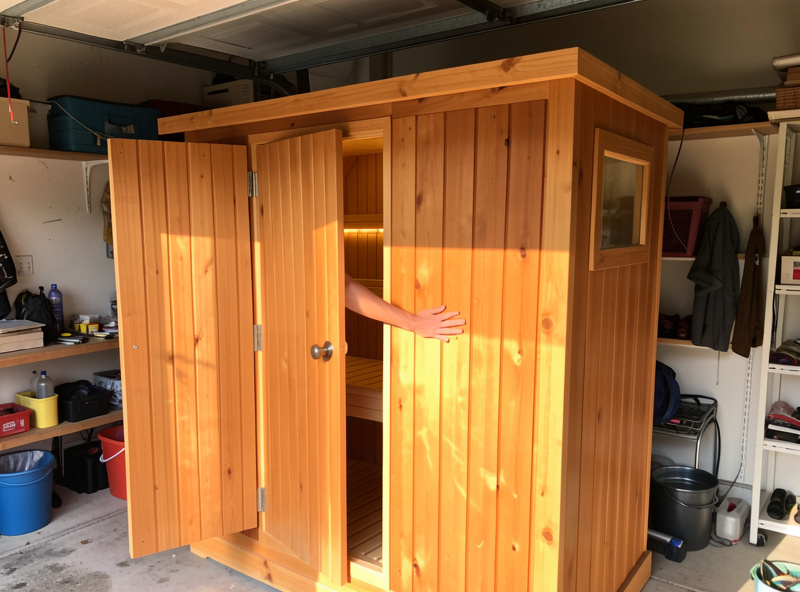
After living with several heater types, my short list of real failure points is small. Carbon-fiber panels degrade gracefully — a dead carbon panel is rare, and when one goes it usually fails open (cold) rather than dangerous. Ceramic rod heaters are more brittle; a cabin that was moved badly can crack a ceramic element. The controller and its low-voltage wiring are the parts most likely to be flaky, because cheap touch-panel controllers are the first thing manufacturers cut cost on.
Here’s the honest hierarchy of what to worry about, roughly in order of how often I see it:
- Controller / touch panel — unresponsive buttons, frozen displays, intermittent power. Common, and replacements for off-brand units can be impossible to source.
- One dead heater zone — a single panel or bank that no longer warms. Easy to detect, often a loose connector rather than a dead element.
- Door glass seal / hinge sag — cosmetic-adjacent but it lets heat leak and lengthens preheat.
- Wood drying / splitting — mostly cosmetic on the bench and walls; structurally these cabins are forgiving.
- Loose or warm wiring connectors — the safety item. A connector running hotter than the panel itself is a fire-adjacent red flag.
Notice what’s not on that list: the radiant performance of a working carbon panel. These heaters don’t “wear out” the way a car engine does. A 10-year-old carbon panel that still warms is putting out essentially the same radiant footprint it did new. That’s the core reason used can be a genuinely good buy — the expensive part ages well. For the full teardown of heater behavior, my carbon vs ceramic comparison and the heater and EMF engineering guide go deeper than I can here.
The In-Person Inspection: Your First 15 Minutes
The single most valuable thing you can do is plug the cabin in and run it while you’re standing there. A seller who won’t let you power it up is telling you something. My on-site routine takes about 15 minutes: power on, confirm the controller responds, set it to a high temp, and start touching panels as they ramp. Within five minutes every heater should be noticeably warming; a cold panel at the ten-minute mark is a dead zone.
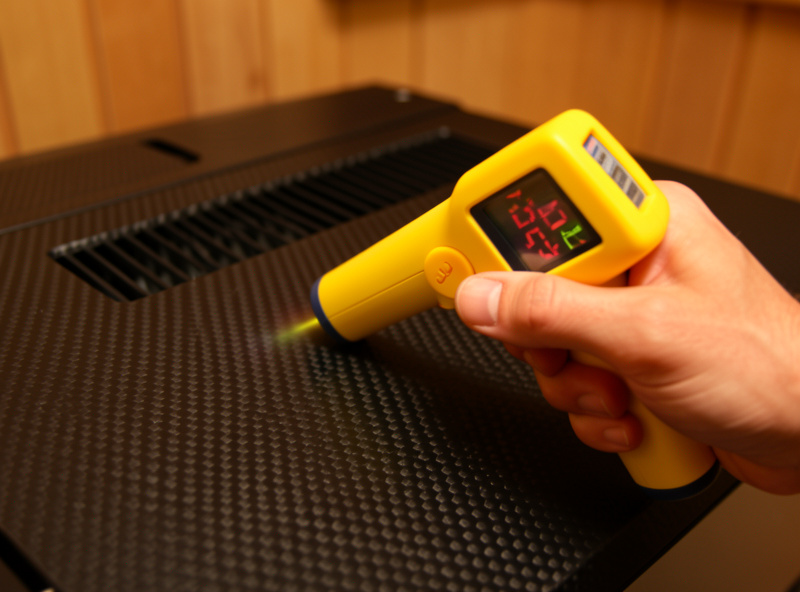
I walk the whole cabin with a bare hand and, when I can, an IR thermometer — every panel surface should climb together, no dead zones, no scorched spots. I check the door seal by feel for escaping heat, wiggle the bench for soft or split wood, and look behind the lower back panel for the wiring connectors. The full step-by-step is in my used sauna inspection checklist, which is the page to print and bring with you. Don’t skip the boring parts — the connector check is the one that matters for safety. I learned that backwards on my first used buy: I was so fixed on the heaters warming that I almost paid without pulling the lower panel, and when I finally looked, one connector was discolored from heat. That five-second check is the one I never skip now.
Testing the Heaters Before You Pay
Heater testing is where you separate a $1,000 bargain from a $1,000 mistake. The good news: it’s fast and it doesn’t need fancy gear. With the cabin running, the test is simply whether every panel reaches a consistent surface temperature in the expected window. Carbon panels on a 2-person cabin should hit the 140–160°F surface range within about 10–12 minutes; if one panel lags badly behind its neighbors, that zone is failing.
An IR thermometer makes this objective — I sweep each panel and note the numbers, looking for one that reads 30°F+ cooler than the rest. A cheap IR thermometer pays for itself the first time it catches a dead zone. As an Amazon Associate I earn from qualifying purchases. The full procedure — including how to read the controller’s behavior and what a healthy ramp curve looks like — lives in how to test used sauna heaters. The key mindset: you are buying the heater array, so test the heater array.
Metering EMF on a Used Unit
This is the part almost no other used-buying guide covers, and it’s the one I care most about. A used cabin’s EMF is not guaranteed to match the spec sheet it shipped with — wiring can sag, a controller can be swapped, and “low-EMF” labels mean different things by brand. The only way to know what a specific used unit reads is to meter it yourself.
I bring my TriField TF2 to every used inspection. With the cabin running, I read the magnetic field at the bench seat where your back actually sits — that’s the number that matters, not the reading two feet from a heater. On the genuine low-EMF carbon cabins I’ve owned, the back-of-bench magnetic field sits in the low single-digit milligauss range; older or budget units can read meaningfully higher near the wiring runs. None of this is about a health claim — it’s about knowing the actual hardware you’re buying. The complete method, including where the field comes from and what readings are reasonable, is in checking EMF on a used infrared sauna, and the meter technique itself is covered in how to measure sauna EMF with a TriField. If low-EMF matters to you, the used market is exactly where a meter earns its keep, because the label on the door no longer tells the whole story.
How Old Is Too Old?
Age alone is a weak signal. I’d take a clean, lightly-used 9-year-old carbon cabin from a reputable brand over a 2-year-old no-name import any day. What actually ages out is parts availability and controller technology, not the radiant heaters. The practical ceiling is the point where you can no longer buy a replacement controller or panel for the unit.
My rough rule: for a known brand still in business, 8–10 years is fine if it tests clean. For a discontinued or off-brand unit, treat anything past 5–6 years as “buy it for the price of the wood and bench, assume zero parts support.” The full reasoning — including how to date a unit and which brands keep parts around — is in how old is too old for a used sauna. The number on the manufacture sticker matters far less than whether the company will still sell you a heater in two years.
The Used 2-Person Sweet Spot
If I were shopping the used market today, I’d aim straight at 2-person far-infrared cabins, and not only because that’s what I run. The 2-person size is the most common new sale, so it’s the most common used listing, which means more inventory and better prices. It also fits through a standard doorway in panels, moves with two people, and runs on a standard or lightly-upgraded circuit. One- and two-person cabins are the practical limit for a normal home; four-person units are heavy, power-hungry, and rarely worth the moving hassle used.
The 2-person used market is deep enough that you can afford to be picky and wait for a clean, low-hour unit. My full breakdown of what to look for at this size — including which footprints actually seat two adults versus “two if they’re friendly” — is in buying a used 2-person infrared sauna, and the size logic generally is in 1 vs 2 vs 4 person sizing.
Where the Used Deals Actually Are
Local marketplace listings are where the real bargains live, precisely because the seller wants the thing out of their basement and pickup is on you. Estate sales, gym closures, and spa renovations occasionally dump multiple units at once. The trade-off is zero warranty and no recourse — which loops straight back to inspecting in person. I’d rather pay a bit more to a seller who lets me run the cabin than save $200 on a “must sell, can’t test, already disconnected” listing.
Manufacturer-refurbished and open-box channels sit at the other end: more money, but often a limited warranty and a unit that’s been bench-tested. The full channel-by-channel comparison, with what to expect on price and recourse from each, is in where to buy used infrared saunas. For new-buying channels by contrast, see where to buy an infrared sauna.
Warranty: What Transfers and What Doesn’t
Most infrared sauna warranties are tied to the original purchaser and do not transfer to a second-hand buyer — assume the warranty is gone unless the brand explicitly says otherwise in writing. Written warranties fall under the federal Magnuson-Moss Warranty Act, and the FTC’s warranty guidance explains why a brand can legally restrict coverage to the first owner. A few premium brands offer transferable or partially-transferable coverage, and a couple build lifetime-warranty language that survives a sale. That single fact can justify paying more for one used brand over another.
This is genuinely a buying lever, not a footnote. A used unit from a brand with a transferable warranty and good parts availability is worth a real premium over an identical-condition unit from a brand that’s gone or won’t honor a resale. The complete breakdown of which warranty terms follow the cabin is in used sauna warranty considerations. When in doubt, email the manufacturer with the serial number before you buy and ask, in writing, what coverage a second owner gets.
What a Fair Used Price Looks Like
Prices vary by region and brand, but the depreciation pattern is consistent: a unit loses roughly 40–55% of retail in its first three to four years, then settles. The table below is the rough framework I use to sanity-check a listing — adjust for brand reputation and tested condition.
| Unit type (typical retail) | Fair used price, tested-good | Walk-away signal | Key risk |
|---|---|---|---|
| 1-person carbon ($1,500) | $500–$750 | Over $1,000 | Controller availability |
| 2-person carbon ($2,800) | $900–$1,400 | Over $1,800 | Dead heater zone |
| 2-person full-spectrum ($4,000) | $1,500–$2,300 | Over $2,800 | NIR emitter hours |
| 3–4 person ($4,500+) | $1,800–$2,800 | Over $3,500 | Moving cost & circuit |
| Off-brand import (any size) | Price of wood + bench only | Any parts dependency | Zero parts support |
The full ownership-cost picture — including the electricity line most buyers never run — is in my infrared sauna cost guide and the per-session electricity breakdown. A used cabin’s running cost is identical to a new one’s; the kWh per session doesn’t care how you acquired the box.
Moving, Reassembly, and the Circuit
Almost every consumer infrared cabin disassembles into flat panels that clip or buckle together — that’s how they shipped, and it’s how you move them. Photograph the wiring connectors before you pull anything apart; the low-voltage plugs are usually keyed, but a phone photo saves a headache at reassembly. Two people can carry a 2-person cabin’s panels; the glass front is the one piece to handle carefully.
On the electrical side, most 1- and 2-person 120V cabins plug into a standard outlet but really want a dedicated circuit so they’re not sharing a breaker with anything else. Larger and full-spectrum units may need 240V. A cabin pulling around 1,500W is a continuous load, exactly the case the NEC’s dedicated-circuit and continuous-load provisions (NEC 210.23) are written for, which is why it should not share a breaker. None of that changes because the unit is used — confirm what circuit the cabin needs and what you have before you haul it home. The details are in my installation requirements guide, the outlet wiring rundown, and the 240V and breaker requirements. Ventilation and siting don’t change for a used cabin either — see ventilation and where to install it.
Red Flags That Mean Walk Away
Most used cabins are fine. A handful of signals, though, should end the conversation regardless of how good the price looks. The biggest is a seller who has already disconnected and disassembled the unit “to save you time” — that conveniently removes your ability to test it, and it’s the single most common way people end up with dead heaters. If it’s apart and can’t be run, treat it as untested and price it accordingly, or walk.
The other hard stops I’ve learned to respect: any scorch mark, melted connector, or burnt smell around the wiring (a genuine safety issue, not a haggling point); a controller that needs to be “jiggled” or power-cycled to respond; visible water damage or mold inside the cabin, which on the porous wood interior is hard to fully remediate; and a no-name brand with no manufacturer sticker, no model number, and no online footprint, because that unit has exactly zero parts path the day anything fails. None of these are about cosmetics — a scratched bench or a faded exterior is fine and is great leverage on price. These are about safety and whether the cabin can be kept alive.
Negotiating From the Inspection
The inspection is also your negotiation. Once you’ve run the cabin and metered it, every real finding is a lever: a single weak heater zone, a controller that’s clearly an aftermarket replacement, a sagging door seal that’ll lengthen your preheat and nudge up the kWh per session. I don’t manufacture problems, but I do price the ones I find — a dead zone on a 2-person cabin is a “this is now a 1.5-person cabin” conversation. Sellers who let you test in person have usually already accepted the unit is worth less than retail; your job is to land on a number that reflects tested condition, not the optimistic figure in the listing. Bring cash, bring a friend to help carry, and be ready to walk — the used market for 2-person cabins is deep enough that there’s always another listing next month.
Frequently Asked Questions
Is it safe to buy a used infrared sauna?
Yes, if you inspect it in person and run it before paying. The shell and carbon heaters age well; the real checks are that every panel warms, the controller responds, and no wiring connector runs hotter than the panels. A unit you cannot power up before buying is the only genuinely risky purchase.
How much should a used 2-person infrared sauna cost?
A tested-good 2-person carbon cabin that retailed around $2,800 typically sells used for $900 to $1,400, depending on brand, hours, and region. Anything over about $1,800 is overpriced for used. Full-spectrum 2-person units run higher, roughly $1,500 to $2,300 in good condition.
How can I tell if a used sauna heater still works?
Run the cabin at a high set temperature and check every panel after 10 to 12 minutes. Healthy carbon panels reach a 140 to 160 degree Fahrenheit surface temperature together. A panel reading 30 degrees or more cooler than its neighbors is a failing or dead zone. An inexpensive IR thermometer makes this objective.
Does an infrared sauna warranty transfer to a second owner?
Usually not. Most warranties are tied to the original purchaser and end at resale. A few premium brands offer transferable or lifetime coverage that survives a sale. Email the manufacturer with the serial number before buying and ask in writing what a second owner is entitled to.
How old is too old for a used infrared sauna?
Age matters less than parts availability. A clean, lightly-used 8 to 10 year old cabin from a brand still in business is fine if it tests clean. For discontinued or off-brand units, treat anything past 5 to 6 years as a buy-for-the-price-of-the-wood purchase with no parts support.
Should I meter the EMF on a used sauna myself?
If low-EMF matters to you, yes. A used unit’s EMF is not guaranteed to match its original spec sheet, since wiring can shift or a controller may have been swapped. Reading the magnetic field at the bench seat with a meter like a TriField TF2 is the only way to know the actual hardware you are buying.
Related Guides
- Used Infrared Sauna Inspection Checklist
- How to Test Used Sauna Heaters
- Checking EMF on a Used Infrared Sauna
- How Old Is Too Old for a Used Sauna?
- Buying a Used 2-Person Infrared Sauna
- Where to Buy Used Infrared Saunas
- Used Sauna Warranty Considerations
- Infrared Sauna Buying Guide (New)
- Infrared Sauna Buying Scams to Avoid