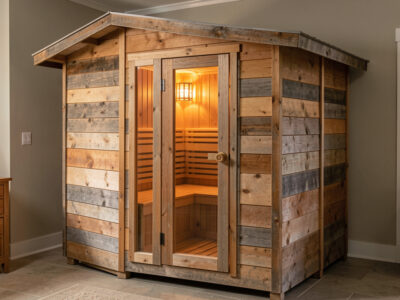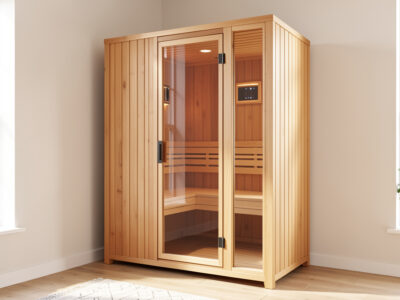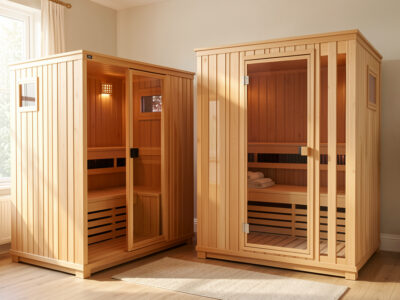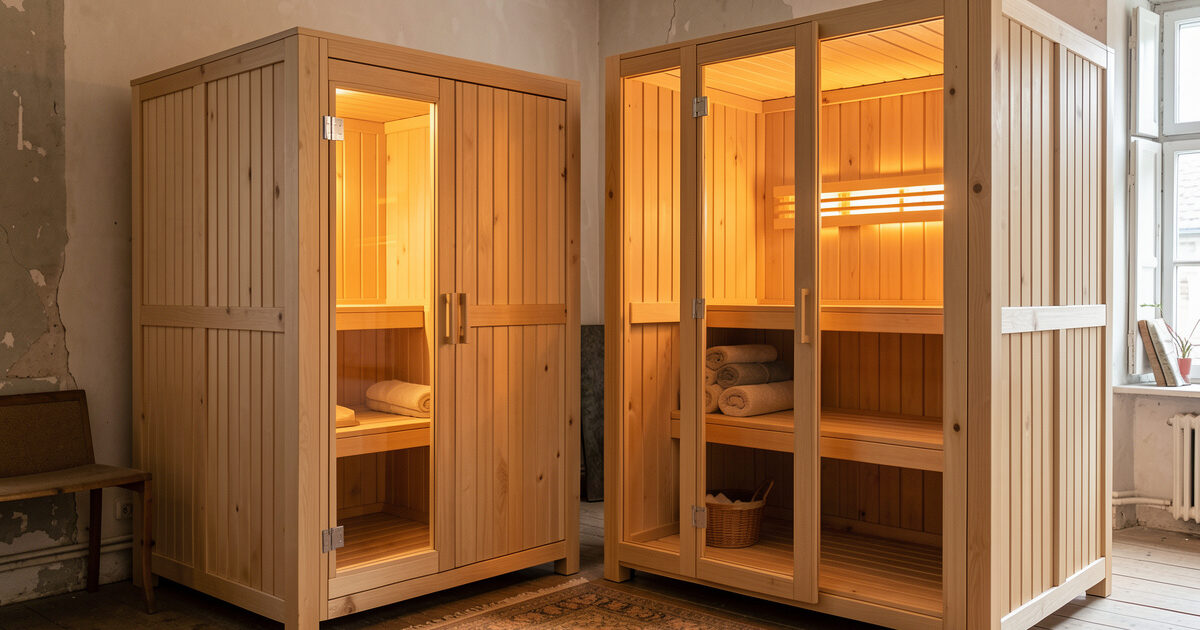
The prefab infrared sauna vs custom build decision comes down to time, fit, and budget: a prefab cabin assembles in an afternoon with hand tools and ships as a complete unit, while a custom build mounts panels into framed walls for a built-in look but turns the project into a renovation. For most buyers, prefab is the right answer — custom earns its cost only in specific situations — and it rarely comes in under a comparable prefab once you add framing, low-EMF wiring, and a dedicated 20A circuit.
I run a prefab 2-person far-infrared cabin and have helped plan a panel-into-the-wall custom install, so I have seen both the flat-pack afternoon and the framing-and-wiring weekend. On the custom plan, the lesson that surprised me was wiring routing: a run of supply cable behind a panel pushed my TriField reading to nearly 4 mG at the bench until we rerouted it along the opposite stud, which dropped it back under 1 mG. A prefab hands you that engineering already solved. This is the trade-off laid out from the build and install side: what each path costs in money and effort, where each one wins, and the third option — portable — that quietly suits more people than either. The decision sits inside our wider infrared sauna buying guide.
The Short Answer
Choose prefab for speed, predictability, and resale; choose custom for an awkward space, a built-in aesthetic, or an ongoing renovation. A prefab cabin is engineered, tested, and warrantied as a unit, so the heat coverage and EMF behavior are known quantities out of the box. A custom build gives you exact fit and finish but makes you responsible for panel layout, wiring, ventilation, and the parts of the result a manufacturer would normally guarantee.
Most people overestimate how much custom buys them. Unless you have a genuine space problem or a design goal a cabin cannot meet, the prefab delivers the same session for less money, less risk, and far less time. I default to recommending prefab and only steer people to custom when their situation actually calls for it.
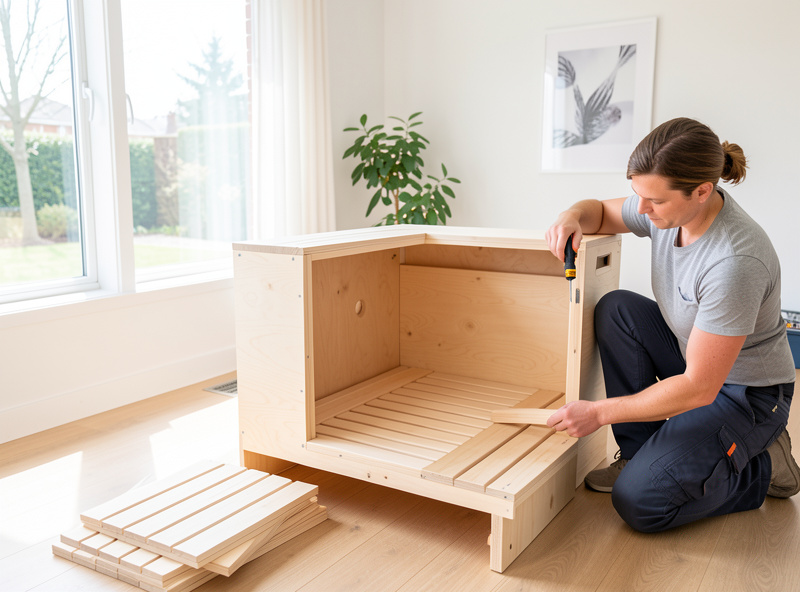
Prefab Infrared Sauna: The Default for Most Buyers
A prefab cabin is a complete product: precut hemlock or basswood panels, pre-mounted heaters, a tested controller, and a clip-and-screw assembly that two people finish in an afternoon. Because the manufacturer engineered the panel coverage, wiring routing, and ventilation, you inherit a known EMF profile and a warranty that covers the heaters and controller as a system. That predictability is the real value — you are buying a solved problem, not a project.
The limits are footprint and fit: a prefab comes in fixed sizes and a standard look, so it sits as furniture rather than blending into the room. For the overwhelming majority of buyers that is fine. The assembly reality is in our assembly walkthrough, and prefab still has install requirements worth checking in the installation guide — clearance, a suitable outlet, and ventilation.
Custom Infrared Sauna: Built-In Fit at a Renovation’s Cost
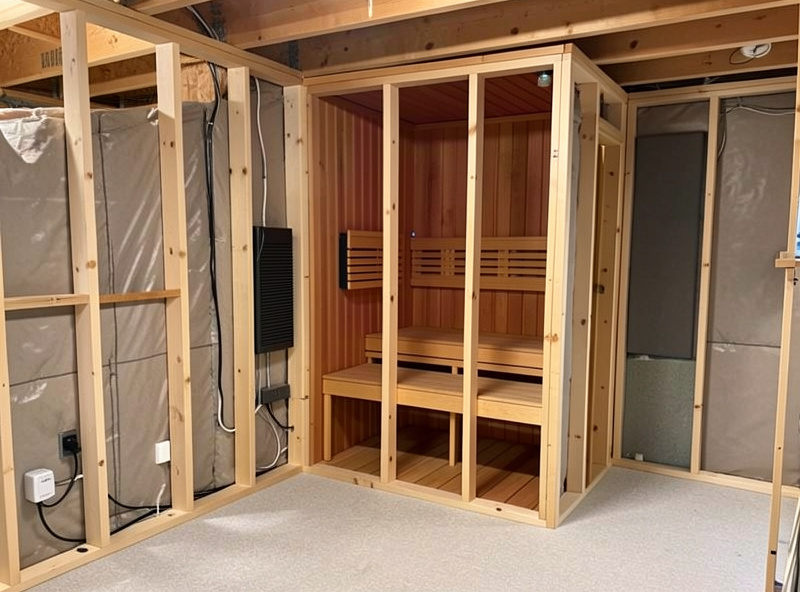
A custom build installs infrared panels into a framed, insulated room you finish yourself, giving exact dimensions and a built-in result that a cabin cannot match. This is the path for an alcove of unusual size, a basement nook, or a bathroom remodel where you want the sauna to disappear into the architecture. Done well, it is the most elegant outcome — and the most demanding, because you are now the integrator responsible for panel spacing, low-EMF wiring routing, a GFCI circuit, ventilation, and heat-tolerant materials.
The cost is rarely lower than a comparable prefab once you count framing, panels, wiring, and finish, and the warranty is fragmented across components rather than unified. In practice a built-in room runs from roughly the same money as a mid-tier prefab up to well beyond it once heat-rated finish materials and an electrician’s time are in, and you carry the risk of any single component if it fails. Budget the panels, the lumber, the circuit, and the labor as separate line items before you decide the look is worth it. If you go this route, plan it carefully with our build a sauna room from scratch guide, the DIY build guide, and the flooring and clearance and ventilation requirements. The line-item budget reality is in the DIY cost breakdown.
The Third Option: Portable
Before committing to either, consider that a portable blanket or tent suits more people than either prefab or custom — especially renters, apartment dwellers, and anyone testing the habit. It costs the least, needs no assembly or wiring, and stores in a closet between sessions. The trade-off is the loss of the enclosed, radiant-wall cabin feel and a heating element that sits close to the body, which is where EMF metering matters most.
I keep a portable far-infrared unit alongside my cabin for travel and small-room comparison, and for many buyers it is the honest first purchase. Because the heating layer wraps close to the body, I metered mine right at the fabric and read a higher field than at my cabin’s bench — nothing alarming, but a real reason to favor a documented low-EMF blanket and keep a little distance where the design allows it. If the routine sticks, you graduate to a prefab cabin with confidence. The options are covered in portable infrared sauna.
Prefab vs Custom vs Portable Compared
The table lines up the three build paths on the factors that decide the call — effort, cost predictability, fit, warranty, and who each one suits. Treat it as a starting filter, then size and budget the specific unit afterward.
| Factor | Prefab cabin | Custom build | Portable |
|---|---|---|---|
| Setup effort | An afternoon, hand tools | A renovation | Minutes, no tools |
| Cost predictability | Fixed, known | Variable, often higher | Lowest |
| Fit and finish | Standard sizes, furniture look | Exact, built-in | None — storable |
| EMF and warranty | Engineered and unified | Your responsibility | Check heating layer |
| Best for | Most buyers | Awkward spaces, remodels | Renters, testing the habit |
How I Would Choose
Default to prefab unless you have a specific reason not to. If your space is standard and you want a known-good, warrantied cabin with the least effort, prefab wins outright. Reach for custom only when an awkward space, a built-in aesthetic, or an existing renovation genuinely justifies becoming the integrator — and budget it honestly, because it rarely undercuts a comparable prefab. In my own house the prefab won on every axis that mattered: it was standing the same afternoon, it metered clean out of the box, and if a heater ever fails I make one call instead of diagnosing which of five components I integrated is at fault. If you are not sure the habit will stick or you rent, start portable and upgrade later.
Once the format is settled, size the unit in 1 vs 2 vs 4 person infrared sauna, set the bracket in the budget-tier guide, and run the spec inspection in what to look for when buying.
Frequently Asked Questions
Is a prefab or custom infrared sauna better?
For most buyers a prefab cabin is better: it assembles in an afternoon, ships with engineered heat coverage and a unified warranty, and costs less than a comparable custom build. A custom build is better only when you have an awkward space, want a built-in look, or are already renovating and can manage the wiring and ventilation yourself.
Is a custom infrared sauna cheaper than a prefab?
Usually not. Once you count framing, insulation, panels, low-EMF wiring, a GFCI circuit, and finish, a custom build rarely undercuts a comparable prefab cabin, and its warranty is fragmented across components rather than unified. Custom is chosen for fit and aesthetics, not to save money.
How long does it take to assemble a prefab infrared sauna?
Typically an afternoon with two people and basic hand tools. Prefab cabins ship as precut panels with pre-mounted heaters that clip and screw together, so most are standing and ready to preheat the same day. Always confirm you have a suitable outlet, clearance, and ventilation before you start.
Do I need an electrician for a custom infrared sauna build?
In most cases yes. A custom build means running a dedicated GFCI circuit and routing wiring for low EMF, which is work best confirmed or done by a licensed electrician, especially since codes are region-dependent. A plug-in prefab cabin often avoids this, needing only a suitable existing outlet.
Should I buy a portable sauna instead of a cabin?
A portable blanket or tent is a strong choice if you rent, live in an apartment, or want to test the habit before committing. It costs the least, needs no assembly, and stores away, but you give up the enclosed cabin feel and should check EMF off the heating layer since the element sits close to your body.