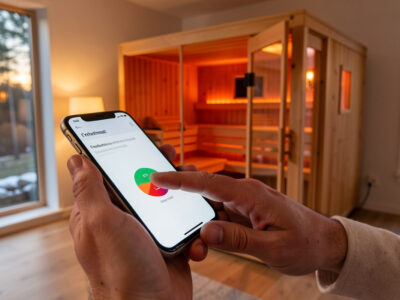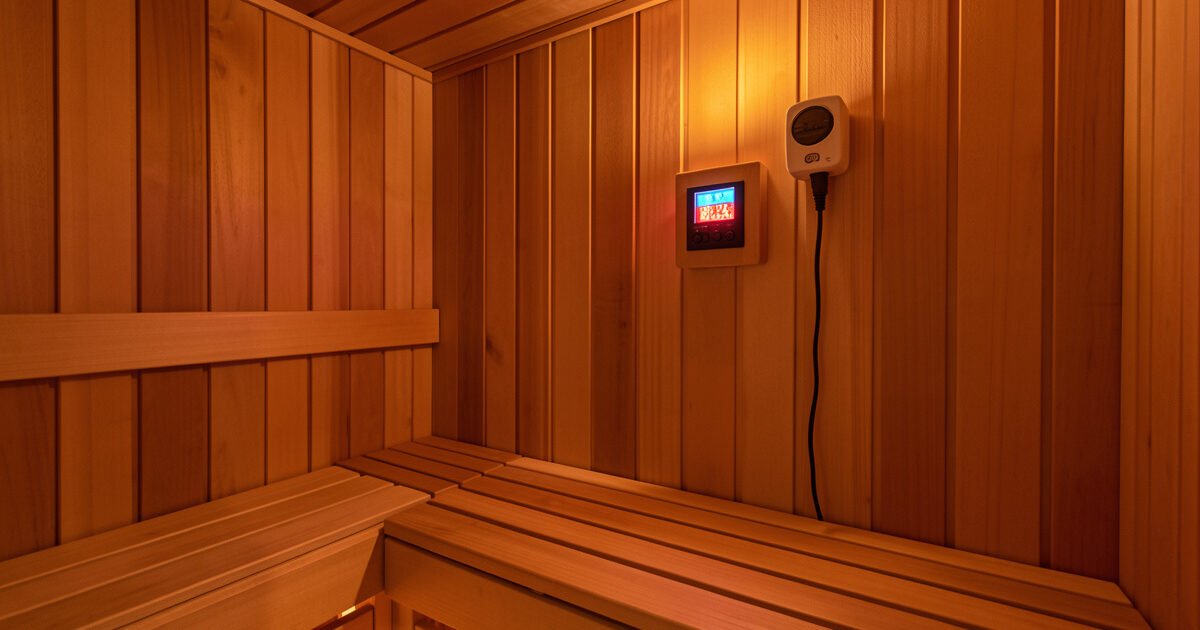
A sauna room thermostat solves the gap between what the cabin’s display says and what your skin actually feels. Infrared heats your body directly, so a panel-mounted sensor reading 130°F can sit well ahead of or behind the real air temperature — and a separate room thermostat gives you an honest second reading plus a deadband cutoff that stops the cabin overshooting. It is the fix for a unit that consistently feels wrong.
I do not run one on every cabin, because some controllers happen to read true. But on my single-person carbon-panel unit the factory sensor reads low, and an independent probe is what caught it. Here is how to tell whether you need a thermostat, which kind fits an infrared cabin, and how to wire it without fighting the factory controller.
Set temp versus felt heat: why the display lies
The core issue is that infrared warms objects and bodies, not primarily the air, so air temperature lags the radiant load. Your factory controller usually reads a sensor mounted on or near a panel, which sees the panel’s influence before the room catches up. The number on the display is a set point the controller is chasing — not a measurement of what you feel on the bench.
That is why two cabins both reading 130°F can feel completely different: sensor placement, cabin size, and heater type all shift the relationship between the displayed number and the felt heat. A room thermostat with its sensor at bench height, away from direct panel line-of-sight, measures the air you actually sit in. When the displayed set temp and the felt heat disagree session after session, that mismatch is the symptom a thermostat exists to fix. I cover the underlying temperature logic in infrared sauna temperature and how it fits the wider stack in the smart infrared sauna controls hub.
Do you actually need one?
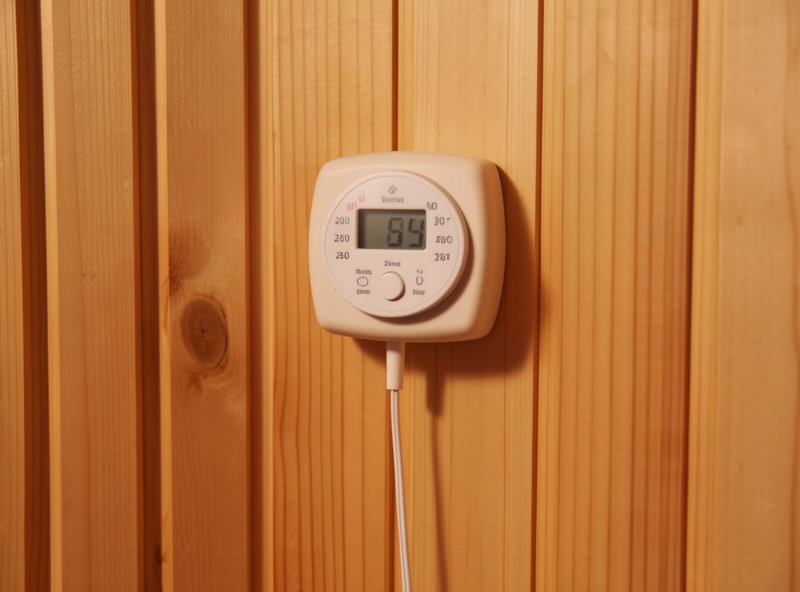
Most owners do not, and I would rather you skip the part than add complexity you do not need. You need a thermostat if any of these is true: your cabin reads a temperature that does not match how it feels, it overshoots and gets uncomfortably hot before cycling down, or your factory controller has no usable temperature regulation at all (some budget units are effectively on/off with a timer). If your unit holds a comfortable, consistent felt heat at its set point, leave it alone.
The quick test I use is a cheap independent thermometer at bench height for a few sessions. Across the heaters I have lived with, the carbon-panel cabin ran several degrees off its display while the far-infrared daily driver tracked true — same brand-tier gear, different sensor placement. Measure before you buy. A thermal thermometer or a small probe tells you in two sessions whether the factory reading can be trusted, and that decides whether a thermostat is worth wiring in.
Types of thermostat that suit an infrared cabin
Not every thermostat belongs in a sauna. A standard home HVAC thermostat tops out around 90°F and is useless here. You want a high-temperature line-voltage thermostat or a smart temperature controller with a remote probe rated for sauna-range heat. The table below is how I sort the options.
| Type | How it works | Best for | Notes |
|---|---|---|---|
| High-temp line-voltage thermostat | Switches the heater circuit at a set temp | Cabins with no usable regulation | Must be rated for the load amperage |
| Smart controller + remote probe | Reads bench-height probe, switches via relay or plug | Owners who want logging and app control | Pairs with a hub for automation |
| Inline temperature monitor | Displays true temp, no switching | Verifying the factory reading | Cheapest sanity check; no control |
| Factory controller only | Built-in set temp and timer | Cabins that already read true | Keep as the safety cutoff regardless |
Wiring it without fighting the factory controller
The mistake here is trying to replace the factory controller. Do not. The cleanest approach is to let your accurate temperature device control power upstream — via a relay or a correctly rated smart plug — while the factory controller stays in place as the final safety timer and overheat cutoff. The thermostat decides “is the room at temp,” the plug or relay carries the load, and the factory timer guarantees the cabin shuts off even if everything else fails.
For a hardwired high-temp thermostat on a 120V cabin, it switches the heater circuit and must be rated for the cabin’s continuous amperage — the same rating logic as a plug, covered in my wiring guide. For 240V and larger cabins, this is electrician territory, like everything else at that power level (see 240V and breaker requirements). I keep my probe at bench height and outboard of direct panel line-of-sight so it reads air, not radiant glare — placement is most of the accuracy.
The EMF footnote
If your thermostat switches the load with a relay mounted inside the cabin, treat it like any other switching hardware: mount it low and outboard, away from where you sit. On my TriField the field from a relay clicking a 15A load is a real local source if it is near your body, and trivial if it is at the wall. A monitor-only thermostat with just a probe adds nothing to the EMF picture — it is not switching current. The full method for checking is in measuring sauna EMF with a TriField, and the broader hardware story in the heater types and EMF guide.
Common mistakes that make a thermostat useless
A thermostat only helps if it is installed right, and three mistakes quietly defeat it. The first is probe placement next to a panel, where it reads radiant glare and cycles the cabin off long before the room is actually warm — the bench feels cold while the controller thinks it is done. The second is using an underrated switching device: a high-temp thermostat or relay switching a 13–15A heater must be rated for that continuous current, or it becomes the same overheating failure point as a cheap plug.
The third, and most common, is fighting the factory controller instead of layering above it. If both the factory controller and the new thermostat are trying to regulate the same heater independently, they hunt against each other — one calls for heat while the other cuts it, and the cabin never settles. The fix is hierarchy: the accurate thermostat is the primary regulator, the factory controller sits at a higher set point as a backstop and safety timer, and only one device actually decides when the room is at temperature. Get those three right and the thermostat does exactly what you bought it for; get any one wrong and it is worse than the factory sensor you were trying to correct. Decide the hierarchy before you wire anything.
How I dial mine in
On the carbon-panel cabin I set the smart controller’s probe to hold the bench-height air at the felt temperature I actually want, then let the factory controller run at a slightly higher set point as a backstop. The result is that the room reaches a consistent felt heat and the factory timer still ends the session no matter what. I check the probe reading against a handheld thermometer every few months because a drifting sensor quietly undoes the whole point. That cross-check is the maintenance the thermostat needs, and it takes one session to do. The payoff is a cabin that feels the same every night regardless of how cold the room started — which, in a Swedish January when the cabin starts at near-freezing, is the difference between a session you look forward to and one you cut short because the felt heat never arrived.
Related Guides
- Smart Infrared Sauna Controls: The Owner-Installer Guide
- Smart Plug for Infrared Sauna: Pick a Safe-Rated Switch
- Infrared Sauna Remote Preheat: Walk Into a Hot Cabin
- Home Assistant Sauna Automation: Rules and Sensors
- Infrared Sauna Temperature: Why 130 Degrees Is Optimal
Frequently Asked Questions
Why does my infrared sauna feel different from its temperature display?
Infrared heats your body directly, so the panel-mounted sensor often reads ahead of the actual air at bench height. The display shows a set point the controller is chasing, not the felt heat. A room thermostat with a bench-height probe gives the honest reading.
Can I use a normal home thermostat in a sauna?
No. Standard HVAC thermostats top out around 90 degrees Fahrenheit and cannot read or switch at sauna temperatures. You need a high-temperature line-voltage thermostat or a smart controller with a remote probe rated for sauna-range heat.
Should a thermostat replace my factory sauna controller?
No. Keep the factory controller as the final safety timer and overheat cutoff. Let an accurate thermostat control power upstream through a relay or rated smart plug. The thermostat manages temperature; the factory timer guarantees the cabin shuts off.
Where should the temperature probe go?
At bench height, away from direct line-of-sight to the panels, so it reads the air you actually sit in rather than radiant glare off a heater. Placement is most of the accuracy, so avoid mounting it right beside a panel.
Does a sauna thermostat add EMF?
Only if it switches the load with a relay mounted inside the cabin near you. Mount any switching hardware low and outboard at the wall. A monitor-only thermostat with just a probe switches no current and adds nothing to the EMF reading.