When two people disagree on sauna heat, you don’t pick a single temperature both tolerate — you give each person a different dose inside the same session. In an infrared cabin the felt heat depends far more on how close you sit to a panel and how long you stay than on the number on the controller. Same set temp, two different experiences.
This is the argument every sharing couple has, and it’s built on a false premise: that the thermostat sets how hot each person feels. It doesn’t. The person who cranks the dial and the person who begs to turn it down are usually both wrong about what the dial actually controls. Once you understand that, the fight mostly disappears — and you stop wearing out the buttons.
I’ve run mismatched sessions in my own cabin for years — I like it hotter and longer than my usual sauna partner — and the fixes below come straight out of my session log, not a spec sheet.
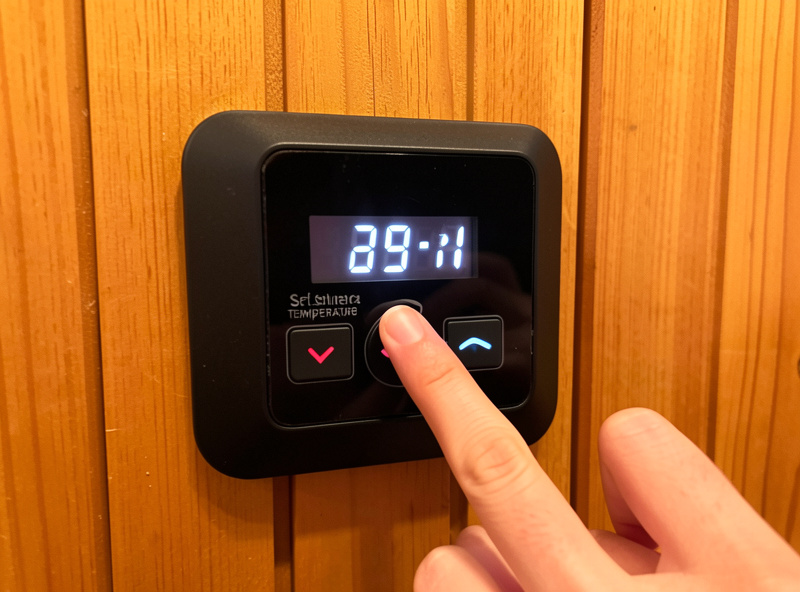
Can Two People Set One Temperature They Both Enjoy?
Rarely at the same intensity — and you don’t need to. The trick is to stop treating the set temp as a single comfort setting and start treating it as the cabin’s target, which each person then experiences differently by where they sit and how long they stay. A shared set temp of around 55–60°C suits most couples once seating does the fine-tuning.
The reason one number can’t please both is that heat tolerance genuinely varies between people — body size, acclimatization, and how much heat someone has grown up with all shift the comfort band. Here in Sweden the sauna habit runs deep, and even so my partner and I sit a full notch apart. Fighting that with the dial just means one of you is always adjusting it back. The full couples guide frames why sharing is an engineering problem before it’s a comfort one; this article is the temperature half of that.
Why Isn’t Set Temp the Same as Felt Heat?
Because an infrared cabin heats you two ways, and the controller only governs one of them. The set temp targets the air temperature, but most of what you feel is radiant heat coming straight off the panels onto your skin — and that radiant intensity depends on your distance from the panel, not the air reading. Move six inches closer and you feel hotter with no change to the dial.
Thermal-comfort engineering has a name for this: mean radiant temperature, the concept behind standards like ASHRAE thermal-comfort work, which recognizes that what a body feels is a blend of air temperature and the radiant temperature of the surfaces around it. In an infrared cabin the panels are those surfaces, and they’re intense and close. That’s why the air can read a mild 55°C while the skin facing a panel feels far hotter. I dig into this distinction for solo users in set temp vs felt heat — for two people it becomes the whole game.
There’s a second lever: time. Radiant dose accumulates, so a person who sits ten minutes longer gets a bigger “dose” at the identical set temp. Between seat distance and session length, you have two dials per person that the single controller never touches.
How Does Seat Position Settle the Heat Argument?
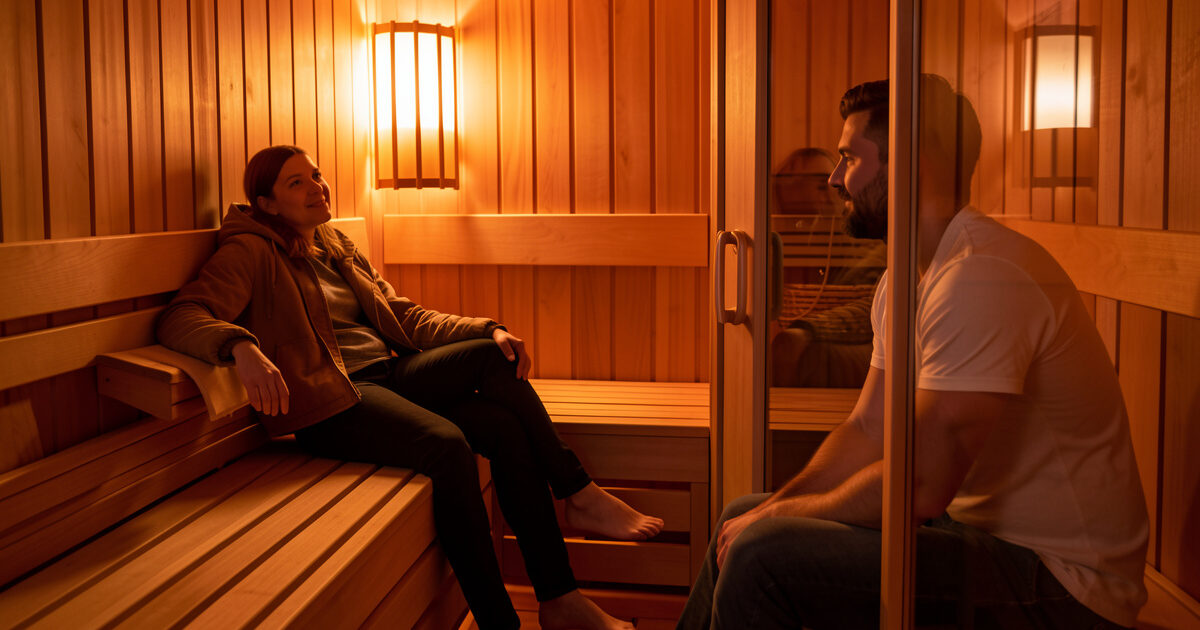
Seat position is the fastest fix. The heat-lover sits closest to a panel — usually the back or corner where radiant coverage is strongest — while the heat-sensitive partner sits toward the door or the center gap, farther from the panels. Same cabin, same set temp, and each person self-selects their intensity by a foot of distance.
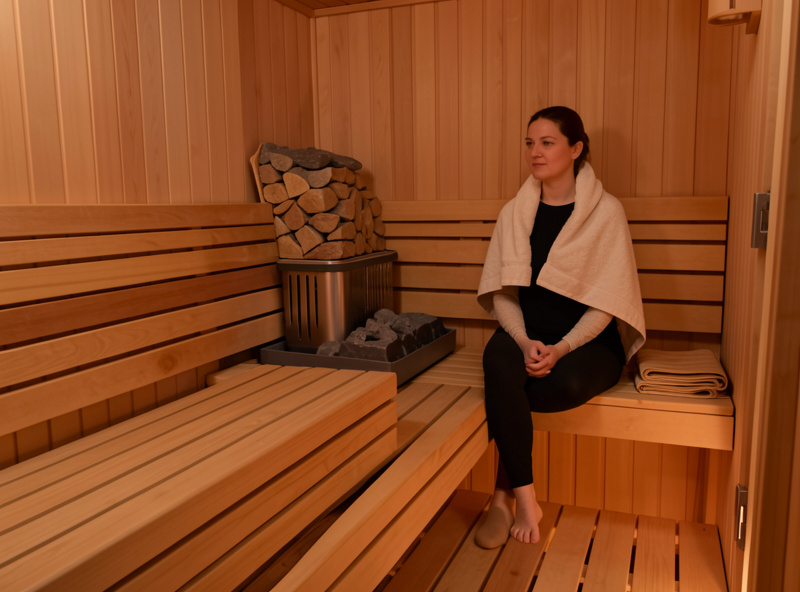
In practice the coolest seat in a two-person cabin is often the center of a shared back bench — the exact spot where two bodies shade each other from the side panels. That center gap is a problem when you both want heat, but a gift when one of you wants less: it’s the built-in cool seat. The corners, by contrast, get radiant coverage from two directions and run warmest. I have my partner take the door-side seat and I take the corner, and neither of us touches the controller. If you want to understand why those hot and cold zones fall where they do, it’s the panel-placement physics I map in the couples hub and the sizing that sets it up in how much room two people need.
What Is the Stagger Trick?
Staggering means the two people don’t start and stop together. The heat-sensitive partner enters a few minutes after the cabin is fully warmed and leaves a few minutes early, while the heat-lover comes in at full temp and stays through. Each gets their own session length — and their own total dose — inside one preheat, with no wasted electricity.
This is the move I reach for when the seat trick isn’t enough. Warm-up matters here: entering a fully preheated cabin versus one that’s still ramping changes the felt heat a lot, which is why I prime the cabin properly first — the routine’s in my warm-up guide. The staggered exit is the underrated half: leaving five minutes early caps the heat-sensitive person’s dose without asking the other to cut their session short. Nobody compromises, because you’ve decoupled the two sessions in time instead of forcing them to share one clock.
Can You Split the Heaters Into Zones?
Some cabins let you. Better units offer independently switchable front and back panel banks, and full-spectrum saunas let you run the near-infrared halogen emitter separately from the far panels. Turning off the panels or emitter on one person’s side, or killing the intense NIR, drops that side’s intensity while the rest of the cabin stays warm.
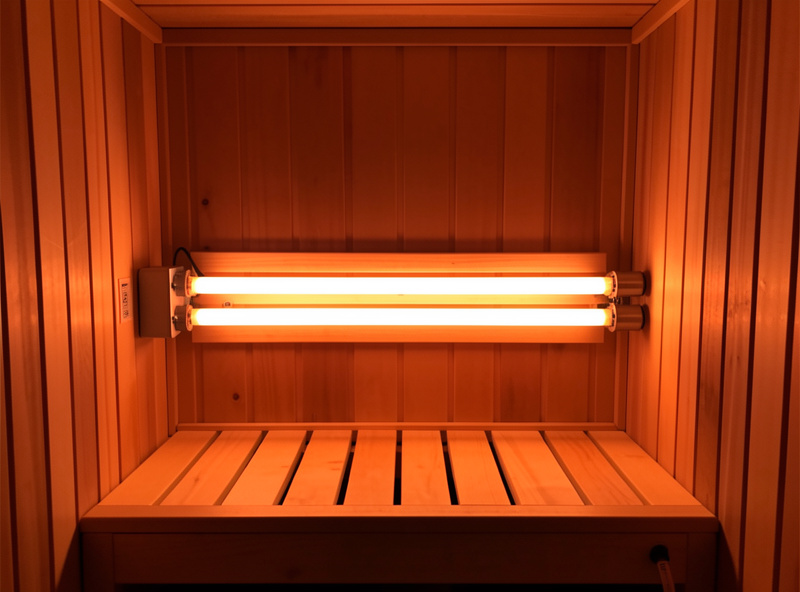
Near-infrared is the key variable. NIR (roughly 0.7–1.4µm, the short-wavelength end that references on infrared radiation define as nearest the visible band) comes from a bright halogen emitter and feels much more intense and penetrating than the gentle far-infrared off a carbon panel. On the full-spectrum unit I’ve lived with, the single biggest comfort lever for a heat-sensitive partner is simply switching the NIR emitter off — the far panels keep the cabin pleasant while the sharp, radiant “sunlamp” quality disappears. If you’re choosing hardware with sharing in mind, the gentle-versus-intense split between panel types is exactly what I compare in carbon vs ceramic: carbon’s broad, mild footprint shares far better across two differing tolerances than hot, localized ceramic rods.
What Compromise Set Temp Actually Works?
For most sharing couples, set the cabin around 55–60°C and let seating and timing do the rest. That band is warm enough that the heat-lover, sitting in a corner and staying full-length, gets a satisfying session, while the heat-sensitive partner near the door with a shorter stay stays comfortable. Pushing the dial to 65°C+ to satisfy one person usually just drives the other out early.
The way I dial mine: I set 58°C, take the warm corner, and my partner takes the door seat and enters a few minutes behind me. That single configuration ends more than it sounds like it should. The mistake I made for a long time was chasing a hotter set temp to make my side better — all it did was make my partner’s side unbearable and cut our shared time short. Lower set temp plus smart seating beat high set temp plus a thermostat war every time, and it uses less electricity doing it.
Should You Just Run Two Separate Units Instead?
If your heat preferences are genuinely far apart, two separate units end the negotiation entirely — each person sets their own intensity, their own length, their own everything. A sauna blanket or a small single-person cabin for the heat-sensitive partner alongside a hotter shared or solo cabin is the zero-compromise route, at the cost of space and money.
I keep a portable infrared blanket in the rotation precisely for this reason — it’s the travel and small-room option, and it also happens to be a heat setting the user controls alone. For a couple where one person tops out at a mild 45°C and the other wants a serious 65°C, no amount of clever seating fully bridges that gap, and a second unit is honestly the calmer answer. It’s worth comparing what a personal infrared sauna blanket costs against a bigger dual-zone cabin before you assume you’re stuck sharing one controller. The trade-offs of a fixed cabin versus a portable are laid out in the couples hub.
As an Amazon Associate I earn from qualifying purchases.
When It’s Not the Heat — It’s the Humidity
Two bodies raise the cabin’s humidity, and higher humidity makes any set temp feel hotter. If the heat-sensitive partner suddenly wants out earlier in a shared session than they ever do solo, the culprit is often moisture, not temperature — combined sweat has loaded the air, and sweat evaporates less efficiently, so the same 58°C feels heavier.
My digital hygrometer confirms this every time: the reading climbs faster with two of us inside. The fix isn’t the thermostat — it’s ventilation. Cracking the door or opening a vent between rounds drops the humidity back down and resets the felt heat for both people. It’s the reason I treat airflow as part of the temperature conversation, not a separate one. Health effects of sauna heat are widely studied, but they’re individual responses; let each person’s own comfort and hydration — not a target number — decide when their session ends.
Related Reading
- Infrared Sauna for Couples: Sharing a Cabin Without Compromise
- How Much Room Two People Actually Need in an Infrared Sauna
- Bench Layout for Sharing: Facing Benches vs Side-by-Side
- Cabin Cold Spots With Two Bodies Blocking the Panels
- Does Two People Cost More to Run? kWh Per Shared Session
How do two people share a sauna when they disagree on temperature?
You give each person a different dose inside one session rather than picking a single temperature. Set the cabin around 55 to 60 degrees Celsius, have the heat-lover sit close to a panel in a corner and stay full length, and have the heat-sensitive partner sit near the door and keep their session shorter.
Why does the same set temperature feel hotter to one person?
Because felt heat in an infrared cabin depends mostly on how close you sit to a panel and how long you stay, not on the air temperature the controller targets. Radiant heat lands on the skin facing a panel, so moving a foot closer feels much hotter with no change to the dial.
What is the coolest seat in a two-person sauna?
Usually the center of a shared back bench, because two bodies shade each other from the side panels there. The corners run warmest since they get radiant coverage from two directions. That built-in cool center seat is ideal for a heat-sensitive partner.
Can you turn down the heat for just one person?
On some cabins yes. Units with independently switchable front and back panel banks, or full-spectrum saunas that run the near-infrared emitter separately, let you drop the intensity on one side. Switching off a full-spectrum unit’s near-infrared halogen emitter is the single biggest comfort lever for a heat-sensitive partner.
Why does a shared sauna session feel hotter than a solo one?
Two bodies raise the cabin humidity through combined sweat, and higher humidity makes any set temperature feel hotter because sweat evaporates less efficiently. If the heat-sensitive partner wants out earlier than they do solo, the cause is often moisture, not temperature. Cracking the door between rounds resets the felt heat.