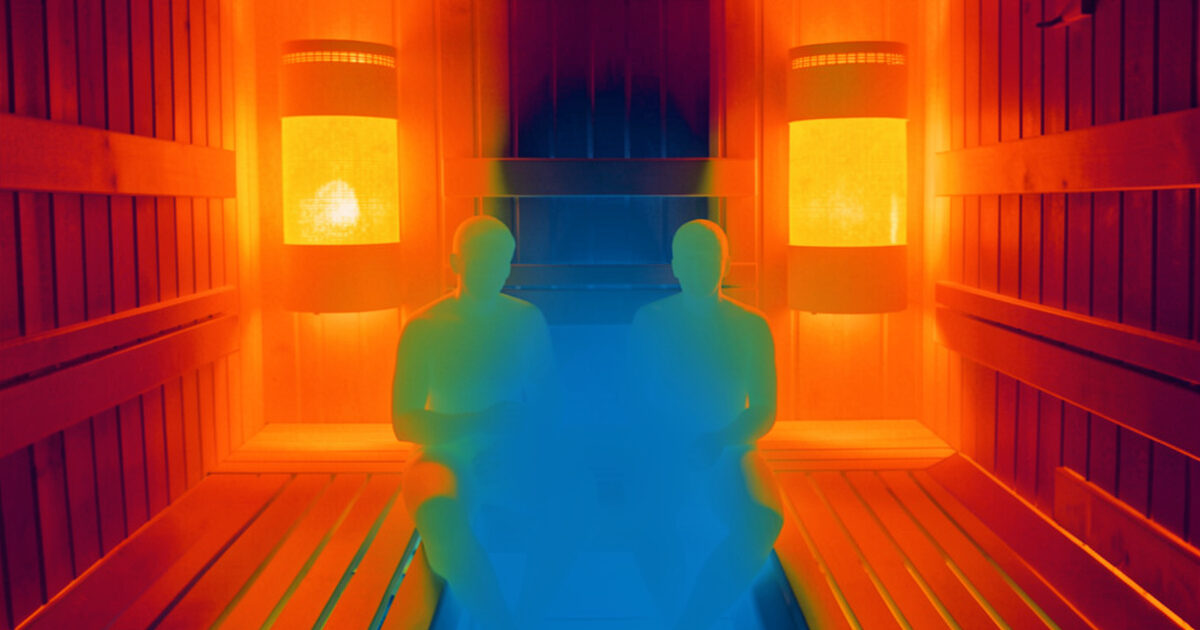
The worst cold spot in a shared infrared sauna forms in the center of a two-person back bench — the strip of wall that both seated bodies shade from the rear panels at once. On my thermal camera that center wood routinely reads 8–12°C cooler than the exposed panel faces beside two people, even with the controller holding a steady set temp. The heat isn’t missing; it’s being blocked.
This is the single most under-discussed problem in shared saunas, and it catches people out because the thermostat lies to you. The air reading says the cabin is at temperature. Your partner in the middle seat says they’re cold. Both are true — and the reason is pure line-of-sight physics, not a broken heater. Understand where the heat shadows fall and you can beat every cold spot by moving bodies, never the dial.
Where Do Cold Spots Form When Two People Share?
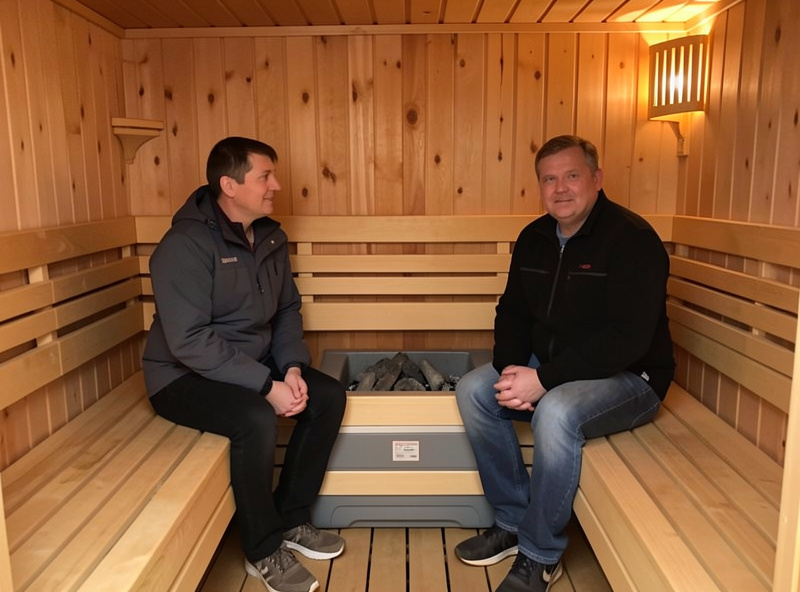
They form wherever a body sits between a panel and another body. The classic case is the center of a shared back bench, where two people’s inner shoulders shade the rear panels behind the gap between them. Side panels get blocked too — your outer arm can shadow the wall beside you, cooling your own flank. The pattern follows the bodies, not the cabin.
With one person in a cabin, cold spots are minor — you’re a single object casting a single shadow, and you can lean to expose your back. Add a second body and the shadows multiply and overlap. Now there’s a zone the rear panels literally cannot reach because two torsos stand between the wood and the heat source. That’s the center gutter, and it’s the coldest spot in the room precisely when you most need even warmth. It’s the same effect that makes side-by-side bench layouts share heat so poorly, and it’s the physics underneath the whole couples guide.
Why Do Two Bodies Block Infrared Heat?
Because infrared heat is radiant and line-of-sight — it travels in straight lines from panel to surface and doesn’t circulate like the hot air in a traditional sauna. A body is opaque to that radiation, so it casts a heat shadow on whatever is behind it, exactly the way an object casts a light shadow. Radiant intensity also falls off with distance, so anything the panel can’t hit directly stays cool.
This is the crucial difference between infrared and a Finnish hot-rock sauna. In a convective sauna the air itself is 80–100°C and it wraps around every body equally; shadows don’t matter because you’re heated by hot air on all sides. In an infrared cabin the air is a milder 45–60°C and most of the warmth you feel is radiant flux landing directly on your skin. Block that straight-line path with a second body and the heat simply doesn’t arrive — the falloff of radiant flux with distance and obstruction is textbook thermal radiation, the kind any physics reference on radiant heat transfer lays out. Cranking the set temp doesn’t fix a shadow; it just makes the lit areas hotter while the shaded strip stays relatively cold.
How Do I Map Cold Spots With a Thermal Camera?
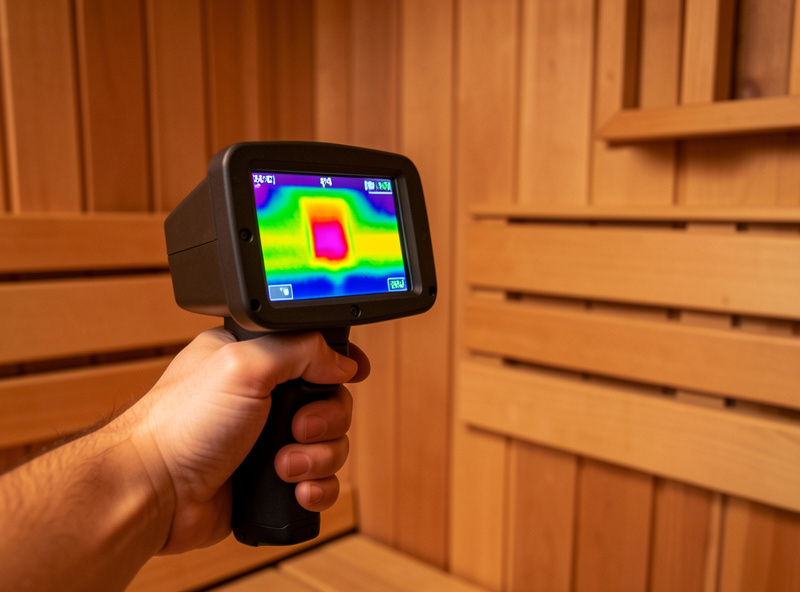
I run a small thermal camera across the cabin walls with people seated, reading the wood surface temperature panel by panel. The camera shows the heat shadows as cooler patches directly behind each body, and the numbers make the invisible visible — the shaded center wood consistently reads several degrees below the exposed panel faces. It’s the same camera I use to map cold spots on a 3D-print bed.
The method is simple and worth doing once in your own cabin. Preheat fully, get two people seated as you normally sit, then scan the back and side walls with the camera and note where the cool patches land. Thermal imaging works by reading emitted infrared and inferring surface temperature — the physics that companies like FLIR built an industry on — and raw hemlock reads cleanly because untreated wood has high, even emissivity. What you’ll see is that the cool zones track the bodies precisely: move a person, and their shadow moves with them. That single exercise tells you more about your cabin’s real heat distribution than any spec sheet, and it’s the metered lens I bring to everything on this site, right down to putting a TriField on the panels for EMF.
Which Seats Run Coldest in a Two-Person Cabin?
The center of a shared back bench runs coldest, followed by any seat where your own body blocks the only nearby panel. Corners run warmest because they catch radiant heat from two directions at once. So in a standard two-person cabin the ranking is predictable: corners hottest, mid-bench coolest, door-side seat cool because it faces the glass rather than a panel.
This ranking is genuinely useful when two people want different heat. The heat-lover takes a corner; the heat-sensitive partner takes the center or door seat and is comfortable at the same set temp — I lean on exactly that in my guide to sharing when you disagree on heat. But when both people want to be warm, that same map is a warning: don’t both drift to the middle, or you’ll each sit in the other’s shadow and both feel underheated. Knowing the cold ranking lets you place bodies deliberately instead of discovering the gutter by feel, ten minutes into a session, cold.
How Do You Beat Cold Spots Without Raising the Temperature?
Move and angle the bodies, don’t touch the dial. Sit slightly turned so each person faces a panel squarely instead of shading it, spread out toward the corners rather than clustering in the center, and add a footrest or backrest that steers a sitter into a well-covered zone. Every one of these exposes more skin to a direct radiant path — which is what actually warms you.
The angling trick is the one people underuse. Sitting square-on to a side panel, turned maybe 20 degrees into a corner, puts your back and shoulder in direct line of the panel instead of casting a shadow across it. In my own cabin I added a low footrest that naturally rotates a sitter toward a side panel, and on the thermal camera their previously cool position warmed measurably — no change to the set temp, just geometry. Spreading toward the corners is the other free fix: two people at opposite ends of a bench each get corner coverage and stop shading the shared center. Raising the temperature, by contrast, is the expensive non-fix — it burns more kWh, makes the hot seats uncomfortable, and leaves the shadowed strip still relatively cold because a shadow scales with the heat, not away from it. The engineering behind where panels can and can’t reach is in my guide to why cold spots happen and heater placement.
Do Carbon Panels Spread Heat Better Than Ceramic for Two?
Yes, generally. Carbon-fiber panels run at a lower surface temperature over a larger area, producing a broad, gentle radiant footprint that covers more of a seated body and overlaps better between two people. Ceramic rods run hotter but more localized, so their coverage is intense up close and drops off fast — which makes cold spots sharper and more punishing when a body blocks one.
For a shared cabin that difference matters. A wide, soft carbon footprint is more forgiving of two bodies moving around and partially shading panels, because the coverage overlaps and there’s radiant heat reaching a seat from several panels at once. A hot, narrow ceramic beam is less forgiving: shade it and the drop is steep. That’s a big part of why I’d steer a sharing couple toward carbon, and it’s the core of my carbon vs ceramic comparison. Neither panel type eliminates heat shadows — physics doesn’t allow that — but carbon’s broad footprint softens their edges, and in a two-person cabin softer edges mean fewer complaints.
Does Panel Placement Matter More Than Wattage?
For even heat across two people, placement beats raw wattage every time. A cabin with more panels distributed across every wall — including low panels near the calves and back panels behind each seat — heats two bodies more evenly than a higher-wattage cabin with a few big panels clustered on one wall. Coverage geometry, not the wattage total, decides where the cold spots fall.
Manufacturers love a big wattage number because it sells, but wattage is gamed and it tells you nothing about distribution. Two cabins can draw identical power and heat completely differently depending on how many panels there are and where they sit. For sharing, what you want is panels on every wall an occupant faces, plus low panels — cold ankles and calves are a classic shared-cabin complaint because most panels sit at torso height and two sets of legs shade the little coverage that reaches floor level. When I evaluate a cabin for two, I count the panels and map their walls before I ever look at the wattage sticker. The felt-heat-versus-spec gap is a theme I return to across the couples hub and the sizing guide: the numbers on the box rarely predict how warm two people actually feel.
What I’d Do About a Cold Spot in My Own Cabin
If a shared session left one of us cold, I wouldn’t reach for the thermostat — I’d reach for the thermal camera first and find the shadow. Nine times out of ten the fix is a seat that needs turning, a body that needs to slide toward a corner, or a footrest to pull someone out of the center gutter. The heat is almost always there; it’s just being blocked.
That’s the whole mindset shift with a shared infrared cabin: it’s a geometry problem, not a power problem. The cold you feel isn’t the cabin failing to make heat — it’s two bodies standing between the heat and the wood behind them. Map the shadows once, learn where the corners and the gutter fall in your specific cabin, and you’ll place yourselves right by instinct after a week. The sound of a session settling in — the tick of the wood warming, the quiet on a dark Swedish evening — is a lot more pleasant when neither of you is quietly shivering in a heat shadow you didn’t know was there.