Lowering 100 liters of water from 39°C to 10°C requires removing 12,140 kilojoules of thermal energy — the same physics as cooling a 100-liter hydroponic reservoir. The cold plunge tub and the DWC reservoir are governed by the same heat-transfer equation.
The difference is that one tub holds a person recovering from a sauna session and the other holds plant roots, but the water does not know the difference. It cools at a rate determined by surface area, ambient temperature, and thermal mass, regardless of what is submerged in it.
The reason most cold-plunge guides treat cooling as a product problem — “buy this chiller” — while hydroponic guides treat it as a physics problem — “here is the heat transfer rate across your reservoir walls” — is a quirk of audience. Sauna users tend to be wellness consumers. Hydroponic growers tend to be system builders. But the physics does not change when you cross from one domain to the other, and the grower’s approach to reservoir cooling produces a better cold plunge than the consumer’s approach every time. Understanding the thermal mass of water, the rate at which it loses heat to ambient air, and how much cooling power you actually need instead of how much the chiller manufacturer wants to sell you — that is the difference between a cold plunge that works on a 30-degree summer day and one that only works in winter.
Thermal Mass: Why Your Cold Plunge Tub Behaves Like a Nutrient Reservoir
Water has a specific heat capacity of 4.184 kilojoules per kilogram per degree Celsius — the highest of any common liquid. That means 100 liters of water absorbs or releases 418.4 kilojoules for every 1-degree change in temperature. A cold plunge tub holding 100 liters at 10 degrees Celsius sitting in a 22-degree room gains roughly 100 to 200 watts of heat continuously from the air through the tub walls, depending on insulation. That is the same wattage a hydroponic reservoir absorbs from a warm grow tent — the ambient-to-water delta drives the heat gain rate, and the water’s thermal mass determines how fast the temperature rises in response.
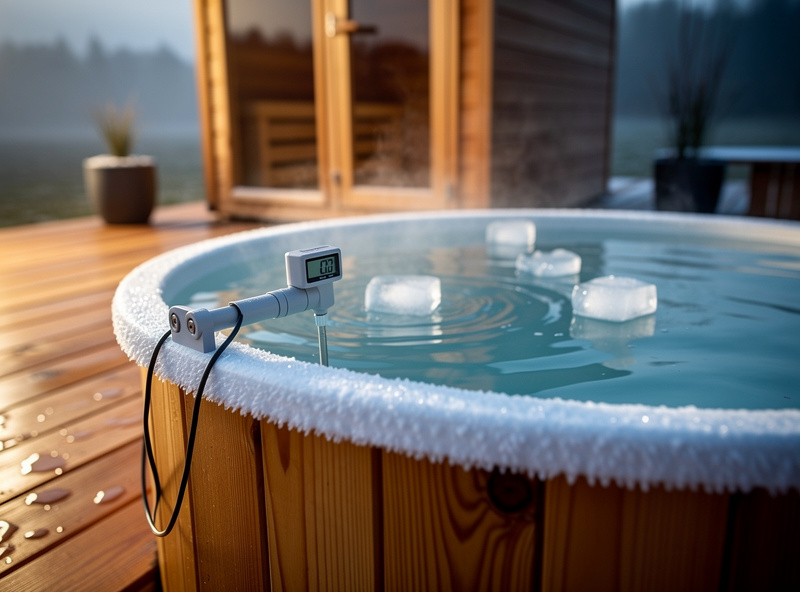
In my setup, a 200-watt Active Aqua chiller keeps a 100-liter Rubbermaid stock tank at 12 degrees through an hour-long session — the same chiller model that a hydroponic grower would bolt to a reservoir shelf. The practical takeaway is the same: a 100-liter cold plunge at 10 degrees in a 22-degree room will warm to roughly 12 degrees in one hour without active cooling. Adding a chiller rated at 200 watts of cooling capacity holds the temperature steady. A chiller rated at 100 watts slows the warming but cannot stop it — the tub gains heat faster than the chiller removes it. This is the exact same sizing math a hydroponic grower runs when deciding whether an aquarium chiller is enough to keep a reservoir below 22 degrees in a grow tent running at 28 degrees. The numbers change — 28 to 22 versus 22 to 10 — but the equation is identical. For the full equipment picture including what hardware actually works at the hobbyist scale, the hydroponic equipment guide covers reservoir cooling with the same physics you would apply to a cold plunge — different liquid, same thermal math.
The Cooling Rate Equation That Both Systems Share
The heat transfer rate from water to ambient air follows Newton’s law of cooling — formally dT/dt = -k(T – T_ambient) — where the rate of temperature change is proportional’s law of cooling: the rate of temperature change is proportional to the difference between the water temperature and the ambient temperature. A reservoir at 28 degrees in a 30-degree grow tent gains heat slowly because the delta is only 2 degrees. The same reservoir at 28 degrees in an 18-degree basement loses heat at roughly five times that rate because the delta is 10 degrees. The cold plunge at 10 degrees in a 22-degree room gains heat at the same rate a 10-degree reservoir would gain heat in that same room — the water does not distinguish between a body and a root mass.
This is why a cold plunge in a Swedish winter on an unheated balcony works beautifully with no chiller at all — the ambient air at 5 degrees is colder than the target water temperature, so the tub loses heat to the air rather than gaining it. The same balcony in July at 28 degrees requires 400 to 500 watts of active cooling to hold 10 degrees. The grower who runs a reservoir in a basement in winter versus a grow tent in summer faces the same seasonal swing: passive cooling works in winter, active cooling is required in summer, and the seasonal chiller sizing math is the same across both applications. Understanding the ambient delta is what separates a system that works year-round from one that only works when the weather cooperates.
Insulation: Why Most Cold Plunge Tubs Are Worse Than Hydroponic Reservoirs
A standard DWC bucket is a 20-liter opaque HDPE container with a wall thickness of roughly 2 millimeters. It gains heat at approximately 5 to 10 watts per degree of ambient-to-water delta. A typical cold plunge tub — a 100-gallon stock tank or a molded polyethylene tub — has thicker walls and a larger surface area, gaining 15 to 25 watts per degree of delta. The stock tank, despite being marketed as a cold plunge, insulates worse per liter than the DWC bucket because the surface-area-to-volume ratio increases as the container gets larger and the plastic wall material is the same.
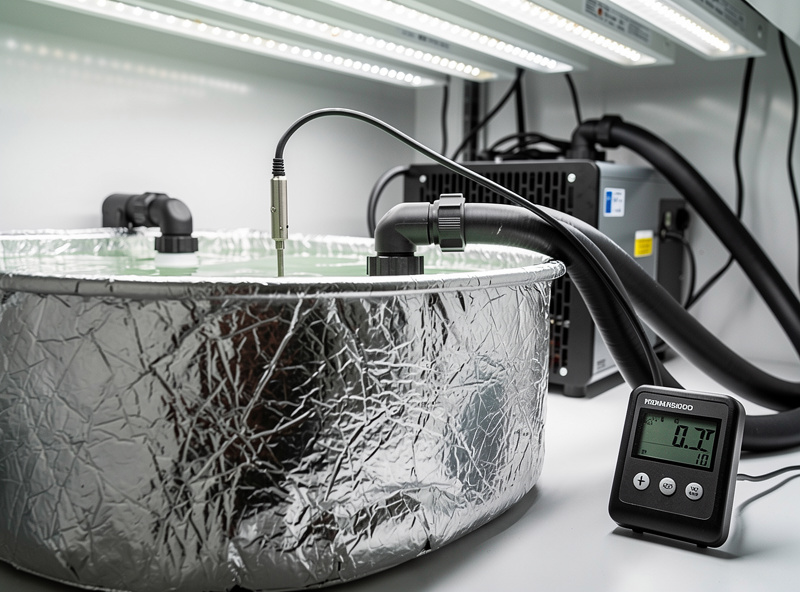
The fix is the same in both domains: wrap the container. A layer of closed-cell foam or reflective bubble insulation around the outside of the tub reduces heat gain by 40 to 60 percent in both the cold plunge and the reservoir. In the hydroponic world, growers wrap reservoirs to keep root-zone temperatures below the Pythium threshold of 22 degrees. In the cold-plunge world, the same wrap keeps the water below 12 degrees with half the chiller runtime. The physics is indifferent to the application — the R-value of the insulation reduces the heat flux through the container wall by the same factor regardless of whether the goal is keeping water cold or keeping it cool.
Chiller Sizing: The Math That Works for Both Worlds
A chiller’s cooling capacity is rated in watts or BTUs, but for water-cooling applications at the hobbyist scale, the relevant number is the degrees-per-hour cooling rate at a given water volume. A chiller rated at 200 watts of cooling capacity can lower 100 liters of water by roughly 1.7 degrees Celsius per hour, minus the ambient heat gain. If the ambient heat gain is 100 watts, the net cooling rate is 100 watts, dropping 100 liters by about 0.85 degrees per hour. To cool from 22 to 10 degrees — a 12-degree drop — at that rate takes roughly 14 hours. That is fine if the tub runs overnight between sessions but unacceptable if you need it cold within 2 hours.
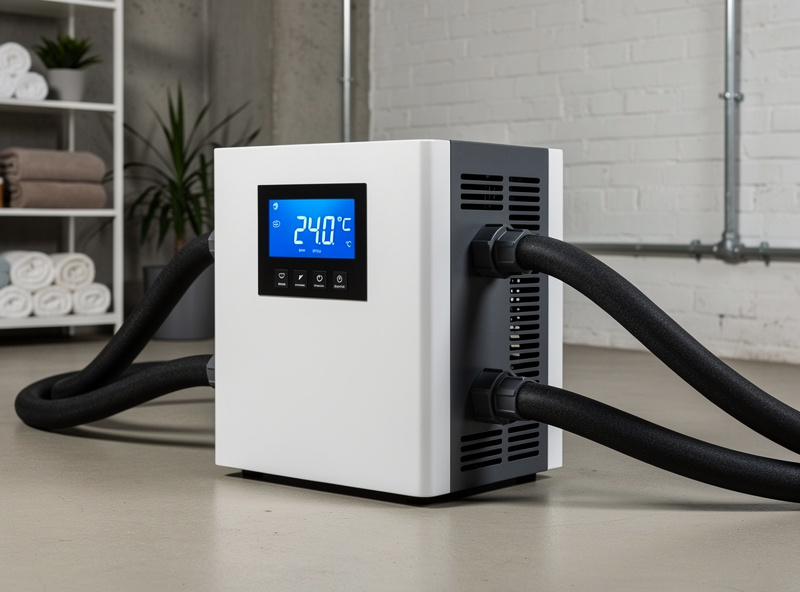
The first chiller I bought was rated at 100 watts because it was 0 cheaper — it ran continuously on a 28-degree summer day and never got the tub below 16 degrees. I swapped it for a 200-watt unit and the temperature dropped to 10 degrees overnight. The hydroponic grower sizing a chiller for a 100-liter reservoir runs the same numbers: how many degrees does the water need to drop, how fast does the environment add heat back, and what is the chiller’s net cooling capacity in this specific setup. A 100-watt aquarium chiller works for a 40-liter reservoir in a 24-degree room and fails for a 100-liter reservoir in a 30-degree grow tent — the chiller cannot overcome the ambient heat load. The same chiller applied to a 100-liter cold plunge in a 20-degree room succeeds for overnight cooling and fails for rapid turnaround. Sizing is a match between cooling capacity, water volume, ambient delta, and acceptable recovery time, and the math does not change when the application changes from plant roots to human recovery.
Building a Cold Plunge That Runs on Reservoir-Cooling Logic
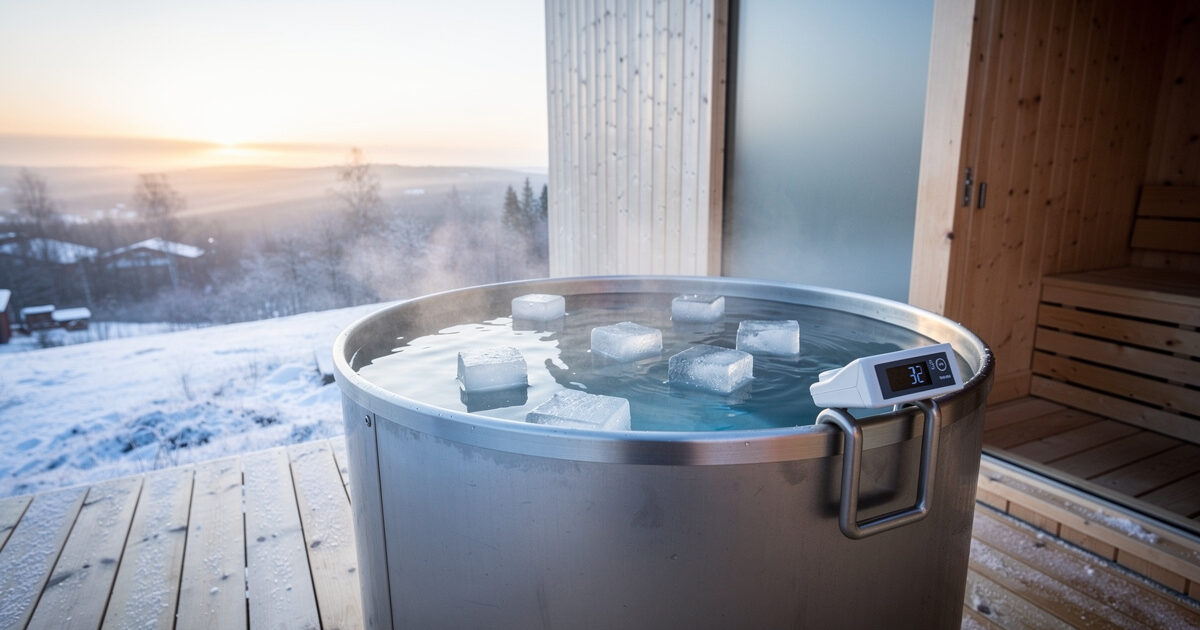
The water at 10 degrees hits differently than water at 15 — the first 10 seconds feel like your skin is tightening around your bones, then the vasoconstriction kicks in and the cold becomes a steady pressure rather than a shock. The simplest cold plunge setup using hydroponic cooling principles: a 100-liter insulated stock tank, a 200-watt aquarium chiller with a built-in thermostat, a small submersible pump rated at 400 liters per hour to circulate water from the tub through the chiller and back, and a floating thermometer to verify the chiller’s thermostat reading. Total cost: $300 to $500, which is one-third to one-half the price of a commercial cold-plunge chiller that delivers the same cooling capacity. The commercial units charge a premium for the “wellness” label, not for better cooling physics. The aquarium chiller uses the same compressor, the same refrigerant, and the same heat-exchanger design — the only difference is the target market and the price tag.
The pump circulates water from the tub through the chiller’s heat exchanger at a flow rate that matches the chiller’s specification — typically 200 to 500 liters per hour. Too fast and the water passes through the heat exchanger before it has time to transfer heat to the refrigerant. Too slow and the chiller short-cycles. The 400 L/h pump is the hydroponic standard for 100-liter systems because it balances flow rate against the heat the pump motor itself adds to the water — every watt the pump draws becomes heat in the water, and a pump that draws 15 watts adds 15 watts of heat load that the chiller then has to remove. The same pump-efficiency logic applies whether the pump lives in a reservoir or a cold plunge. For the full breakdown of pump selection, tubing sizing, and water-circulation design, the hydroponic equipment reference covers everything from pump curves to heat-exchanger matching — the same hardware, the same physics, a different label on the tub.
Frequently Asked Questions
How cold should a post-sauna cold plunge be?
10 to 15 degrees Celsius is the effective range. Below 10 degrees triggers the cold-shock response that raises heart rate and blood pressure rapidly, which counteracts the parasympathetic relaxation the sauna session just produced. The 12-degree midpoint delivers vasoconstriction and the dopamine release without the cold-shock spike.
Can I use an aquarium chiller for a cold plunge tub?
Yes. A 200-watt aquarium chiller rated for 100 to 200 liters works for a cold plunge of the same volume. Match the chiller’s flow-rate specification to a submersible pump rated at 200 to 500 liters per hour. Aquarium chillers use the same compressor and heat-exchanger design as commercial cold-plunge chillers at one-third the cost.
How long does it take to cool a cold plunge tub from tap temperature?
With a 200-watt chiller and a 100-liter insulated tub, cooling from 22 degrees to 10 degrees Celsius takes 10 to 14 hours. To achieve cold-plunge temperature within 2 hours, you need roughly 1,200 watts of cooling capacity or pre-chilled water. Most users run the chiller on a timer overnight so the tub is at temperature for morning sessions.
Should I insulate my cold plunge tub?
Yes. A layer of closed-cell foam or reflective bubble insulation around the tub exterior reduces ambient heat gain by 40 to 60 percent, cutting chiller runtime in half. This is the same practice hydroponic growers use to keep reservoir temperatures stable and prevent root rot in warm grow tents.
Why does my cold plunge water warm up faster in summer than my hydroponic reservoir?
Cold plunge water at 10 degrees has a larger delta to ambient air (22 degrees air minus 10 degrees water equals a 12-degree delta) than a reservoir at 20 degrees (28 degrees air minus 20 degrees water equals an 8-degree delta). Newton’s law of cooling dictates a faster heat gain rate for the larger delta. Insulation reduces this effect regardless of the target temperature.
Do I need a separate pump for the chiller circuit?
Yes. The cold plunge tub needs a submersible circulation pump dedicated to the chiller loop, rated at 200 to 500 liters per hour. Do not rely on the chiller’s internal pump if it has one — most aquarium chillers require external flow. A 400 L/h pump drawing 10 to 15 watts adds minimal heat load and provides safe flow through standard 13-millimeter chiller tubing.