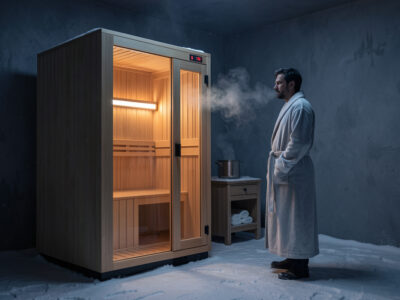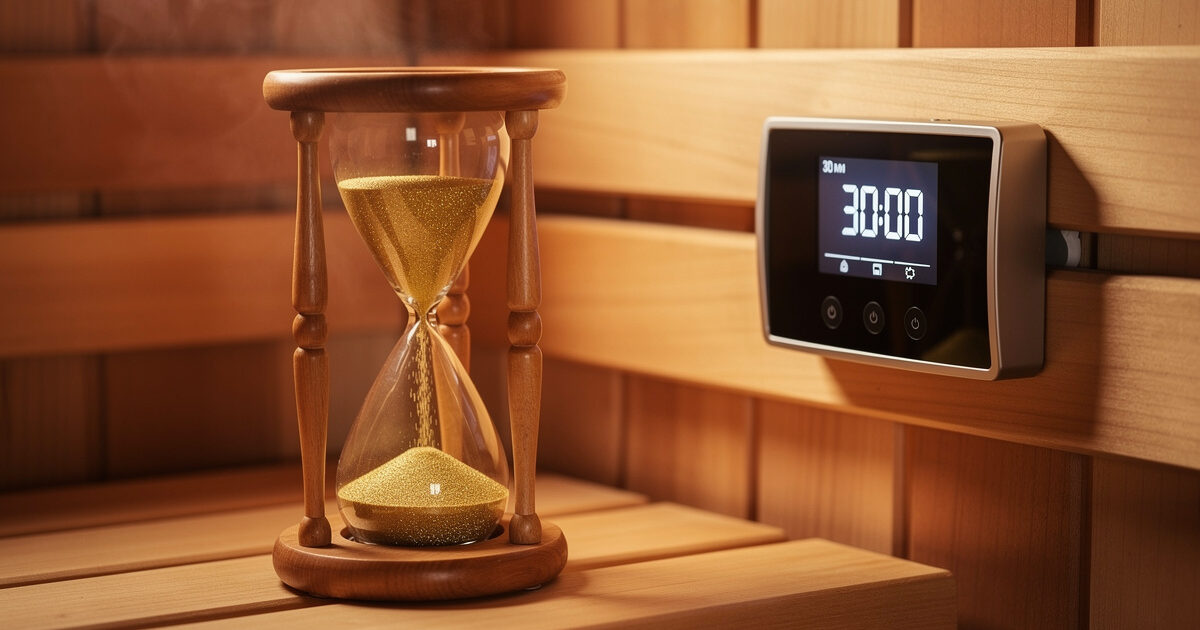
Infrared sauna sessions run 15 to 60 minutes depending on experience and goals. Beginners start at 15 minutes; most regular users settle on 25 to 35 minutes; advanced users push to 30 to 45 minutes for cardiovascular benefits documented in the JAMA Internal Medicine 2018 analysis. Sessions over 45 minutes show diminishing returns and increased dehydration risk. This guide breaks down session length by experience level, by goal, and by your body’s individual response.
Quick Answer: How Long Should an Infrared Sauna Session Be?
For first-time users: 15 to 20 minutes at 110 to 115°F. For week 2-4: 20 to 25 minutes at 115 to 125°F. For most established users: 25 to 35 minutes at 125 to 135°F. For advanced cardio benefits: 30 to 45 minutes at 130 to 140°F. Sessions exceeding 60 minutes are not recommended — body shifts from beneficial heat-shock-protein response to cortisol stress response, plus dehydration risk multiplies.
Session Length by Experience Level
| Experience | Recommended Duration | Temperature | Sweat Onset | Notes |
|---|---|---|---|---|
| First time (sessions 1-3) | 15-20 min | 110-115°F | By minute 15-18 | Build heat tolerance |
| New (week 2-4) | 20-25 min | 115-125°F | By minute 12-15 | Sustainable routine forming |
| Established (month 2-6) | 25-35 min | 125-135°F | By minute 8-12 | Most home sessions |
| Experienced (6+ months) | 30-45 min | 130-140°F | By minute 5-8 | Cardio benefit zone |
| Advanced (athletic protocol) | 40-60 min | 135-145°F | Almost immediate | Specific training cycles only |
Sweat onset is a useful tolerance indicator — earlier sweat means heat-acclimated body. Beginners’ bodies don’t sweat efficiently until later in sessions; experienced users start sweating in the first 5 minutes.
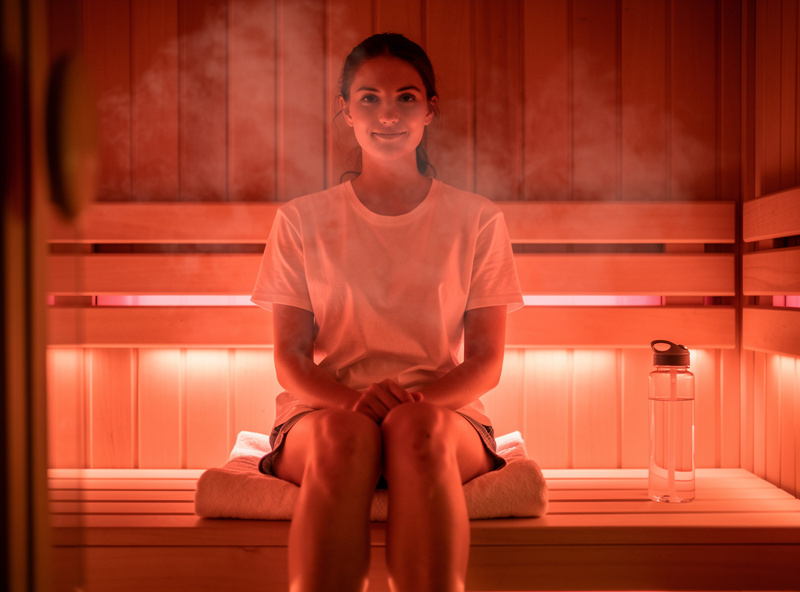
Session Length by Goal
| Goal | Optimal Session Length | Notes |
|---|---|---|
| Cardiovascular health | 30-40 min | JAMA-supported research range |
| Stress reduction | 20-30 min | Cortisol drop in 20+ min |
| Sleep improvement | 25-35 min, 1-3 hr before bed | Core temp drop signals sleep |
| Athletic recovery | 20-30 min post-workout | Wait 30-60 min after exercise |
| Heat shock protein production | 30+ min at 130°F+ | Threshold for measurable HSP70 increase |
| Detox / sweating support | 35-45 min | Peak sweat output, longer sessions |
| Skin health / circulation | 20-25 min | Adequate without over-stress |
| Energy / pre-day boost | 15-20 min, morning | Short, mild, repeatable |
For complete session execution, see our How to Use an Infrared Sauna guide.
Why 45 Minutes Is the Practical Maximum
Three reasons sessions over 45 minutes are not recommended for most users:
1. Diminishing Heat Shock Protein Response
Heat shock proteins (HSP70 specifically) increase in response to thermal stress. Research published in European Journal of Applied Physiology (2017) shows HSP70 expression peaks at 30 to 40 minutes of sustained core temperature elevation. Beyond that point, additional time does not produce proportionally more HSP70. The cellular benefit plateau hits at the 30-40 minute mark.
2. Cortisol Spike
The body responds to thermal stress with controlled cortisol release. At 20-40 minutes the cortisol response is mild and beneficial (similar to moderate exercise). At 60+ minutes, cortisol response shifts to a stress pattern more like acute illness — the opposite of what most users want.
3. Dehydration Risk Compounds
Sweat output during a 60-minute session can exceed 32-48 oz of fluid loss. Replacing that during the session is mechanically difficult; replacing it within 60 minutes after is hard for most users. Cumulative dehydration over multiple long sessions per week produces fatigue, headaches, and electrolyte imbalance.
Session Length by Body Size and Heat Tolerance
Body size affects session length tolerance. Larger users typically tolerate longer sessions because they have more thermal mass to absorb heat before core temperature rises significantly. Smaller users hit core temperature limits faster.
General guidance:
- Under 130 lbs: 20-30 minute sessions appropriate; 35+ minutes may overheat
- 130-180 lbs: 25-40 minute sessions standard
- Over 180 lbs: 30-45 minute sessions tolerable; longer durations sustainable
Heat tolerance is also genetically variable. Some users acclimate quickly to long sessions; others find 25 minutes their natural ceiling. Listen to your body, not the chart.
How to Tell When Your Session Should End
Five signals that mean exit immediately:
- Lightheadedness or dizziness: Blood pressure dropping due to vasodilation + dehydration. Exit, sit, hydrate.
- Nausea: Body is overheating beyond comfort. Exit and cool down.
- Headache during session: Almost always dehydration. Exit, drink electrolyte water.
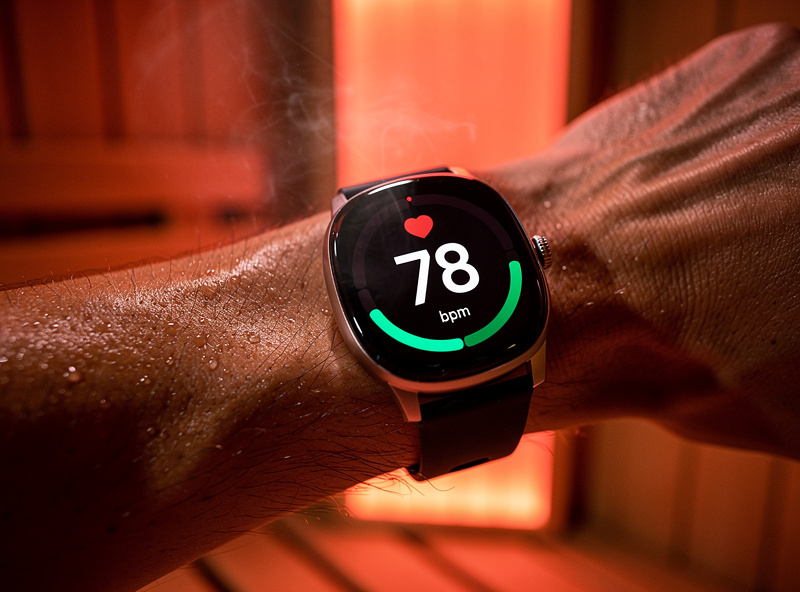
- Heart racing above 140 BPM: Past the cardio benefit zone, into stress response. Lower temperature or exit.
- Vision changes (blurry, tunnel vision): Serious overheating signal. Exit immediately, cool down outside the sauna.
None of these are normal. They mean stop, not push through. Most are reversible within 10-15 minutes of exiting and rehydrating.
For broader safety guidance, see our Infrared Sauna Safety guide.
Splitting Sessions: Two 20-Minute vs One 40-Minute
For users who can’t tolerate longer single sessions, two shorter sessions per day produce comparable but not identical benefits. Two 20-minute sessions:
- Easier on hydration (rehydrate fully between)
- Easier on schedule (fits commute or break time)
- Slightly less HSP70 response than one 40-minute session
- Cardiovascular load is lower per individual session
One 40-minute session is generally preferred for measurable health benefits. Two 20-minute sessions are an acceptable second-best for users who can’t sustain one 40-minute session.
Increasing Session Length Safely
Most users overshoot session length in the first month and end up dehydrated, fatigued, and dropping the habit. Progressive build:
| Week | Session Length Target | Temperature |
|---|---|---|
| Week 1-2 | 15 minutes | 110-115°F |
| Week 3-4 | 20 minutes | 115-125°F |
| Week 5-8 | 25 minutes | 120-130°F |
| Week 9-16 | 30 minutes | 125-135°F |
| Month 5+ | 30-45 minutes (as comfortable) | 130-140°F |
Add 5 minutes at a time, every 1-2 weeks. If you experience post-session fatigue or headache, you’ve moved too fast — drop back to the previous comfortable length and stay there longer before progressing.
What If You Can’t Tolerate 30 Minutes?
Heat tolerance varies substantially by individual. About 15 percent of users find 25-30 minutes their natural ceiling and don’t comfortably extend further. That’s fine — the cardiovascular research shows benefit at 20+ minute sessions, just less pronounced than at 30-40 minute sessions.
If you cap at 20-25 minutes per session:
- Compensate with higher frequency (5-6 sessions per week vs 4)
- Stay at lower temperature (115-125°F)
- Focus on consistency over intensity
For many users, 5 sessions per week at 25 minutes produces better measurable outcomes than 3 sessions per week at 40 minutes — total weekly thermal load matters more than per-session length.
For broader cluster context, see our How Often Infrared Sauna guide.
How long should an infrared sauna session be?
15-20 minutes for first-time users. 25-35 minutes for most regular users. 30-45 minutes for advanced users targeting cardiovascular benefits. Sessions over 45 minutes show diminishing returns due to plateau in heat shock protein response and increased dehydration risk.
Is 30 minutes long enough for infrared sauna?
Yes for most health goals. 30 minutes at 125-135°F is the standard sweet spot — produces full sweat response, supports cardiovascular benefits per JAMA 2018 research, and is sustainable as a daily practice. Sessions can extend to 45 minutes for advanced users targeting peak cardio response.
Can I stay in the infrared sauna for an hour?
Not recommended. Sessions over 60 minutes shift the body’s response from beneficial heat-shock to cortisol stress, increase dehydration risk substantially, and provide no proportional benefit increase. The 30-45 minute window covers virtually all measurable health benefits.
How long does it take to start sweating in an infrared sauna?
Beginners start sweating at minute 15 to 18. Within 3 to 4 weeks of consistent use, sweat onset moves to minute 8 to 12. Experienced users with 6+ months of practice begin sweating within the first 5 minutes. Earlier sweat onset is a heat-acclimation signal.
Should I do longer or more frequent sauna sessions?
More frequent is generally better. 5 sessions per week at 25 minutes typically outperforms 3 sessions per week at 40 minutes for cardiovascular and stress-reduction outcomes. Total weekly thermal load matters more than session length.
Is it OK to have shorter infrared sauna sessions?
Yes. Sessions as short as 15-20 minutes still produce measurable benefits, especially for stress reduction and sleep quality. Beginner sessions, recovery sessions after intense workouts, and pre-bed wind-down sessions all work well at 15-20 minutes.