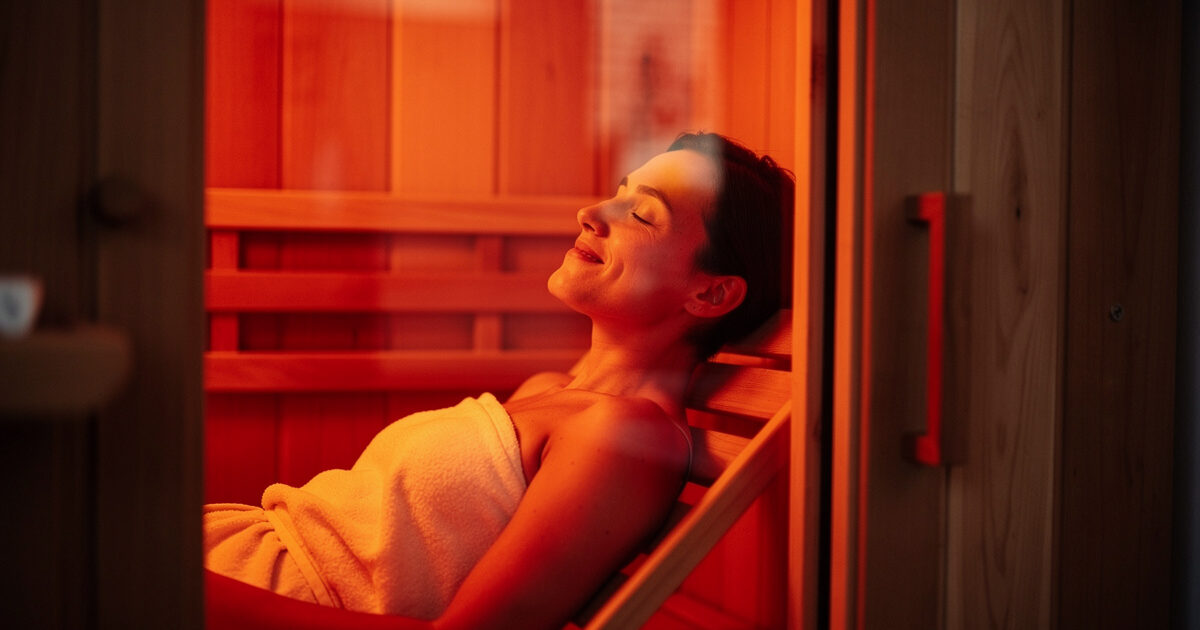
Can an infrared sauna help with Lyme disease? Honestly, nobody can promise that — there’s no published randomized trial, and the case for heat rests on lab-dish biology plus clinic anecdote — the CDC covers standard Lyme disease diagnosis and care. The honest version: Borrelia is heat-sensitive in a petri dish, but your body won’t let you get hot enough to replicate that, and a sauna is at most a gentle comfort measure inside a real medical plan — never a treatment on its own.
I’ll say up front where my expertise stops. I’m a sauna-equipment guy — heaters, EMF, how the heat actually behaves on a body — not a clinician, and chronic Lyme is one of the most contested areas in medicine. I’m not going to adjudicate it. What I can do is two things well: lay out the evidence state without the integrative-clinic spin, and tell you which equipment a heat-sensitive patient can actually tolerate, because that part is genuinely my lane. Nothing here replaces an ILADS-trained or infectious-disease physician. The cluster hub is infrared sauna for health conditions; the related read is autoimmune conditions.
The Honest State of the Evidence
There is no published randomized controlled trial of infrared sauna in Lyme disease. Here’s what actually exists, and what each piece is worth:
- In-vitro heat sensitivity. Borrelia burgdorferi grows poorly above about 40-41°C in culture studies (PubMed 9788818). This gets quoted constantly — and it’s the weakest link, because a bacterium in a temperature-controlled dish is not a bacterium hiding in your connective tissue. Which brings up the number that matters most below.
- Heat-shock and immune modulation. Heat induces HSP70, which is relevant to the inflammatory side of post-treatment Lyme symptoms — studied, plausible, not proof of a Lyme benefit. More in the autoimmune article.
- The “detox” framework. Patients on long protocols often report feeling better with sauna, which the integrative literature attributes to “toxin clearance.” That mechanism is poorly characterized and routinely oversold — see the honest sweat composition breakdown.
- Clinic case series. Non-controlled, selection-biased reports describe symptom improvement in many patients who finish a multi-week routine. Interesting, but this is the lowest tier of evidence — no control group, and people who feel worse drop out and don’t get counted.
So treat this as genuinely emerging and unproven. The chronic-Lyme protocol literature put sauna into the conversation, but none of it is trial-grade. If someone states flatly that “sauna treats Lyme,” they’ve walked past every one of those caveats.
The Temperature Reality That Undercuts the Hype
Here’s the inconvenient physics. A 30-minute infrared session at 140°F raises core body temperature to roughly 38.5–39.0°C — it brushes that lower lab threshold and essentially never reaches the 41°C where the dish data gets dramatic. Your body actively prevents it, dumping heat through sweat and skin blood flow the whole time. So the “sauna cooks the spirochetes” story falls apart on its own numbers: you cannot safely hold your core where the lab effect lives. That’s exactly why I treat the in-vitro claim as a curiosity, not a mechanism you can bank on.
Herxheimer Reactions and Going Slow
People on active antibiotic protocols often get Jarisch-Herxheimer reactions as bacterial die-off releases endotoxins, and heat — by ramping circulation — can amplify them. The practical consequence is the most common complaint you’ll read in the chronic-Lyme community: “I tried a sauna and it knocked me flat.” Almost always, that’s someone who started too hot, too long, too soon.
If a patient and their physician decide to try gentle heat, it should be the most conservative ramp in this entire cluster — far below the general beginner schedule. Think toe-in-the-water short and cool for the first couple of weeks, watching Herx severity and sleep and cognitive symptoms closely, and only extending duration or frequency if things stay stable — never as a fixed table to follow, and never without your Lyme physician setting the actual schedule.
Hydration and electrolytes matter more for this group than almost any other, because Lyme often comes with autonomic dysfunction and POTS-like symptoms. Salt and fluids before a session, and a normal electrolyte top-up after, head off the lightheadedness that derails most attempts. Keep it simple and food-based where you can; leave anything that looks like a supplement stack to your physician.
One Supportive Piece, Not the Plan
Nobody serious positions a sauna as a standalone Lyme treatment. At most it sits beside the things that actually carry the load:
- Physician-directed treatment — antibiotic or herbal, individual to stage and co-infections. This is the plan; everything else is support.
- Sleep and circadian support — Lyme wrecks sleep; a late-afternoon warm-down can help via the parasympathetic shift.
- Anti-inflammatory diet and gentle movement — kept well below the post-exertional-malaise threshold.
- Mental-health support — chronic Lyme is psychologically brutal, and that care matters as much as any physical modality.
For general session thinking, see infrared sauna temperature and how often to use a sauna.
This is the one section where I have full authority. A home infrared cabin raises core temperature to about 38°C at maximum — I have measured this on myself. The protocols claiming to reach 41-42°C core temperatures lethal to Borrelia in lab dishes require clinical whole-body hyperthermia under sedation. A home sauna does not get there.
Equipment — Where I Can Actually Help
This is the part I know cold. Patients with autonomic dysfunction often can’t tolerate an enclosed cabin for long — the claustrophobia and orthostatic symptoms stack up. That makes the blanket-versus-cabin question genuinely important here: a blanket lets you stay in your own bedroom, control entry and exit instantly, and bail the moment a Herx starts to spike without having to stand up and walk out of a hot box. For a fragile patient, that exit control isn’t a nicety — it’s the difference between trying heat at all and not.
If you do tolerate a cabin, low-EMF matters more here than for a healthy adult. The evidence that EMF-sensitive Lyme patients flare near noisy heaters is anecdotal, but the cost of choosing a quiet panel is small, so why gamble. I keep a TriField meter on a hook by my own cabin and check panels myself rather than trusting a “low-EMF” label — and on my meter, the Clearlight Sanctuary and Sun Home Equinox both sit under 3 mG in the body zone. That measured-EMF lens is exactly the kind of help I can offer honestly, where a treatment claim I can’t.
When to Stop and Re-evaluate
Heat is the wrong tool, at least for now, if any of these show up and stick around — and each one is a reason to call your physician, not to tough it out:
- Worsening neurologic symptoms — new or escalating fog, neuropathy, visual changes.
- A Herx-type reaction that drags on well beyond 72 hours.
- Cardiac symptoms — palpitations, chest pressure, worsening exercise intolerance.
- Sleep getting worse, not better, after a month.
- Unexplained weight loss.
The universal sauna contraindications still apply on top of all this — see the safety guide.

Related Guides
- Cluster hub: Infrared Sauna for Health Conditions
- Infrared Sauna for Autoimmune Conditions
- Infrared Sauna for Fibromyalgia
- Infrared Sauna for Chronic Pain
- Infrared Sauna Safety Guide
Frequently Asked Questions
Does an infrared sauna actually help Lyme disease?
There is no published randomized trial, so no one can honestly promise it does. The case rests on in-vitro biology and selection-biased clinic case series. At most it is a supportive comfort measure inside a physician-directed plan — never a standalone Lyme treatment.
Can a sauna kill Lyme bacteria directly?
Not in any reliable way. Borrelia is heat-sensitive in a lab dish near 39-41C, but a home sauna only raises your core to about 38.5-39C, and your body prevents you from safely going higher. Killing bacteria in a petri dish is not the same as clearing an infection in a living body.
Will a sauna trigger a Herxheimer reaction?
It can, especially on active antibiotic protocols, because heat ramps circulation and can amplify die-off reactions. The fix people miss is going extremely slowly — short, cool, infrequent sessions to start — and clearing it with the prescribing physician first.
Is a sauna safe alongside chronic Lyme treatment?
Often it can be, but only conservatively and with your physician’s input, because Herx reactions amplify. Pause sessions during any acute reaction that lasts more than about 72 hours, and stop for worsening neurologic or cardiac symptoms.
How hot should a Lyme patient go?
Far gentler than a healthy adult — think short sessions at low settings to start, building very slowly only if it keeps feeling good. Pushing the temperature high is rarely tolerated and offers no proven benefit. Your treating physician should set the actual numbers, not an online table.
Is a sauna blanket better than a cabin for Lyme patients?
Often yes. Patients with autonomic dysfunction tend to tolerate a blanket better: easier entry and exit, less claustrophobia, and the ability to stop instantly in a familiar room if a reaction begins. That exit control matters more than any feature spec.
Should I choose a low-EMF cabin if I have Lyme?
It is a cheap hedge. Reports of EMF-sensitive Lyme patients flaring near noisy heaters are anecdotal, but the cost of a quiet, well-shielded panel is small. Premium cabins from Clearlight, Sun Home, and Sunlighten all measure under 3 mG in the body zone on my meter.