What’s actually in the sweat you produce in an infrared sauna? About 99% water and electrolytes — and a remaining sliver containing urea, lactate, and genuinely tiny, measurable traces of heavy metals — peer-reviewed blood/urine/sweat comparisons (Genuis et al. 2011, heavy metals and Genuis et al. 2012, BPA) quantify the amounts of metals, BPA, phthalates, and other compounds. That’s the honest picture, and it’s interesting precisely because it’s the opposite of the “sweat out your toxins” sales pitch: the numbers themselves show sweating is a minor side channel, not your body’s detox button.
I find this science genuinely fascinating, partly because I’m the kind of person who weighs himself before and after a session to know exactly how much I sweat — and once you put real numbers to it, the marketing falls apart on its own. Let’s look at what the research actually measured. For the broader honest take, see the detox hub.
What Sweat Actually Is
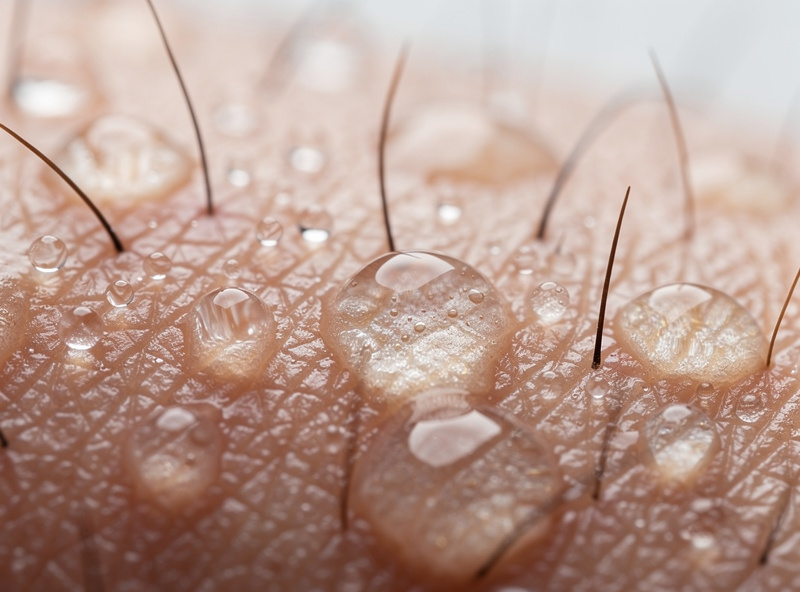
Sweat comes from two gland types. Eccrine glands produce the bulk of it — a watery fluid that’s roughly 99% water plus electrolytes, with traces of urea, lactate, and various compounds. Apocrine glands (armpits, groin) make a protein-rich sweat that skin bacteria turn into body odor. Crucially, sweat’s job is thermoregulation — cooling you down — not detoxification. Any toxin that leaves in it is hitching a ride, not being purposefully excreted.
Here’s the standard breakdown by mass:
| Component | Typical concentration | Role |
|---|---|---|
| Water | ~99% | Cooling |
| Sodium | 0.4–1.6 g/L | Main electrolyte lost |
| Chloride | 0.2–1.0 g/L | Pairs with sodium |
| Potassium | 0.15–0.30 g/L | Cellular function |
| Urea | 0.02–1.5 g/L | Protein-metabolism waste |
| Lactate | 0.4–3.0 g/L | Metabolic waste |
| Heavy metals | 0.0001–0.0015 g/L | Trace excretion |
| BPA, phthalates | Nanogram levels | Trace excretion |
Look at the scale difference, because it’s the whole story: electrolytes are measured in grams per litre, toxins in nanograms per millilitre. A typical 30-minute session — for me, close to a pound of sweat, about 500 mL — carries somewhere around 50–150 nanograms of heavy metals total. That’s real, and it’s also a rounding error against what your kidneys move in a day. Both things are true at once.
Heavy Metals in Sweat
The 2011 Genuis study measured heavy metals in sauna sweat, and that data is the source for nearly every sauna detox claim you’ll read. Here’s what they actually found:
| Metal | In sweat | Share of daily excretion via sweat |
|---|---|---|
| Arsenic | 10–50 ng/mL | ~3–5% (relatively sweat-friendly) |
| Cadmium | 2–10 ng/mL | ~2–4% |
| Lead | 5–30 ng/mL | ~0.5–2% (kidneys do the work) |
| Mercury | 0.5–5 ng/mL | ~0.5–1.5% |
| Aluminum | 20–150 ng/mL | ~1–3% |
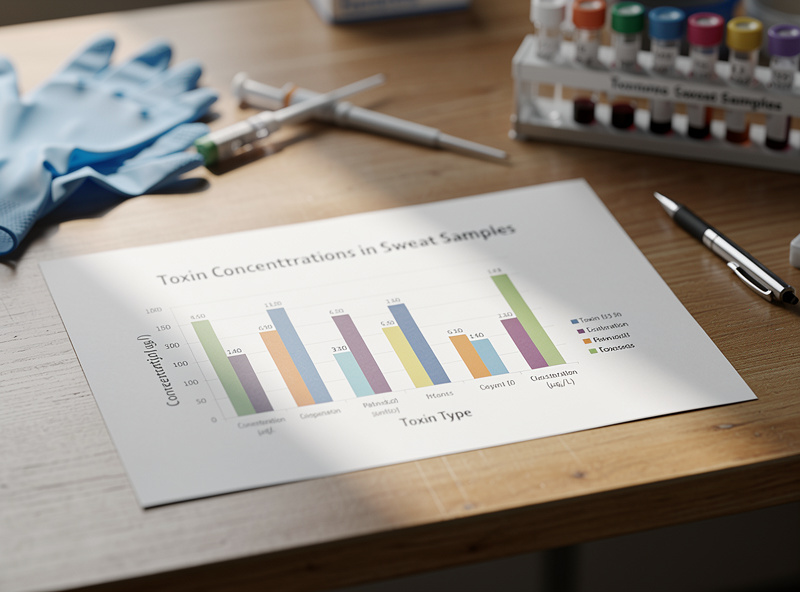
The honest takeaways: arsenic and cadmium leave relatively more readily through sweat, while lead and mercury barely register because your kidneys and bile handle them. Concentrations do tend to rise with overall body burden, which is mildly interesting — but notice that even the “sweat-friendly” metals top out around 3–5% of a day’s excretion. There is no metal here where sweating is the main exit. That single column is why I treat “sauna chelates your bloodstream” as marketing.
BPA and Phthalates — the Source of the “30%” Claim
The famous “30% of toxins leave through sweat” line comes from one place: BPA research. The 2012 Genuis BPA study measured BPA in sweat at notably higher relative levels — up to around 30% of daily excretion in some people. That’s the single highest sweat-excretion figure for any compound studied, and it gets quietly generalized to “toxins” as a category, which is the sleight of hand at the heart of detox marketing.
Phthalates (common plasticizers) also leave more readily than heavy metals — a few to maybe 15–20% via sweat depending on the compound. The reason is simple chemistry: BPA and phthalates are fat-soluble, they pool in subcutaneous fat, and heat mobilizes them into circulation where they cross into sweat easily. Heavy metals are charged ions that cross membranes poorly. So “fat-soluble plasticizers leave fairly well; metals barely leave” is the accurate, boring, useful summary — and it’s worth knowing that even the BPA headline applies mainly to people with elevated burden, and to a compound the body already clears within hours.
Medications and Other Compounds
Studies have also picked up traces of pharmaceuticals, household-chemical residues (VOCs), and persistent pollutants like PCBs in sweat. The practical points worth knowing:
- Medications mostly leave at low single-digit percentages via sweat, so a sauna won’t meaningfully change your drug levels in most cases. If you take several medications and run long, frequent sessions, that’s a reasonable thing to mention to your doctor — not because it’s dangerous, but because it’s tidy to confirm.
- Persistent pollutants (PCBs, dioxins) barely appear in sweat — under ~2% — because the body offloads them through bile over months and years, not through a hot afternoon.
- VOCs mostly leave on your breath, not your skin.
Sweat vs Urine vs Stool — the Full Picture
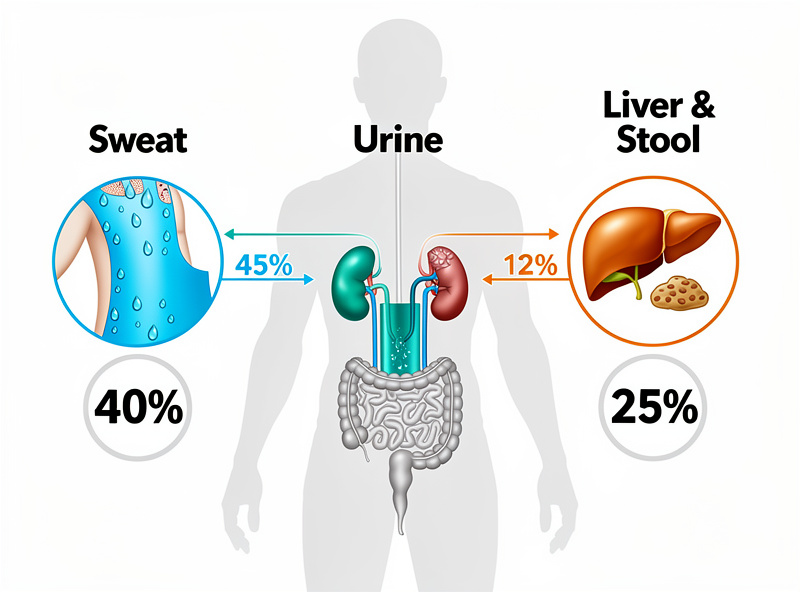
This is the table the detox industry would rather you didn’t see, because it puts sweat in perspective against the routes that actually do the work:
| Toxin class | Urine | Stool/bile | Sweat | Other |
|---|---|---|---|---|
| Heavy metals | 40–60% | 30–50% | 0.5–5% | 1–5% |
| BPA | 50–70% | 10–20% | 5–30% | 1–3% |
| Phthalates | 40–60% | 20–40% | 5–20% | 1–3% |
| Persistent pollutants | 5–15% | 50–80% | 0.5–2% | 2–5% |
The kidneys and the liver/bile route do the overwhelming majority of the job. Sweat is genuinely a secondary, minor pathway — real, but complementary to organs that are vastly better at this. The single most useful sentence on this whole page: sweat is a thermoregulatory fluid, not a detox organ. A sauna activates a small real pathway; it does not replace, enhance, or “support” your liver and kidneys in any way they need.
What Changes the Numbers
If you’re the type who likes to understand the variation, a few things move sweat-toxin concentrations: how much is actually stored in your body (higher exposure means higher concentrations), your hydration (well-hydrated sweat is more dilute but greater in volume, which actually moves more total mass — a good reason to drink), your body-fat percentage (more fat stores more fat-soluble compounds), and how recent the exposure was. The one counterintuitive bit worth knowing: cranking the temperature or staying in twice as long doesn’t proportionally increase what comes out — the mobilization is rate-limited. Frequency and hydration matter more than heroics, which is the same lesson the rest of this site keeps landing on.
What This Actually Means for You
Strip it down to honest, useful takeaways:
- Hydrate well — not to “flush toxins,” but because well-hydrated sweat in decent volume is both healthier and the version that carries marginally more of anything out. It’s also how you avoid the dehydration that masquerades as a “detox reaction.”
- Frequency beats intensity — a few moderate sessions a week does more than the occasional marathon bake.
- Don’t buy the supplement stack — binders, “liver support” pills, and the rest get sold on the back of this data, but the evidence they meaningfully change your body burden alongside a home sauna is weak, and chelation is genuine medical territory. Skip it.
- Don’t overstate the numbers — “sauna detoxes your body” is misleading. The honest version: a sauna adds a small, measurable secondary exit for certain compounds, on top of organs that do nearly all the work anyway.
Can You Get Your Sweat Tested?
You can, but I’d mostly save your money. A handful of specialty labs offer sweat heavy-metal collection, and it can confirm that excretion is happening during a session — but it’s not a great screening tool, and the hair-analysis tests often pushed alongside it aren’t diagnostic and are easy to dramatize a “result” from. If a genuine exposure worries you, the right move is a physician and a standard blood panel, not a home kit sold by the same site that sold you the cabin. Test because a doctor recommends it, not because a “detox” funnel told you that you’re toxic.
This page sits squarely in my measurement lane: I can tell you the exact surface temperature of a far-infrared panel (measured with a thermal probe), the ambient cabin temperature at head height (128-134°F in my 2-person unit), and the resulting sweat rate. What that sweat contains chemically is published physiology — and the answer is mostly water.
Frequently Asked Questions
What toxins actually leave the body through sweat?
Trace amounts of heavy metals (around 0.5-5% of daily excretion), BPA and phthalates (higher for fat-soluble compounds, up to roughly 30% for BPA), small amounts of some medications, and a little of various household chemicals. Sweat is a real but minor secondary route — your kidneys and liver handle the large majority.
Is the 30% of toxins via sweat claim accurate?
Only for BPA specifically, and mainly in people with elevated levels. That single figure gets generalized to all toxins, which is misleading. For most heavy metals, sweat carries only about 0.5 to 5 percent of daily excretion.
How much heavy metal does one sauna session remove?
A typical 30-minute session producing around 500 mL of sweat carries roughly 50 to 150 nanograms of heavy metals — a tiny fraction of what your body eliminates daily through urine and stool. It is measurable but not a meaningful dent in total body burden for most people.
What does sauna sweat actually contain?
About 99% water and electrolytes (sodium, chloride, potassium), plus traces of urea, lactate, and very small concentrations of heavy metals, BPA, phthalates, and other compounds measured in nanograms per millilitre. It is fundamentally a cooling fluid, not a detox excretion.
Why don’t more toxins leave through sweat?
Because sweat’s job is temperature control, not detoxification, and your liver and kidneys are built for the latter. Heavy metals are charged ions that cross sweat-gland membranes poorly, while fat-soluble compounds like BPA cross more easily — which is why those show higher sweat percentages.
Should I get my sweat tested for toxins?
Usually not worth it. Sweat testing exists but is a poor screening tool, and the hair tests often bundled with it are not diagnostic. If a genuine exposure concerns you, see a physician for a standard blood panel rather than buying a home kit from a detox funnel.
Does drinking water during a session help?
Yes, but not as a toxin flush. Staying well hydrated keeps your sweat volume up, which is healthier and moves marginally more of anything out, and it prevents the dehydration that people often mistake for a detox reaction. Drink before, during, and after, with some electrolytes.
Related Articles
- Infrared Sauna Detox: What the Science Shows — the honest detox hub
- Infrared Sauna and Heavy Metals — what sweat does and doesn’t do
- Lymphatic Drainage and Infrared Sauna — the honest mechanism
- Infrared Sauna Benefits Research — the documented benefits
- Infrared Sauna Safety Guide — session safety and contraindications