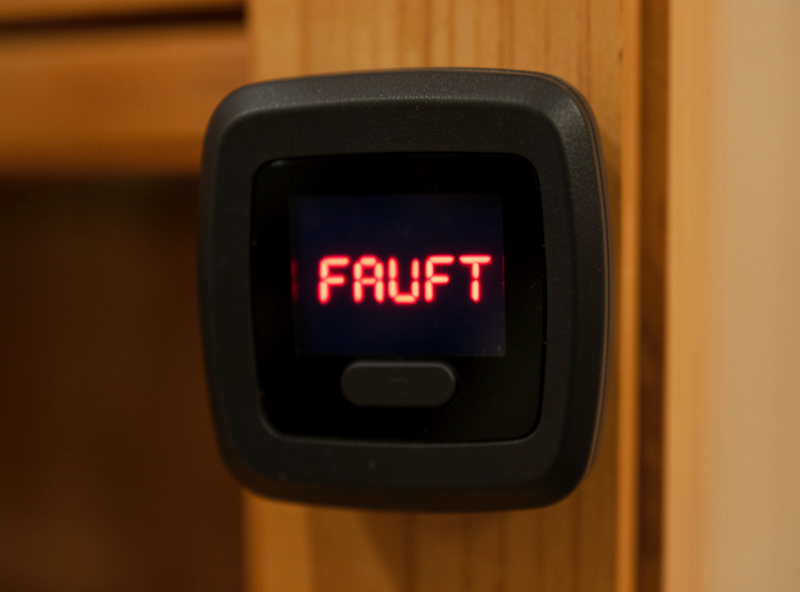
An error code on an infrared sauna controller is not the problem — it is the controller telling you what it sees, and almost every code on a far-infrared cabin falls into one of three families: a temperature-sensor fault, a communication fault between the display and the main board, or an over-heat trip — the last firing when the probe reads past the ceiling the controller allows, set well above the 45–60 °C band a far-infrared cabin normally runs. On the controllers I have worked with, learning to read which family a code belongs to gets you to the actual fault far faster than searching the exact letters, because the letters change between brands but the underlying logic does not.
That last point is the one to hold onto before we go further: error codes are not standardized across manufacturers. An “E1” on one cabin is a sensor fault; on another it is a communication error. So the printed letters matter less than understanding what the controller is actually checking. Your unit’s manual is the final authority on the exact mapping — what I can give you is the engineering behind the families so that whatever code you are staring at, you know where to point the meter.
The Three Families Almost Every Code Belongs To
Strip away the brand-specific letters and infrared sauna error codes cluster into three groups. Sensor faults mean the controller cannot get a sane temperature reading from its probe — an open, shorted, or disconnected thermistor. Communication faults mean the display board and the main control board have lost their conversation. Over-heat or protection trips mean the controller saw a temperature it judged dangerous and shut the heaters down on purpose. A fourth, rarer group covers timer and power-supply faults. Once you know which family a code sits in, the check list writes itself.
This is also why I tell people not to panic at a code. A protection trip is the controller doing its job — it is a symptom of something upstream, not a broken controller. The skill is reading the family, confirming the cause, and only then deciding whether anything needs replacing. The table below is the translation key I work from.
| Code Family | Typical Letters Seen | What the Controller Sees | First Thing to Check |
|---|---|---|---|
| Sensor / probe fault | E1, Er1, EE, “—“, HHH, LLL | No valid temperature from the probe | Thermistor lead, connector, and probe placement |
| Communication fault | E2, Er2, EC, “no link” | Display and main board not talking | Ribbon or data cable between panel and board |
| Over-heat / protection | OHT, OH, E3, HOT, “P” | Temperature read as too high | Probe position and ventilation |
| Emergency stop / safety | ES, SOS, “Stop” | A safety input was triggered | Door switch, bench cut-off, reset button |
| Timer / power fault | E4, “888”, blank flicker | Internal supply or timer error | Power supply and inline fuse |
Sensor Faults: E1, “—“, HHH and the Cousins
By a wide margin, sensor faults are the most common code I see, and they are also the most reassuring because they rarely mean an expensive part has died. The controller reads cabin temperature through a thermistor — a small probe whose resistance changes with heat. If the lead is unplugged, the wire is broken, or the connector has corroded, the controller gets a reading that makes no physical sense and throws a sensor code rather than guessing.
The check is methodical: power down, find the probe (usually clipped to a wall near the upper bench), and confirm it is seated and its connector is clean and tight. A probe that has fallen out of its clip and is dangling against a panel will read wildly and trip a fault. If the connection looks good, the probe itself can be tested — a thermistor has a sensible resistance at room temperature (a common NTC type sits near 10 kΩ at 25 °C), and an open or shorted reading on the meter convicts it. Meter makers such as Fluke describe the same resistance-mode procedure for checking any thermistor, so a probe that reads wildly off that ballpark is the fault, not the cabin. This is the same continuity-and-resistance skill covered in testing a heater element with a multimeter, just applied to the sensor instead of the element.
Communication Faults: When the Display and Board Stop Talking
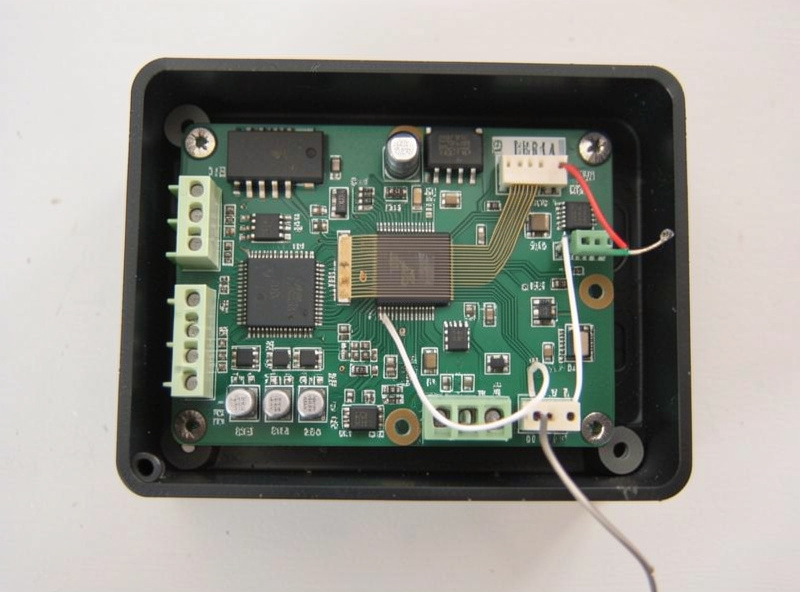
A communication code means the screen you are reading and the brain doing the work have lost their link. The display board is a relatively dumb screen; the real control lives on the main board near the heaters. They are joined by a ribbon or data cable, and that cable is the usual suspect — backed off its header, pinched during an install, or degraded by humidity. On a cabin that gets condensation, I have seen a data connector corrode just enough to drop the link intermittently, which shows as a code that comes and goes.
Because this fault sits between two boards, the fix is almost always a cable re-seat, not a board swap. Power down, trace the cable from the back of the display to the main board, and reconnect both ends firmly. If the code persists with a known-good cable, then the board is suspect — and that decision tree runs straight into replacing the controller, where matching the right part matters more than the price.
Over-Heat Trips: OHT, OH and the Probe That Lies
An over-heat code is the one people fear and the one that is most often a false alarm. The controller has a ceiling temperature it will not allow, and when the probe reports a value above it, the heaters cut out. The catch is that the probe can report a high temperature without the cabin actually being hot — most commonly because the probe has drifted out of cabin air and is now reading the surface of a panel, which on my thermal camera runs far hotter than the air the probe is supposed to measure.
So an over-heat trip ten minutes into a session, with a cabin that never felt hot, points at probe placement, not a runaway heater. Confirm the sensor sits in open cabin air and ventilation is not blocked. A genuinely overheating cabin — one that is actually too hot — is rarer and more serious, and if the heaters will not cut out even when the cabin is plainly overheating, that is a controller or relay fault to stop using immediately. Knowing what cabin temperature should actually read is what tells you which of those two you have.
Emergency-Stop and Safety Codes
Some cabins have safety inputs — a door switch, an emergency-stop button, a bench cut-off — and a code in this family means one of them was triggered or has failed open. These are easy to overlook because the cause can be as mundane as a door not fully closed or a stuck reset button. Walk the safety inputs before assuming anything electronic has failed; a safety code clearing the moment you close the door properly is a very common and very anticlimactic fix.
When a Code Means Stop, Not Troubleshoot
Most codes are an invitation to diagnose. A few are an instruction to stop. If a code appears alongside a burning smell, visible scorching, or a breaker that trips at the same moment, the electronic fault has become an electrical hazard and the response is to power down and inspect, not to clear the code and try again. I cover that line in detail in burning smell from an infrared sauna and in the breaker side at when a sauna keeps tripping the breaker. Clearing a code that keeps coming back the instant you re-power is the controller telling you the underlying fault is still there.
For everything else — a lone sensor code, a comms code, a benign over-heat trip from a drifted probe — the path is the same: read the family, check the cause, fix the cheap thing first. If the code survives that, work back through the whole-cabin sequence in the no-heat troubleshooting map, which puts error codes in their place within the larger power-to-sensor diagnosis. And if it is one cold panel rather than a code, that is the dead-emitter trace instead.
Frequently Asked Questions
What does E1 mean on an infrared sauna?
On most cabins E1 is a temperature-sensor fault, meaning the controller cannot read a valid value from its probe, but codes are not standardized between brands. Check the thermistor lead, connector, and that the probe is clipped in cabin air. Your manual gives the exact mapping for your model.
Are infrared sauna error codes the same across brands?
No. Error codes are not standardized. An E1 may be a sensor fault on one cabin and a communication error on another. Use your unit’s manual for the exact letters, but the underlying families are universal: sensor, communication, over-heat, safety, and power faults.
What does an OHT or over-heat code mean?
An over-heat code means the controller read a temperature above its safety ceiling and cut the heaters. The most common cause is a probe that drifted out of cabin air and is reading a hot panel surface, not a genuinely overheating cabin. Check probe placement and ventilation first.
Why does my sauna show an error code then work again?
An intermittent code usually means a loose or corroded connection, most often a data cable between the display and main board or a sensor connector affected by condensation. Power down and re-seat both ends of the suspect cable. A code that comes and goes points at connections, not a dead board.
What is an ES code on an infrared sauna?
ES usually points to a safety or emergency-stop input on cabins that have one, such as a door switch, bench cut-off, or reset button. Walk those inputs first. The cause is often as simple as a door not fully closed or a stuck reset, which clears the code with no electronics involved.
Should I keep using my sauna with an error code showing?
Only if you have identified a benign cause like a drifted probe or unseated cable. Stop immediately if the code appears with a burning smell, scorching, or a tripping breaker. A code that returns the instant you re-power means the underlying fault is still present and needs diagnosis.