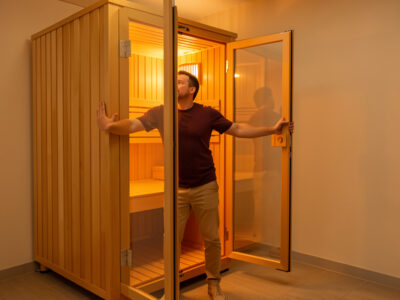
Drying an infrared sauna after use is the single step that decides whether it stays fresh or slowly sours. The method is simple: as soon as your session ends, prop the door wide open and move air through the cabin for about ten minutes, until the interior humidity drops back near the room’s ambient level. Wet wood is what odor and mold need — take away the wet window and neither can start.
I run a two-person far-infrared cabin through Swedish winters, and drying is the habit I underrated the longest. For months I’d wipe the bench, feel proud of myself, and close the glass door on a cabin that was still quietly humid inside. The wood felt dry to my hand and wasn’t — and that gap is exactly where a stale smell breeds. This is the full method I use now: the timing, the airflow, the humidity numbers I actually watch, and why the cold months make all of it harder.
Why Does Drying an Infrared Sauna Matter So Much?
Drying matters because sauna wood holds moisture long after its surface feels dry, and that trapped water is what feeds odor bacteria and, eventually, mold. Softwoods like hemlock and cedar are hygroscopic — they absorb and release moisture with the air around them, and they do it slowly. Skip the drying step and you leave the wood damp for hours.
The physics here isn’t opinion. The USDA Forest Products Laboratory’s Wood Handbook chapter on moisture relations lays out how wood constantly equilibrates with ambient humidity, holding water inside its cell walls well after the surface reads dry to the touch. In a sauna that means the bench can feel ready to close up while the fibers a millimeter down are still carrying salted sweat and moisture. Bacteria work in that hidden layer. The EPA’s guidance in its brief guide to mold and moisture is blunt about the threshold: keep indoor relative humidity below 60 percent, ideally 30 to 50 percent. A closed-up cabin after a sweaty session can sit well above that for an hour or more — plenty of time. Drying is how you close that window on purpose instead of hoping it closes itself.
How Long Should You Dry an Infrared Sauna After a Session?
About ten minutes of active airflow is enough for most cabins, though a heavy-sweat session in a cold room can want fifteen. The goal isn’t a fixed clock, it’s a target: get the interior humidity back down near the surrounding room. Once air is actually moving through an open door, that happens faster than people expect.
Timing off the end of the session matters because warm wood gives up its moisture far more willingly than cold wood. The best drying window is the ten minutes right after you step out, while the panels and wood are still holding residual heat and the whole cabin wants to off-gas moisture into moving air. Wait an hour and you’ve lost that free assist — the cabin has cooled, the moisture has re-condensed onto the coolest surfaces, and you’re now drying cold, wet wood the hard way. In my session log the difference is obvious: dried-immediately sessions have the cabin back to room humidity before I’ve finished my post-sauna glass of water, while a “I’ll open it later” session is often still reading high when I check an hour on. Ten minutes, right away, door open, air moving. That’s the rule.
What’s the Best Way to Move Air Through the Cabin?
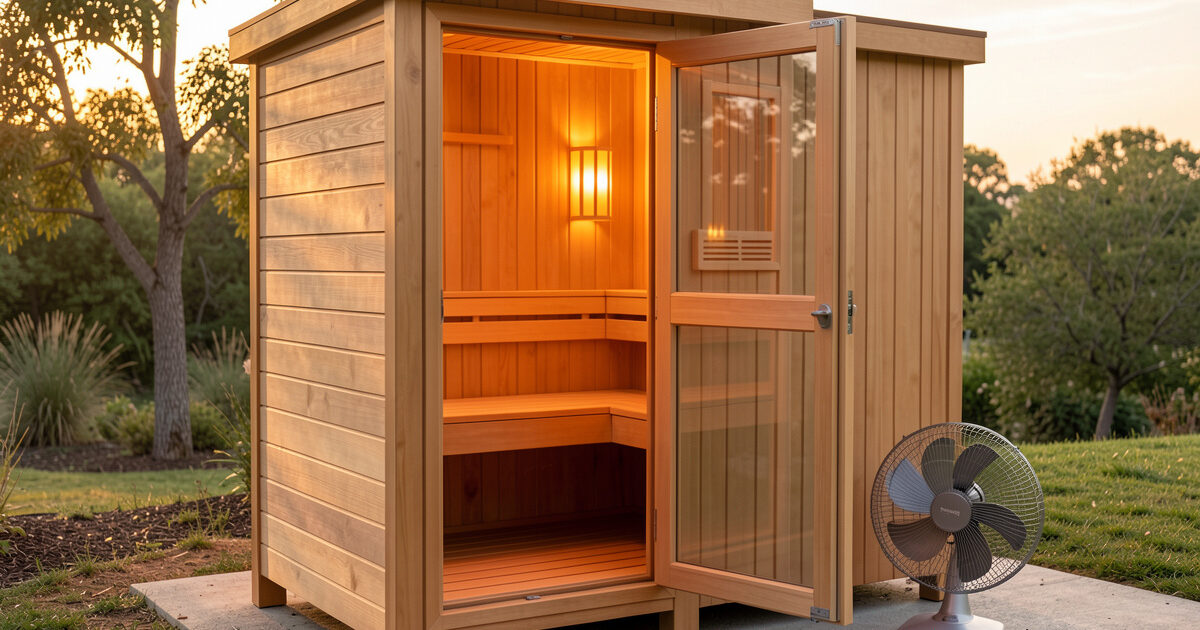
An open door plus a fan beats an open door alone every time, because passive convection out of a small cabin is slow. My cabin has an internal ceiling fan, and I run it for ten minutes with the door propped as wide as it goes. On the dampest evenings I add a small room fan aimed straight at the open doorway to force an exchange of the humid interior air for drier room air.
The direction of airflow is the part people get wrong. You want the humid air pushed out and drier air pulled in, so a fan that moves air across the doorway does far more than one that just stirs the inside. If your cabin has no built-in fan, a cheap clip-on fan on the door frame pointed inward works fine — you’re not trying to cool anything, just to swap the air a few times over. The sound of it is part of my shut-down routine now: session ends, door swings open, fan clicks on, and by the time the fan cycles off the cabin smells like warm hemlock instead of like me. I go deeper on the interplay between airflow and how much you sweat by heater type in how long it takes to sweat by heater type, because more sweat simply means more moisture to clear.
Should You Use a Hygrometer to Check the Cabin Is Dry?
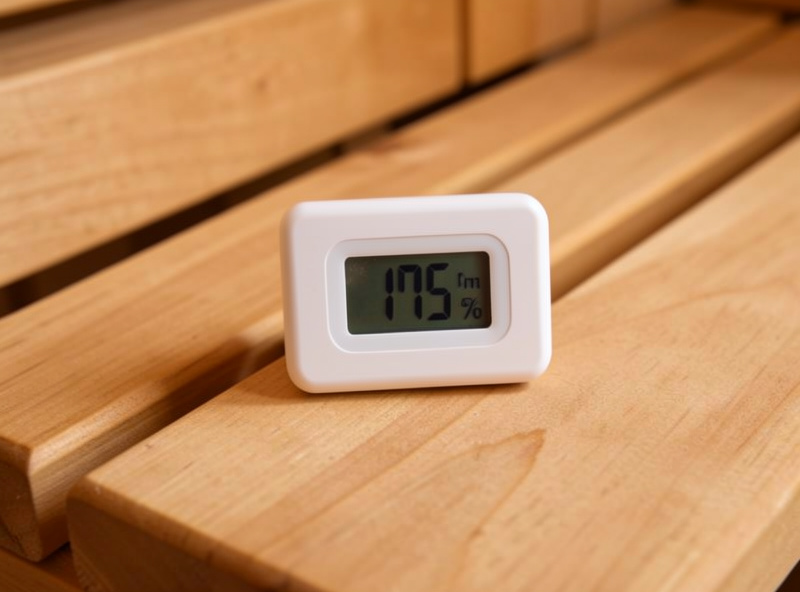
Yes — a cheap digital hygrometer removes all the guesswork, and guessing is how cabins stay damp. I keep one sitting on the bench, and the rule is simple: when the interior reading drops to within a few points of the room’s ambient humidity, the cabin is dry enough to close. Your hand can’t feel the difference between 45 and 65 percent; the meter can.
A five-dollar hygrometer is the highest-value hygiene tool I own after the microfiber cloth. Before I had one I was closing the door on gut feel and getting it wrong on exactly the humid nights when it mattered most. Now the number decides. On a normal evening the cabin reads high right after a session and settles to near-room within the ten-minute fan run; on a cold, humid night it takes longer and the meter tells me so, which is the whole point. Tie the target to the EPA’s below-60-percent guidance and you have an objective finish line instead of a vibe. Pair the meter with a wipe-down and you’ve covered the two things that actually control odor — the full picture is in the infrared sauna hygiene and odor guide.
Why Is Drying Harder in Winter?
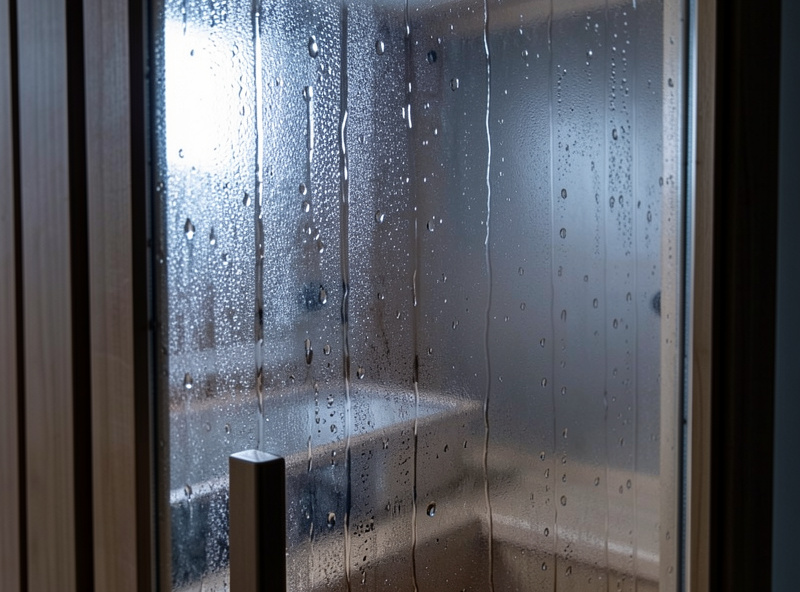
Winter is harder because a cold room surrounding a warm, humid cabin drives fast condensation. The moment humid interior air hits the cold glass door and the coolest wood, it dumps its moisture as droplets — you can watch it bead up. So in the cold months the cabin doesn’t just need to dry, it needs to out-run condensation, and that takes more deliberate airflow.
This is a real Nordic problem and I plan around it. On the coldest evenings I extend the fan run, keep the door fully open rather than cracked, and sometimes give the cabin a short low-power reheat to warm the wood back up so it releases the last of its moisture instead of holding it. The seasonal swing in how sauna wood takes on and sheds moisture is worth understanding on its own; I cover it in freeze-thaw and sauna wood. A cabin that’s well built helps enormously here — good insulation and vapor control keeps the wood warmer longer after shutdown, which means it dries itself further before condensation can win. If your cabin is a cold-garage install, budget extra drying time and don’t trust your hand — trust the meter.
What Happens If You Never Dry the Cabin?
Skip drying for a few weeks and the wood stays in a chronic damp state that first turns to a stale sweat smell and then, if it continues, to visible darkening and mold at the coolest, least-ventilated spots. The corners under the bench and behind the backrest go first, because that’s where air moves least and moisture lingers longest.
I’ve never let mine get to visible mold, but I caught the early smell in my first winter and it was a clear warning. The wood behind the bench had that soured-towel note the moment I opened the cold door, and no amount of wiping the surface fixed it because the problem was moisture held deep in the grain that never got to leave. The fix wasn’t a cleaner — it was finally adding the drying step and letting a couple of weeks of full drying reset the wood. If you’re already smelling it, start with the hygiene guide’s recovery steps, then keep it gone by never closing the door on a damp cabin again. And if more than one person uses the cabin, drying matters even more because there’s simply more sweat going in — the between-users routine is in shared-sauna hygiene.
My After-Session Drying Routine, Step by Step
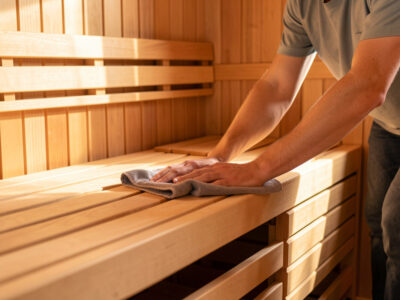
Here’s the whole thing in order, and it costs me almost no active time. Session ends and I step out. Door swings fully open and the internal fan goes on. I do a quick warm wipe of the bench and floor slats while the fan runs — the two habits overlap, so the drying is happening while I clean. Hygrometer stays on the bench; I glance at it as I hang the towel to wash.
When the meter reads near room humidity — usually about ten minutes, longer on a cold damp night — I switch the fan off but leave the door cracked rather than sealing it tight, so any last moisture keeps venting instead of condensing. That’s it. No products, no scrubbing, just airflow and a number to hit. The reason I’m this deliberate about a boring step is that it’s the cheapest insurance in the whole hobby: ten passive minutes now versus a full stripping-and-re-oiling job later. For where drying fits alongside towels, safe cleaners, and stain removal, the complete hygiene and odor guide ties the whole routine together, and the wood types guide explains why some interiors are more forgiving of the occasional missed drying than others.
How long should I dry my infrared sauna after each session?
About ten minutes of active airflow with the door open is enough for most cabins, or up to fifteen after a heavy-sweat session in a cold room. The real target is not a fixed time but a humidity level: dry until the interior reads close to the surrounding room’s ambient humidity, then it is safe to close up.
Should I leave the sauna door open or closed after use?
Open, or at least propped, until the cabin has dried. Closing the door on a warm, humid interior traps moisture that then condenses on the coolest wood and glass overnight, which is exactly what feeds odor and mold. Prop it wide with a fan running to dry, then leave it slightly cracked rather than sealed tight.
What humidity should an infrared sauna dry down to?
Aim to get the interior back near the room’s ambient humidity, and in general keep it below 60 percent relative humidity, ideally 30 to 50 percent, which is the range the EPA recommends indoors to discourage mold. A cheap digital hygrometer on the bench gives you an objective finish line instead of guessing by feel.
Why does my sauna get condensation on the glass in winter?
Because warm, humid air from your session meets the cold glass and cool wood surfaces and dumps its moisture as droplets. It is normal in a cold room but a sign the cabin needs more airflow to dry. Extend the fan run, keep the door fully open, and consider a short low-power reheat to warm the wood so it releases moisture instead of holding it.