Does an infrared sauna help type 2 diabetes? The honest answer: small pilot studies hint that regular heat exposure may nudge insulin sensitivity in the right direction, but the trials are tiny and uncontrolled, and a sauna is at most a minor adjunct to real diabetes care — never a substitute for it. If you take insulin or other glucose-lowering medication, there’s also a genuine safety angle here that belongs with your doctor, not a blog.
My lane is sauna hardware, not endocrinology, so I’ll be careful here. Type 2 diabetes is a serious chronic condition managed by people far more qualified than me. What I can give you is the honest state of the research without the supplement-and-cabin sales spin, plus the one safety point that actually matters if you medicate. Nothing here is medical advice, and you should not change a single thing about your treatment based on it. This sits in the health conditions cluster; for the cardiovascular side, see blood pressure.
The Evidence — Small Pilots, Promising Direction, No Proof
The most-cited human dataset is small: Beever’s 2010 work followed a handful of type 2 patients through eight weeks of thrice-weekly infrared sessions, and HbA1c trended gently downward with better quality-of-life scores. The catch list is long — tiny sample, no control group, short duration — so it proves direction, not effect. A 2018 Mayo Clinic Proceedings review pulled these pilots together and rated the evidence as moderate-by-mechanism, which is research-speak for “the biology is plausible and the human data is thin.”
A review of heat therapy and glucose metabolism (PubMed 25910248) covers the human pilot landscape. The mechanism story is genuinely the stronger half. In animal models, heat acclimation lowers fasting insulin and improves how muscle disposes of glucose, and heat-acclimation studies in athletes echo the insulin-sensitivity finding. But “consistent in rodents and plausible in humans” is exactly where honest writing should stop and marketing keeps going. Anyone quoting a precise percentage drop from a sauna is dressing a pilot study up as a prescription.
Why Heat Might Help Insulin Sensitivity
Researchers propose three overlapping mechanisms — worth understanding, none of them a promise:
Heat-Shock Proteins and SIRT3
Regular heat exposure induces heat-shock proteins, which appear to upregulate sirtuin-3 (PubMed 29745965) (SIRT3), a regulator of mitochondrial fuel handling in muscle. The hypothesis is that this improves the muscle’s ability to clear glucose — which would explain why studies see fasting insulin soften before fasting glucose does. Studied in models; not a settled human outcome.
Mitochondrial Adaptation
Repeated mild thermal stress is associated with increased mitochondrial biogenesis in skeletal muscle — in plain terms, a slightly higher-capacity metabolic engine. It’s the same broad adaptation exercise drives, which is exactly why nobody should expect a sauna to match what a walk does.
Better Blood Flow, Better Glucose Delivery
The same microvascular improvements behind the blood-pressure signal also improve muscle perfusion, and better perfusion means better glucose delivery to muscle. This is a parallel pathway to exercise — and it achieves a fraction of exercise’s effect, not a replacement for it. That framing matters: the gold-standard intervention in pre-diabetes is movement, full stop.
Easing In — If Your Doctor Has Cleared You
If your doctor has cleared you and you simply want to add sauna as a relaxation-and-recovery habit, the right approach is conservative and unhurried — start short and cool, and let comfort set the pace rather than a fixed schedule. The general on-ramp I walk any new sauna owner through, diabetic or not, lives in the beginner schedule; if you medicate, your care team sets your real numbers, not a generic table.
One genuinely useful, non-medical timing tip: don’t sauna right after a big meal. Digestion pulls blood to the gut while the sauna pulls it to the skin, and the combination can leave you lightheaded. A couple of hours after eating, or before a meal, is more comfortable for anyone — diabetic or not.
The Medication Point — This One’s for Your Doctor
Type 2 diabetes management is medication-dependent for millions of people — the CDC covers the condition overview. If you take insulin or sulfonylureas, the rest of this section is the safety conversation to bring to your prescriber.
Here’s the part I want to be loud about, because it’s the only place a sauna actually carries risk for a person with diabetes. Heat changes how the body handles some glucose-lowering medications, and that can tip the balance toward low blood sugar:
- Insulin and sulfonylureas carry the real hypoglycemia risk — heat can speed insulin absorption and amplify a low. How you handle that is a planning conversation with your prescriber, not something to improvise from an article.
- SGLT2 inhibitors increase fluid loss, so dehydration is a bigger deal — again, a point to raise with your doctor before adding regular heat.
- Metformin, GLP-1 agonists, DPP-4 inhibitors are generally less of a concern, but “generally” is not “always,” and only your clinician knows your full picture.
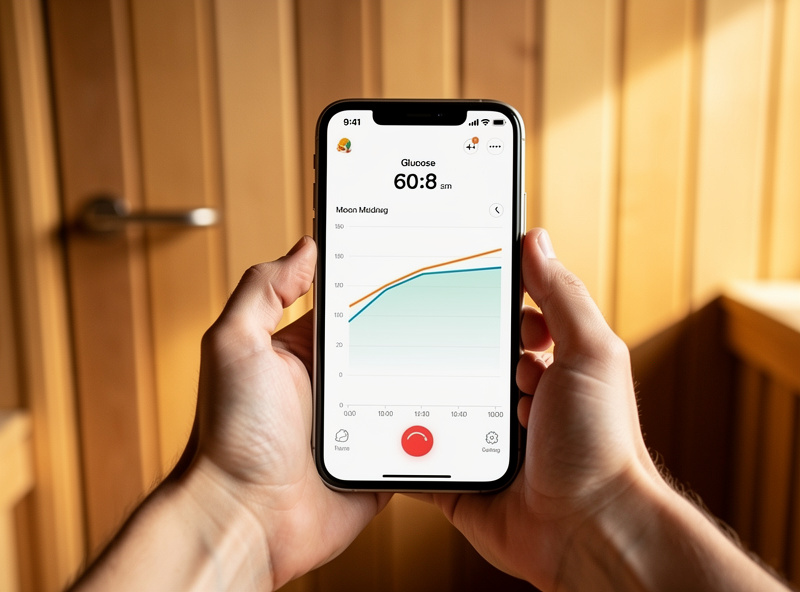
Do not self-adjust medication timing or doses around sauna use. If you want to use a sauna, the single best move is to bring it up at your next appointment and let your endocrinologist or GP tell you how — and whether — to fit it in. A continuous glucose monitor, if you use one, makes that far easier by showing the trend in real time, but it doesn’t replace the conversation.
The Honest Winner: a Post-Meal Walk
If you take one thing from this page, make it this: the most evidence-backed everyday move for post-meal glucose is a ten-minute walk, not a sauna session. They’re complementary — heat and muscle contraction both improve glucose uptake through different physiology — but the walk is the one with the real track record. A reasonable pairing for someone who enjoys both is a relaxed late-afternoon session followed by an easy walk before dinner. The walk is doing the heavy lifting; the sauna is the wind-down.
I’m the kind of person who tests things on myself, so I once wore a continuous glucose monitor for a couple of weeks out of pure curiosity — not because I’m diabetic, but because I wanted to see what actually moved the line. The result was humbling for anyone tempted to sell sauna as a metabolic fix: a 30-minute session barely registered on my glucose trace, while a slow walk after dinner visibly flattened the post-meal hump every single time. That’s a sample size of one and proves nothing clinically, but it lines up exactly with what the real research says — the muscle contraction is the lever, and the warm box is the reward afterward. General dose thinking lives in the how-often guide.
Who Should Be Especially Cautious
On the equipment side, the relevant fact is that a far-infrared cabin raises core temperature gradually but steadily — on my session log, a 30-minute session at 130°F moves my core about 0.7°C. For someone with impaired heat sensation (diabetic neuropathy in the feet is the classic case), that gradual rise is harder to self-monitor by feel alone. A session timer and a hydration habit are the practical tools that matter here.
- Diabetic peripheral neuropathy with reduced sensation — burn risk, because you may not feel overheating. Lower temperature, shorter sessions, and clear it with your doctor.
- Autonomic neuropathy — higher risk of lightheadedness on cool-down; first sessions supervised.
- Recent severe hypoglycemia — stabilize with your care team before adding anything.
- Foot ulcers or active wounds — wait for full healing.
- Poorly controlled diabetes or a DKA history — this is firmly physician territory, not a self-directed experiment.

Related Guides
- Cluster hub: Infrared Sauna for Health Conditions
- Infrared Sauna and Blood Pressure
- How Often to Use an Infrared Sauna
- Infrared Sauna Safety Guide
Frequently Asked Questions
Does an infrared sauna lower blood sugar?
At most indirectly, and the evidence is thin. Small uncontrolled pilot studies suggest regular use may improve insulin sensitivity over weeks, but single-session glucose effects are minor and unreliable. It is not a blood-sugar treatment and should never replace prescribed care.
How might an infrared sauna help type 2 diabetes?
Researchers propose that heat induces heat-shock proteins and mitochondrial adaptations that improve how muscle handles glucose, plus better blood flow that aids glucose delivery. This is studied mostly in animal models and small human pilots, and it achieves only a fraction of what exercise does.
Is an infrared sauna safe for diabetics?
For many stable, well-controlled patients it can be, but only after a doctor clears it. Anyone with neuropathy, recent severe hypoglycemia, foot ulcers, or poorly controlled diabetes needs physician oversight first, because heat adds real risks for these groups.
Can a sauna cause low blood sugar?
Yes, particularly for people on insulin or sulfonylureas, because heat can speed insulin absorption and amplify a low. This is exactly why medication timing around sauna use must be planned with your prescriber — never improvised from an article, and never by self-adjusting doses.
When is the best time to use a sauna with diabetes?
Not right after a large meal — digestion and sauna both pull blood flow in competing directions and can leave you lightheaded. A couple of hours after eating, or before a meal, is more comfortable. If you medicate, let your doctor confirm timing that is safe for you.
How often should someone with diabetes use a sauna?
Conservatively — a few moderate sessions a week is plenty, built up slowly. More is not better and raises dehydration and hypoglycemia risk. Treat it as a relaxation habit layered on top of your real treatment, with frequency cleared by your care team.
Can a sauna replace metformin or insulin?
No, absolutely not. Any metabolic effect is small relative to first-line medication, and stopping or reducing prescribed treatment based on sauna use is dangerous. Use it only as an optional adjunct to standard care, and never adjust medication on your own.