No — an infrared sauna does not fight cancer, and anyone selling it that way is trading on fear. Clinical heat-based oncology is real medicine, but it works at 40–45°C under medical supervision. A home cabin barely nudges your core temperature past 38°C. This page draws the honest line between the two, explains the only role a sauna can reasonably play during cancer care — a comfort measure, with your oncology team’s blessing — and cites the sources you can verify yourself.
Let me be straight about my lane. I write about sauna hardware — heaters, EMF, wiring, how the heat actually behaves on a meter — and this is the one topic where I want that boundary in neon. I am not a clinician, and nothing here is medical advice. I went deep on the heat-oncology literature because it is genuinely fascinating thermal physics, and because I wanted to understand exactly where the “sauna fights cancer” marketing goes wrong. The short version: I put my own body-temp readout on a hard 140°F session and watched my core top out around 38°C — and that single number is the whole story. For the broader picture, the cluster hub is infrared sauna for health conditions; the basics are in the safety guide.
What Clinical Heat Oncology Actually Is
Clinical hyperthermia is an established oncology modality used alongside radiation and chemotherapy in specific cancers. The National Cancer Institute describes it as raising tumor tissue to 40–45°C through regional, local, or whole-body approaches, always under clinical monitoring. It is used in specialized centers for cancers including cervical, melanoma, sarcoma, breast-cancer recurrence, and certain head-and-neck tumors — paired with, not instead of, standard oncology care.
The mechanism is well characterized. Tumor blood vessels are malformed and respond poorly to heat — they do not vasodilate the way healthy vessels do — so heat preferentially pools in tumor tissue. That heated tumor is then radiosensitized and chemosensitized: the same dose of radiation or chemo lands harder. Clinical trials have shown survival improvements in specific cancers when heat is added to standard care. This is serious oncology delivered with precise temperature control, imaging, and monitoring — worlds away from sitting in a warm wooden box at home.
Why a Home Sauna Cannot Replicate It
Here is the number that collapses the marketing. A home infrared sauna at 130–140°F raises core body temperature by roughly 0.6–1.0°C — to about 37.5–38.0°C. Clinical hyperthermia needs 40–45°C. You are not 2°C short by accident; you are short because your body is actively fighting to not cook itself, dumping heat through sweat and skin blood flow the entire time. Tumor temperature in a home session does not change in any clinically meaningful way.
I tested this on myself the boring, literal way — a core-temp readout through a full 140°F session, the cabin properly preheated, my TriField confirming the heaters were running at full output. Core crept to about 38°C and stalled there no matter how long I stayed in. That is the ceiling of what a home sauna does to core temperature, and it sits below the floor of what clinical oncology requires. So when a brand implies their cabin delivers “hyperthermia,” they are conflating two things that share a word and nothing else. The NCI fact sheet linked above states plainly that the temperatures required cannot be achieved by sitting in a warm room.

What a Sauna Can Honestly Offer Someone in Cancer Care
Stripped of the anti-cancer fantasy, there is still a modest, honest role — and it is about quality of life, never the disease itself:
- A relaxation and parasympathetic-shift ritual during a brutally stressful stretch of life.
- Possible help with sleep and with the bone-deep fatigue some patients carry — limited, mostly anecdotal data.
- Gentle cardiovascular conditioning during recovery, which matters after cardiotoxic regimens. A 2018 systematic review in Evidence-Based Complementary and Alternative Medicine (PubMed 29849692) pooled sauna-bathing studies and found modest cardiovascular associations in general populations — not cancer-specific data, but relevant context for survivors.
- Thirty quiet minutes that are warm, private, and yours.
None of those are anti-cancer effects. They are comfort and recovery effects, and the honest move is to call them exactly that. If a sauna helps someone feel a little more human through a hard season, that is worth something — but it is worth nothing if it is sold as a substitute for the medicine that actually fights the disease.
During Active Treatment — Your Oncology Team Decides First
If you are in active chemotherapy or radiation, do not start sauna use without explicit oncologist approval. These are not my rules to set — they are concrete clinical concerns, and I am listing them so you know what to ask your team about, not so you can self-clear:
| Treatment phase | The concern to raise | Typical caution |
|---|---|---|
| Active chemotherapy | Hydration, nausea, infection risk if immune-suppressed, drug–heat interactions | Often paused entirely until off-treatment |
| Active radiation | Skin reactions in the radiation field amplified by heat | Usually avoided during the course; resumed weeks after the final fraction |
| Surgical recovery | Wound healing, drain sites, infection | Avoided until full incision closure |
| Cardiotoxic regimens | Sauna’s cardiac demand mimics moderate exercise | Cardiology + oncology clearance |
| Immunotherapy | Immune/cytokine overlap with heat-shock response is unclear | Conservative; discuss specifically |
| Endocrine therapy | Hot flashes amplified; hydration | Often permitted, conservatively |
For a lot of patients the simplest answer during active care is to pause the sauna entirely and pick it back up in survivorship. There is rarely any urgency that justifies the added complexity mid-treatment.
Survivorship Use
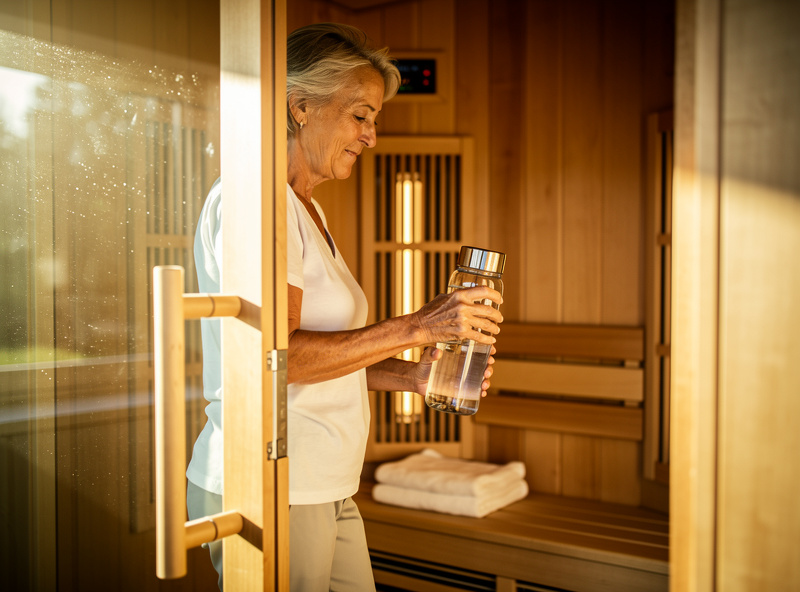
For survivors who have finished primary care, are off active therapy, and have oncologist clearance, a sauna can be a reasonable wellness habit — and the cardiovascular side is genuinely relevant after cardiotoxic regimens. Finnish cohort research on sauna bathing and cardiovascular outcomes (PubMed 25705824, Laukkanen et al.) reports associations between regular sauna use and cardiovascular health in general populations — not cancer-specific, but useful background for survivorship discussions. What a return to the sauna should look like is the gentlest possible on-ramp, and the exact numbers belong to your care team, not to me: think short and cool to start — on the order of 15 minutes at a low setting a couple of times a week — and build slowly over a couple of months only if it keeps feeling good. Any new symptom (worsening swelling, a surgical-site issue, a change in neuropathy) is a reason to stop and check in, not push through. If your oncology team gives you a different schedule than anything you read online, theirs wins — full stop.
A Word on Lymphedema
If you have lymphedema — common after mastectomy or pelvic-cancer surgery — heat deserves real caution, because it transiently increases the interstitial fluid load that a damaged lymphatic system cannot clear. I am not going to hand you a regimen for this; I am going to tell you what to take to your lymphedema-trained physical therapist: ask whether compression during a session makes sense for you, whether a short low-temperature trial is reasonable, and what swelling response should make you stop. Some people tolerate gentle heat fine; others do not, and the only safe way to find out is supervised. Your therapist informs this, not a blog.
Marketing Claims to Ignore
These recurring claims have no clinical support and should be read as marketing — the dangerous kind:
- “Infrared sauna kills cancer cells.” Not in home use. Clinical hyperthermia works at temperatures and durations a home cabin cannot reach, as the NCI fact sheet makes clear.
- “Sauna detoxifies chemotherapy from your body.” Sweat removes a negligible fraction of any drug; your liver and kidneys do that work.
- “Sauna prevents recurrence.” No evidence. Recurrence surveillance is your oncologist’s domain.
- “Heat can replace oncology care.” No. Walking away from recommended care because of a heat claim is genuinely dangerous, and it is the reason I write these pages the way I do.

My Honest Bottom Line
I sell my readers one thing: a straight answer about sauna gear from someone who actually meters it. On cancer, the straight answer is humbling — a sauna is a warm box that might make a hard season slightly more bearable, with your doctor’s okay, and that is the entire claim. The moment anyone tells you it does more, check whether they are also selling you the cabin. If you are navigating care, the most valuable thing I can do is point you firmly back to the people qualified to help: your oncology team. Bring them this page if it is useful, and let them draw the line.
Related Guides
- Cluster Hub: Infrared Sauna for Health Conditions
- Infrared Sauna and Blood Pressure
- Infrared Sauna for Autoimmune Conditions
- Infrared Sauna Detox: What the Science Actually Shows
- Infrared Sauna Safety Guide
Frequently Asked Questions
Can an infrared sauna be used as cancer care?
No. A home infrared sauna does not replicate clinical hyperthermia oncology, which works at 40-45C under medical supervision. At home, a sauna is at most a quality-of-life comfort measure, never a cancer therapy, and it should never replace oncologist-recommended care.
Is an infrared sauna safe during chemotherapy?
Usually it is paused during active chemotherapy. Hydration, nausea, infection risk if your immune system is suppressed, and drug-heat interactions all argue against it. Some oncologists permit brief sessions during stable cycles, but only with explicit clearance from your own team first.
Can cancer survivors use an infrared sauna?
Often yes, once primary care is complete, you are off active therapy, and your oncologist has cleared it. Use the gentlest possible on-ramp and let your care team set the schedule. The cardiovascular side can be relevant after cardiotoxic chemotherapy.
Does a sauna help with chemotherapy side effects?
There is limited, mostly anecdotal evidence of modest help with sleep, fatigue, and stress in stable patients. A sauna does not detoxify chemotherapy drugs. Treat any benefit as comfort, not care.
Should I avoid a sauna during radiation therapy?
Generally yes. Radiation skin reactions are amplified by heat in the treated field. Most teams advise waiting several weeks after the final radiation fraction, with full skin healing and oncologist approval, before resuming.
Can a sauna worsen lymphedema?
It can, transiently, because heat raises the interstitial fluid load a damaged lymphatic system struggles to clear. If you have lymphedema, work through it with a lymphedema-trained physical therapist before any sauna use.