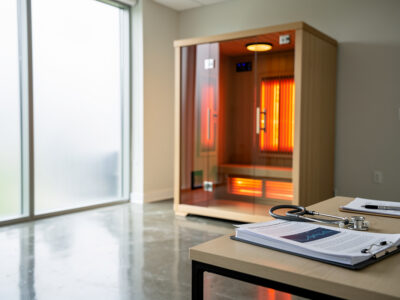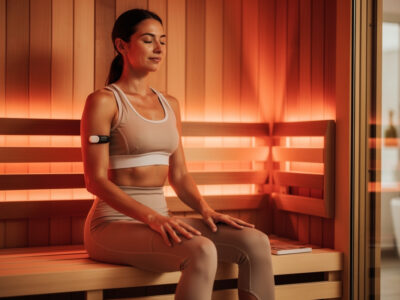
Can you use an infrared sauna while pregnant? The honest, and emphatic, answer is no — the standard medical advice is to skip it for the whole pregnancy. The American College of Obstetricians and Gynecologists (ACOG) advises against anything that pushes your core temperature past about 102°F/39°C, especially in the first trimester, because of well-established links between early-pregnancy overheating and serious birth defects. A normal 30-minute infrared session reliably crosses that line. So this is the one page on this whole site where I’m not going to hunt for a clever workaround — there isn’t a safe one, and pretending otherwise would be exactly the kind of wellness overreach I built this site to push back against.
I write about sauna hardware, and on the medical side this is squarely your OB/GYN’s call — every pregnancy is different, and nothing here overrides individual obstetric advice. What I can do is explain the reasoning clearly, answer the equipment questions honestly, and point you at the safer ways to get what you actually want. For context, the cluster hub is infrared sauna for health conditions; the broader picture is the safety guide.
Why the Advice Is to Avoid It
The 102°F core-temperature limit comes from teratology research linking maternal overheating in early pregnancy to neural-tube defects (spina bifida, anencephaly) and some heart and craniofacial defects. A well-known 1992 JAMA paper (Milunsky et al., PubMed 1404493) reported a roughly threefold increase in neural-tube defect risk among women with documented overheating in the first few weeks after conception. The biological mechanism is plausible too — heat stress during the frantic early phase of cell division can disrupt how an embryo’s proteins fold.
That research has real limits — it’s retrospective, it lumps in fevers from illness, and recall is imperfect. But this is precisely the situation where the precautionary principle is the right call, and it’s why obstetric practice is firm on it. The math is lopsided: the cost of skipping the sauna for nine months is a minor inconvenience, while the cost of being wrong is permanent. I find that an easy trade to recommend.
I want to add one thing here, because I know how this page tends to get read. If you’re searching this after a session, possibly with a knot of guilt in your stomach — please breathe. The studies describe a relative increase in risk across populations, not a verdict on your pregnancy, and a single short, lower-temperature session early on is a long way from the prolonged, repeated overheating the research is really about. The honest, kind, and accurate thing to do is bring it up plainly with your OB or midwife; they deal with this question constantly and can reassure you against your actual history and your actual scans. What this page is for is the decision going forward — and going forward, the answer is simply to pause.
On the hardware side, the one part of this I can speak to with full authority: I have metered my own infrared cabin with a TriField TF2 and a thermal probe during preheat, and the panel surface temperatures run at the levels the manufacturers specify. The physics of radiant heat means your core temperature rises steadily the longer you sit in that field. There is no “low-temperature infrared exception” to maternal hyperthermia. The wavelength does not change the biology of how heat crosses the placenta. If your OB says no heat exposure, that includes infrared.
Trimester by Trimester
The level of risk shifts across pregnancy, but the practical advice barely does — it’s “avoid” almost the whole way through:
| Stage | The concern | Practical advice |
|---|---|---|
| Trying to conceive | Heat may transiently affect sperm quality; possible early-embryo sensitivity | Optional break; once pregnancy is confirmed, stop immediately |
| First trimester | Highest defect risk, during organ formation | Avoid completely |
| Second trimester | Lower defect risk, but fetal growth and maternal circulation concerns | Avoid; only an OB might permit a rare exception — never self-direct |
| Third trimester | Blood-pressure drops, dehydration, reduced placental blood flow | Avoid — vasodilation can cut uteroplacental perfusion |
| After delivery | Healing and breastfeeding hydration | Resume once your provider clears you |
One myth worth killing directly: the infrared crowd sometimes argues that the lower air temperature of an infrared cabin makes it safe in pregnancy. It doesn’t. What matters is your core temperature, not the cabin’s air, and a long infrared session raises core temperature just as a steam sauna or a hot bath does. There’s no clinical evidence behind the “infrared is the pregnancy-safe exception” claim, and ACOG has never endorsed it. Same rule applies to hot tubs and hot baths.

Safer Ways to Get What You Wanted
Most of the reasons people miss the sauna during pregnancy — relaxation, achy muscles, sleep, a calmer head — have alternatives that don’t raise core temperature:
- Warm (not hot) showers — keep it comfortable, not steaming, and not too long.
- Prenatal massage — goes straight at the muscle aches.
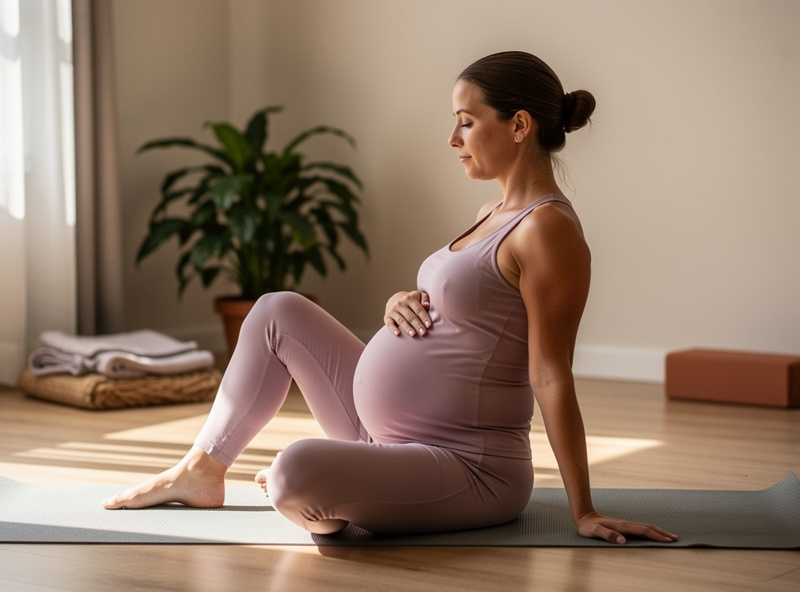
- Prenatal yoga — sleep and anxiety help without the heat.
- Meditation and breathwork — the same calming, parasympathetic wind-down people chase in the sauna.
- Cool-water pool time — eases tension and joint load with zero thermal stress.
If your motivation was cardiovascular conditioning, the right substitute is OB-approved prenatal exercise: a raised heart rate is fine in pregnancy, a raised core temperature is the problem. A sauna is not a cardio substitute here — they’re different physiology, and only one of them is safe right now. Your OB can point you to a heart-rate range that keeps the conditioning without the heat load.
Partner Use — The Question I Can Answer With Full Confidence
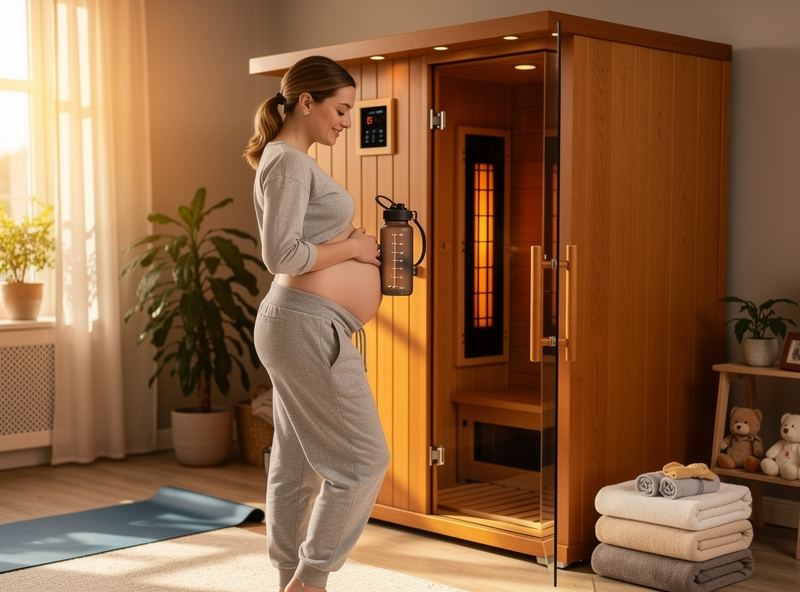
Here’s the one question on this page that’s pure physics, my actual lane, so I’ll answer it without hedging: if your household has an infrared cabin and your non-pregnant partner uses it, there is no passive risk to you from being in the same house. A far-infrared panel is a line-of-sight radiant heater, not a field that fills a room. Step a pace past the open cabin door and the warmth falls off almost immediately — that’s the same reason a cabin has to be enclosed to hold session temperature at all. The heat doesn’t reach into the next room, and nothing else from the panels does either. You can be in the same home, on the same sofa, perfectly fine — you just don’t get in the cabin yourself.
On the flip side, for couples trying to conceive: heavy sauna use can temporarily dip a man’s sperm count and motility, so a few weeks’ pause before a planned IVF cycle or during difficulty conceiving is a sensible, low-cost hedge — not strictly required, but easy insurance.
Coming Back After the Baby
After delivery and your standard postpartum check, most providers will clear you to return — but ease back in, and mind three things:
- Healing first. Any perineal tears or a C-section incision need to be fully healed before you sit in heat.
- Breastfeeding and hydration. Sauna fluid loss stacks on top of nursing’s fluid demand — drink generously with electrolytes around every session.
- Sleep deprivation. Running on no sleep makes you more prone to feeling faint on cool-down, so sit and rehydrate a few minutes before you stand.
When your provider gives the green light, approach it like starting fresh: short, low-temperature sessions to begin with, building gently from there. The beginner schedule lays out an easy return.
Related Guides
- Cluster hub: Infrared Sauna for Health Conditions
- Infrared Sauna Safety Guide
- Infrared Sauna Beginner Schedule (postpartum return)
- Infrared Sauna Temperature
- Cardiovascular and Mental Benefits
Frequently Asked Questions
Can I use an infrared sauna while pregnant?
The standard advice is no. ACOG recommends avoiding anything that raises core body temperature above about 102F, especially in the first trimester, because of the link to neural-tube defects. The default is to avoid sauna for the entire pregnancy, and to follow your own OB/GYN’s guidance.
Is an infrared sauna safer than a regular sauna during pregnancy?
No. There is no clinical evidence that infrared is safer in pregnancy. What matters is your core temperature, not the cabin’s air temperature, and a long infrared session raises core temperature just like a steam sauna or hot bath. ACOG has not endorsed any temperature-modified protocol as pregnancy-safe.
What if I used a sauna before I knew I was pregnant?
Talk to your OB/GYN, but try not to panic — most brief, lower-temperature early exposure does not lead to a problem, and routine prenatal ultrasound screening checks for the relevant defects. Your provider can reassure you based on your specific situation.
Can my partner use the sauna while I am pregnant?
Yes. A far-infrared panel is a line-of-sight radiant heater, not a field that fills a room — the warmth falls off within a step of the cabin, so there is no passive risk to you elsewhere in the house. You simply do not get in the cabin yourself.
How long after birth can I resume a sauna?
Most providers clear sauna use after your postpartum check, once any tears or a C-section incision are fully healed. Ease back in with short, low-temperature sessions, and hydrate extra if you are breastfeeding.
Does sauna use affect male fertility?
Heavy sauna use can temporarily reduce sperm count and motility. A few weeks’ pause before a planned IVF cycle or while trying to conceive is a reasonable, low-cost precaution, though not strictly required for natural conception.
What can I use instead of a sauna during pregnancy?
Warm (not hot) showers, prenatal massage, prenatal yoga, meditation and breathwork, and cool-water pool exercise all deliver parts of what people seek from a sauna without raising core temperature. Run any new routine past your OB/GYN first.